Disclosure: this guide contains Amazon affiliate links. As an Amazon Associate, Anantam IAS earns from qualifying purchases — at no extra cost to you.
UPSC Mains GS 3 Strategy: Economy, Science, Environment
GS Paper 3 is the most data-intensive and current-affairs-heavy paper in the UPSC Mains. Covering economy, science & technology, environment, disaster management, and internal security, it carries 250 marks across 20 questions. This paper rewards candidates who can connect economic theories to policy outcomes, understand technological implications for governance, and analyze security challenges with nuance.
Many candidates find GS 3 challenging because it demands both conceptual clarity and updated factual knowledge. The Economic Survey, Union Budget, and NITI Aayog reports aren’t optional reading — they’re essential ammunition.
GS 3 Syllabus: Five Domains
Section-Wise Weightage
| Section | Topics | Weightage |
|---|---|---|
| Economy | Growth, development, employment, trade, fiscal/monetary policy | 30–35% |
| Science & Technology | Developments, applications, indigenization, awareness | 15–20% |
| Environment & Ecology | Conservation, pollution, EIA, biodiversity | 20–25% |
| Disaster Management | Types, prevention, mitigation, preparedness | 5–10% |
| Internal Security | Terrorism, insurgency, cyber security, border management | 15–20% |
Detailed Topic Coverage
Economy:
- Indian economy: issues relating to planning, mobilization of resources, growth, development, employment
- Inclusive growth and budgetary issues
- Government budgeting, fiscal policy
- Major crops, irrigation, agricultural produce, MSP, food processing
- Land reforms, effects of liberalization
- Infrastructure: energy, ports, roads, airports, railways
- Investment models: PPP, FDI
Science & Technology:
- Developments and their applications in everyday life
- Awareness in IT, space, computers, robotics, nanotechnology, biotechnology
- Intellectual property rights
- Science and technology achievements of Indians
Environment:
- Conservation, environmental pollution, degradation
- Environmental impact assessment
- Disaster and disaster management
- Biodiversity, bio-geographical classification
Internal Security:
- Linkages between development and spread of extremism
- Role of external state and non-state actors
- Challenges to internal security through communication networks
- Security challenges and their management in border areas
- Various security forces and agencies
UPSC Syllabus 2026: Complete Prelims & Mains Guide
Economy: The Core of GS 3
Building Economic Understanding
| Level | Resources | Focus |
|---|---|---|
| Foundation | NCERT Class 11–12 Economics | Basic concepts |
| Intermediate | Ramesh Singh — Indian Economy | Applied understanding |
| Advanced | Economic Survey, Union Budget | Current policy |
| Expert | RBI Annual Report, NITI Aayog reports | Data and analysis |
High-Priority Economy Topics
Agriculture:
- MSP mechanism and procurement issues
- Farm reforms and their debate
- Agricultural credit, insurance (PMFBY), marketing
- Food security: PDS, NFSA, buffer stock management
- Technology in agriculture: precision farming, drones, AI
Industry and Infrastructure:
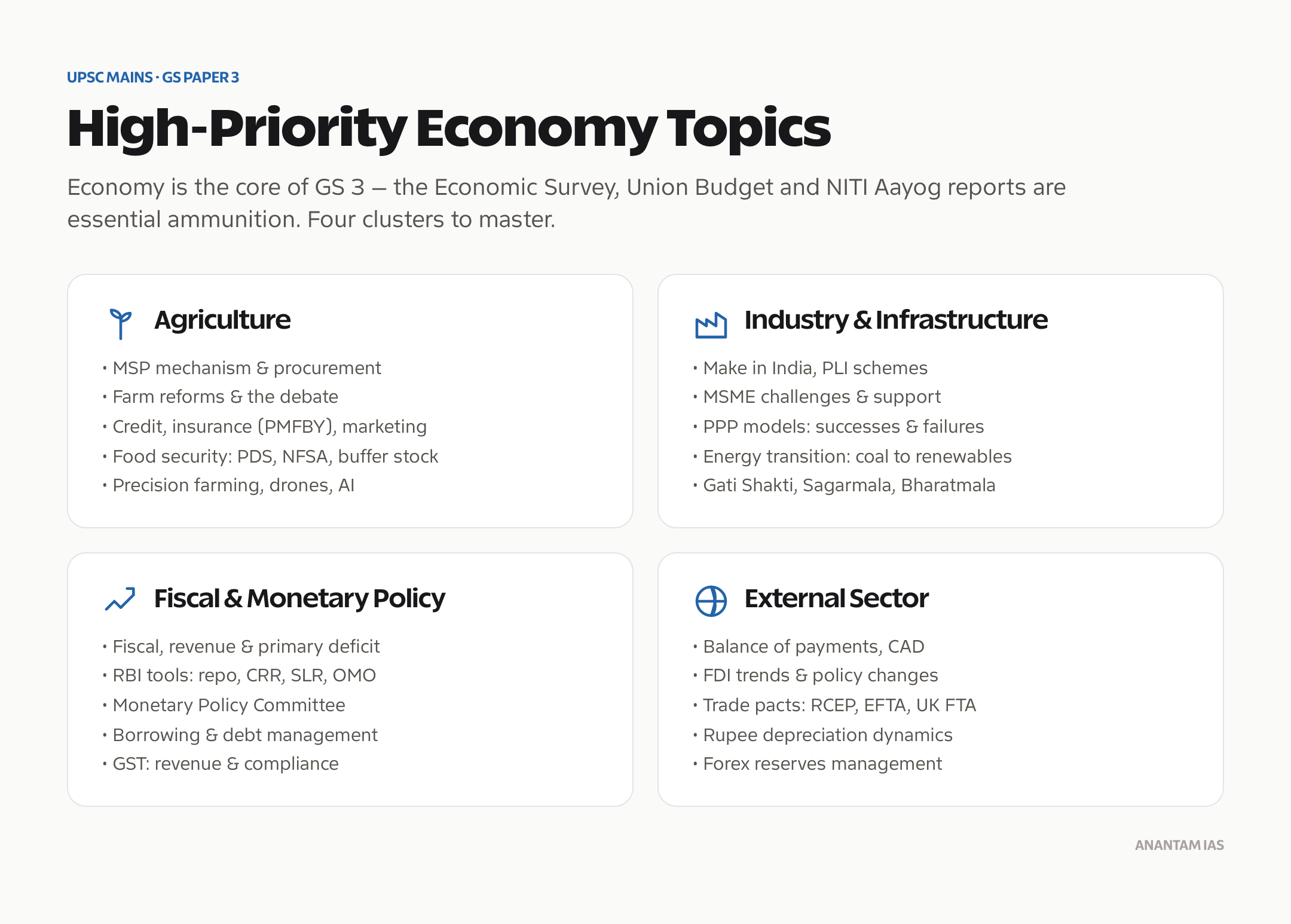
- Make in India, PLI schemes
- MSME challenges and support frameworks
- PPP models: successes and failures
- Energy transition: coal to renewables
- Logistics: PM Gati Shakti, Sagarmala, Bharatmala
Fiscal and Monetary Policy:
- Fiscal deficit, revenue deficit, primary deficit
- RBI’s monetary policy tools (repo, CRR, SLR, OMO)
- Monetary Policy Committee decisions
- Government borrowing and debt management
- GST: revenue trends and compliance challenges
External Sector:
- Balance of payments, current account deficit
- FDI trends and policy changes
- Trade agreements: RCEP debate, India-EFTA, India-UK FTA
- Rupee depreciation/appreciation dynamics
- Foreign exchange reserves management
GDP of India 2026: Growth Rate & Key Indicators
Economy Answer Writing Tips
- Always cite data: GDP growth rate, fiscal deficit as % of GDP, FDI inflow figures
- Reference the Economic Survey by chapter when relevant
- Use the “challenge → government response → gap → suggestion” framework
- Draw diagrams for monetary transmission, fiscal multiplier, or trade flows
Science and Technology
What UPSC Expects
UPSC doesn’t test deep technical knowledge. The focus is on:
- Understanding how technologies impact society and governance
- Awareness of India’s S&T achievements
- Ethical and policy dimensions of emerging technologies
- Indigenous development efforts
Key Areas to Cover
| Domain | Topics |
|---|---|
| Space | ISRO missions (Gaganyaan, Chandrayaan), satellite applications, space policy |
| Defence | DRDO projects, indigenization, defence exports |
| Health | Vaccines, genomics, telemedicine, drug regulation |
| IT | AI policy, 5G, cybersecurity, data governance |
| Biotech | GM crops, gene editing (CRISPR), biosafety |
| Energy | Nuclear energy, hydrogen mission, battery technology |
| Emerging | Quantum computing, blockchain, IoT, nanotechnology |
Preparation Strategy
- Follow “Science” and “Technology” sections of newspapers daily
- Read PIB releases on S&T developments
- Know India’s major S&T policies (Science, Technology and Innovation Policy, National Quantum Mission)
- Understand IPR framework: Patents Act, geographical indications, TRIPS
- Connect S&T to other GS 3 topics (tech for agriculture, AI for security)
ISRO Missions: Chandrayaan, Gaganyaan & More
Environment and Ecology
A Consistently High-Scoring Section
Environment questions are highly predictable. The same themes recur: biodiversity conservation, climate change, pollution, environmental governance, and international agreements.
Preparation Roadmap
| Topic | Key Content |
|---|---|
| Biodiversity | Hotspots, endemic species, in-situ/ex-situ conservation, IUCN Red List |
| Climate Change | UNFCCC, Paris Agreement, India’s NDCs, carbon trading, climate finance |
| Pollution | Air (NCAP), water (Namami Gange), soil, plastic waste management |
| Environmental Laws | EPA 1986, Forest Conservation Act, Wildlife Protection Act, EIA notification |
| International | CBD, Ramsar Convention, COP outcomes, SDGs |
| India-Specific | National parks, tiger reserves, wetlands, mangroves, coral reefs |
Environment Answer Writing
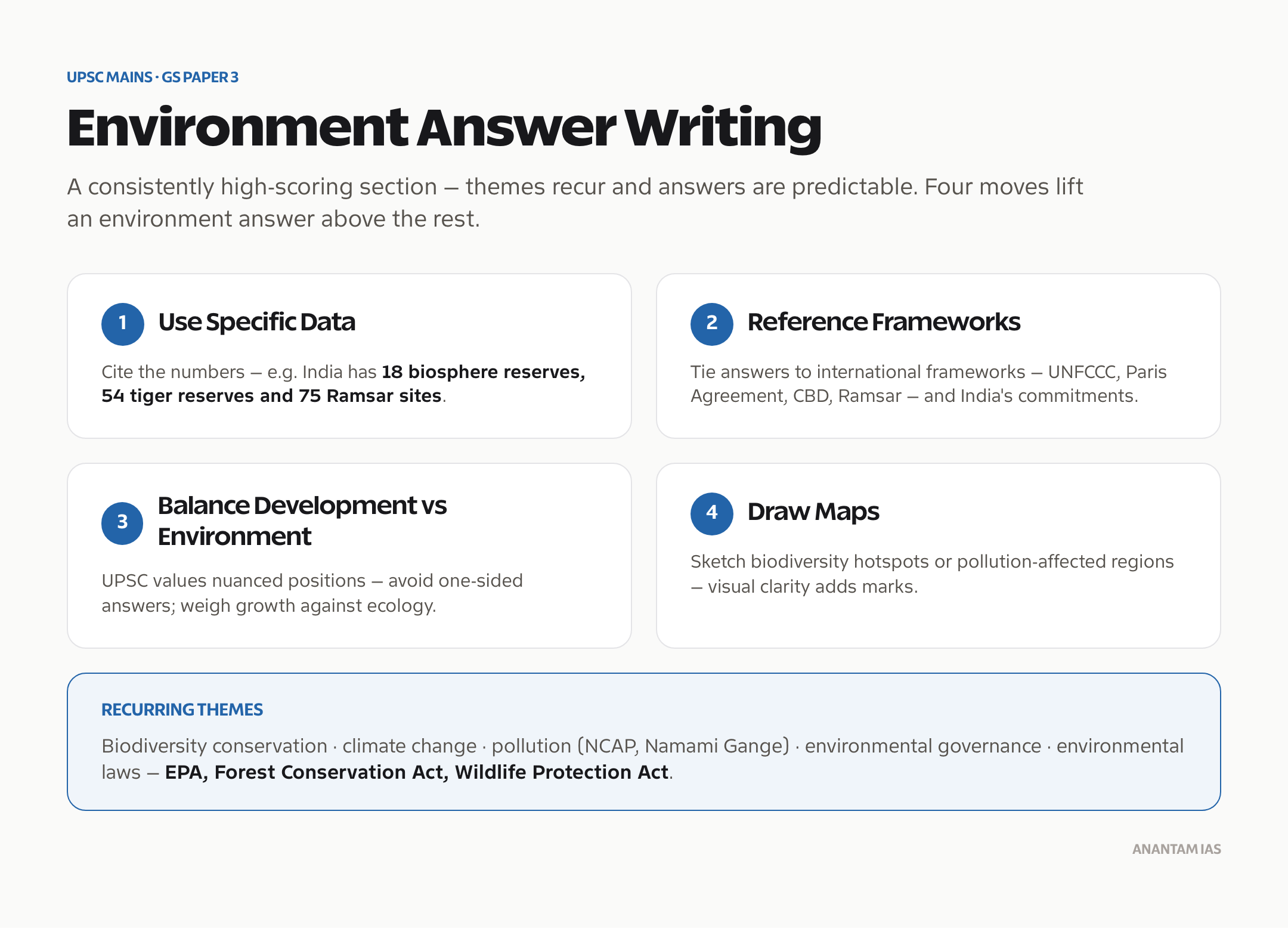
- Use specific data: “India has 18 biosphere reserves, 54 tiger reserves, and 75 Ramsar sites (as of 2025)”
- Reference international frameworks and India’s commitments
- Balance development vs environment — UPSC values nuanced positions
- Draw maps showing biodiversity hotspots or pollution-affected regions
Disaster Management
This sub-section carries fewer questions (1–2) but they’re high-scoring if prepared well.
Essential Knowledge:
- NDMA, SDMA, DDMA framework
- Sendai Framework for Disaster Risk Reduction
- Types: earthquakes, floods, cyclones, droughts, landslides, CBRN threats
- India’s disaster vulnerability zones
- Community-based disaster management approaches
- Technology in disaster management: early warning systems, satellite imagery
Disaster Management: UPSC Complete Notes
Internal Security
The Least-Prepared Section
Many candidates neglect internal security, yet it carries 15–20% weightage. Questions are analytical and solution-oriented.
Core Topics
| Area | Focus Points |
|---|---|
| Left Wing Extremism | Root causes, SAMADHAN strategy, development approach |
| Terrorism | Cross-border terrorism, lone wolf attacks, radicalization |
| Insurgency | Northeast insurgencies, peace accords, AFSPA debate |
| Cyber Security | IT Act, CERT-In, data protection, cyber warfare |
| Border Management | India-Pakistan (LoC), India-China (LAC), coastal security |
| Money Laundering | PMLA, FATF, hawala, benami transactions |
| Organized Crime | Drug trafficking, human trafficking, arms smuggling |
Preparation Resources
- Ashok Kumar — “Internal Security” (dedicated book)
- Ministry of Home Affairs annual report
- IDSA monographs on security topics
- Newspaper coverage of security developments
Internal Security Answer Writing
- Frame answers in terms of “threat assessment → existing framework → gaps → recommendations”
- Reference specific agencies (NIA, NSG, BSF, CRPF, RAW, IB) with their mandates
- Balance security with human rights — UPSC values this perspective
- Use data on extremism-affected districts, terrorism incidents, or cybercrime statistics
Internal Security of India: Challenges & Framework
GS 3 Answer Writing: General Guidelines
Data-Driven Answers
GS 3 answers without data are incomplete. Maintain a fact sheet with:
| Category | Data Points to Remember |
|---|---|
| GDP | Growth rate, sectoral composition, per capita income |
| Agriculture | Share of GDP, employment share, food grain production |
| FDI | Total inflows, top sectors, top source countries |
| Fiscal | Fiscal deficit target, revenue collection, GST revenue |
| Environment | Forest cover %, renewable energy capacity, emission targets |
| Security | Naxal-affected districts, cybercrime cases, terrorism incidents |
Diagram Usage in GS 3
Flowcharts, graphs, and maps add significant value:
- Monetary policy transmission mechanism
- GST structure
- Biodiversity hotspot map of India
- Cyclone formation process
- India’s internal security architecture
Frequently Asked Questions
Watch on YouTube
Related video from the Anantam IAS YouTube channel.
Is the Economic Survey essential for GS 3?
The Economic Survey is the single most important document for GS 3 economy preparation. It provides data, analysis, and policy recommendations that directly translate into question material. Reading the summary chapter and key thematic chapters is a minimum requirement. Many Mains questions mirror Survey analysis.
How to handle science and technology questions without a science background?
GS 3 S&T questions don’t require technical depth. Focus on the u0022what it doesu0022 and u0022why it mattersu0022 rather than u0022how it works.u0022 A humanities graduate explaining AI’s governance implications or CRISPR’s ethical concerns scores as well as an engineer. Follow news coverage and government policy documents rather than technical journals.
Should internal security preparation start early or close to Mains?
Start early. Internal security requires building a framework of knowledge about agencies, laws, and ongoing challenges that newspapers alone don’t provide. Read one dedicated book (Ashok Kumar or similar) during the foundation phase, then supplement with current affairs throughout the preparation period.
How to balance between all five GS 3 domains?
Allocate time proportional to weightage: Economy (35%), Environment (25%), Internal Security (20%), Science & Tech (15%), Disaster Management (5%). But don’t neglect any section — even 1 question in disaster management is worth 10–15 marks. Use the last 2 weeks before Mains for quick revision of lower-weightage sections.
What’s the biggest scoring differentiator in GS 3?
Data and specificity. An answer mentioning u0022India’s fiscal deficit is 5.1% of GDP against the target of 4.5%u0022 scores higher than one saying u0022fiscal deficit is high.u0022 Candidates who cite specific scheme outcomes, survey data, and committee recommendations consistently outperform those relying on general statements.
Tell Google you want more of this.
Add Anantam IAS as a preferred sourceOne tap, and this site shows up more often in your own Top Stories, AI Overviews and AI Mode. Remove it any time.