India’s Bullet-Train Tunnels: The Engineering Behind High-Speed Rail
Why in News?
The Indian Express explained why the Mumbai-Ahmedabad High Speed Rail (MAHSR) corridor is fitting special tunnel hoods at its tunnel portals: at speeds near 320 km/h, a train piston-pushing air into a sealed tube generates a pressure shock that can burst out of the far end as a loud bang called the tunnel-boom.
The clarification matters because MAHSR is India’s first bullet-train project, built on Japanese Shinkansen technology with JICA financing, and includes the country’s first undersea rail tunnel near Mumbai – so the engineering choices being made now define how high-speed rail will be built across India’s railways.
- Tunnel hoods: flared, vented hood structures bolted to tunnel mouths that let compressed air bleed out gradually, suppressing the micro-pressure wave (the sonic tunnel-boom) instead of releasing it as a single bang.
- Why a boom forms: a train entering a tunnel at 320 km/h acts like a piston, compressing air ahead of it into a pressure pulse that travels down the bore and radiates as noise at the exit portal.
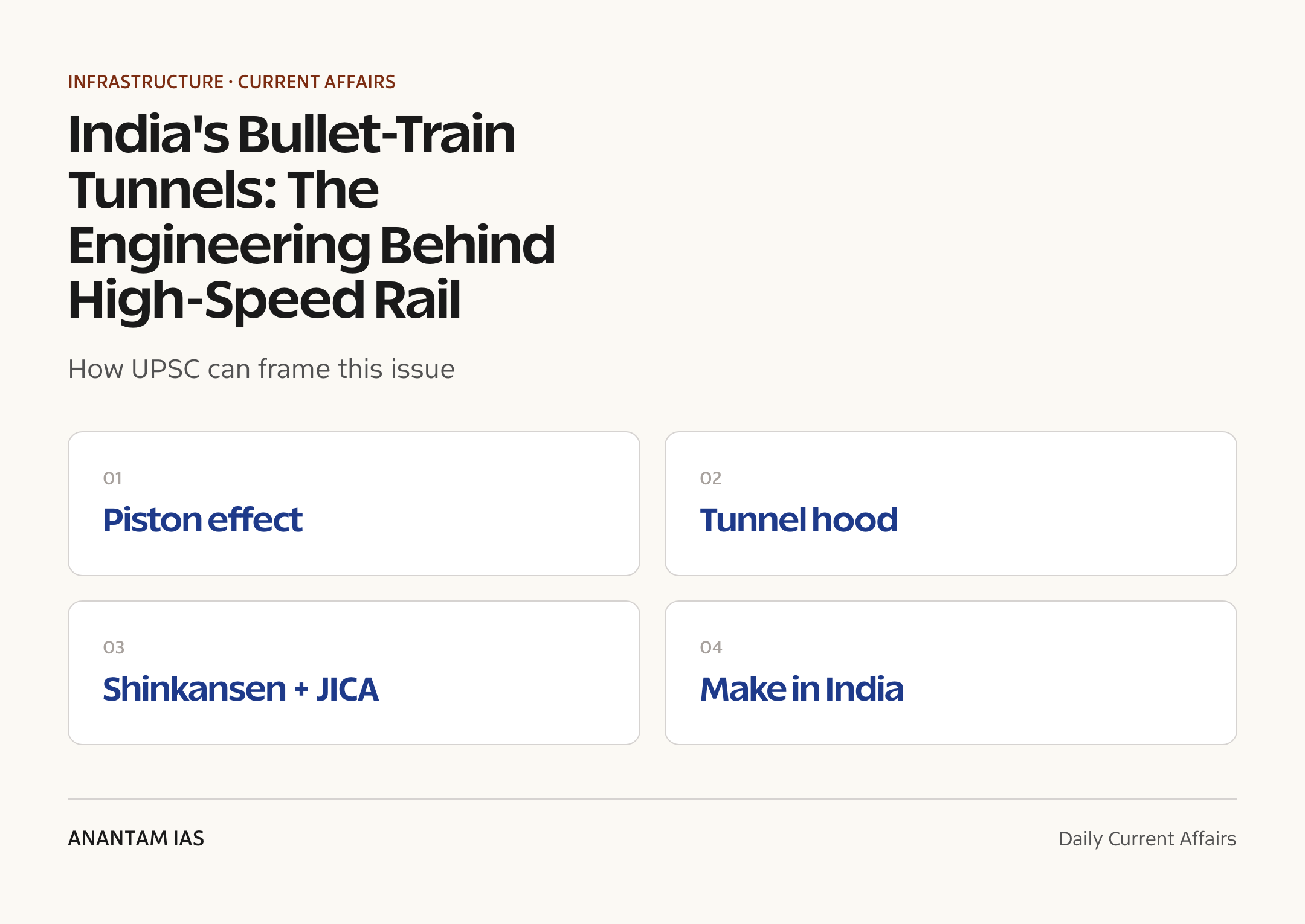
- Project scale: The MAHSR corridor runs about 508 km with 12 stations, linking Mumbai (Maharashtra) and Ahmedabad (Gujarat) via Surat and Vadodara.
- Undersea first: the alignment includes a roughly 21 km tunnel near Mumbai, of which about 7 km runs under the sea bed beneath Thane creek – India’s first undersea rail tunnel.
- Implementing body: the National High Speed Rail Corporation Limited (NHSRCL), a special-purpose vehicle jointly owned by the Centre, Maharashtra and Gujarat, executes the corridor.
- Speed design: trains are designed for operating speeds around 320 km/h and a design speed of about 350 km/h, far above conventional Indian railway speeds.
The development matters in the context of:
- India-Japan cooperation: MAHSR is the flagship of bilateral infrastructure ties, using Shinkansen rolling stock and signalling with a long-tenor JICA soft loan.
- Energy and emissions: high-speed electric rail offers a low-carbon alternative to short-haul flights and road travel on dense corridors.
- Domestic capability: viaducts, tunnels and rolling-stock localisation under Make in India seed an Indian high-speed-rail engineering ecosystem.
UPSC Relevance
Prelims Relevance
- Tunnel hood: a portal structure that suppresses the micro-pressure wave (tunnel-boom) by venting compressed air gradually.
- Piston effect: the aerodynamic phenomenon by which a fast train pushes air through a tunnel like a piston.
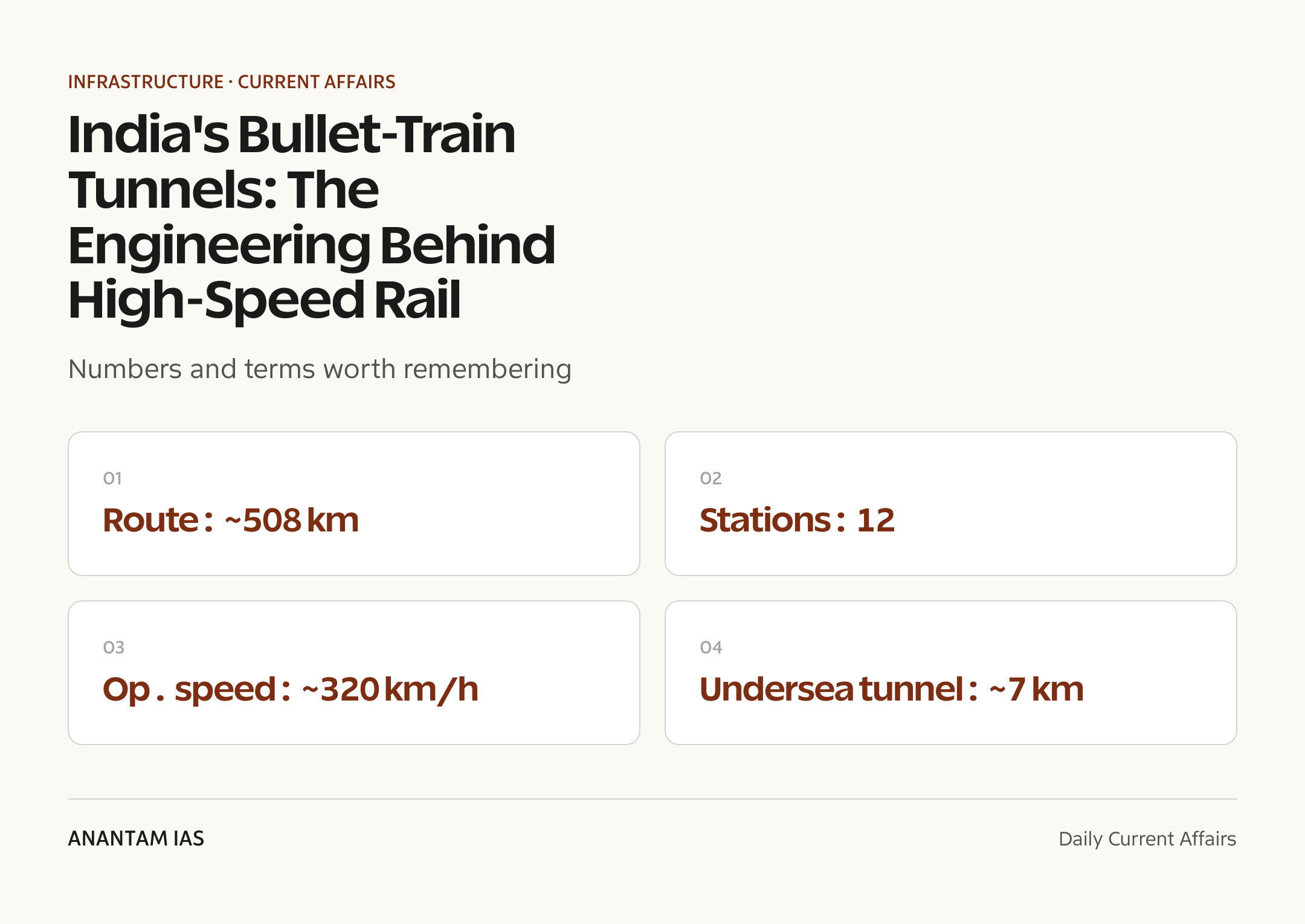
- MAHSR route: about 508 km, 12 stations, Mumbai to Ahmedabad via Surat and Vadodara.
- Undersea tunnel: about 7 km of a 21 km tunnel runs under the sea near Mumbai – India’s first.
- NHSRCL: the special-purpose vehicle implementing the project, jointly owned by the Union government and the two states.
- Shinkansen: Japan’s high-speed rail system; E5 series trainsets are planned for India, with later E10 generation tech under discussion.
- JICA: the Japan International Cooperation Agency, which funds the project through a concessional loan.
- Operating speed: about 320 km/h, with a design speed near 350 km/h.
Mains Relevance
GS Paper 3
- Infrastructure and growth: assess how high-speed rail reshapes intercity mobility, land use along corridors and regional economic geography.
- Science and technology: explain the aerodynamics of tunnelling at high speed and the engineering of tunnel hoods, undersea boring and slab track.
- Indigenisation: evaluate localisation of rolling stock, signalling and civil works under Make in India and the technology-transfer terms of foreign cooperation.
- Project financing: discuss long-tenor concessional loans, cost-overrun risk and the fiscal trade-offs of capital-intensive megaprojects.
GS Paper 2
- Bilateral cooperation: analyse India-Japan development partnership and the strategic logic of flagship connectivity projects.
Essay
- Technology and nation-building: use the bullet-train corridor to argue how a single megaproject can transfer skills, set standards and seed an industry.
- Speed versus sustainability: weigh the climate case for electric high-speed rail against the capital cost and land footprint of new corridors.
Background and Context
The tunnel-boom problem and how hoods fix it
The headline issue is aerodynamic: a very fast train turns a tunnel into a sealed air column that can fire a pressure pulse out the far end.
- Piston effect: as a train enters at 320 km/h, it shoves the air ahead of it, forming a compression wave that races down the bore at the speed of sound.
- Micro-pressure wave: when that wave reaches the exit portal it radiates outward as a sharp tunnel-boom – a sudden bang that can disturb residents and structures nearby.
- Hood design: a tunnel hood is a perforated, gradually flared extension at the portal; vents let the compressed air escape progressively so the pressure rises slowly rather than all at once.
- Net effect: spreading the pressure gradient over a longer length blunts the peak, cutting the boom’s intensity and the noise it throws into the surroundings.
- Where it applies: hoods are added selectively at portals where speed, tunnel length and nearby habitation make the boom significant.
The Mumbai-Ahmedabad corridor at a glance
MAHSR is the template project against which all later Indian high-speed corridors will be judged.
- Route: about 508 km between Mumbai and Ahmedabad with 12 stations, passing Thane, Surat, Bharuch and Vadodara.
- Speeds: operating speed around 320 km/h and design speed near 350 km/h, cutting travel time from hours to a couple of hours.
- Alignment: largely elevated viaduct to limit land acquisition and avoid level crossings, with tunnel sections where terrain or the sea demand it.
- Rolling stock: based on Japan’s Shinkansen E5 trainsets, with later E10-generation technology under discussion for future fleets.
- Implementation: built by NHSRCL, a special-purpose vehicle jointly owned by the Union government, Maharashtra and Gujarat.
India’s first undersea rail tunnel
The Mumbai approach forced one of the project’s hardest engineering tasks – boring beneath the sea.
- Length: a roughly 21 km tunnel near Mumbai, of which about 7 km runs under the seabed beneath Thane creek.
- Method: large-diameter tunnel boring machines (TBMs) alongside the conventional New Austrian Tunnelling Method in rockier stretches.
- Challenges: managing water ingress, ground settlement under dense urban areas, and ventilation and safety for a long single bore.
- Significance: It is India’s first undersea rail tunnel, building domestic capability for future coastal and metro tunnelling, like the Kolkata underwater metro.
- Aerodynamic link: long tunnels intensify the piston effect, which is exactly why portal hoods and cross-section design matter on this corridor.
Technology, financing and Make in India
The project is as much an economic and diplomatic instrument as an engineering one.
- Shinkansen base: trains, signalling and operating practices draw on Japan’s high-speed system, prized for a decades-long record without a passenger fatality from derailment or collision.
- JICA loan: the bulk of the cost is met by a long-tenor concessional loan from the Japan International Cooperation Agency, anchoring the project in the wider India-Japan partnership.
- Localisation: civil works, viaduct segments, track and a growing share of components are made in India under Make in India, with technology transfer a stated goal.
- Standards: the corridor sets Indian norms for slab track, ballastless permanent way, earthquake-detection systems and high-speed safety that future lines can reuse.
- Skills: A new cadre of Indian engineers and technicians is being trained in high-speed civil, electrical and rolling-stock disciplines.
Why high-speed rail matters for India
Beyond the spectacle, the case rests on mobility, emissions and industrial spillovers.
- Modal shift: on dense corridors, fast electric rail can absorb traffic that would otherwise go to short-haul flights or congested highways.
- Low-carbon transport: electric high-speed rail is far less carbon-intensive per passenger-kilometre than air or road travel.
- Economic corridors: stations can anchor real estate, logistics and services growth, knitting cities into a single labour market.
- Industrial seeding: the engineering demands pull up domestic capability in tunnelling, precision civil works and rolling-stock manufacture.
- Caveats: high capital cost, land acquisition friction and the need for high ridership to justify the investment temper the optimism.
Way Forward
Engineering and safety
- Standardise tunnel-portal hood and cross-section design rules from MAHSR data so later corridors avoid retrofits.
- Build domestic capacity in undersea and urban tunnelling, ventilation and high-speed track maintenance.
- Institutionalise earthquake-detection, fire-safety and intrusion systems as mandatory high-speed-rail standards.
Localisation and ecosystem
- Deepen technology transfer so Indian firms can design, not just assemble, future high-speed rolling stock and signalling.
- Develop an indigenous supplier base for slab track, electrification and precision viaduct segments.
- Create a permanent high-speed rail skilling pipeline through dedicated institutes and on-site training.
Financing and network planning
- Sequence future corridors by projected ridership and economic density to protect viability.
- Blend concessional foreign loans with domestic capital and value-capture from station-area development.
- Integrate high-speed stations with metro, suburban rail and last-mile transit to maximise modal shift.
Conclusion
Small detail, big lesson: a tunnel hood is a modest structure, but it captures how high-speed rail forces India to solve problems – aerodynamics, undersea boring, precision civil works – it has never faced at this scale.
A template, not a one-off: the standards, skills and supplier base built on the Mumbai-Ahmedabad corridor will decide how fast and how cheaply India can roll out high-speed rail elsewhere.
Conditional payoff: the climate and mobility gains are real, but they depend on strong ridership, disciplined cost control and genuine technology transfer.
UPSC Practice Questions
Prelims MCQ 1
With reference to high-speed rail engineering, consider the following statements:
- A tunnel hood is fitted at a tunnel portal to suppress the micro-pressure wave generated by a fast-moving train.
- The tunnel-boom arises because a high-speed train compresses the air ahead of it like a piston.
- The Mumbai-Ahmedabad corridor includes India’s first undersea rail tunnel.
How many of the above statements are correct?
(a) Only one (b) Only two (c) All three (d) None
Answer: (c) All three
Explanation:
All three are correct. Tunnel hoods vent compressed air gradually to tame the micro-pressure wave; the boom is caused by the train’s piston effect on tunnel air; and the corridor’s roughly 21 km Mumbai tunnel includes about 7 km of undersea bore – India’s first.
Prelims MCQ 2
The Mumbai-Ahmedabad High Speed Rail project is being implemented with technical and financial cooperation primarily from which country?
(a) France (b) Germany (c) Japan (d) South Korea
Answer: (c) Japan
Explanation:
The corridor uses Japan’s Shinkansen technology and is financed largely by a concessional loan from the Japan International Cooperation Agency (JICA).
UPSC Mains Questions
- High-speed rail forces a country to master engineering problems it has never faced at scale. With reference to the Mumbai-Ahmedabad corridor, discuss the technological challenges – from tunnel aerodynamics to undersea boring – and their wider implications for Indian infrastructure.
- Evaluate high-speed rail as an instrument of low-carbon transport and industrial capability in India. What conditions must be met for such capital-intensive corridors to be economically and environmentally justified?
- Examine the role of foreign technology and concessional financing in India’s flagship infrastructure projects, using the bullet train corridor as a case study. How can such partnerships be structured to maximise genuine technology transfer?
Sources: National High Speed Rail Corporation Limited (NHSRCL) and The Indian Express (Explained, science and technology desk).
Frequently Asked Questions
What is a tunnel hood and why is it needed?
A tunnel hood is a flared, vented structure fitted at a tunnel mouth. When a bullet train enters a tunnel at high speed it compresses the air ahead of it, creating a pressure pulse that can burst out of the far portal as a loud bang called the tunnel-boom. The hood lets that compressed air escape gradually, smoothing the pressure rise and cutting the noise.
What causes the tunnel-boom?
It is caused by the piston effect. A train moving at about 320 km/h pushes the air in front of it down the sealed tunnel like a piston in a cylinder. This forms a compression wave that travels to the exit portal and radiates outward as a sharp micro-pressure wave, heard as a sudden boom.
How long is the Mumbai-Ahmedabad bullet-train route?
The corridor runs about 508 km between Mumbai and Ahmedabad with 12 stations, passing through Thane, Surat, Bharuch and Vadodara. Trains are designed to operate at around 320 km/h, sharply reducing travel time compared with conventional rail or road.
Does the project include an undersea tunnel?
Yes. The alignment near Mumbai includes a tunnel of about 21 km, of which roughly 7 km runs under the sea bed beneath Thane creek. It is India’s first undersea rail tunnel and is bored using tunnel boring machines and conventional tunnelling methods.
Which technology and funding does the project use?
The corridor is based on Japan’s Shinkansen high-speed rail technology, with E5-series trainsets planned and later-generation technology under discussion. Most of the cost is met by a long-tenor concessional loan from the Japan International Cooperation Agency, while civil works and components are increasingly made in India.
Why is high-speed rail important for India?
On dense intercity corridors it can shift travellers away from short-haul flights and congested highways, offering a low-carbon electric alternative. It also seeds domestic engineering capability in tunnelling, precision civil works and rolling-stock manufacture, and can anchor economic growth around stations – though high cost and the need for strong ridership remain real constraints.