Introduction
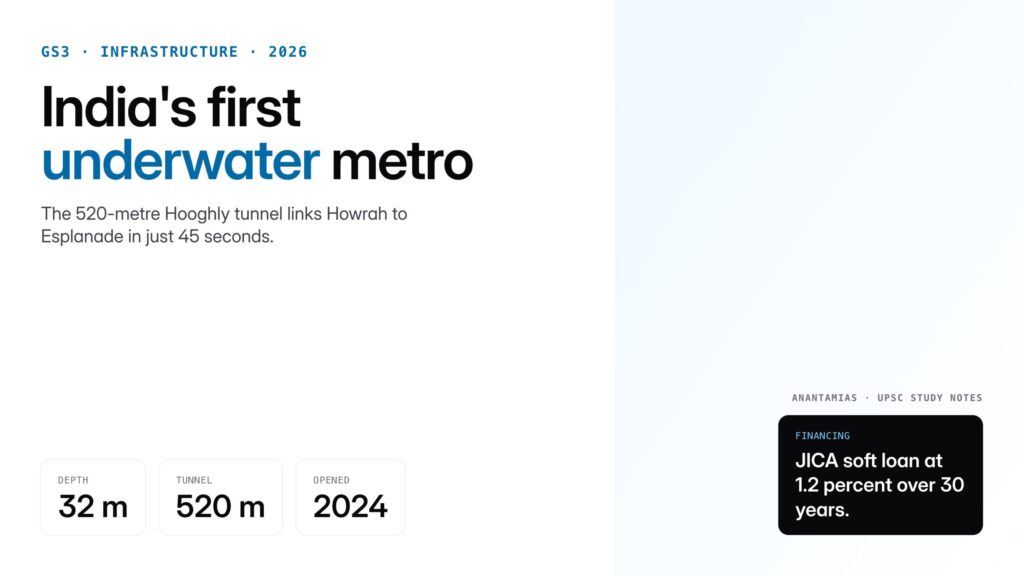
The Kolkata Underwater Metro, the Howrah Maidan to Esplanade stretch of the East-West Metro corridor, became the first transportation tunnel in India to pass beneath a riverbed when it was inaugurated by Prime Minister Narendra Modi on 6 March 2024. Running 32 metres below the bed of the Hooghly river, the 520-metre under-river section lets metro trains cross from Howrah to central Kolkata in just 45 seconds, stitching together two halves of a metropolitan region that the Hooghly has divided for nearly three centuries.
For the UPSC aspirant, this is a high-yield topic. It combines infrastructure (GS3), science and technology (GS3), urban governance (GS2) and the history of Indian railway pioneering (GS1), and it has already featured as a current affairs MCQ in prelims-prep material published by PIB and PRS India. This guide consolidates the route, engineering choices, timeline, cost structure and strategic significance in one place.
Quick Facts at a Glance
| Parameter | Detail |
|---|---|
| Official name | Kolkata Metro Line 2 (East-West Corridor), Howrah Maidan to Esplanade section |
| Opened | 6 March 2024 (inaugurated); 15 March 2024 (commercial operations) |
| Implementing agency | Kolkata Metro Rail Corporation (KMRC), a Ministry of Railways SPV |
| Funding partner | Japan International Cooperation Agency (JICA) |
| Total corridor length | 16.6 km (Howrah Maidan to Salt Lake Sector V) |
| Under-river tunnel length | 520 metres |
| Depth below riverbed | 32 metres |
| Tunnel boring machine | Herrenknecht EPB TBM (Germany) |
| Stations in underwater stretch | Howrah Maidan, Howrah, Mahakaran, Esplanade |
| Crossing time under river | 45 seconds |
Background and Historical Context
Kolkata’s relationship with underground transport goes back to 24 October 1984, when it became the first Indian city to open a metro rail line, the north-south Tollygunge to Esplanade stretch. The idea of extending the metro across the Hooghly, however, remained on paper for decades. A technical study by RITES in the 1990s recommended either a second bridge or a tunnel, and successive committees leaned toward a tunnel for reasons of port navigation, aesthetic preservation of the Howrah Bridge precinct, and all-weather reliability.
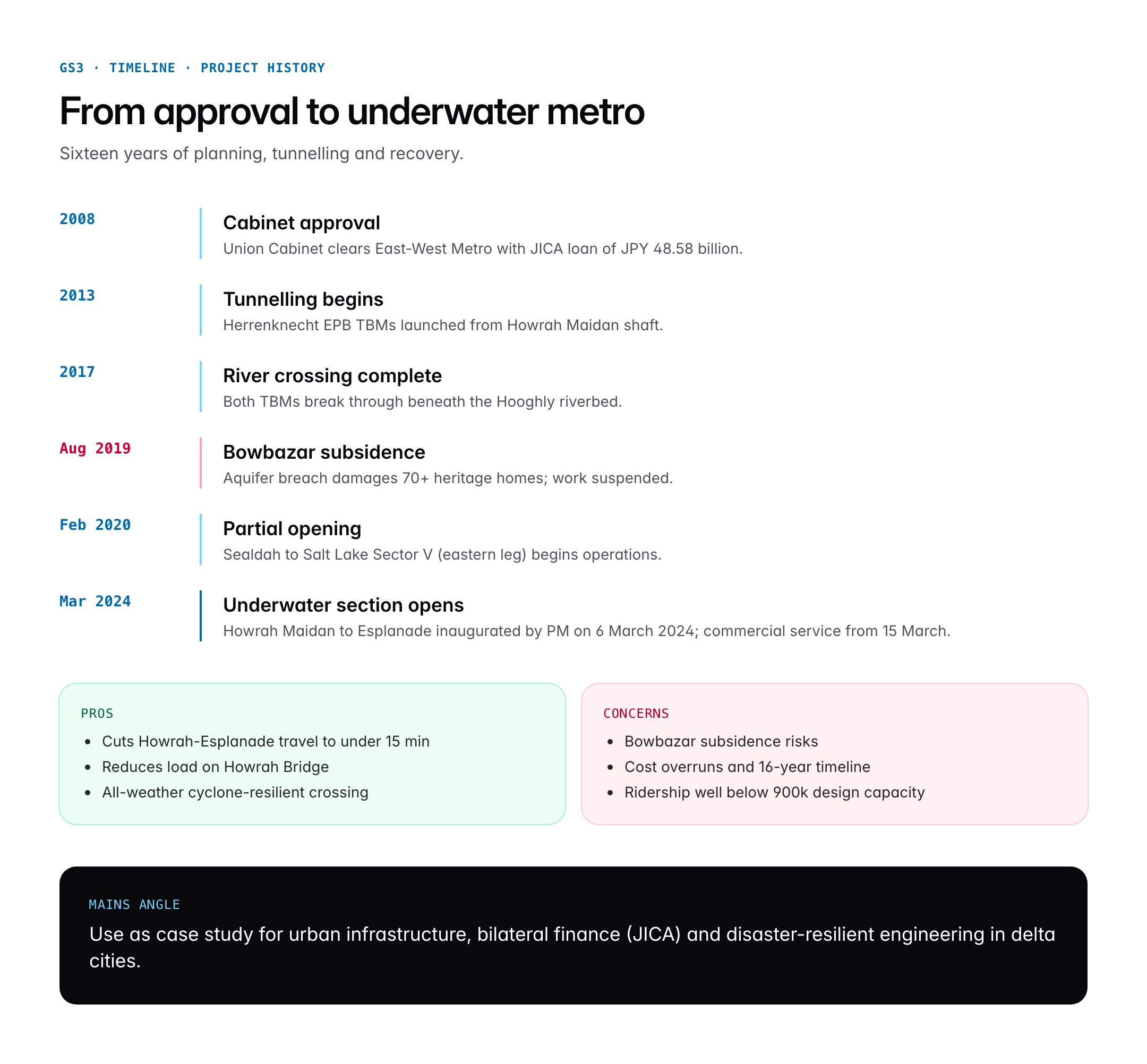
The East-West Metro project was formally cleared by the Union Cabinet in 2008, with a first loan tranche of JPY 48.58 billion from JICA. Tunnelling across the river, however, was slow and treacherous. The city’s terrain posed three problems at once: the Hooghly is a tidally influenced river with variable silt loading; central Kolkata’s colonial-era buildings on the Esplanade side sit on shallow mat foundations that cannot tolerate ground movement; and the soft alluvial geology of the Gangetic delta offered no stable bedrock to anchor the tunnel within. A major setback came in August 2019 when an aquifer breach at Bowbazar caused catastrophic subsidence, damaging dozens of heritage homes and halting work for almost three years.
Despite these obstacles, the tunnelling was completed in 2017, track laying and signal commissioning were accelerated after 2022, and the ceremonial first run of revenue service took place in March 2024. India thus joined a small club of countries, alongside the United Kingdom, France, Russia, China and Turkey, with operational underwater metro systems.
Key Features
Alignment and Route
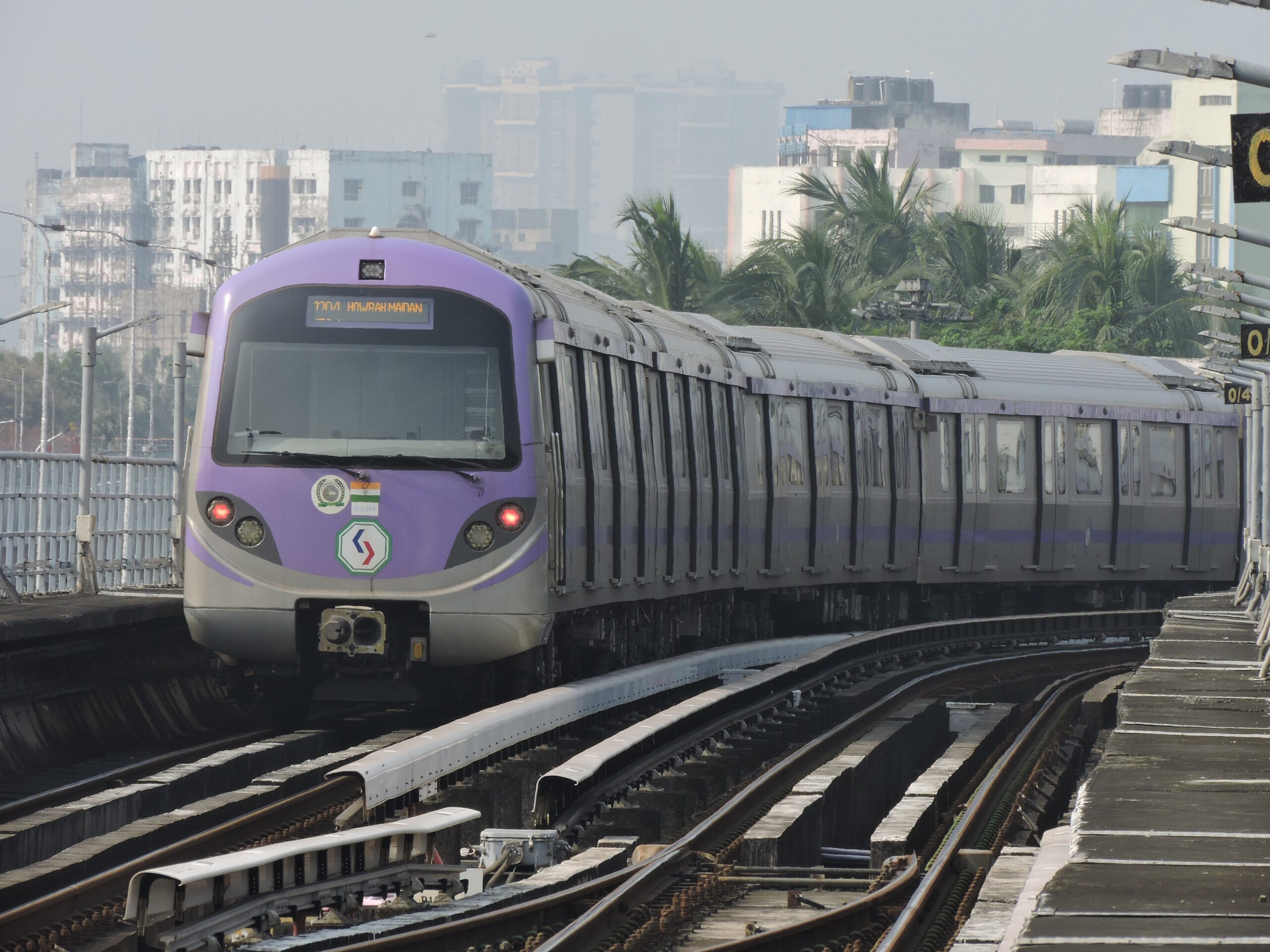
The Howrah Maidan to Esplanade section is part of the broader Kolkata Metro Line 2, also called the East-West Corridor, which connects Howrah Maidan on the west bank of the Hooghly to Salt Lake Sector V on Kolkata’s eastern IT corridor. The full 16.6-kilometre line has twelve stations, of which six are underground (Howrah Maidan, Howrah, Mahakaran, Esplanade, Sealdah, Phoolbagan) and six elevated. The underwater stretch lies between Howrah and Mahakaran stations.
Tunnelling Engineering
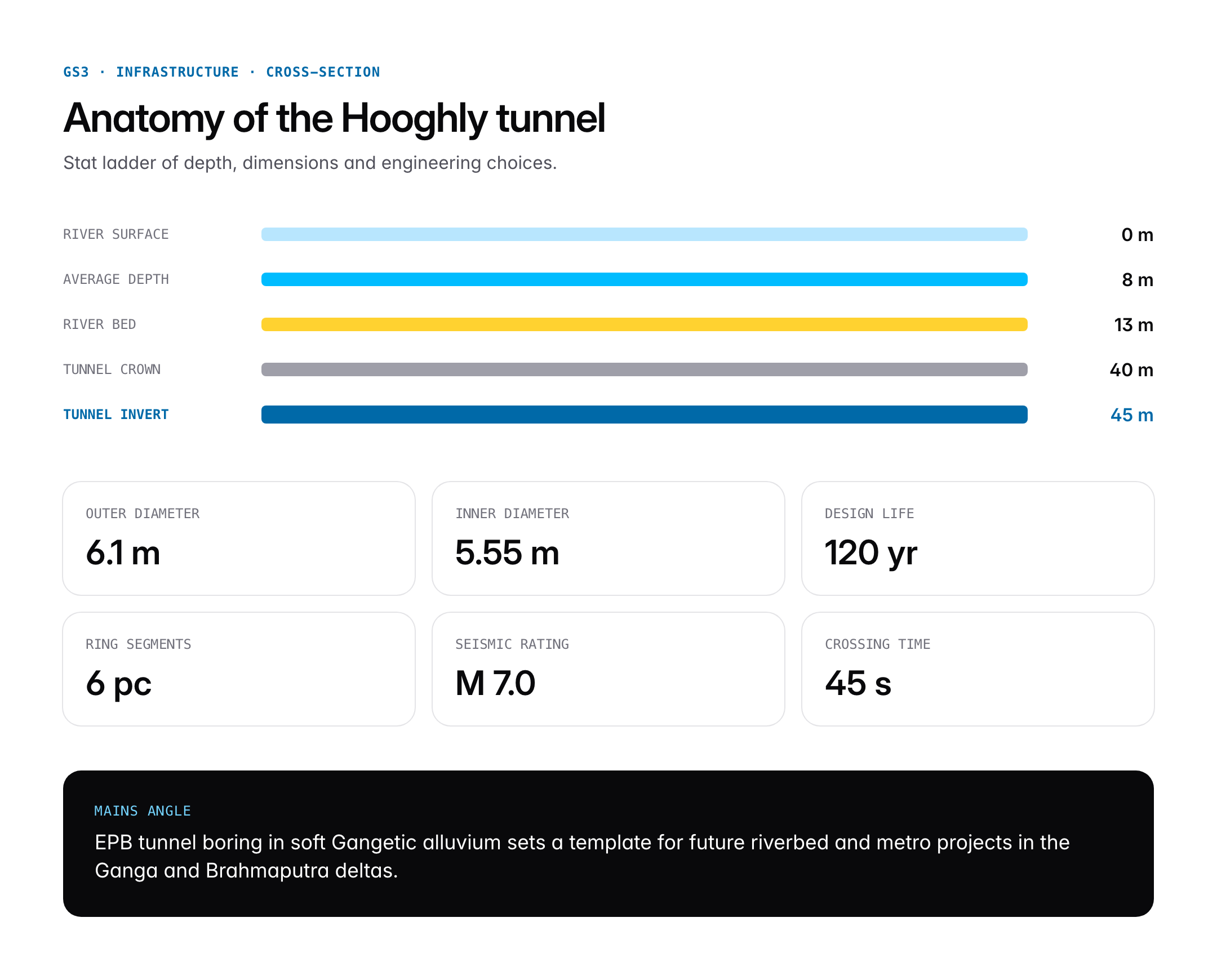
Two parallel single-track tunnels, each with an internal diameter of 5.55 metres and an outer diameter of 6.1 metres, were bored using German-made Herrenknecht Earth Pressure Balance (EPB) Tunnel Boring Machines. Affiliated contractor Afcons Infrastructure executed the contract with Transtonnelstroy of Russia as technology partner. The TBMs maintained a face pressure equal to the hydrostatic head of the river plus earth overburden, which prevented water ingress while simultaneously supporting the excavation face.
Lining and Water-Tightness
The tunnels are lined with pre-cast concrete segmental rings bolted into six-piece configurations. Each ring is 1.4 metres wide and uses EPDM rubber gaskets at every joint to stop infiltration. The design life is 120 years, and the tunnel is rated to withstand a 7.0-magnitude earthquake using flexible rubber seals that absorb ground motion.
Stations: Howrah Underground
Howrah Metro Station is the deepest metro station in India at 33 metres below ground level, with four levels of concourse and platforms. It is also the first metro station integrated directly beneath a major Indian Railways terminal, connecting through underground walkways to Howrah Station which handles over one million passengers a day. Mahakaran serves the state secretariat Nabanna and the old commercial core around BBD Bagh, while Esplanade is the interchange with the north-south Line 1.
Safety, Ventilation and Fire
A dedicated 1.2-kilometre emergency evacuation tunnel runs parallel to the running tunnels. Smoke extraction is handled by jet fans and axial flow fans with separate ventilation shafts at each end of the under-river reach. CCTV, automatic train protection (ATP) using communication-based train control (CBTC), and platform screen doors at all underground stations reduce the risk of falls and intrusion.
Significance for UPSC and General Knowledge
- First underwater transportation tunnel in India, making Kolkata the first Indian city with an operational underwater metro line.
- Demonstrates deployment of advanced EPB tunnel boring technology in soft alluvial geology and dense urban terrain.
- Example of bilateral development cooperation under the India-Japan partnership, with JICA providing concessional finance.
- Improves urban mobility by cutting Howrah to Esplanade travel time from up to 90 minutes by road during peak hour to under 15 minutes.
- Supports India’s National Common Mobility Card (NCMC) ecosystem and multi-modal integration with Indian Railways and ferries.
- Reduces vehicular load on the Howrah Bridge (Rabindra Setu) and Vidyasagar Setu, extending their structural life.
Detailed Analysis: Strategic and Economic Importance
The Howrah-Kolkata metropolitan area is India’s third-largest urban agglomeration by population, with an estimated 15 million residents as of the 2011 Census (projected to 18 million for 2024). The Hooghly river, however, has functioned as a physical and economic barrier. Crossings have historically been limited to four: Rabindra Setu (Howrah Bridge, 1943), Vidyasagar Setu (1992), Nivedita Setu (2007) and the Kolkata Circular Railway bridge at Bally. All four are congested, and the Howrah Bridge alone carries over 150,000 vehicles and 4 million pedestrians on an average day, well beyond its 1940s design capacity.
The underwater metro changes this equation in three ways. First, it adds roughly 900,000 passengers per day of rated capacity to cross-river movement, according to KMRC projections, substantially unclogging the bridge corridor. Second, it integrates Howrah Junction, the busiest railway station in eastern India, directly into the Kolkata metro network for the first time. Commuters arriving from Bardhaman, Kharagpur or the Purulia-Asansol industrial belt can now transfer underground and reach Salt Lake Sector V, the regional IT hub home to TCS, Wipro, Cognizant and more than 200 other firms, in under 40 minutes. Third, by placing a high-capacity route beneath the river, the project reduces the vulnerability of the city’s cross-river transport to extreme weather events, increasingly relevant in a delta city facing cyclones like Amphan (2020) and Yaas (2021).
Economically, the project cost around Rs 8,575 crore for the full Line 2 corridor, with a benefit-cost ratio estimated by JICA at above 1.5. Construction generated several thousand engineering jobs, and operations generate recurring employment for drivers, signalling staff, security personnel and maintenance workers. The soft-loan financing model, at around 1.2 percent interest over 30 years with a 10-year moratorium, demonstrates a template for financing future metro and high-speed rail projects.
Comparative Perspective
How does Kolkata’s underwater metro compare globally?
| Project | City | Under-river/sea length | Depth | Year opened |
|---|---|---|---|---|
| Kolkata Metro Line 2 | Kolkata | 520 m (Hooghly) | 32 m below riverbed | 2024 |
| Thames Tunnel (first) | London | 396 m | 23 m below riverbed | 1843 (pedestrian); later rail |
| Seikan Tunnel | Japan | 23.3 km (Tsugaru Strait) | 140 m below seabed | 1988 |
| Channel Tunnel | UK-France | 37.9 km under-sea | 75 m below seabed | 1994 |
| Marmaray | Istanbul | 1.4 km (Bosphorus) | 56 m below seabed | 2013 |
| Shanghai Metro Line 10 | Shanghai | Under Huangpu | 20 m | 2010 |
The Kolkata project is modest in length but significant in its sub-urban-heritage setting and in being the first of its kind in India. It compares most naturally with Istanbul’s Marmaray, which similarly threads beneath a culturally dense and seismically active city.
Challenges and Criticisms
The East-West Metro’s construction history is also a cautionary tale about tunnelling in urban India. The Bowbazar subsidence incidents of 31 August 2019 and subsequent re-occurrences in 2022 damaged more than 70 heritage homes and displaced hundreds of residents. Aquifer inflow during tunnelling caused sudden soil loss, cracking facades and forcing the abandonment of one TBM underground. Compensation and relocation of affected families added more than Rs 250 crore to the project cost and delayed commissioning by almost three years.
Critics also note that the total project timeline, from cabinet approval in 2008 to commercial underwater operations in 2024, stretched to 16 years, reflecting broader challenges in land acquisition, utility shifting and multi-agency coordination that plague Indian metro projects. Safety engineers have additionally flagged the need for continuous groundwater monitoring and aquifer grouting around the tunnel lining to prevent long-term seepage. Fare recovery remains a question; ridership as of early 2025 was well below the 900,000 per day design figure, at roughly 180,000 daily passengers, which raises concerns about operational cost recovery.
Prelims Pointers
- Kolkata Metro’s north-south line opened on 24 October 1984, the first metro in India.
- The East-West Corridor is officially Kolkata Metro Line 2.
- The underwater tunnel is 520 metres long and 32 metres below the Hooghly riverbed.
- Implementing agency is Kolkata Metro Rail Corporation (KMRC), under Ministry of Railways.
- Financing partner is Japan International Cooperation Agency (JICA).
- Tunnel Boring Machines were Herrenknecht EPB TBMs from Germany.
- Main contractor for tunnelling was Afcons Infrastructure.
- Howrah metro station is the deepest in India at 33 metres below ground level.
- Tunnels use EPDM rubber gaskets and six-piece concrete segmental rings.
- The under-river crossing takes 45 seconds at rated speed.
- Commercial operations began on 15 March 2024.
- The under-river stretch lies between Howrah and Mahakaran stations.
Mains Practice Questions
Q1. “Urban transport innovations like the Kolkata underwater metro represent both technological progress and social trade-offs.” Examine. (15 marks, 250 words)
- Outline technological progress: EPB TBM tunnelling, JICA-financed soft loans, multi-modal integration with Indian Railways and road transport.
- Discuss social trade-offs: Bowbazar subsidence, displacement of heritage property residents, cost overruns, fare affordability.
- Conclude with balanced recommendations: continuous geotechnical monitoring, fair compensation frameworks and phased ridership ramp-up.
Q2. Discuss the role of bilateral development finance, with reference to JICA, in India’s metro rail expansion. (10 marks, 150 words)
- List JICA-financed metro projects: Delhi Metro Phase I-IV, Bengaluru Metro, Chennai Metro, Mumbai Metro Line 3 and Kolkata East-West.
- Explain terms: concessional interest, long tenor, technology transfer, standards adoption.
- Evaluate benefits and limitations, including tied procurement and currency-risk on yen-denominated loans.
Conclusion
The Kolkata underwater metro is more than an engineering novelty. It is a concrete demonstration that Indian cities can deploy world-class geotechnical and tunnelling technology, integrate colonial-era railway terminals with new urban mobility, and absorb the hard lessons of urban subsidence into better design codes. For a delta-city agglomeration that has lived with the Hooghly’s division for three centuries, the 520-metre tunnel marks a genuine turning point.
For UPSC aspirants, the project offers a textbook case study in urban infrastructure, bilateral finance, disaster-resilient design and the tension between development and heritage preservation. Pairing the factual skeleton of route, depth and cost with the analytical themes of JICA cooperation, aquifer risk and modal integration gives you a ready-made answer-writing framework for any GS3 question on urban transport or GS2 question on metropolitan governance.
Frequently Asked Questions
What is the Kolkata underwater metro?
It is the Howrah Maidan to Esplanade section of Kolkata Metro Line 2 (East-West Corridor), India’s first transportation tunnel that passes beneath a riverbed. A 520-metre tunnel runs 32 metres below the Hooghly river, connecting Howrah on the west bank to central Kolkata in just 45 seconds.
Why is the Kolkata underwater metro important for UPSC?
It features across GS3 (infrastructure and science and technology), GS2 (urban governance) and GS1 (history of Indian railways). UPSC regularly asks about JICA-financed metro projects, tunnel boring technology, Bowbazar subsidence and multi-modal urban mobility, all of which the project illustrates.
How is the Kolkata underwater metro related to the Howrah Bridge?
The underwater metro reduces passenger load on the Howrah Bridge (Rabindra Setu) and Vidyasagar Setu, both of which carry over 150,000 vehicles daily. By providing a high-capacity cross-river route, the metro extends the structural life of these ageing bridges and offers an all-weather alternative during cyclones and monsoon flooding.
When did the Kolkata underwater metro open?
Prime Minister Narendra Modi inaugurated the section on 6 March 2024. Commercial revenue operations began on 15 March 2024. This followed almost 16 years of construction after cabinet approval in 2008, including a nearly three-year delay caused by the Bowbazar aquifer subsidence of 2019.
What technology was used to build the Kolkata underwater metro?
Construction used German-manufactured Herrenknecht Earth Pressure Balance (EPB) Tunnel Boring Machines. Two parallel single-track tunnels were bored, each 5.55 metres in internal diameter, lined with six-piece pre-cast concrete segmental rings sealed with EPDM rubber gaskets for a 120-year design life.
How deep is the Kolkata underwater metro?
The tunnel sits approximately 32 metres below the Hooghly riverbed, which places it about 37 metres below the mean water surface. The Howrah metro station above it is the deepest metro station in India at 33 metres below ground level, with four concourse and platform levels stacked vertically.
Which agencies built the Kolkata underwater metro?
The implementing agency is Kolkata Metro Rail Corporation (KMRC), a special purpose vehicle under the Ministry of Railways. Afcons Infrastructure was the main tunnelling contractor, with Russian firm Transtonnelstroy as technology partner. Japan International Cooperation Agency (JICA) provided concessional financing under India-Japan development cooperation.
What was the Bowbazar subsidence incident?
On 31 August 2019, tunnelling for the East-West Metro caused an aquifer breach at Bowbazar in central Kolkata. Soil loss triggered subsidence that damaged more than 70 heritage homes and displaced hundreds of residents. Subsequent incidents occurred in May and October 2022, pushing costs up by Rs 250 crore and delaying the underwater section by nearly three years.
Tell Google you want more of this.
Add Anantam IAS as a preferred sourceOne tap, and this site shows up more often in your own Top Stories, AI Overviews and AI Mode. Remove it any time.