ILO Convention No. 193: India’s Split Vote on Platform-Worker Rights
Why in News?
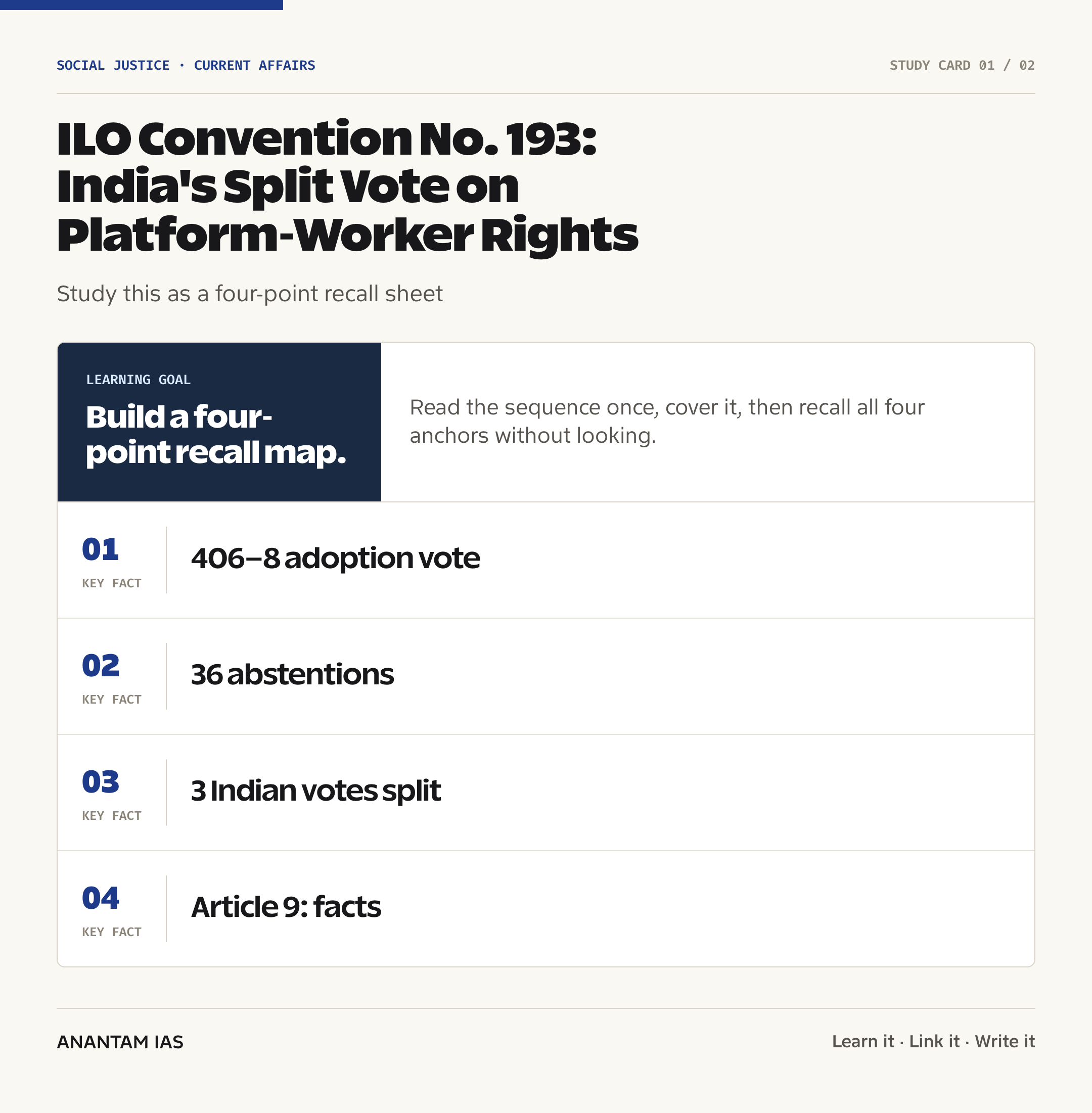
The Hindu examined India’s position on ILO Convention No. 193, the Decent Work in the Platform Economy Convention adopted by the International Labour Conference in Geneva on 12 June 2026. The recorded vote was 406 in favour, 8 against and 36 abstentions.
The official ILO voting record shows a split within India’s tripartite participation: India’s employer delegate and worker delegate voted for adoption, while a government delegate abstained. The Convention remains open to India for later ratification; an abstention at adoption is not a permanent legal bar.
- Convention No. 193 is the first international labour standard dedicated specifically to the platform economy.
- The Convention covers location-based work, such as ride-hailing and delivery, and online work, such as data labelling and digital tasks.
- Its scope extends to platform workers in the formal and informal economy, whether or not they are in an employment relationship.
- The ILO’s recorded result was 406–8, with 36 abstentions; India’s worker and employer representatives supported the instrument.
- The latest ILO NORMLEX instrument profile checked for this note listed zero ratifications, so the Convention had not entered into force.
The development matters in the context of:
- The dispute is not only about benefits. It asks whether a contractual label can override the facts of control, work and payment in deciding a worker’s legal status.
- Platform workers face risks created by algorithmic management: automated task allocation, rating, pay calculation, monitoring and account deactivation.
- India already recognises gig and platform workers under the Code on Social Security, 2020, but Convention No. 193 offers a wider benchmark linking status, pay, safety, data rights and remedies.
UPSC Relevance
Prelims Relevance
- ILO Convention No. 193 was adopted at the 114th International Labour Conference on 12 June 2026.
- An ILO member’s Conference delegation is constitutionally tripartite: two government delegates, one employer delegate and one worker delegate.
- Convention No. 193 applies to all digital labour platforms and platform workers in both formal and informal economies, subject to tightly framed national exclusions.
- Article 9 requires correct classification guided mainly by facts relating to work performance and remuneration, not merely the contract’s label.
- Article 10 requires timely and full payment due under law, agreement or contract; the applicable minimum-wage guarantee is expressly tied to workers in an employment relationship.
- Article 12 requires social-security access on terms no less favourable than for other workers with the same status in employment.
- Articles 13–15 address algorithmic monitoring, decision-making, written explanations, review and appropriate human involvement.
- Under Article 27, the Convention enters into force 12 months after the second ratification is registered; for later ratifying states, it applies 12 months after registration.
- Under Article 19 of the ILO Constitution, newly adopted instruments must be submitted to the competent national authority even before a state chooses whether to ratify.
Mains Relevance
GS Paper 2
- Use the issue to examine welfare governance, labour protection, social justice and accountability for automated decisions.
- Assess the balance between regulatory flexibility and a minimum rights floor for workers whose income depends on platforms.
GS Paper 2
- Connect India’s vote to the ILO’s tripartite structure, treaty adoption, ratification and the domestic role of Parliament and competent authorities.
- Distinguish an adoption vote from ratification: voting behaviour has political significance, while binding treaty obligations arise only after ratification and entry into force.
GS Paper 3
- Analyse how digital platforms create work and formalisation opportunities while transferring fuel, equipment, waiting-time and income risks to workers.
- Evaluate algorithmic management as an economic-governance issue involving productivity, competition, data protection and access to livelihood.
Essay
- Technology changes the organisation of work faster than the moral claim to dignity at work.
- Flexibility is meaningful only when workers can understand, contest and survive the rules that govern their income.
Background and Context
What Convention No. 193 Covers
The Convention creates a common floor without forcing every platform worker into one employment category.
- Article 1 defines a digital labour platform through digital technologies and automated decision-making systems that organise or facilitate paid service work.
- A digital platform worker is a person employed or engaged for paid work organised or facilitated by a platform, regardless of their classification.
- Article 2 covers online and location-based work, and workers in formal as well as informal economies.
- A member may exclude only limited categories where substantial special problems arise, after consultation; it must explain the exclusion in ILO reports and consider progressive extension.
- The Convention recognises intermediaries and subcontracting chains, preventing a platform from escaping responsibility simply by placing another entity between itself and the worker.
Tripartism and India's Split Position
The vote is a useful illustration of how the ILO gives governments, employers and workers distinct voices.
- Under the ILO Constitution, each member may send two government delegates, one employer delegate and one worker delegate; non-government delegates act independently.
- The official roll records India’s employer representative and worker representative among the 406 votes for adoption.
- An Indian government representative appears among the 36 abstentions. The record supports describing India’s position as internally split, not as unanimous national rejection.
- The adoption vote made Convention No. 193 an ILO standard, but it did not itself bind India. Binding obligations depend on ratification registered with the ILO.
- India can still ratify later. Even without ratification, the instrument supplies a policy benchmark and must be brought before the competent authority under the ILO Constitution.
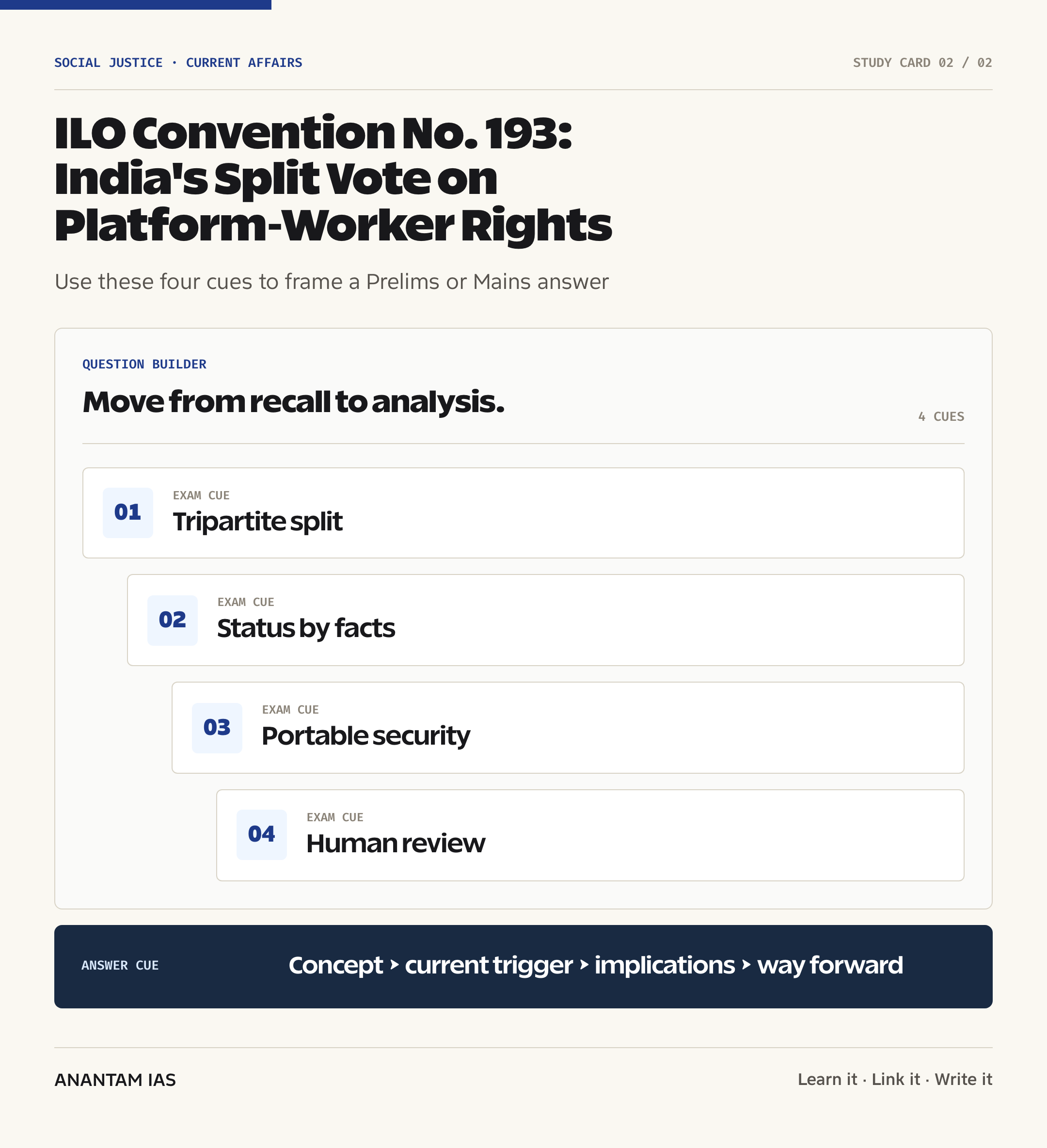
Classification: Facts Before Contract Labels
Worker classification determines which rights attach to the relationship, making Article 9 the Convention’s structural core.
- Platforms may describe workers as independent partners, yet still shape price, access to tasks, ratings, performance and continued access to the app.
- Article 9 asks states to determine the existence or absence of an employment relationship mainly from facts about performance and payment, while considering platform-work specificities.
- The Convention does not declare every worker an employee and does not prohibit self-employment; it seeks accurate status and suitable protection.
- Correct classification matters because minimum wage, compensation of work expenses and some other guarantees depend on whether the person is in an employment relationship.
- Some rights are broader than employee status, including fundamental principles at work, safety, protection from violence, data safeguards and access to remedies.
Pay, Safety and Social Protection
The Convention combines universal protections with status-sensitive entitlements rather than pretending every platform arrangement is identical.
- Articles 3–6 cover freedom of association, collective bargaining, freedom from forced and child labour, non-discrimination, safe work and protection from violence and harassment.
- Article 5 protects a worker who leaves a situation reasonably believed to present imminent and serious danger, without undue consequences.
- Article 10 requires payment due under applicable rules to be timely, full, lawfully deducted and made through lawful means.
- For workers in an employment relationship, pay excluding tips cannot fall below the applicable statutory or negotiated minimum wage; states must consider whether similar protection should extend to others.
- Article 12 uses a comparability rule: platform workers should receive social-security protection no less favourable than workers with the same employment status.
- Article 23 reinforces no-less-favourable treatment, preventing digital intermediation from becoming a reason for inferior protection.
Algorithms, Data and Deactivation
Convention No. 193 treats software rules as labour-governance rules when they shape work or access to income.
- Article 13 requires platforms to disclose automated systems used to monitor or evaluate work and to explain their effects on conditions or access to work.
- Article 15 supports a written explanation and review of significant adverse automated decisions, including non-payment, suspension, deactivation or termination.
- Review must include appropriate human involvement; an automated appeal loop cannot be the only answer to an automated penalty.
- Article 16 requires legitimate-purpose processing and gives workers rights to seek access, rectification and erasure, subject to data-retention law.
- Article 17 prohibits suspension, deactivation or termination on discriminatory or otherwise unlawful grounds.
- Article 21 requires safe, fair and effective dispute-resolution mechanisms and appropriate remedies for workers and platforms.
India's Domestic Baseline
India has statutory recognition and a funding framework, but Convention No. 193 asks a wider set of questions about the employment relationship and platform power.
- The Code on Social Security, 2020, in force from 21 November 2025, defines gig workers, platform workers and aggregators and enables welfare schemes for these groups.
- The Code permits schemes covering life and disability, accident, health, maternity and old-age protection and provides a role for the National Social Security Board.
- Its aggregator contribution may be notified between 1% and 2% of annual turnover, capped at 5% of the amount paid or payable to gig and platform workers.
- The Code’s categories do not by themselves resolve whether a particular worker is an employee. Convention Article 9 adds a fact-based status test that could reshape access to employment-linked rights.
- India’s policy gap is best framed as recognition versus enforceable delivery: registration, funding, benefit eligibility, portability, claims, appeal and classification all need workable rules.
- A worker may earn through several apps, migrate between states or alternate between platform and non-platform work. A usable system needs a single portable worker record without making one platform the gatekeeper of identity or benefits.
- The central framework and state welfare initiatives must agree on worker identification, contribution credit and benefit portability. Otherwise the same worker can be duplicated, excluded or lose continuity when crossing a state border.
- State legislation, including Rajasthan’s Platform Based Gig Workers Act, 2023, shows that welfare boards and transaction-linked funding can be designed locally. But fragmented state databases and contribution rules would raise compliance costs and weaken portability.
- The Code focuses on social-security schemes, while Convention No. 193 joins welfare to classification, occupational safety, pay transparency, algorithmic accountability and remedies. Domestic alignment would need more than a welfare-fund notification.
- For the domestic framework, revise Anantam IAS notes on social security for gig and informal workers and the guide to gig workers’ rights.
From Algorithmic Disclosure to Enforceable Due Process
The Convention identifies the right questions, but national rules must convert disclosure and review into procedures that work at platform speed.
- A platform should disclose which systems influence task allocation, dynamic pricing, ratings, incentives, fraud flags and deactivation, not merely publish a broad statement that algorithms are used.
- An explanation must identify the decisive inputs, the rule applied and the available appeal route in language the worker can understand. A generic fraud label is not a meaningful written explanation.
- Human involvement should be real: the reviewer needs authority to inspect records, correct data, restore access and reverse withheld payment. A support agent reading the same automated output would not satisfy the purpose of human review.
- Time limits matter because account suspension can remove a worker’s daily income. Domestic rules should create urgent interim review for deactivation, alongside ordinary grievance and appeal channels.
- Platforms should preserve auditable logs of notices, significant decisions, human interventions and outcomes. Regulators need secure access for enforcement without requiring publication of commercially sensitive information, which Article 24 also protects.
- Workers who use multiple platforms need consistent minimum safeguards. A common national protocol can define notice, explanation, review and data correction while allowing states to provide additional welfare and enforcement mechanisms.
Legal Effect and Ratification Path
Adoption, submission, ratification and entry into force are separate stages and should not be collapsed into one.
- The 12 June vote completed adoption by the International Labour Conference; it did not automatically rewrite national labour law.
- The latest ILO instrument profile checked for this note showed zero ratifications and no in-force date.
- Under Article 27, two registered ratifications are needed to start the clock for global entry into force, which occurs 12 months later.
- For each later ratifying member, the Convention becomes binding 12 months after its ratification is registered.
- The official texts adopted at the 114th session include the Convention but not a companion Recommendation. A Recommendation is normally non-binding guidance that can supply more detailed implementation choices; its absence does not weaken the Convention’s legal status after ratification.
- The Convention deliberately leaves implementation routes open. Article 24 permits laws, regulations, collective agreements, court decisions or a combination consistent with national practice, while requiring consultation with representative employer and worker organisations.
- Before ratification, India can conduct a conformity review identifying provisions already covered, those needing rules and those requiring primary legislation. This separates genuine legal conflicts from administrative gaps.
- Submission to the competent authority under the ILO Constitution should precede a reasoned decision. Ratification is an executive international act, but domestic enforceability depends on changes made through India’s constitutional and legislative processes.
- Implementation may use laws, regulations, collective agreements, court decisions or a combination, in consultation with representative employer and worker organisations.
- Ratification would require India to examine the relationship between central labour codes, state welfare laws, platform contracts, data rules and accessible enforcement.
Way Forward
Publish a Reasoned National Position
- Place the Convention before the competent authority with an article-by-article comparison of Indian law and a public explanation of the abstention.
- Use genuine tripartite consultation with worker organisations, aggregators, states and independent labour experts before deciding on ratification.
Build a Fact-Based Classification Test
- Assess control over price, task allocation, monitoring, discipline, customer access and economic dependence instead of relying only on the platform’s contractual label.
- Create a rebuttable, evidence-based process with clear burdens of proof and fast appeals so classification disputes don’t require years of litigation.
Make Social Security Portable
- Tie benefits to the worker across platforms and states, with transparent contributions, interoperable records and protection for intermittent work.
- Publish dashboards on registration, contributions, eligible workers, claims, rejection reasons and grievance disposal, while protecting personal data.
Regulate Algorithmic Management
- Require plain-language notice of pay rules, ratings, task allocation and deactivation triggers, plus a written explanation for adverse decisions.
- Guarantee timely human review, restoration of wrongly blocked accounts and compensation where unlawful deactivation causes income loss.
Conclusion
Convention No. 193 does not abolish flexible platform work. It draws a line between flexibility and unaccountable risk transfer by combining accurate classification with rights that follow the worker.
India’s split vote should lead to a transparent legal comparison, not a symbolic argument about Geneva. The practical test is whether a worker can receive fair payment, carry social protection, understand an algorithmic decision and obtain a remedy when access to livelihood is wrongly removed.
UPSC Practice Questions
Prelims MCQ 1
With reference to ILO Convention No. 193, consider the following statements:
- It applies to digital platform workers in both formal and informal economies.
- It automatically classifies every digital platform worker as an employee.
- It provides for written explanation and review of certain adverse automated decisions.
How many of the above statements are correct?
(a) Only one (b) Only two (c) All three (d) None
Answer: (b) Only two
Explanation:
Statements 1 and 3 are correct. Statement 2 is incorrect: Article 9 requires correct classification based mainly on facts about work and payment, but the Convention does not impose one status on every worker.
Prelims MCQ 2
When will ILO Convention No. 193 first enter into force under its Article 27?
(a) Immediately after adoption by the International Labour Conference (b) Six months after the first member ratifies it (c) Twelve months after the second registered ratification (d) Only after a majority of ILO members ratify it
Answer: (c) Twelve months after the second registered ratification
Explanation:
Article 27 requires two registered ratifications. The Convention first enters into force 12 months after the second is registered; it binds each later ratifying member 12 months after that member’s registration.
UPSC Mains Questions
- ILO Convention No. 193 does not impose a single employment status, yet it challenges platform business models built on contractual labels. Examine how its fact-based classification test can reconcile genuine self-employment with protection against disguised employment.
- India’s worker and employer delegates supported ILO Convention No. 193 while a government delegate abstained. Discuss what this split reveals about tripartism, treaty-making and the need for transparent domestic consultation on labour standards.
- Algorithmic management converts software design into a question of livelihood and due process. Evaluate the safeguards India needs for automated pay, ratings, task allocation and account deactivation in the platform economy.
Sources: International Labour Organization and The Hindu.
Frequently Asked Questions
What is ILO Convention No. 193?
It is the Decent Work in the Platform Economy Convention adopted on 12 June 2026. It is the first international labour standard devoted specifically to platform work, covering classification, payment, safety, social security, automated systems, personal data, deactivation and access to remedies.
Did India vote against the Convention?
No. The official roll records India’s employer and worker delegates voting in favour, while an Indian government delegate abstained. This is best described as a split tripartite position. Abstention at adoption does not stop India from ratifying the Convention later.
Does it make every gig worker an employee?
No. Article 9 requires states to classify workers correctly, guided mainly by facts about how work is performed and paid. It neither mandates employee status for everyone nor bans self-employment. The aim is to prevent contractual labels from concealing the real working relationship.
What protection applies regardless of status?
Its broad floor includes fundamental principles and rights at work, occupational safety and health, protection from violence and harassment, safeguards for personal data, lawful treatment in deactivation and access to dispute resolution. Some pay protections are expressly linked to an employment relationship.
How does it regulate platform algorithms?
Platforms must disclose relevant automated monitoring and decision systems and explain their effects on work. Workers should be able to request written reasons and review for major adverse outcomes such as non-payment, suspension, deactivation or termination, with appropriate human involvement.
Is the Convention already binding on India?
No. An ILO Convention becomes binding on a member only after ratification is registered and the treaty enters into force for that member. India has not ratified Convention No. 193. The instrument can still guide policy, and the ILO Constitution requires submission to the competent authority.