India–Indonesia Partnership: Defence, Critical Minerals and the Malacca Strait Angle
Why in News?
Prime Minister Narendra Modi began a three-nation tour of Indonesia, Australia and New Zealand on 6 July 2026, landing in Jakarta as the first stop. President Prabowo Subianto personally received him at the airport, and the two leaders held delegation-level talks on 7 July covering defence and maritime partnership, critical minerals, food security and the digital economy.
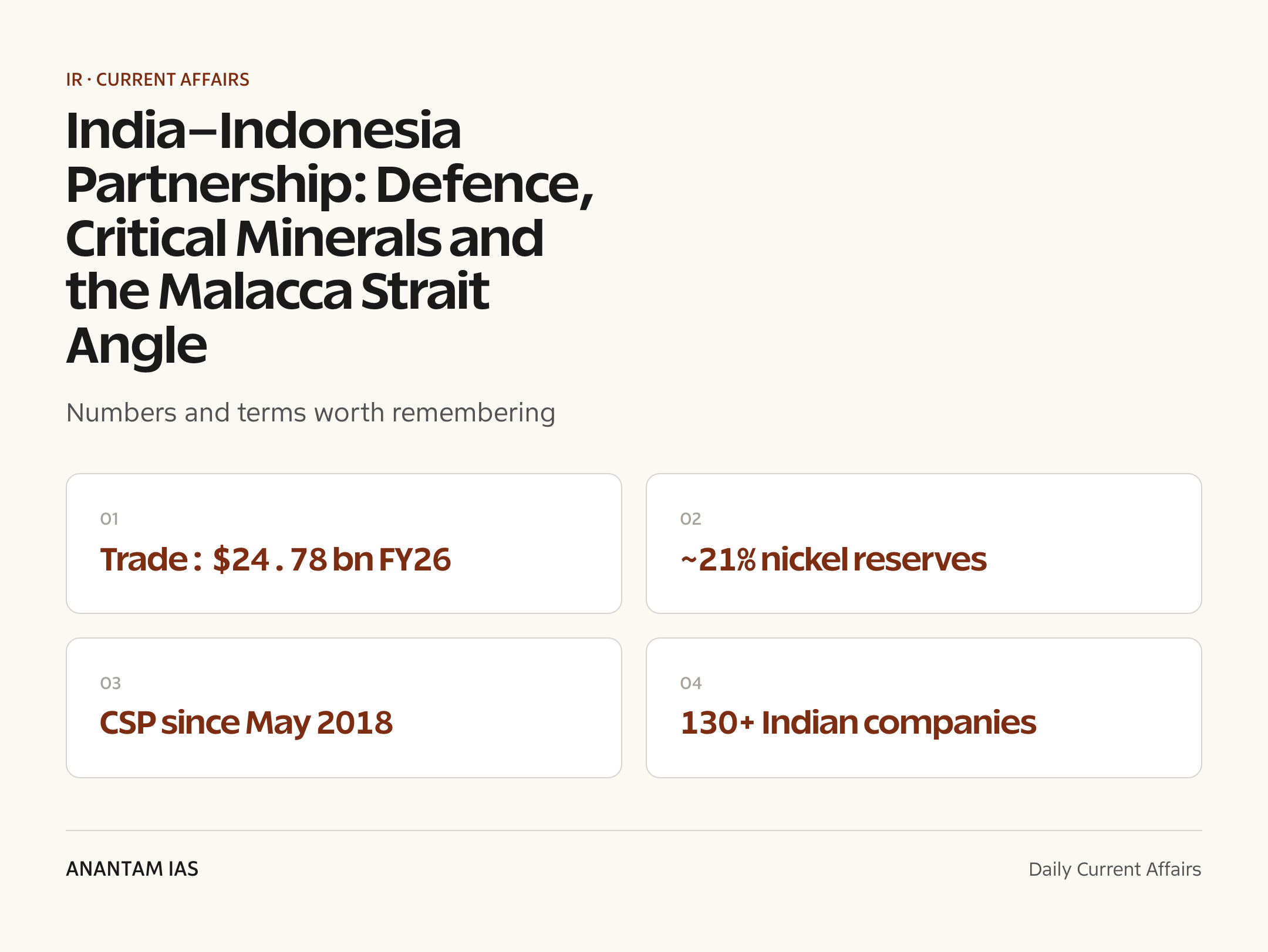
The Indian Express reported that this is Modi’s fourth visit to Indonesia but his first bilateral visit since the two countries elevated ties to a Comprehensive Strategic Partnership (CSP) in May 2018 — with a BrahMos missile sale, an Indonesian liaison officer at India’s IFC-IOR, and nickel-centred critical-mineral cooperation all on the table.
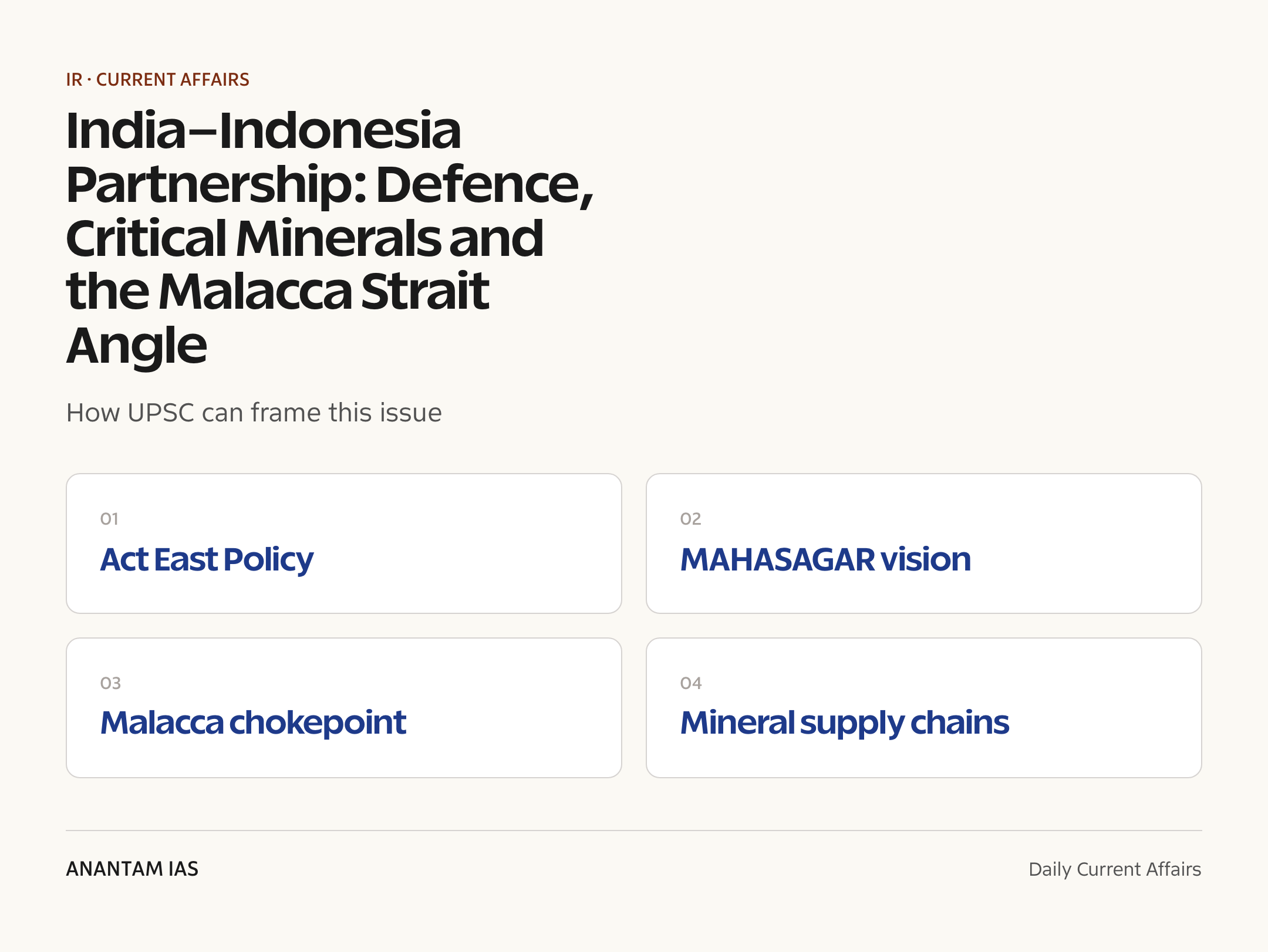
- The tour runs 6–11 July 2026; Modi said it will strengthen the Act East Policy, the MAHASAGAR Vision and India’s outlook towards a free and open Indo-Pacific.
- Bilateral trade touched US$ 24.78 billion in 2025-26, making Indonesia India’s second-largest trading partner in ASEAN; over 130 Indian companies are invested there.
- Defence deliverables flagged by officials: defence-industry cooperation including the sale of BrahMos missiles, an Indonesian liaison officer at the Information Fusion Centre – Indian Ocean Region (IFC-IOR), and training slots at the NDA and Defence Services Staff College.
- Officials noted Indonesia commands roughly 21% of the world’s nickel reserves and ranks among the top producers of copper, bauxite and tin.
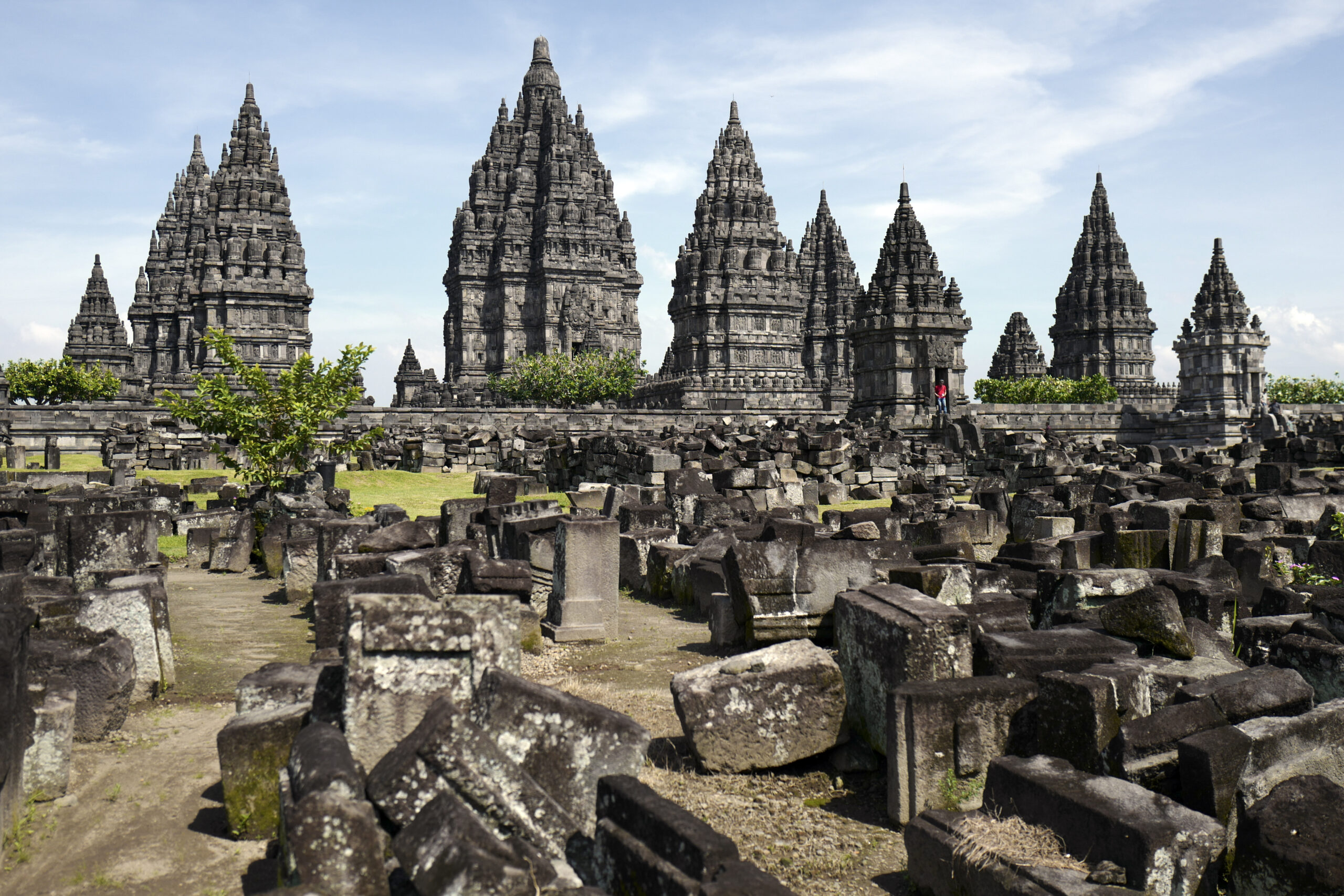
- The two leaders are set to visit the Prambanan temple complex at Yogyakarta; India will mark the centenary of Rabindranath Tagore’s Indonesia visit in 2027.
The development matters in the context of:
- Indonesia sits astride the Strait of Malacca; Observer Research Foundation studies estimate about 60% of India’s sea-borne trade transits this single chokepoint.
- Indonesian mineral processing is dominated by Chinese capital; Deccan Herald reported India is seeking a foothold in the nickel value chain to de-risk its clean-energy transition.
- The visit tests whether Act East rhetoric can convert civilisational goodwill into hard outcomes — defence sales, mineral access and maritime domain awareness.
UPSC Relevance
Prelims Relevance
- Comprehensive Strategic Partnership — India–Indonesia ties elevated in May 2018 during PM Modi’s Jakarta visit.
- MAHASAGAR — Mutual and Holistic Advancement for Security and Growth Across Regions; the upgrade of SAGAR (2015) announced at Mauritius in March 2025.
- IFC-IOR — Indian Navy’s maritime information hub at Gurugram (2018); Indonesia to station a liaison officer.
- Bilateral exercises — Garuda Shakti (army), Samudra Shakti (navy), IND-INDO CORPAT patrols since 2002.
- Strait of Malacca — links the Andaman Sea to the South China Sea between the Malay Peninsula and Sumatra; about 2.5 km at its narrowest.
- Sabang port (Aceh) — India gained development access in 2018 near the strait’s western approaches.
- Nickel — Indonesia holds ~21% of global reserves; key input for EV battery cathodes and stainless steel.
- National Critical Mineral Mission (2025) — Cabinet-approved with a ₹16,300-crore outlay; KABIL is India’s overseas mineral-acquisition JV.
- Prambanan — 9th-century Hindu temple complex (Trimurti) near Yogyakarta; a UNESCO World Heritage Site.
- Bandung Conference (1955) — Afro-Asian solidarity meet hosted by Indonesia; a precursor to the Non-Aligned Movement.
Mains Relevance
GS Paper 2
- India–Indonesia as the pivot of the Act East policy: how bilateral CSPs give substance to ASEAN centrality in India’s Indo-Pacific strategy.
- Defence diplomacy as statecraft — BrahMos exports, training slots and liaison postings as instruments of strategic trust-building.
- Comparative developmental visions: convergence of Viksit Bharat 2047 and Indonesia Emas 2045 as a template for South–South cooperation.
GS Paper 3
- Critical-mineral supply chains: de-risking nickel, copper and tin sourcing for India’s energy transition amid Chinese processing dominance.
- Maritime security of chokepoints: the Malacca Strait, the Andaman and Nicobar Islands and maritime domain awareness as internal-security multipliers.
Essay
- Geography is destiny: how straits and seas script the fates of nations.
- From Bandung to batteries: the reinvention of Asian solidarity in a multipolar world.
Background and Context
From Bandung to Comprehensive Strategic Partnership
India and Indonesia are old friends whose relationship has repeatedly reinvented itself.
- President Sukarno was the chief guest at India’s first Republic Day in 1950, and the two nations co-anchored the Bandung Conference of 1955 that seeded the Non-Aligned Movement.
- Ties were elevated to a Comprehensive Strategic Partnership during PM Modi’s Jakarta visit in May 2018, alongside the Shared Vision of India-Indonesia Maritime Cooperation in the Indo-Pacific.
- President Prabowo Subianto was chief guest at India’s 76th Republic Day in January 2025, signalling the personal investment of both leaderships.
- The current trip is Modi’s fourth visit to Indonesia but the first bilateral one since 2018; Bloomberg reported the two leaders were set to sign a defence pact plus agreements spanning education, health and technology.
- Officials see “strong synergies” between Viksit Bharat 2047 and Indonesia Emas (Golden Indonesia) 2045 — both target developed-economy status around their independence centenaries.
Defence Cooperation: BrahMos, Exercises and Training
Defence has moved from ceremonial exchanges to hardware, training and industrial partnership.
- Negotiations on the BrahMos supersonic cruise missile are at an advanced stage; Jakarta Globe and Indian media reports describe a proposed coastal-defence battery sale of roughly US$ 450 million, which Jakarta reportedly wants to scale up.
- A BrahMos sale would make Indonesia the second ASEAN buyer after the Philippines (2022) — consolidating India’s shift from arms importer to defence exporter.
- The armies exercise together in Garuda Shakti, the navies in Samudra Shakti, and both navies have run the IND-INDO CORPAT coordinated patrol near the Andaman Sea since 2002.
- India will earmark seats for Indonesian cadets at the National Defence Academy and Defence Services Staff College — long-horizon capacity building that shapes future military elites.
- An Indonesian liaison officer will join IFC-IOR, the Indian Navy’s Gurugram fusion centre set up in 2018, plugging Jakarta into India’s maritime domain awareness network.
The Maritime Geography: Why the Strait of Malacca Matters
Everything about this partnership ultimately routes through one narrow waterway.
- The Strait of Malacca runs between the Malay Peninsula and Sumatra, connecting the Andaman Sea (Indian Ocean) to the South China Sea (Pacific); it narrows to about 2.5 km at its tightest point.
- Observer Research Foundation studies estimate roughly 30% of global trade and about 60% of India’s sea-based trade pass through the strait; the US Energy Information Administration ranks it among the world’s biggest oil-transit chokepoints.
- India’s Great Nicobar Island lies only about 40 nautical miles (74 km) from the strait’s western approaches — the strategic logic behind the Andaman and Nicobar Command, India’s only tri-service theatre command, headquartered at Sri Vijaya Puram (formerly Port Blair).
- In 2018, Indonesia gave India access to develop the deep-sea port of Sabang in Aceh, at the strait’s northern mouth — a rare physical foothold at the chokepoint.
- China’s dependence on the same waterway — its “Malacca dilemma” — makes the strait a point where Indian, Chinese and ASEAN anxieties intersect; the Malacca Strait Patrol grouping (Indonesia, Malaysia, Singapore, Thailand) polices it, and India is not a member.
Critical Minerals: Nickel and the China Factor
The newest pillar of the relationship is dug out of Sulawesi’s mines.
- Indonesia holds roughly 21% of the world’s nickel reserves — the largest share of any country — and is a top producer of copper, bauxite and tin, all on India’s critical-minerals list.
- Nickel is indispensable for lithium-ion battery cathodes and stainless steel; India has minimal domestic supply, making imports a hard constraint on its EV and clean-energy targets.
- Deccan Herald reported that Indonesian nickel smelting is dominated by Chinese firms, so New Delhi is negotiating joint ventures and processing partnerships to enter the value chain rather than just buy ore.
- At home, the National Critical Mineral Mission (Cabinet-approved January 2025, ₹16,300-crore outlay) and KABIL — the NALCO–HCL–MECL overseas-assets JV — provide the institutional machinery for such deals.
- The Ministry of Mines’ 30-mineral critical list (2023) frames the demand side; Indonesia is the single most consequential partner for its battery-metals slice.
Trade, Food Security and Development Learning
The economic agenda pairs headline trade numbers with quieter policy exchange.
- Bilateral trade of US$ 24.78 billion in 2025-26 makes Indonesia India’s second-largest ASEAN trading partner, with over 130 Indian companies invested across sectors.
- Indonesian delegations have studied India’s Public Distribution System, fortified rice scheme and fertiliser-subsidy reforms; officials say Indonesia’s free nutritious meals initiative is modelled on India’s midday meal programme.
- The 7 July talks also cover food security and the digital economy — areas where India exports governance templates, not just goods.
- A deeper India–ASEAN economic relationship, including the review of the ASEAN–India Trade in Goods Agreement (AITIGA), gives the bilateral push regional scaffolding.
The Civilisational Connect
Culture is the oldest, and still the most disarming, bridge between the two nations.
- Modi and Prabowo are set to visit Prambanan, the 9th-century Trimurti temple complex near Yogyakarta and a UNESCO World Heritage Site; Indonesia also hosts Borobudur, the world’s largest Buddhist monument.
- The Ramayana and Mahabharata live on in Javanese and Balinese performance, and Indonesia’s national emblem is the Garuda — testimony to centuries of Indic exchange.
- Odisha’s Bali Jatra festival commemorates the Kalinga mariners who sailed to the Indonesian archipelago — the maritime link the modern partnership consciously invokes.
- India will mark the centenary of Rabindranath Tagore’s visit to Indonesia in 2027; Indonesia remains the world’s largest Muslim-population country with a syncretic Hindu-Buddhist heritage.
Way Forward
Consolidate the security partnership
- Close the BrahMos contract and deliver on time — credibility as a defence exporter is built on execution, not announcements.
- Operationalise the IFC-IOR liaison into real-time shipping-data exchange, and expand CORPAT into joint exercises with wider ASEAN participation.
- Invest visibly in Sabang and Andaman and Nicobar infrastructure so geography translates into presence at the Malacca approaches.
Build the minerals bridge
- Negotiate a government-to-government critical-minerals framework covering nickel, copper, bauxite and tin, with KABIL and private players taking equity in mining and processing.
- Prioritise midstream processing partnerships — refining and precursor production — over ore imports, to capture value and cut dependence on any single country’s smelters.
- Use the AITIGA review and the Viksit Bharat 2047–Indonesia Emas 2045 synergy to anchor mineral ties in a broader, balanced trade relationship.
Conclusion
The Jakarta leg of this tour shows India’s Indonesia policy graduating from symbolism to substance. A BrahMos sale, a liaison officer inside India’s maritime nerve-centre and NDA training pipelines are the unglamorous, compounding investments that turn a Comprehensive Strategic Partnership from a communiqué phrase into working strategy.
The stakes are structural. The country that co-owns the Malacca chokepoint also holds a fifth of the world’s nickel — the metal on which India’s EV and clean-energy ambitions depend. Few relationships map so neatly onto both of India’s core vulnerabilities: sea-lane security and mineral supply.
For the exam, anchor this visit to the durable frames — Act East, MAHASAGAR, ASEAN centrality and critical-mineral supply chains — because the news will fade, but the geography and the geology will not.
UPSC Practice Questions
Prelims MCQ 1
With reference to the Strait of Malacca, consider the following statements:
- It connects the Andaman Sea with the South China Sea.
- India is a member of the Malacca Strait Patrol grouping that polices the strait.
- India’s Great Nicobar Island lies about 40 nautical miles from the strait’s western approaches.
How many of the above statements are correct?
(a) Only one (b) Only two (c) All three (d) None
Answer: (b) Only two
Explanation:
Statements 1 and 3 are correct. Statement 2 is incorrect — the Malacca Strait Patrol comprises Indonesia, Malaysia, Singapore and Thailand; India is not a member.
Prelims MCQ 2
Indonesia, a key partner in India’s critical-mineral diplomacy, holds roughly 21% of the world’s reserves of which one of the following minerals?
(a) Lithium (b) Nickel (c) Cobalt (d) Graphite
Answer: (b) Nickel
Explanation:
Indonesia commands about 21% of global nickel reserves — the world’s largest share — and is a leading producer of copper, bauxite and tin. Nickel is critical for lithium-ion battery cathodes, which is why it anchors the India–Indonesia minerals agenda.
UPSC Mains Questions
- “India–Indonesia relations have moved from civilisational familiarity to strategic necessity.” Discuss in the light of the defence, maritime and critical-mineral dimensions of the Comprehensive Strategic Partnership under India’s Act East policy.
- The Strait of Malacca is as central to India’s security calculus as it is to its trade. Examine the role of the Andaman and Nicobar Islands and of partnerships with littoral states such as Indonesia in securing this chokepoint.
- Critical-mineral supply chains have become the new theatre of geoeconomic competition. Evaluate how mineral partnerships with resource-rich states like Indonesia can de-risk India’s clean-energy transition, and identify the institutional mechanisms India has built for this.
Sources: The Indian Express and The Hindu.
Frequently Asked Questions
Why is PM Modi’s 2026 Indonesia visit significant?
It is his first bilateral visit to Indonesia since ties were raised to a Comprehensive Strategic Partnership in May 2018, and the opening leg of a July 6–11 three-nation tour. The agenda spans a BrahMos sale, an Indonesian liaison officer at IFC-IOR, critical-mineral joint ventures, food security and the digital economy.
What is the India–Indonesia Comprehensive Strategic Partnership?
It is the highest tier of bilateral engagement, adopted in May 2018 during PM Modi’s Jakarta visit alongside a Shared Vision of Maritime Cooperation in the Indo-Pacific. It frames cooperation across defence, maritime security, trade, connectivity and culture — from BrahMos talks to nickel diplomacy.
Why does India want Indonesian nickel?
Indonesia holds about 21% of global nickel reserves, the world’s largest share, while India has negligible domestic supply. Nickel is essential for lithium-ion battery cathodes and stainless steel. Since Chinese firms dominate Indonesian smelting, India is negotiating joint ventures so its EV and clean-energy plans are not hostage to one country’s processors.
Why is the Strait of Malacca important for India?
The strait between the Malay Peninsula and Sumatra is the shortest route linking the Indian Ocean to East Asia. Research estimates suggest around 60% of India’s sea-borne trade transits it, and Great Nicobar lies about 40 nautical miles away. Partnership with Indonesia, its largest littoral state, directly serves India’s economic and naval security.
What is the MAHASAGAR vision?
MAHASAGAR — Mutual and Holistic Advancement for Security and Growth Across Regions — is India’s upgraded maritime doctrine announced at Mauritius in March 2025. It widens the SAGAR (2015) framework from the Indian Ocean neighbourhood to the broader Indo-Pacific, stressing security cooperation, capacity building and development partnership.
Which military exercises do India and Indonesia conduct?
The armies hold Garuda Shakti and the navies Samudra Shakti. Since 2002 the two navies have also run IND-INDO CORPAT, coordinated patrols along their maritime boundary near the Andaman Sea. India is now adding training slots for Indonesian cadets at the National Defence Academy and Defence Services Staff College.