India-Russia Annual Summit 2025: Programme 2030 and the Strategic Partnership
On 4-5 December 2025, Vladimir Putin landed in New Delhi for a two-day state visit, and for those forty-eight hours one of the world’s most-watched relationships sat in plain view. The trip produced the 23rd India-Russia Annual Summit, a meeting Prime Minister Modi and the Russian President hold turn by turn each year. They signed a stack of agreements, guaranteed each other oil and security, and adopted a long-range economic plan the two governments are calling Programme 2030. It was Putin’s first visit to India since the war in Ukraine reshaped the global map, and it came while Washington was openly punishing New Delhi for buying Russian crude. So the summit was never going to be just protocol and photographs. It was a test of whether India can keep an old friend close without letting a new strain define everything.
And the answer it gave matters far beyond the two capitals. This summit marked twenty-five years of the formal partnership the two countries built in 2000, and it landed at a moment when India is trying to prove that it can deal with Russia, the United States and Europe all at once without picking a camp. For a UPSC aspirant, this is one of the cleanest live cases of strategic autonomy you will find — a textbook idea playing out in real headlines, with real costs and real trade-offs. Get the summit number, the dates and Programme 2030 right, and you have an answer that works across international relations, the external sector and the essay paper alike.
Why It’s in the News
The summit is in the news because of what it signalled as much as what it delivered. Putin had not made a bilateral visit to India since 2021, so the trip itself was a statement: India was willing to host the Russian President warmly even as the United States slapped extra tariffs on Indian goods specifically to punish New Delhi for buying Russian oil. By late 2025 those US duties had stacked up to around 50 per cent on a swathe of Indian exports — half of it a straight penalty tied to Russian crude. Hosting Putin in that climate was India saying, in effect, that it would decide its own partners.
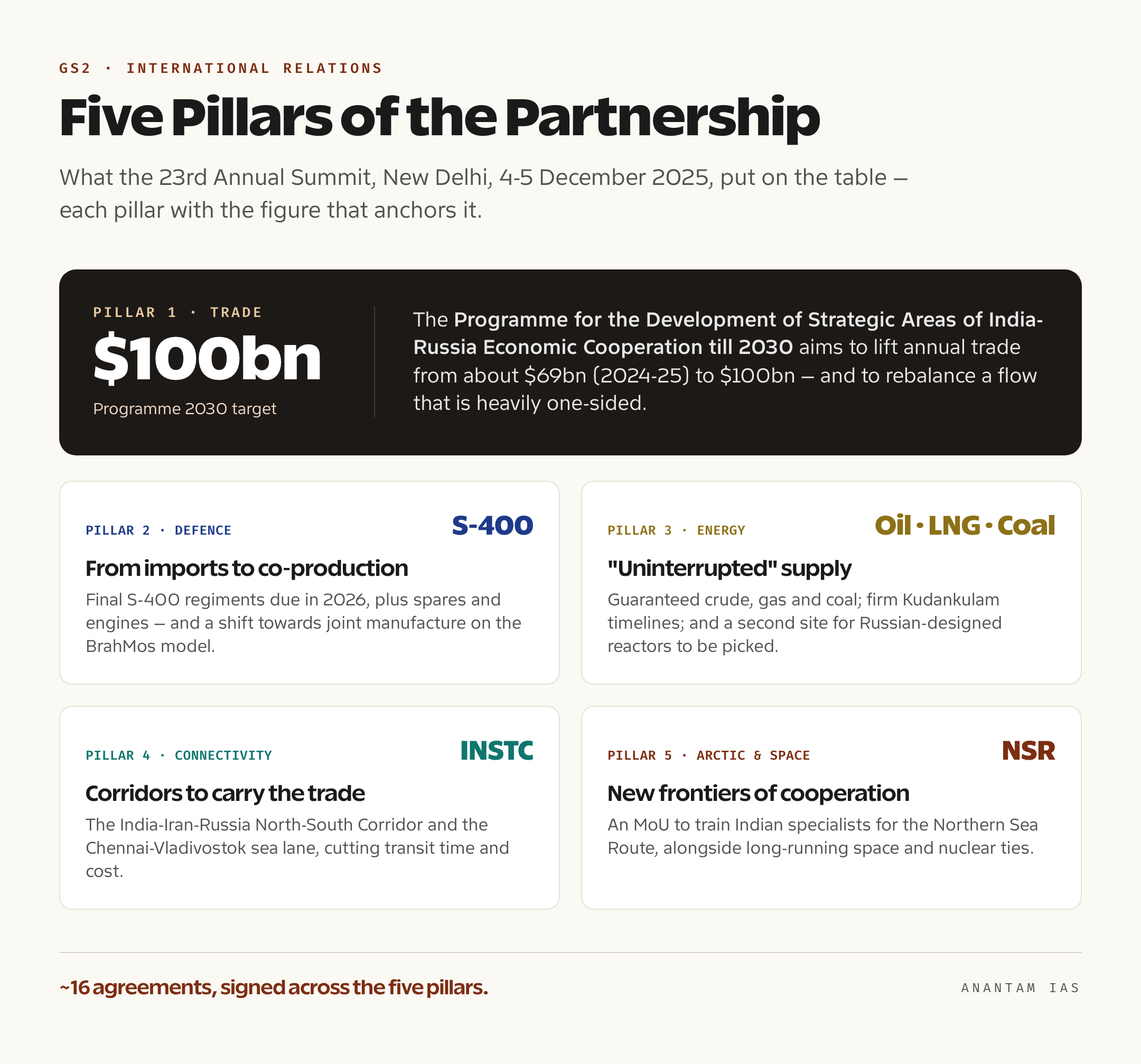
The headline outcome was Programme 2030 — short for the Programme for the Development of Strategic Areas of India-Russia Economic Cooperation till 2030. It is a roadmap to widen and rebalance trade, with a revised target of $100 billion in annual bilateral trade by the end of the decade, up from about $69 billion in 2024-25. The two sides signed roughly sixteen agreements spanning defence, energy, shipbuilding, healthcare, critical minerals and connectivity. Putin guaranteed “uninterrupted” supplies of oil, gas and coal, the leaders reaffirmed the long-running defence relationship including the S-400 air-defence system, and they pushed two big connectivity projects — the International North-South Transport Corridor and the Chennai-Vladivostok sea route. Layered over all of it was the question every analyst kept asking: how long can India keep this balancing act going, and at what price.
The Strategic Partnership: How the Annual Summit Mechanism Works
To see why this summit carried weight, you have to know the architecture behind it. India and Russia have run an annual leaders’ summit since 2000, when then Russian President Putin and Prime Minister Vajpayee signed the Declaration on Strategic Partnership during a Moscow visit. That document created a standing habit — the two heads of government would meet once every year, alternating between Russia and India, to take stock of the whole relationship at the top level. It is one of only a handful of such fixed annual summit mechanisms India maintains with any country, which itself tells you how central Moscow has been to Indian foreign policy.
In 2010 the two countries upgraded the language to a “Special and Privileged Strategic Partnership” — a phrase India reserves for Russia alone. The “special and privileged” wording is not decoration. It captures a relationship that runs deeper than ordinary diplomacy: decades of defence supply going back to the Soviet era, reliable backing at the United Nations Security Council where Russia holds a veto, energy and nuclear cooperation, and a level of mutual trust forged through the Cold War and after. The summit mechanism is the instrument that keeps all of this serviced and current, year after year, regardless of who else either country is courting at the time. The 2025 meeting in New Delhi was the 23rd in that sequence, and it deliberately marked the silver jubilee — twenty-five years — of the original 2000 declaration.
That history is exactly why the 2025 summit was loaded with meaning. The relationship has been quietly shifting under India’s feet. Russia’s invasion of Ukraine in 2022 turned Moscow into a pariah across the West and pushed it far closer to Beijing — an awkward fact for India, which counts China as its principal strategic rival. At the same time, cheap Russian oil after 2022 sent bilateral trade rocketing from around $10 billion to nearly $69 billion in a few years. So India arrived at this summit needing to do two things at once: reassure an old partner that the bond holds, and reshape a trade relationship that had grown huge but dangerously lopsided. The annual summit gave both sides the stage to attempt exactly that.
Key Outcomes: Trade, Defence, Energy and Connectivity
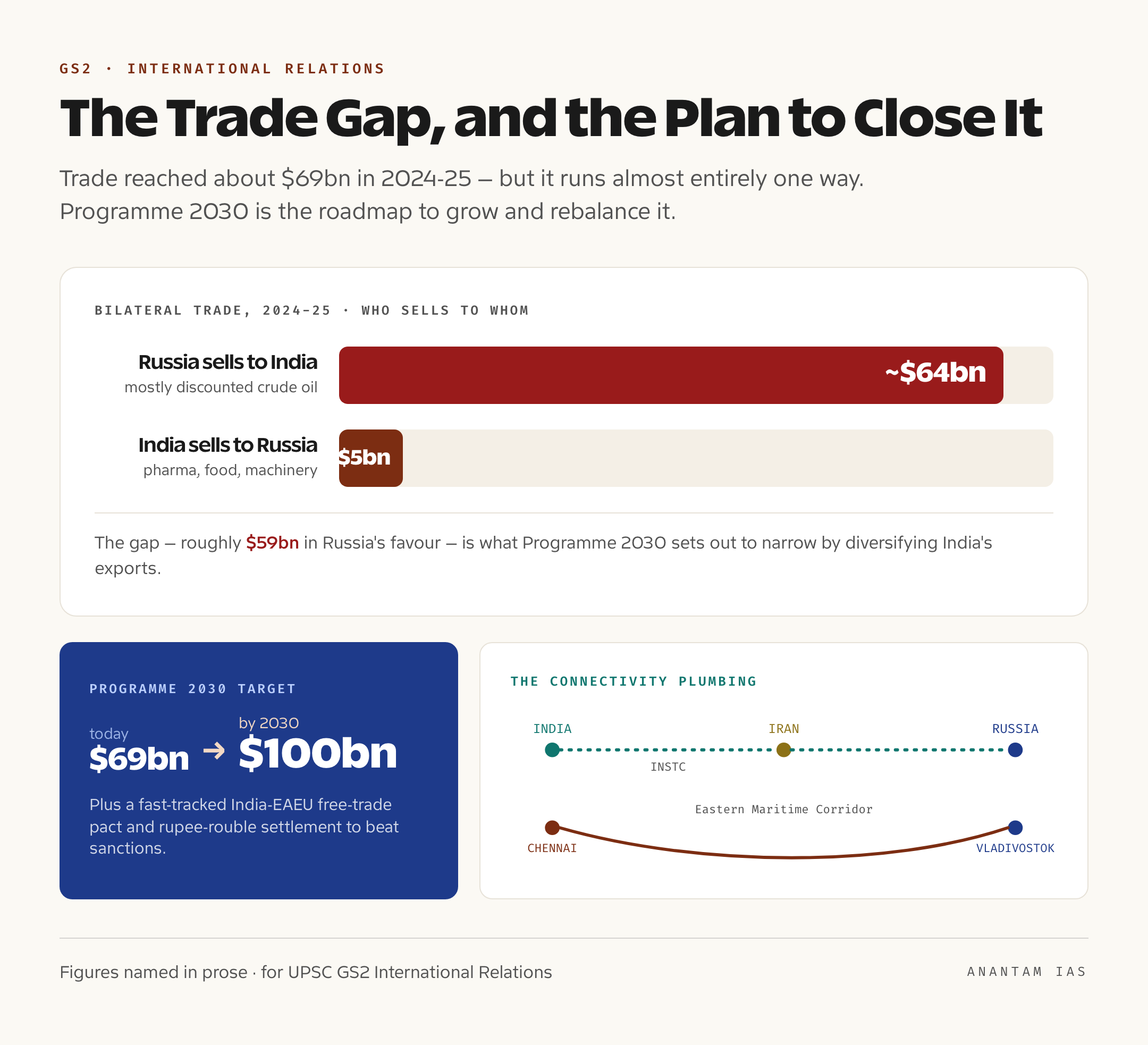
Start with trade, because it is where the summit tried hardest and where the problem is sharpest. Bilateral trade reached about $69 billion in 2024-25, but it is brutally one-sided — India bought roughly $64 billion of Russian goods, mostly oil, and sold barely $5 billion back. That gap is the entire trade story. Programme 2030 sets the headline goal of $100 billion by 2030, but the real work is rebalancing, not just growing. The two sides agreed to tackle tariff and non-tariff barriers, fix logistics bottlenecks and smooth payments, and Russia promised to buy more Indian pharmaceuticals, food products, engineering goods and other manufactures to narrow the deficit. They also agreed to fast-track a free-trade agreement between India and the Russia-led Eurasian Economic Union, the trade bloc that groups Russia with several former Soviet states. Crucially, with Western banking sanctions in the way, the leaders leaned hard on settling trade in national currencies — rupees and roubles — and on linking their financial messaging systems so payments can flow without depending on Western channels. By the summit, the overwhelming bulk of bilateral transactions was already being done in national currencies rather than dollars.
Defence is the oldest pillar and it held firm. Russia remains India’s single largest arms supplier over the decades, and the relationship showed its worth during India’s 2025 standoff with Pakistan, when Russian-origin S-400 systems and Sukhoi fighters were in the front line. At the summit, the two sides ensured continuity in major deliveries — the final regiments of the S-400 Triumf air-defence system are due in 2026, completing the roughly $5.5 billion deal signed back in 2018 — along with spares, engines and ongoing maintenance. The bigger shift is from buying off the shelf to making together: talks now centre on co-production and technology transfer, building on the BrahMos missile model, with Russia offering local manufacturing of fighter components and even pitching its newer air-defence systems for joint production on Indian soil. That fits India’s “Make in India” and self-reliance push, turning a supplier relationship into a partnership that builds capability at home.
Energy is the engine of the modern relationship, and Modi called energy security the “guiding star” of the partnership. Putin guaranteed uninterrupted shipments of crude oil, liquefied natural gas and coal, which mattered enormously with the United States pressing India to cut Russian oil purchases. Russia had become India’s top crude supplier after 2022 because the oil came at a discount, accounting at its peak for well over a third of India’s imports, though that share had begun easing under US pressure by late 2025. Nuclear cooperation got fresh momentum too. Russia committed to firm timelines for the remaining units of the Kudankulam Nuclear Power Plant in Tamil Nadu — India’s largest nuclear station, built with Russian reactors — and the two sides agreed to speed up picking a second site for Russian-designed reactors, feeding India’s ambition of reaching 100 GW of nuclear capacity by 2047.
Connectivity rounded out the agenda, because trade can only grow if goods can actually move. The summit pushed the International North-South Transport Corridor, a multi-mode network of ship, rail and road links running from India through Iran to Russia and onward to Europe, which can cut both the time and cost of moving cargo compared with the long sea route around Europe. It also backed the Chennai-Vladivostok Eastern Maritime Corridor, a direct sea lane linking India’s east coast to Russia’s Far East that slashes shipping time to the Pacific region. And the two sides opened cooperation on the Northern Sea Route, the Arctic shipping passage along Russia’s coast, with an agreement to train Indian specialists in polar navigation. Together these are the plumbing meant to make the $100 billion target physically possible.
Significance and the Balancing Act
The deeper significance of this summit is that it was a live demonstration of strategic autonomy — India’s bedrock principle of making foreign-policy choices on its own merits rather than aligning permanently with any bloc. India today practices what analysts call multi-alignment: working with the United States and the Quad on the Indo-Pacific, with Europe on trade and technology, and with Russia on defence and energy, all at the same time, refusing to let any one partnership cancel out the others. Hosting Putin warmly while negotiating hard with Washington was that doctrine in motion. The message New Delhi sent was that its ties with Russia are not bargaining chips to be surrendered under pressure, and that India will be no one’s junior partner.
There are concrete national interests behind the principle. Russia supplies the spares, engines and platforms that keep a large slice of India’s military running, so a clean break would leave real gaps in readiness for years. Russia is a veto-holding permanent member of the Security Council whose support India values on Kashmir and on its own bid for a permanent seat. Discounted Russian oil helped India shield its economy and its consumers from the price spikes that followed 2022. And keeping a working channel to Moscow is one of the few ways India can hope to slow Russia’s drift into China’s orbit — an outcome that would be strategically dangerous for New Delhi. Walking away from Russia, in other words, would not be a costless moral gesture. It would weaken India in concrete ways.
But the balancing act is genuinely getting harder, and the summit could not pretend otherwise. The United States had imposed steep tariffs explicitly tied to India’s Russian oil purchases, and the shadow of CAATSA — the US Countering America’s Adversaries Through Sanctions Act, which threatens sanctions on countries making major arms deals with Russia — hangs over every new defence purchase. India had escaped CAATSA penalties on its original S-400 deal, but fresh Russian weapons buys risk reopening that fight. Europe, meanwhile, is uneasy about anything that helps fund Russia’s war. So India is threading a needle: deepening ties with Moscow enough to protect its interests, while managing relations with the West carefully enough to avoid real economic damage. The summit showed India can still do this — but it also showed how little slack is left in the rope.
Concerns and the Way Forward
The honest reading of this summit is that it managed a difficult relationship well without solving its central problems. The trade imbalance is the first and biggest worry. A relationship where India buys $64 billion and sells $5 billion is not a partnership of equals — it is a one-way energy bill, and the rupees Russia earns can pile up faster than it can spend them on Indian goods. Programme 2030’s pledge to diversify into pharma, food, engineering and services is the right answer, but pledges have been made before and the numbers have barely moved. Whether this roadmap is different will depend on follow-through, not the joint statement.
The second concern is the external squeeze. India’s room to manoeuvre depends on the United States staying willing to tolerate its Russia ties, and that tolerance has limits, as the 2025 tariffs showed. If Washington hardens further, or if a future defence deal trips the CAATSA wire, India could face a genuine choice it has so far avoided. There is also the China factor sitting quietly underneath everything: the closer Russia leans on Beijing for its own survival, the less independent a partner Moscow becomes, which slowly erodes the strategic value India gets from the relationship. And payments remain fragile — national-currency settlement works, but it leaves India holding roubles it struggles to use and exposed to currency swings.
The way forward, then, is less about grand declarations and more about disciplined execution. India needs to convert Programme 2030 from a target into actual diversified exports, finish the Eurasian Economic Union trade agreement to open Russian and Central Asian markets, and make the INSTC and Chennai-Vladivostok corridors genuinely operational rather than aspirational so logistics stop being the excuse. On defence, the smart path is exactly the one the summit pointed to — moving from imports to co-production, which builds Indian capacity and is far easier to defend against sanctions pressure than buying finished Russian weapons. And on the diplomatic front, India will have to keep doing what it did during Putin’s visit: being clear with every partner that its choices are its own, while quietly making sure no single relationship grows so dominant that losing it would be catastrophic. The 23rd summit bought India time and goodwill. The next few years will decide whether it bought lasting balance.
For Your Mains Answer
This is a high-value topic for GS Paper 2, which covers India’s foreign relations, bilateral and regional groupings, agreements involving India, and the effect of major powers’ policies on Indian interests. Questions on India-Russia relations, strategic autonomy and multi-alignment, the impact of US sanctions and CAATSA, and connectivity diplomacy can all be answered from this material. It also gives a sharp, current example for the Essay paper on themes of national interest, sovereignty and balancing competing pressures. The skill examiners reward is the same one this article uses: anchor the answer in two or three exact facts — the summit number, the dates, the $100 billion target — and then explain the trade-offs with a clear chain of cause and effect.
How to Build the Answer
Open with the event and its significance — the 23rd Annual Summit on 4-5 December 2025, marking twenty-five years of the partnership and producing Programme 2030. Then move through the pillars in a logical order: trade (huge but lopsided, which drives the $100 billion rebalancing target), defence (S-400, spares, the shift to co-production), energy (oil guarantees and Kudankulam), and connectivity (INSTC and Chennai-Vladivostok). Pivot to the analytical core — why India does this (strategic autonomy and concrete interests) and what strains it (US tariffs, CAATSA, the China factor). Close with a judgement on whether the balancing act is sustainable. That arc — event, pillars, rationale, strains, verdict — fits almost any India-Russia or strategic-autonomy question.
Common Mistakes to Avoid
Don’t get the summit number or dates wrong — it is the 23rd Annual Summit, on 4-5 December 2025. Don’t describe the relationship as trouble-free; the trade imbalance and the US sanctions squeeze are central, and ignoring them flattens the answer. Don’t confuse strategic autonomy with non-alignment of the old kind — multi-alignment means engaging everyone, not staying aloof from everyone. And don’t treat Programme 2030 as a done deal; frame it as a roadmap whose success depends on diversifying India’s exports, not just growing the total.
A Compact Answer Spine
23rd India-Russia Annual Summit, New Delhi, 4-5 Dec 2025, marking 25 years of the Special and Privileged Strategic Partnership → adopts Programme 2030, target $100 bn trade by 2030 (from ~$69 bn in 2024-25) → trade is lopsided (~$64 bn imports vs ~$5 bn exports), driven by discounted crude; fix via diversification, EAEU FTA, rupee-rouble settlement → defence: S-400 deliveries by 2026, spares, shift to co-production (BrahMos model) → energy: guaranteed oil/LNG/coal, Kudankulam timelines, second reactor site → connectivity: INSTC and Chennai-Vladivostok corridor → all underpinned by strategic autonomy / multi-alignment under US tariff and CAATSA pressure → verdict: bought time and balance, but trade gap and external squeeze remain unresolved.
Diagram or Flowchart Idea
Draw India at the centre with four arrows out to the pillars — trade, defence, energy, connectivity — each tagged with one figure ($100 bn target, S-400, Kudankulam, INSTC). Beside it, a small balance-scale sketch with “Russia (energy, defence, UNSC veto)” on one side and “US/EU (trade, technology, tariffs, CAATSA)” on the other, with India holding the beam — the visual shorthand for the balancing act.
A Balanced-Conclusion Line
A line that lands the marks: “The 23rd summit and Programme 2030 show India practising strategic autonomy in its purest form — keeping a time-tested partner close for energy, defence and diplomatic ballast, while refusing to let that bond, or Western pressure against it, dictate the whole of its foreign policy.”
How to Use Data Without Cramming
You need only a handful of anchors, not a fact sheet: the 23rd Annual Summit, 4-5 December 2025; twenty-five years of partnership; the $100 billion Programme 2030 target against ~$69 billion current trade; and the lopsided ~$64 billion-to-$5 billion split. Drop those into the right sentences and the answer reads as authoritative. Attribute them plainly — “as the joint statement set out” — rather than scattering numbers loose.
FAQ
What was the India-Russia Annual Summit 2025 and when was it held? It was the 23rd India-Russia Annual Summit, held in New Delhi on 4-5 December 2025 during President Vladimir Putin’s state visit. The annual summit is a fixed mechanism running since 2000, with the two leaders meeting once a year, alternating between the two countries. The 2025 edition marked twenty-five years of the Special and Privileged Strategic Partnership and produced Programme 2030 along with roughly sixteen agreements.
What is Programme 2030? Programme 2030 is short for the Programme for the Development of Strategic Areas of India-Russia Economic Cooperation till 2030 — a roadmap to expand and rebalance trade. Its headline goal is to lift annual bilateral trade to $100 billion by 2030, up from about $69 billion in 2024-25, by tackling tariff and logistics barriers, diversifying India’s exports beyond the current energy-dominated mix, and settling trade in national currencies.
Why is the India-Russia trade relationship so unbalanced? Because it runs largely on energy. After 2022, India became a major buyer of discounted Russian crude oil, gas and coal, which pushed bilateral trade from around $10 billion to nearly $69 billion. But most of that flow is India buying — roughly $64 billion of imports against only about $5 billion of Indian exports. Programme 2030 aims to narrow that gap by getting Russia to buy more Indian pharmaceuticals, food and manufactured goods.
How does India balance Russia ties against US pressure? Through strategic autonomy and multi-alignment — engaging the United States, Europe and Russia all at once on their own merits, without locking into any bloc. India hosted Putin warmly even while the US had imposed tariffs of around 50 per cent partly to punish its Russian oil purchases, and while the CAATSA sanctions law shadows new defence deals. India argues its choices serve its own interests — energy security, defence supply, a UN Security Council partner — and refuses to treat them as bargaining chips.
Practice Questions
Prelims MCQs
- The 23rd India-Russia Annual Summit was held in which year and city?
(a) 2024, Moscow
(b) 2025, New Delhi
(c) 2025, St Petersburg
(d) 2024, New Delhi
Answer: (b) The 23rd Annual Summit was held in New Delhi on 4-5 December 2025 during President Putin’s state visit, marking twenty-five years of the partnership. - “Programme 2030,” adopted at the 2025 summit, primarily relates to which area?
(a) Joint military exercises
(b) Climate and Arctic research
(c) Economic cooperation and a bilateral trade target
(d) Cultural and educational exchange
Answer: (c) Programme 2030 is the roadmap for India-Russia economic cooperation, with a target of $100 billion in annual bilateral trade by 2030. - The term “Special and Privileged Strategic Partnership,” used at the summit, describes India’s relationship with which country?
(a) The United States
(b) France
(c) Japan
(d) Russia
Answer: (d) India reserves the “Special and Privileged Strategic Partnership” label for Russia; it was adopted in 2010, upgrading the strategic partnership first declared in 2000. - The International North-South Transport Corridor (INSTC) connects India to Russia primarily through which country?
(a) China
(b) Iran
(c) Afghanistan
(d) Kazakhstan only
Answer: (b) The INSTC is a multi-mode ship-rail-road network running from India through Iran to Russia and onward to Europe, cutting transit time and cost versus the sea route around Europe. - With reference to the S-400 and CAATSA, which statement is correct?
(a) CAATSA is a US law that threatens sanctions on countries making major arms deals with Russia
(b) The S-400 is an Indian-made fighter aircraft
(c) CAATSA is a Russian trade bloc
(d) India bought the S-400 to comply with CAATSA
Answer: (a) CAATSA — the Countering America’s Adversaries Through Sanctions Act — can trigger US sanctions over major Russian arms purchases; the final S-400 regiments are due in India in 2026.
Mains Practice Questions
- Examine the key outcomes of the 23rd India-Russia Annual Summit (2025), and discuss how Programme 2030 seeks to address the imbalance in bilateral trade. (15 marks, 250 words)
- “India’s engagement with Russia is a live test of strategic autonomy.” In light of the 2025 summit and US sanctions pressure, critically analyse India’s policy of multi-alignment. (15 marks, 250 words)
- Discuss the role of connectivity initiatives such as the International North-South Transport Corridor and the Chennai-Vladivostok Eastern Maritime Corridor in advancing India-Russia economic cooperation. (15 marks, 250 words)
- How has the India-Russia defence relationship evolved from arms imports towards co-production, and why does this shift matter for India’s strategic interests? (10 marks, 150 words)
- Evaluate the opportunities and risks for India in deepening its energy and economic partnership with Russia in the context of CAATSA and Western sanctions. (15 marks, 250 words)