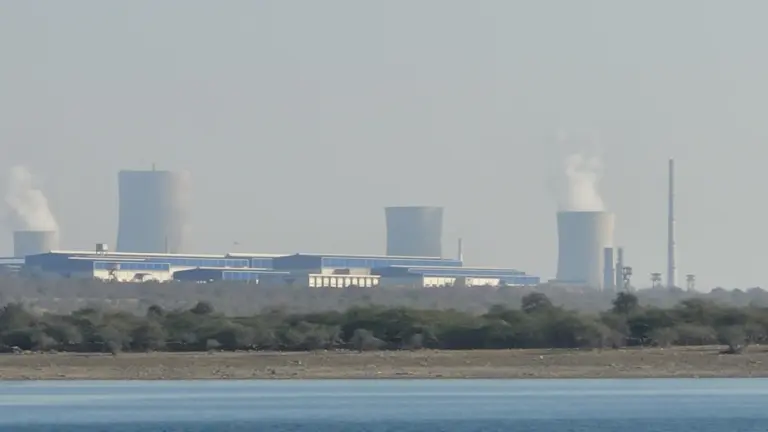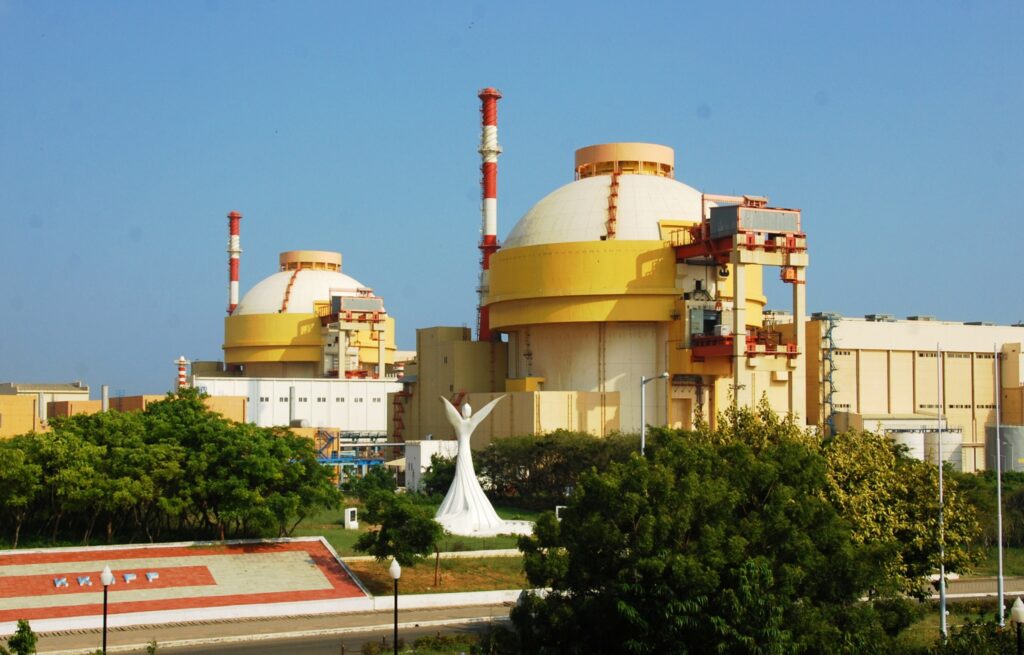
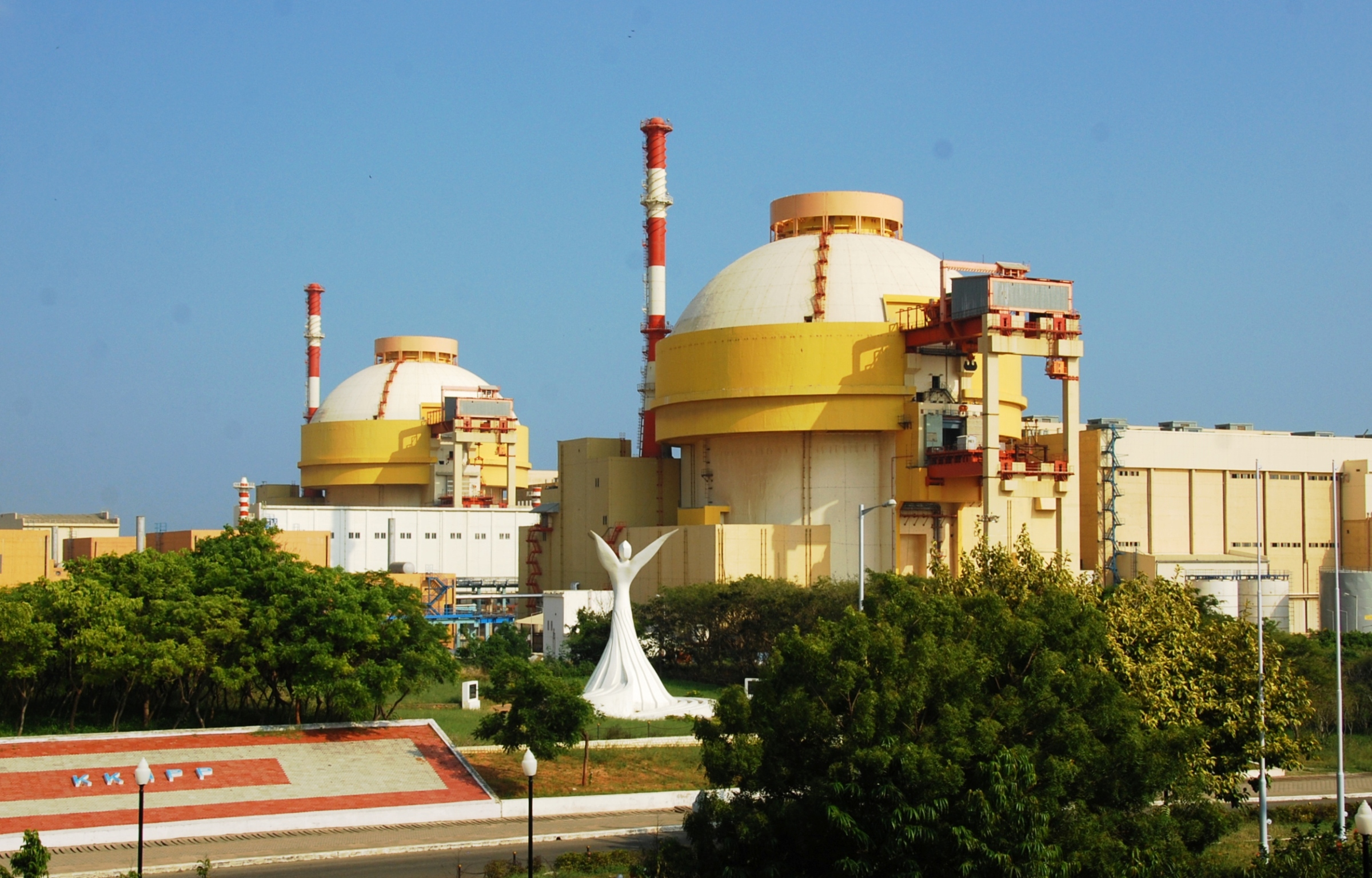
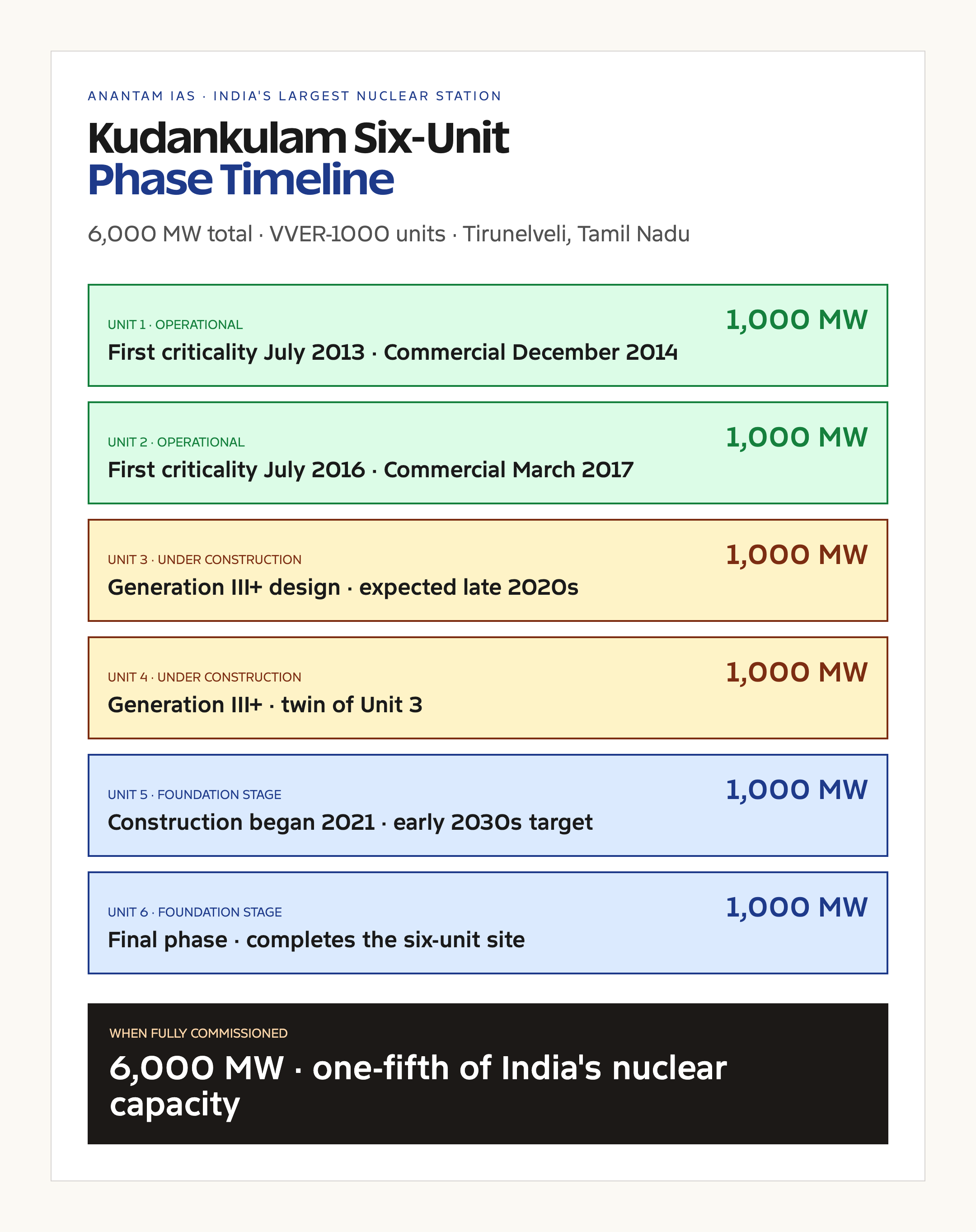
The Kudankulam Nuclear Power Plant in Tirunelveli district of Tamil Nadu is India’s largest nuclear station by planned capacity. Six VVER-1000 pressurised water reactors of 1,000 MW each are coming up on the site, for a total nameplate capacity of 6,000 MW. Units 1 and 2 are operational. Units 3 and 4 are under construction. Units 5 and 6 are at the foundation stage. When fully commissioned, the plant will contribute roughly one-fifth of India’s nuclear power capacity.
The project is the centrepiece of the India-Russia civil nuclear partnership. The original intergovernmental agreement was signed in 1988 between Rajiv Gandhi and Mikhail Gorbachev, but the project lay dormant after the Soviet Union dissolved. The agreement was revived in 1998. Construction of Units 1 and 2 began in 2002. Russia supplied the reactors, the fuel, the turbines, and the senior technical personnel. India built the civil structures, the cooling systems, and the auxiliary facilities. The plant was the first in India to use light water reactor technology at scale.
Kudankulam has been politically sensitive throughout. Local fishing communities protested against the plant from 2011 onwards, citing safety concerns after the Fukushima disaster. The Supreme Court cleared the plant in May 2013. The Civil Liability for Nuclear Damage Act of 2010 became a Russia-India sticking point because of its supplier-liability provisions. This explainer walks through what the plant is, how the VVER technology works, why it matters for India’s energy mix, and the unresolved tensions around expansion.
Quick Facts at a Glance
- Location: Kudankulam village, Radhapuram taluk, Tirunelveli district, Tamil Nadu
- Coordinates: Approximately 8.17 N, 77.71 E, on the Gulf of Mannar coast
- Total planned capacity: 6,000 MW (6 units of 1,000 MW each)
- Operator: Nuclear Power Corporation of India Limited (NPCIL)
- Reactor type: VVER-1000 (Water-Water Energetic Reactor, version 1000 MW), Generation III+ in later units
- Reactor supplier: Atomstroyexport (Russia, part of Rosatom State Corporation)
- Unit 1 commissioning: First criticality July 2013, commercial operation December 2014
- Unit 2 commissioning: First criticality July 2016, commercial operation March 2017
- Units 3 and 4: Under construction since 2017
- Units 5 and 6: Foundation stone laid 2017, construction ongoing
- Original 1988 agreement: Rajiv Gandhi – Mikhail Gorbachev intergovernmental agreement
- Project revival: 1998 supplementary agreement under Vajpayee-Yeltsin
- Estimated total cost: Around Rs 1.7 lakh crore for all six units in 2026 prices
- Construction workforce: Russia supplies roughly 1,000 technical specialists at peak; Indian workforce around 9,000
What Kudankulam Is and Why It’s Different
Most of India’s operating nuclear plants run Pressurised Heavy Water Reactors (PHWRs), an indigenous design derived from the Canadian CANDU. These reactors use natural uranium fuel and heavy water as both moderator and coolant. The PHWR family powers Tarapur Units 3 and 4, Rajasthan, Kakrapar, Kaiga, Madras, and Narora.
Kudankulam is different. It runs the VVER-1000, a Russian pressurised water reactor that uses enriched uranium (around 4 percent U-235) as fuel and ordinary light water as both moderator and coolant. The reactor is a sealed pressure vessel design, with vertical fuel assemblies and four primary coolant loops. The thermal power of each reactor is around 3,000 MW; the electrical output is 1,000 MW. The plant uses seawater for condenser cooling, drawn from the Gulf of Mannar.
The VVER design at Kudankulam is the AES-92 variant, which incorporates passive safety features developed in response to the Three Mile Island and Chernobyl experiences. Passive heat removal can keep the core cool for up to 24 hours without external power or operator action, using natural convection. A core catcher beneath the reactor vessel is designed to contain molten fuel in the event of a severe accident, preventing the China-syndrome scenario. The containment building is a double dome with a steel inner liner and a thick concrete outer shell, designed to withstand aircraft impact.
Background and Historical Context
The India-Soviet civil nuclear cooperation began with the original 1988 agreement during the late Cold War. The Soviet collapse and the early-1990s economic crisis put the project on hold. Russia inherited the agreement but lacked the financing. India lacked the political bandwidth to push it, especially after the 1998 nuclear tests at Pokhran-II, which triggered international sanctions.
The 1998 Vajpayee-Yeltsin supplementary agreement reactivated the project. Russia agreed to supply two reactors at favourable financing, with a credit line covering most of the cost. Construction at the Kudankulam site began on 31 March 2002. The project moved slowly through the 2000s because of design changes, supply-chain issues, and Russia’s own difficulties.
In 2011, the Fukushima disaster transformed the political environment. Local protests in the fishing villages around Kudankulam, particularly Idinthakarai, escalated. The People’s Movement Against Nuclear Energy (PMANE), led by S P Udayakumar, organised sit-ins and hunger strikes. The Tamil Nadu government temporarily withdrew support in late 2011. The Manmohan Singh government held firm. The Atomic Energy Regulatory Board cleared Unit 1 for fuel loading in mid-2012. The Supreme Court, in a writ petition challenging the plant, upheld the project on 6 May 2013, ruling that the Atomic Energy Regulatory Board (AERB) had followed due process.
Unit 1 attained first criticality on 13 July 2013. It was synchronised to the southern grid on 22 October 2013. Commercial operation began on 31 December 2014, with a delay of more than five years compared to the original schedule.
Unit 2 followed, with first criticality on 10 July 2016 and commercial operation on 31 March 2017.
Units 3, 4, 5, and 6 are being built under General Framework Agreements signed in 2008 and 2017. The construction has continued despite the Russia-Ukraine war and the associated sanctions, because the India-Russia civil nuclear cooperation has special carve-outs in the relevant US and EU export control regimes.
Key Features of the Kudankulam VVER-1000 Reactors
The Generation III+ design used in Units 3 to 6 incorporates several upgrades over Units 1 and 2.
Reactor pressure vessel. A welded steel vessel about 11 metres tall and 4.5 metres in inner diameter, with the reactor core inside. Operating pressure is around 157 bar and temperature around 320 degrees Celsius.
Fuel assemblies. Each reactor has 163 hexagonal fuel assemblies, each containing 311 fuel rods. The fuel is uranium dioxide enriched to roughly 4 percent U-235. The fuel cycle is 12 to 18 months between refuelling.
Primary circuit. Four loops, each with a steam generator and a primary coolant pump. Light water acts as both moderator and coolant.
Steam generators. Horizontal steam generators (a distinctive VVER feature; western pressurised water reactors use vertical generators). The horizontal layout simplifies maintenance but takes more floor space.
Safety systems. Active high-pressure injection, passive accumulator tanks, passive heat removal via natural convection, hydrogen recombiners to prevent explosions, core catcher, double containment.
Turbine and generator. Two-shaft turbo-generator from Power Machines (Russia), with cooling tower or seawater condenser. Kudankulam uses seawater.
Why Kudankulam Matters for India’s Energy Mix
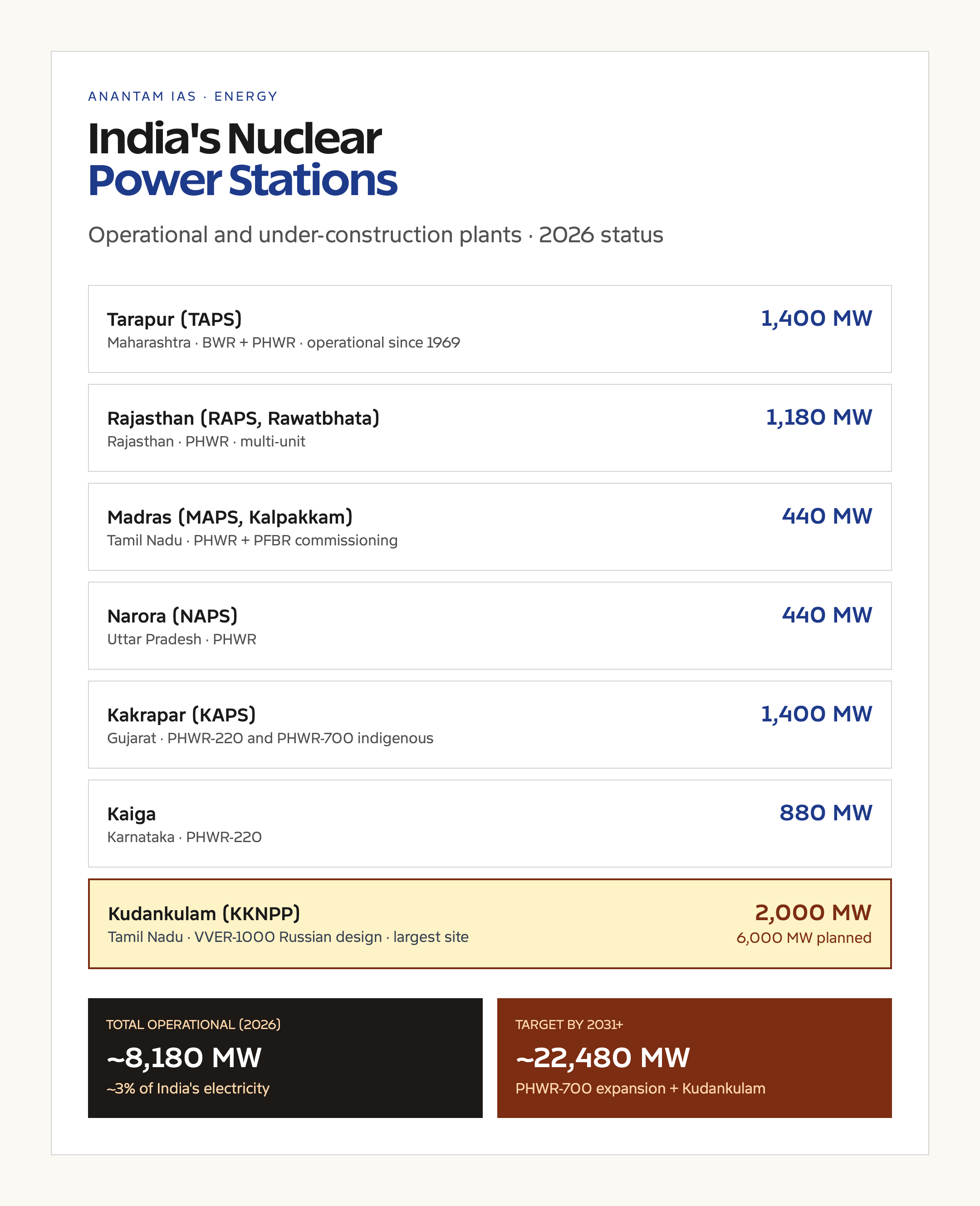
India’s nuclear energy programme has installed capacity of around 8,180 MW as of early 2026, contributing roughly 3 percent of national electricity generation. The official target under the three-stage Bhabha programme is to scale nuclear to around 22,480 MW by 2031 and beyond.
Kudankulam alone accounts for 2,000 MW operational and 4,000 MW under construction. When all six units are operational (expected by the early 2030s), the plant will be one-fifth of India’s nuclear capacity. The base load contribution to the southern grid will be significant. Tamil Nadu, Karnataka, Kerala, Andhra Pradesh, and Puducherry share Kudankulam’s output through the southern regional load dispatch centre.
The plant is also strategically important for India-Russia ties. Civil nuclear cooperation has been one of the most stable strands of the relationship through the 2010s and the Ukraine war years. The 2025 Modi-Putin summit reaffirmed the partnership and discussed additional Russian-design reactors at a possible second site (Haripur in West Bengal was earlier mentioned, then dropped after state government opposition; Andhra Pradesh’s Kovvada was reportedly under discussion).
For UPSC General Studies Paper 3, Kudankulam is a case study in technology import, energy security, supplier liability, public consultation, and federal coordination.
Detailed Analysis of the CLNDA Issue
The Civil Liability for Nuclear Damage Act 2010 (CLNDA) is the statutory framework for compensation in case of a nuclear accident in India. Its Section 17(b) gives the operator (NPCIL) a right of recourse against the supplier if the accident is caused by an act of the supplier or by patent or latent defects in equipment.
This provision is unique. The international Convention on Supplementary Compensation for Nuclear Damage (CSC), which India ratified in 2016, channels liability exclusively to the operator. Section 17(b) of the Indian Act departs from this norm. Russia objected. The American suppliers (Westinghouse, GE) cited the same provision as a reason for not signing reactor supply contracts for the Kovvada and Mithi Virdi projects.
The Indian government’s interpretation in a 2015 clarification was that Section 17(b) provides a right but not an obligation, and that NPCIL could waive the right contractually. The Atomic Energy Regulatory Board issued guidelines on supplier indemnity. The India Nuclear Insurance Pool, with an initial corpus of Rs 1,500 crore, was set up to cover supplier liability.
Kudankulam Units 1 and 2 predate the CLNDA. Units 3 to 6 were signed under General Framework Agreements that include indemnity clauses negotiated with Russia. The exact contractual terms are not public.
Comparative View: Kudankulam in India’s Nuclear Landscape
| Plant | State | Reactor Type | Capacity | Status |
|---|---|---|---|---|
| Tarapur | Maharashtra | BWR + PHWR | 1,400 MW | Operational |
| Rajasthan (Rawatbhata) | Rajasthan | PHWR | 1,180 MW | Operational |
| Kalpakkam (MAPS) | Tamil Nadu | PHWR | 440 MW | Operational |
| Narora | Uttar Pradesh | PHWR | 440 MW | Operational |
| Kakrapar | Gujarat | PHWR | 1,400 MW | Operational |
| Kaiga | Karnataka | PHWR | 880 MW | Operational |
| Kudankulam | Tamil Nadu | VVER-1000 | 2,000 MW now, 6,000 MW planned | Operational + under construction |
| GHAVP (Gorakhpur) | Haryana | PHWR-700 | 2,800 MW planned | Construction |
| Mahi Banswara | Rajasthan | PHWR-700 | 2,800 MW planned | Sanctioned |
The PHWR-700 indigenous design (used in Kakrapar 3 and 4 and planned for Mahi Banswara, Gorakhpur, Chutka, and Kaiga 5 and 6) is the workhorse of India’s expansion. Kudankulam’s VVER imports complement this by adding high-capacity base load through a proven foreign design.
Challenges That Persist
Cost and time overruns. Unit 1 was originally scheduled for 2007. Commercial operation came in 2014, a slip of seven years. Unit 2 slipped by a similar margin. Units 3 to 6 are likely to slip as well, partly because of pandemic-era delays and partly because of Russian supply-chain stress during the Ukraine war.
Local opposition. The protests of 2011 to 2013 were intense and persistent. They have subsided since the plant became operational, but the underlying issues (loss of fishing access, fear of radiation, demand for local employment) remain. The Tamil Nadu government’s stance has shifted with political cycles.
Cooling water and marine ecology. The plant draws and discharges large volumes of seawater. Thermal discharge effects on the Gulf of Mannar Marine Biosphere Reserve, one of India’s first biosphere reserves, have been studied with mixed conclusions.
Spent fuel and waste. The plant’s spent fuel is currently stored on site in cooling pools. India’s reprocessing capacity is limited. The longer-term solution depends on the closed fuel cycle that the three-stage programme envisages, but the timeline is uncertain.
Geopolitical risk. The dependence on Russian fuel supply and technical expertise leaves a strategic vulnerability. India has been diversifying nuclear partnerships (with France for Jaitapur, talks with the US, and now small modular reactors), but Kudankulam remains a single-vendor relationship.
Prelims Pointers
- Kudankulam Nuclear Power Plant is in Tirunelveli district, Tamil Nadu, on the Gulf of Mannar coast.
- The reactor type is the VVER-1000, a Russian pressurised water reactor.
- Total planned capacity is 6 units of 1,000 MW each, totalling 6,000 MW.
- The plant operator is Nuclear Power Corporation of India Limited (NPCIL).
- The reactor supplier is Atomstroyexport (Rosatom, Russia).
- The original intergovernmental agreement was signed in 1988 between Rajiv Gandhi and Mikhail Gorbachev.
- The project was revived in 1998 under the Vajpayee-Yeltsin supplementary agreement.
- Unit 1 commercial operation began on 31 December 2014; Unit 2 on 31 March 2017.
- The Supreme Court cleared the plant in May 2013.
- The Civil Liability for Nuclear Damage Act 2010 Section 17(b) gives the operator a right of recourse against the supplier, a unique feature internationally.
- The Atomic Energy Regulatory Board (AERB) is the safety regulator.
- The Department of Atomic Energy (DAE) is the nodal department.
Mains Practice Questions
- “The Kudankulam Nuclear Power Plant is both an energy project and a foreign-policy instrument.” Discuss this proposition with reference to the India-Russia civil nuclear partnership. (GS Paper 2 / Paper 3, International Relations and Energy, 250 words)
- Examine the Civil Liability for Nuclear Damage Act 2010 in the light of supplier liability. How has its Section 17(b) shaped India’s nuclear procurement? (GS Paper 3, Internal Security and Energy, 250 words)
- The 2011 protests against the Kudankulam plant raised questions about public consultation and environmental impact assessment. Discuss the lessons for India’s nuclear expansion. (GS Paper 3, Environmental Governance, 250 words)
- Compare the VVER-1000 reactor at Kudankulam with the indigenous PHWR-700 used at Kakrapar. What is the strategic value of running both technology streams? (GS Paper 3, Science and Technology, 150 words)
Way Forward
Kudankulam will reach full 6,000 MW capacity sometime in the early 2030s if Units 3 to 6 stay on revised schedules. Beyond that, several questions need clarity.
First, the next Russian site. A second VVER cluster has been discussed at Kovvada in Andhra Pradesh (originally a US site that fell through) or at another coastal location. A decision is pending.
Second, the fuel-cycle question. India’s three-stage programme requires fast breeder reactors and thorium reactors. The Prototype Fast Breeder Reactor at Kalpakkam is still in commissioning. Kudankulam’s enriched uranium dependence will continue indefinitely; the strategic alternative is the indigenous PHWR-700 line.
Third, the regulatory upgrade. The Atomic Energy Regulatory Board is not yet a statutory body independent of the Department of Atomic Energy. The Nuclear Safety Regulatory Authority Bill, drafted in 2011, has not moved. Independence of the regulator is a long-pending reform that the IAEA has repeatedly recommended.
Fourth, community benefits. The fishing communities around Kudankulam see only marginal direct benefit from the plant. Skill development, alternative livelihoods, and revenue sharing are all areas where the policy framework is thin.
The plant has shifted from a politically contested project to an established part of the southern grid. The next decade will determine whether it scales to its full design and whether the model can be replicated at a second Indian site.
Frequently Asked Questions
Where is the Kudankulam Nuclear Power Plant located?
In Kudankulam village, Radhapuram taluk, Tirunelveli district, Tamil Nadu, on the Gulf of Mannar coast about 25 km from the Sri Lankan coast.
Who operates the Kudankulam Nuclear Power Plant?
The Nuclear Power Corporation of India Limited (NPCIL), a public sector undertaking under the Department of Atomic Energy.
What reactor technology does Kudankulam use?
The VVER-1000, a Russian pressurised water reactor supplied by Atomstroyexport (part of Rosatom). Units 3 to 6 use a Generation III+ variant with enhanced passive safety features.
How many units are operational at Kudankulam?
Two units of 1,000 MW each. Unit 1 has been operational since December 2014 and Unit 2 since March 2017. Units 3 to 6 are under various stages of construction.
Why was Kudankulam controversial?
Local fishing communities in Idinthakarai and surrounding villages protested from 2011, with concerns about safety after the Fukushima disaster, fishing access, and emergency planning. The Supreme Court cleared the plant in May 2013 after a writ petition.
What is the role of the Civil Liability for Nuclear Damage Act 2010 in Kudankulam?
The Act’s Section 17(b) gives the operator a right of recourse against the supplier in case of an accident. This is uncommon internationally. Russia raised concerns, and Indian government clarifications since 2015 have provided contractual flexibility.
When will Kudankulam reach full 6,000 MW capacity?
Units 3 and 4 are expected to come online by the late 2020s. Units 5 and 6 are likely to follow in the early 2030s. The exact dates depend on construction progress and supply-chain conditions.
How does VVER differ from PHWR?
The VVER uses enriched uranium fuel and light water as both moderator and coolant in a pressurised vessel. The PHWR uses natural uranium fuel and heavy water in pressure tubes. VVER reactors are typically larger (1,000 MW or more) than the Indian PHWR-700.
Is Kudankulam fuel sourced from Russia?
Yes. The enriched uranium fuel assemblies are manufactured in Russia and shipped to India under the bilateral agreement. India does not enrich uranium domestically for power reactors at commercial scale.
What happens to spent fuel at Kudankulam?
Spent fuel is initially stored in cooling pools at the plant site. Long-term management is part of India’s closed nuclear fuel cycle, with reprocessing planned at central facilities. As of 2026, the operational arrangements are still being scaled up.
Tell Google you want more of this.
Add Anantam IAS as a preferred sourceOne tap, and this site shows up more often in your own Top Stories, AI Overviews and AI Mode. Remove it any time.