India’s Steel Sector in Q1 FY26: Production Up, Prices Soften, Consumption Surges
Why in News?
The Ministry of Steel released its monthly performance summary on 6 July 2026, and PIB confirmed that India’s steel sector recorded growth across production, consumption and trade in Q1 FY26 (April–June 2026). The figures are provisional Joint Plant Committee (JPC) data — the official statistics for the iron and steel industry.
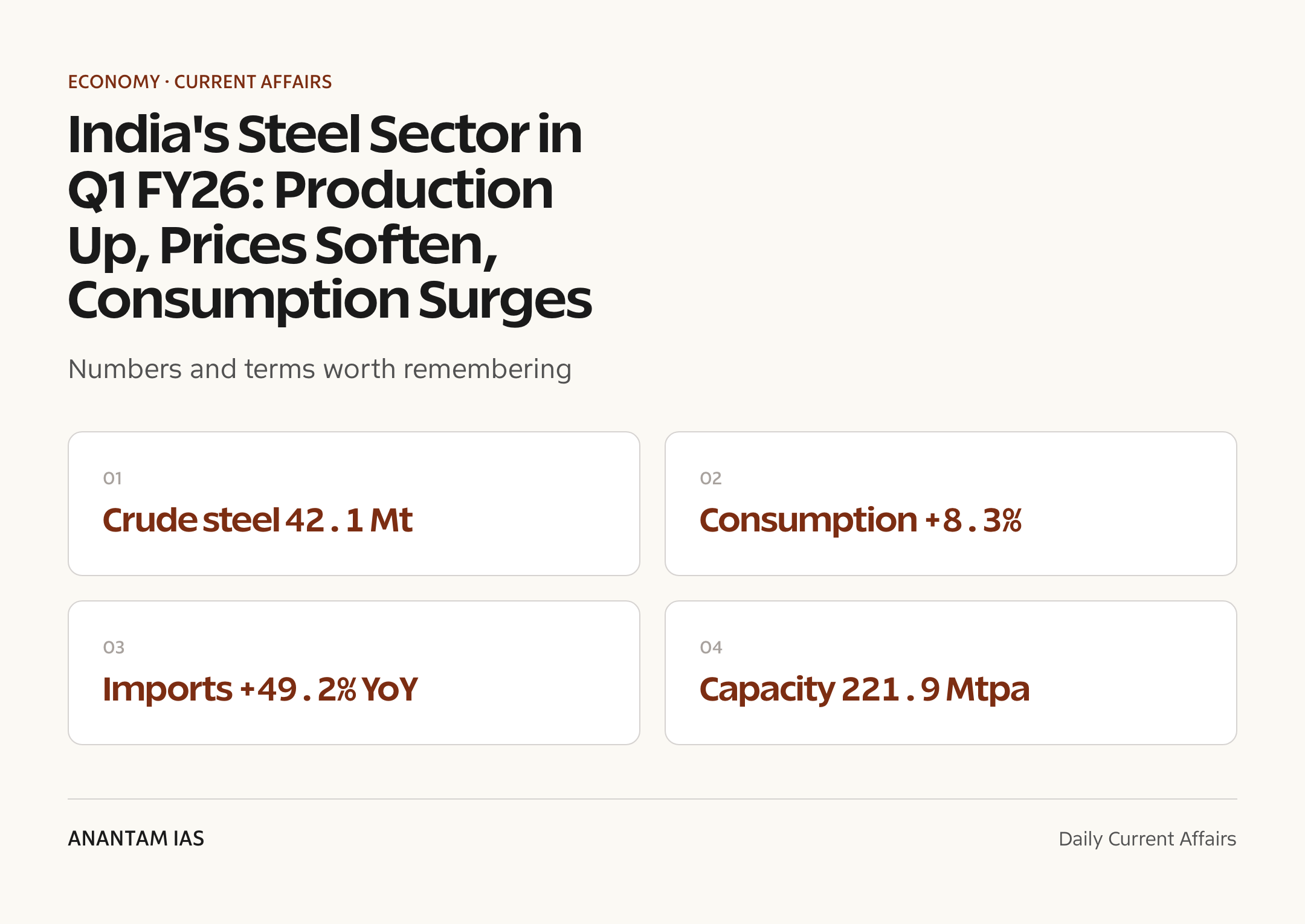
Crude steel production rose 3.0% year-on-year to 42.1 million tonnes (Mt), finished steel consumption jumped 8.3% to 41.6 Mt, and benchmark prices softened month-on-month even as imports surged nearly 50%. India remained a net importer of finished steel for the quarter.
- Crude steel: 42.1 Mt in April–June 2026, up 3.0% over the corresponding period last year; June alone stood at 14.1 Mt (+3.9% YoY).
- Finished steel production reached 41.0 Mt (+5.9%), while finished steel consumption hit 41.6 Mt (+8.3%) — demand grew faster than output.
- Prices eased in June: TMT bars (10 mm) averaged ₹60,068/tonne (−4.7% month-on-month); HR coil at ₹70,108/tonne (−0.5% MoM) but still +11.2% YoY.
- Trade: finished steel imports touched 2.06 Mt (+49.2%) against exports of 1.59 Mt (+31.4%) — India stayed a net importer in quantity terms.
The development matters in the context of:
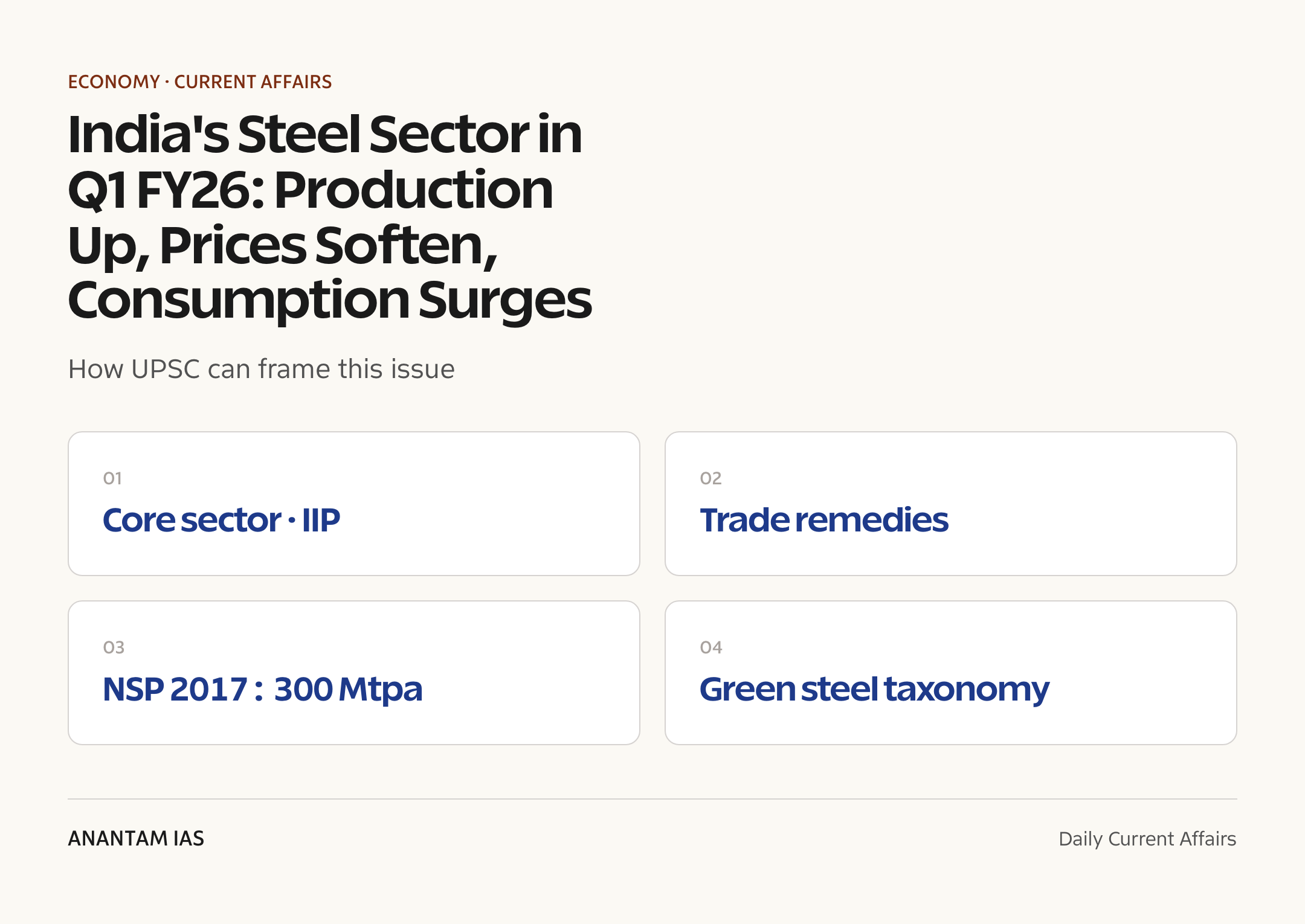
- Steel is one of the eight core industries, so this dataset is direct evidence for questions on industrial growth, IIP trends and infrastructure-led demand.
- The import surge sits behind live policy action — a fresh DGTR anti-dumping investigation into hot-rolled flat steel from China, Japan and Russia — making this a ready case study on trade remedies.
UPSC Relevance
Prelims Relevance
- Steel is one of the eight core industries, with about a 17.92% weight in the Index of Eight Core Industries (ICI) — behind only refinery products and electricity.
- The eight core industries together carry a 40.27% weight in the Index of Industrial Production (IIP).
- The Joint Plant Committee (JPC), under the Ministry of Steel, is the only body officially empowered to collect data on the Indian iron and steel industry.
- India has been the world’s second-largest crude steel producer since 2018, behind China; it is also the second-largest consumer of finished steel.
- Q1 FY26 scorecard: crude steel 42.1 Mt (+3.0%), finished steel consumption 41.6 Mt (+8.3%), India a net importer in quantity terms.
- National Steel Policy 2017 targets: 300 Mtpa crude steel capacity and 160 kg per-capita finished steel consumption by 2030-31.
- PLI Scheme for Specialty Steel (2021): ₹6,322 crore outlay across five product categories; PLI 1.1 launched in January 2025.
- SAIL supplied all 5,700 tonnes of special steel for three new Indian Navy vessels — INS Dunagiri, INS Agray and INS Sanshodhak.
Mains Relevance
GS Paper 3
- Steel as a lead indicator of infrastructure-led growth — consumption rising 8.3% signals construction and capital-expenditure momentum in the wider economy.
- Trade policy design: weighing anti-dumping and safeguard duties against cost pressures on steel-using industries such as construction, autos and MSME fabricators.
- Decarbonising a hard-to-abate sector: the green steel taxonomy, plant-level CO₂ dashboards and the challenge of carbon border measures like CBAM.
GS Paper 2
- Government policies and interventions for industrial development — National Steel Policy 2017, PLI for specialty steel and CPSE autonomy (Miniratna status) as instruments of state capacity.
Essay
- Infrastructure as the engine of development — steel demand as the measurable footprint of nation-building.
- Growth versus climate: can a late industrialiser build big and build green at the same time?
Background and Context
Steel as a Core Sector: Why One Monthly Release Matters
Steel data is a proxy for the wider economy, which is why examiners keep returning to it.
- Steel is one of the eight core industries, carrying about a 17.92% weight in the Index of Eight Core Industries (ICI) — third after refinery products and electricity; the eight together hold 40.27% of the IIP.
- All figures are provisional Joint Plant Committee (JPC) data for June 2026 — the JPC is the sole official agency for iron and steel statistics under the Ministry of Steel.
- India has been the world’s second-largest crude steel producer since 2018, when it overtook Japan, and is second only to China in finished steel consumption.
- Steel demand tracks construction, railways, defence and capital goods, so a consumption spike signals an infrastructure-led investment cycle in the broader manufacturing sector.
The Q1 FY26 Production Scorecard
PIB’s headline tables show growth across the value chain, with finished steel outpacing crude.
- Crude steel: 42.1 Mt against 40.8 Mt a year earlier (+3.0%); June output was 14.1 Mt (+3.9% YoY).
- Hot metal — molten iron tapped from blast furnaces — grew 1.4% to 23.5 Mt; finished steel production rose 5.9% to 41.0 Mt.
- The top 7 producers — SAIL, RINL, NSL, TSL Group, AM/NS, JSL(JSPL) and JSW Group — made 23.2 Mt of crude steel, roughly 55% of the total.
- The public sector share was 15.7% of crude steel but 30.4% of hot metal — a marker of the PSU fleet’s blast-furnace-heavy route.
- Capacity held at 221.9 Mtpa against the National Steel Policy’s 300 Mtpa goal; JSW Group began building a 2 MTPA integrated plant at Kadapa, Andhra Pradesh.
- Upstream, NMDC produced 5.15 Mt of iron ore in June (up 44% YoY), taking Q1 output to 15.10 Mt despite the monsoon.
Demand and Prices: Consumption Outpaces Output
The demand side is the strongest signal in this release.
- Finished steel consumption reached 41.6 Mt, up 8.3% over the corresponding period last year; June alone was 14.2 Mt (+7.2%).
- Consumption growth (8.3%) ran ahead of finished-production growth (5.9%) — a gap bridged largely by imports.
- All four benchmark products got cheaper month-on-month in June: TMT (10 mm) at ₹60,068/tonne (−4.7%), HR coil at ₹70,108 (−0.5%), CR coil at ₹77,053 (−1.1%) and GP sheet at ₹86,505 (−2.8%).
- Year-on-year, though, every product was costlier — GP sheet +15.8%, HR coil +11.2%, TMT +4.4% — so June’s softening is a monthly correction, not a slump. Prices are GST-inclusive averages across four metros.
- Raw materials were mixed: NMDC Bailadila iron ore lump rose 3.6% MoM to ₹5,700/tonne, while MOIL manganese ore fell 5.0% and HMS-II scrap fell 4.4%.
- Market signals stayed constructive: the Nifty Metal Index averaged 12,971.9 in June (+39.3% YoY) and the PMI Manufacturing read 54.2 (above 50 = expansion).
Trade Dynamics: The Import Surge and Trade Remedies
Trade is where the stress shows — imports rose faster than exports and India stayed a net buyer.
- Imports of finished steel hit 2,063.9 thousand tonnes, up 49.2%, worth ₹20,214.5 crore; June alone jumped 57.9% YoY.
- Exports grew a slower 31.4% to 1,592.8 thousand tonnes — PIB states India was a net importer of finished steel in quantity terms for the quarter.
- In response, the DGTR (Directorate General of Trade Remedies, Ministry of Commerce and Industry) initiated an anti-dumping investigation into hot-rolled flat steel imports from China, Japan and Russia.
- Concept check: an anti-dumping duty targets goods priced below normal value from specific countries; a safeguard duty targets an import surge from all sources; a countervailing duty offsets foreign subsidies.
- India imposed a 12% safeguard duty on certain flat-steel products in 2025 after a similar surge, so the new probe extends an established trade-defence playbook.
- The Steel Import Monitoring System (SIMS), running since 2019, requires advance registration of steel imports — the government’s early-warning radar.
- The GS3 trade-off to argue: duties shield producers but raise input costs for steel-using MSMEs, construction and automakers — protection is never free.
Policy Framework: NSP 2017, PLI and the Institutional Push
The durable syllabus behind this data is the policy stack that steers capacity, quality and self-reliance.
- National Steel Policy 2017: 300 Mtpa crude capacity, 255 Mt production and 160 kg per-capita consumption by 2030-31; current capacity of 221.9 Mtpa shows the distance left.
- The PLI Scheme for Specialty Steel (2021, ₹6,322 crore) incentivises five value-added categories, from coated products to electrical steel; PLI 1.1 opened in January 2025.
- The DMI&SP policy gives preference to domestic iron and steel in government procurement; the Steel Scrap Recycling Policy 2019 formalises the scrap ecosystem.
- PIB highlighted a Chintan Shivir on Digitalisation in the Steel Sector (24 June 2026), pushing AI, automation, digital mining and predictive maintenance.
- MECON Limited received Miniratna Category-I status — such CPSEs can invest up to ₹500 crore or their net worth, whichever is lower, without government approval.
- Import substitution in defence steel: SAIL supplied all 5,700 tonnes of special steel for INS Dunagiri, INS Agray and INS Sanshodhak — a self-reliance data point that pairs with the National Manufacturing Mission.
Green Steel: Decarbonising a Hard-to-Abate Sector
Steel’s carbon intensity is now a first-order policy question, and this release flags the early institutional responses.
- Iron and steel account for roughly 10–12% of India’s CO₂ emissions (about 7–8% globally), making the sector central to any net-zero pathway.
- India’s Green Steel Taxonomy (December 2024) defines green steel by emission intensity below 2.2 tCO₂e per tonne of finished steel, with star ratings — five-star for under 1.6.
- SAIL’s Rourkela Steel Plant launched a first-of-its-kind CO₂ Dashboard with 100% ERP-SAP data integration to track decarbonisation.
- Hydrogen-based DRI (direct reduced iron) is the long-term technology bet: steel is a named focus sector of the National Green Hydrogen Mission.
- The external pressure is real: the EU’s Carbon Border Adjustment Mechanism (CBAM) starts pricing the embedded carbon of steel imports from 2026, directly hitting Indian exporters.
Way Forward
Calibrate trade defence
- Conclude the DGTR hot-rolled steel probe on evidence and on schedule; prefer targeted, time-limited duties over blanket protection.
- Use SIMS data as a genuine early-warning system, and track the cost pass-through to steel-using MSMEs before extending any measure.
Close the capacity and raw-material gap
- Bridging 221.9 to 300 Mtpa needs faster brownfield expansion plus greenfield clusters like Kadapa, supported by logistics planning under PM Gati Shakti.
- Reduce dependence on imported coking coal (around 85% of requirement) through beneficiation, blending and scrap-based capacity under the Steel Scrap Recycling Policy 2019.
Make the growth green
- Operationalise the green steel taxonomy through green public procurement of star-rated steel in government projects.
- Scale hydrogen-DRI pilots under the National Green Hydrogen Mission and replicate plant-level CO₂ dashboards, so exporters are CBAM-ready by design.
Conclusion
Q1 FY26 is a good-news release with one caveat. Demand is the standout — consumption growing 8.3% is unambiguous evidence of an infrastructure and construction upcycle. But output grew only 3%, and the near-50% import surge shows domestic supply is not yet meeting that demand at competitive prices.
For the exam, memorise the direction rather than the decimals: production up, consumption up faster, prices softening month-on-month, India a net importer, capacity at 221.9 Mtpa against the 300 Mtpa target — and the policy stack (NSP 2017, PLI, trade remedies, green steel taxonomy) that hangs off these numbers.
UPSC Practice Questions
Prelims MCQ 1
With reference to India’s steel sector data for Q1 FY26 (April–June 2026), consider the following statements:
- Crude steel production grew year-on-year, while finished steel consumption grew faster than crude steel production.
- India was a net exporter of finished steel in quantity terms during the quarter.
- The official data on the Indian iron and steel industry is collected by the Joint Plant Committee under the Ministry of Steel.
How many of the above statements are correct?
(a) Only one (b) Only two (c) All three (d) None
Answer: (b) Only two
Explanation:
Statements 1 and 3 are correct: crude output rose 3.0% while consumption rose 8.3%, and the JPC is the sole official data agency. Statement 2 is wrong — India was a net IMPORTER of finished steel in quantity terms.
Prelims MCQ 2
Which of the following best describes the difference between an anti-dumping duty and a safeguard duty?
(a) An anti-dumping duty applies to all imports of a product, while a safeguard duty targets specific countries (b) An anti-dumping duty counters below-normal-value pricing from specific countries, while a safeguard duty counters an import surge from all sources (c) An anti-dumping duty is imposed by the WTO, while a safeguard duty is imposed by the importing country (d) Both duties require proof that the exporting government subsidised the product
Answer: (b) An anti-dumping duty counters below-normal-value pricing from specific countries, while a safeguard duty counters an import surge from all sources
Explanation:
Anti-dumping duties are country-specific remedies against dumping; safeguard duties respond to import surges irrespective of pricing. Subsidies are countered by countervailing duties. DGTR investigates and recommends; the Department of Revenue notifies.
UPSC Mains Questions
- India’s finished steel consumption grew 8.3% in Q1 FY26 even as finished steel imports surged nearly 50%. Examine the factors driving steel demand in India and evaluate how far trade remedies can protect domestic producers without raising costs for steel-using industries.
- The National Steel Policy 2017 targets 300 Mtpa of crude steel capacity by 2030-31, while current capacity stands at about 222 Mtpa. Discuss the raw-material, financing and carbon-intensity constraints on this target and suggest policy measures to overcome them.
- Steel is among the hardest industrial sectors to decarbonise. Discuss how India’s green steel taxonomy and the National Green Hydrogen Mission can align steel-capacity expansion with the net-zero commitment, in the context of carbon border measures such as the EU’s CBAM.
Source: PIB, Ministry of Steel.
Frequently Asked Questions
How did India’s steel sector perform in Q1 FY26?
Per provisional JPC data released by PIB, crude steel production rose 3.0% year-on-year to 42.1 million tonnes in April–June 2026, finished steel production rose 5.9% to 41.0 Mt, and consumption grew 8.3% to 41.6 Mt. Prices softened month-on-month in June, and India remained a net importer of finished steel.
Why is steel called a core sector industry?
Steel is one of the eight core industries, holding roughly a 17.92% weight in the Index of Eight Core Industries. The eight together carry a 40.27% weight in the Index of Industrial Production, so steel output directly moves India’s headline industrial-growth numbers and signals infrastructure activity.
What is the Joint Plant Committee?
The Joint Plant Committee (JPC) is the only body officially empowered to collect data on India’s iron and steel industry. It functions under the Ministry of Steel, and its provisional monthly figures — like the June 2026 numbers in this release — form the sector’s official statistical record.
Is India a net importer or exporter of steel?
For April–June 2026, India was a net importer of finished steel in quantity terms. Imports rose 49.2% to about 2.06 million tonnes while exports grew 31.4% to about 1.59 million tonnes. The surge has triggered a DGTR anti-dumping probe into hot-rolled flat steel from China, Japan and Russia.
What counts as green steel in India?
Under the Green Steel Taxonomy released in December 2024, steel earns a green star rating if its emission intensity is below 2.2 tonnes of CO₂ equivalent per tonne of finished steel, with five-star status under 1.6. The framework enables green public procurement and prepares exporters for measures like CBAM.