

CBAM is easy to dismiss as green protectionism, and there is truth in that charge. But it would be a mistake to stop there. The EU’s carbon border rule is also a signal that future trade will price carbon intensity, documentation and verification. India can object to unfairness, but it cannot afford to be unprepared.
The Issue, Framed
The issue is not whether climate policy should enter trade. It already has. The issue is who writes the rules, who pays the transition cost, and whether developing economies get punished for industrialising later. CBAM sits exactly at that uncomfortable intersection.
For UPSC, this is a high-value topic because it joins GS3 environment, GS3 economy and GS2 international relations. It is about carbon markets, industrial policy, WTO rules, climate justice, export competitiveness and technology access. A flat answer calling CBAM either good or bad will miss the exam-worthy tension.
My stance is balanced but firm: India should resist discriminatory design and defend equity, but it should also treat CBAM as a rehearsal for a lower-carbon export economy. The worst response would be moral outrage without measurement capacity.
What the Data Says
The European Commission CBAM page says the mechanism is meant to put a fair price on carbon emitted during production of carbon-intensive goods entering the EU. The transitional phase began on 1 October 2023 and runs until 31 December 2025, with reporting obligations but no financial adjustment.
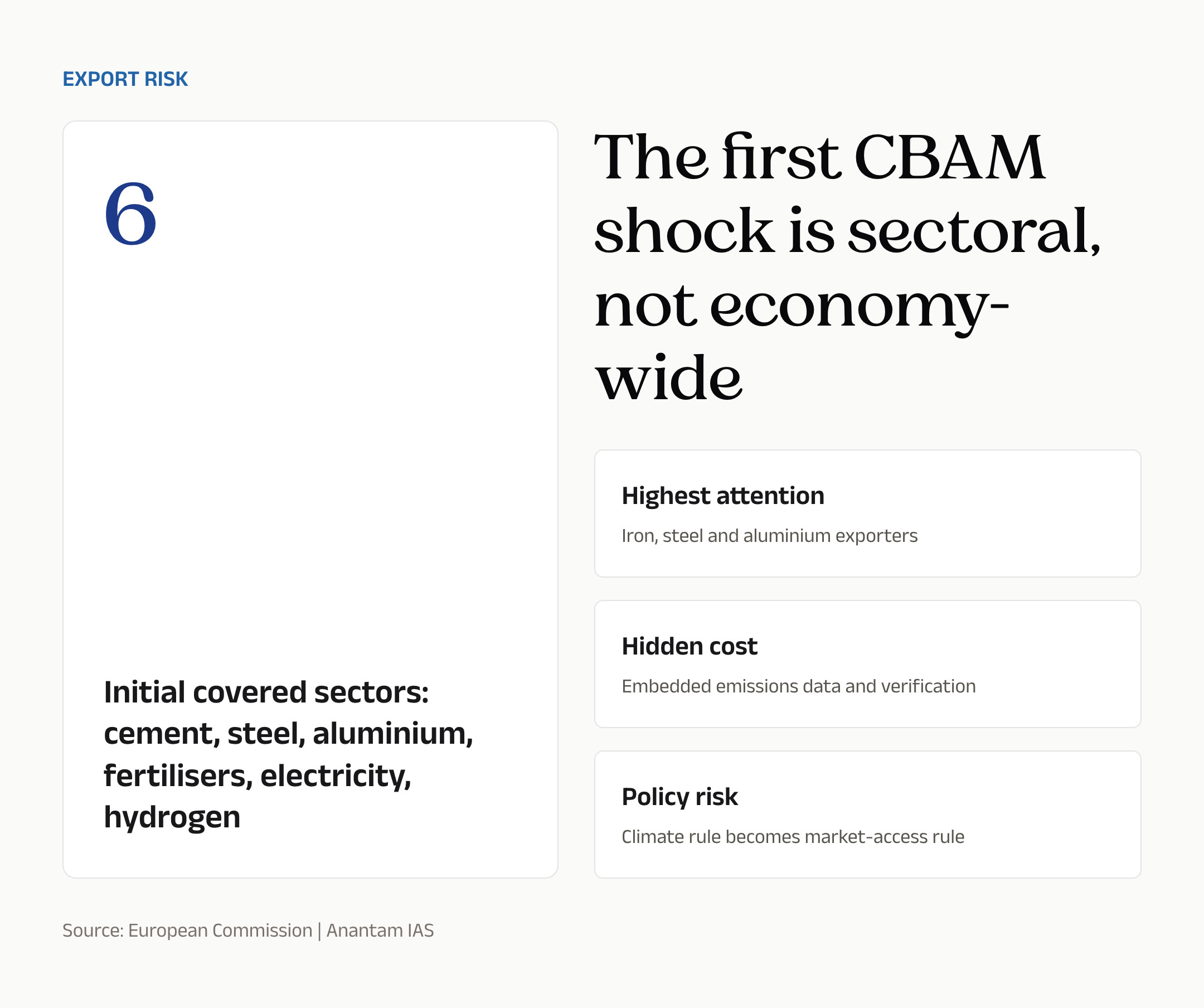
The definitive phase begins from 2026. The initial sectors are cement, iron and steel, aluminium, fertilisers, electricity and hydrogen. That sector list matters because it targets foundational materials, not luxury goods. It is aimed at the carbon spine of industrialisation.
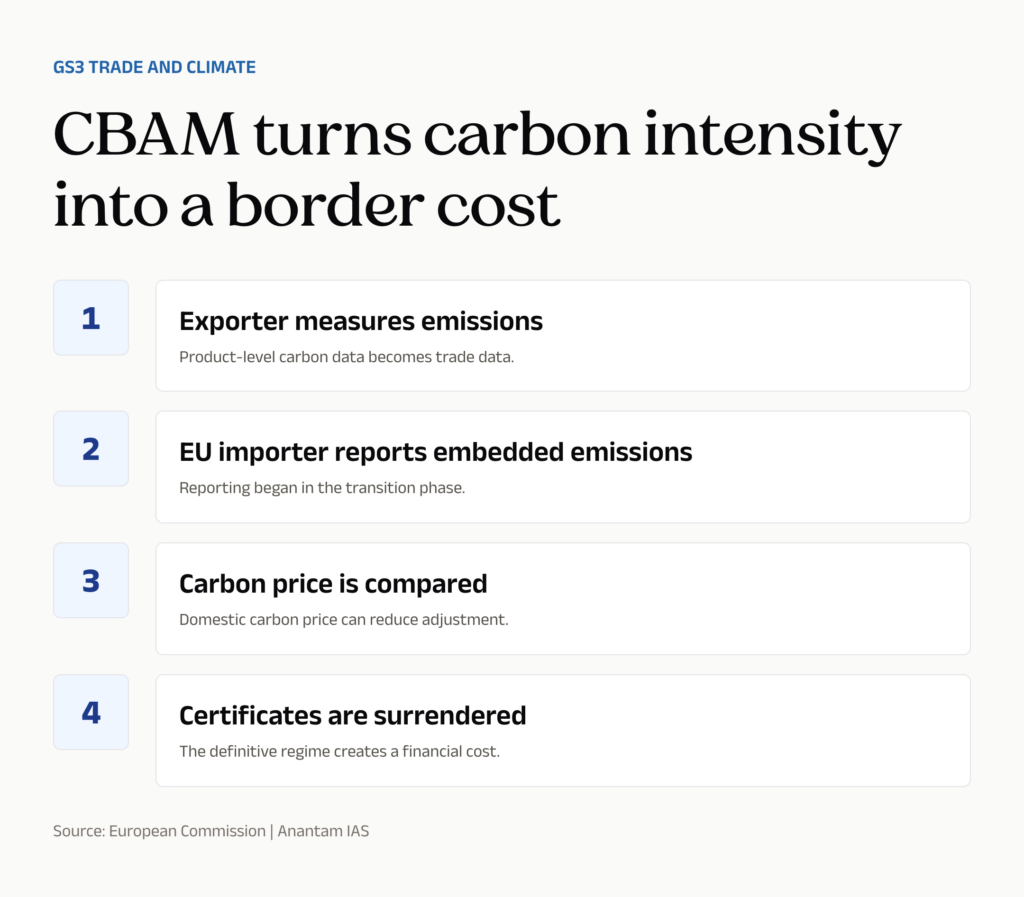
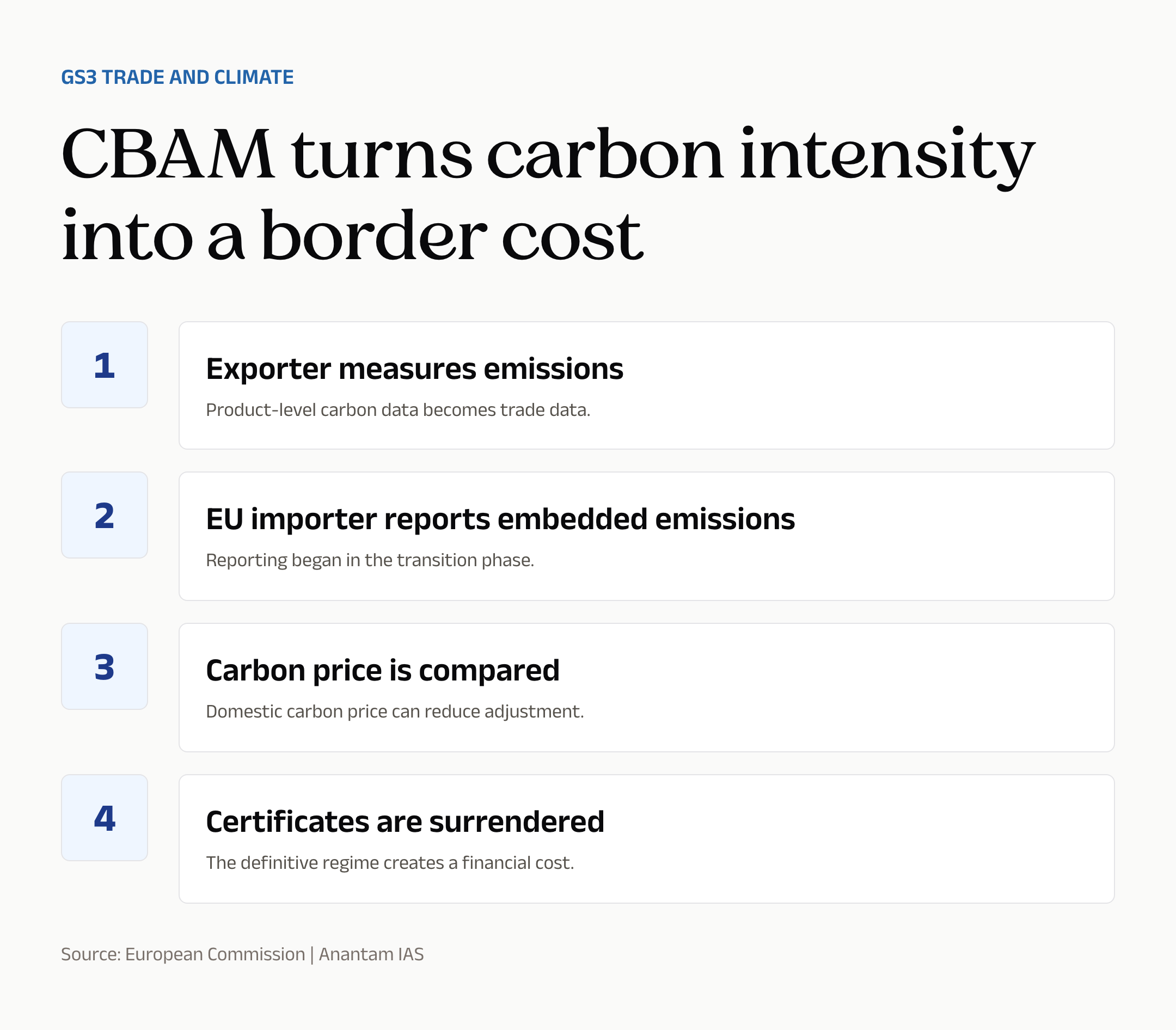
The mechanism works through embedded emissions. EU importers will surrender CBAM certificates linked to the EU Emissions Trading System price, with adjustment for any carbon price already paid in the exporting country. In practice, this rewards firms that can measure, verify and reduce emissions.
The Indian Express explainer rightly frames the risk for Indian metal exports. The immediate issue is not only carbon intensity. It is also whether Indian exporters, especially smaller firms in supply chains, can produce credible product-level emissions data.
The Case For
The case for CBAM is that climate policy cannot ignore carbon leakage. If a region prices carbon domestically but imports cheaper carbon-intensive goods from countries with looser rules, emissions do not fall. They move. A border adjustment tries to protect the environmental integrity of domestic carbon pricing.
It can also push global industry toward cleaner production. Steel, cement and aluminium are hard-to-abate sectors. A price signal at the border tells firms that emissions intensity will affect market access. That can accelerate investment in efficient processes, scrap use, clean power and eventually green hydrogen.
There is a governance gain too. CBAM forces measurement. Once firms measure embedded emissions, governments can design better industrial policy. You cannot decarbonise what you cannot measure.
The Case Against
The case against CBAM is that it transfers the burden of rich-country climate ambition onto developing-country exporters. Europe industrialised using high-carbon pathways, built wealth, and now writes rules that can make late industrialisation more expensive for others. That is why the climate justice objection is not rhetorical. It is rooted in history.
CBAM may also become industrial policy wearing a climate coat. If the rule protects European producers while poorer exporters struggle with technology costs and reporting complexity, it can function as a non-tariff barrier. The more complex the MRV system, the more it favours large firms with compliance departments.
There is another problem: revenue. If CBAM revenues stay largely with the importing jurisdiction instead of supporting decarbonisation in exporting countries, the fairness argument weakens. A climate tool that raises money from developing-world exports without financing their transition will invite resistance.
The Deeper Structural Read
The deeper structural read is that climate competitiveness is becoming a new layer of trade competitiveness. Earlier, exporters competed on price, quality, scale and logistics. Now they will increasingly compete on carbon data, clean power access and verification credibility.
This is uncomfortable for India because some of our competitive sectors are energy-intensive. Steel, aluminium and cement cannot decarbonise overnight. Their transition needs electricity reform, scrap systems, process efficiency, green hydrogen, carbon capture debates, and long-term finance. None of that fits neatly into a one-year export-support package.
But denial is not a strategy. If India argues only that CBAM is unfair, it may win sympathy but lose markets. If it treats CBAM as a signal, it can build domestic systems that help exporters in the EU and beyond. Other markets may create similar rules. The first mover will shape standards; the late mover will fill forms.
The central policy question is whether India can convert a defensive trade challenge into an industrial upgrading agenda. That means credible MRV, cleaner electricity for industry, and finance for firms that cannot carry transition costs alone.
This is also where the Mains answer should avoid a lazy North-South frame. Equity is essential, but equity does not mean India should remain measurement-poor. A steel exporter who can prove lower emissions will be stronger in every market, not only Europe. A regulator who can certify data credibly will give Indian firms a negotiating tool. A finance system that helps factories switch to cleaner power will protect both jobs and climate credibility. The practical answer is therefore not ‘reject CBAM’ or ‘accept CBAM’. It is to contest unfair design while building the domestic capacity that makes unfair rules less damaging.
What Should Be Done
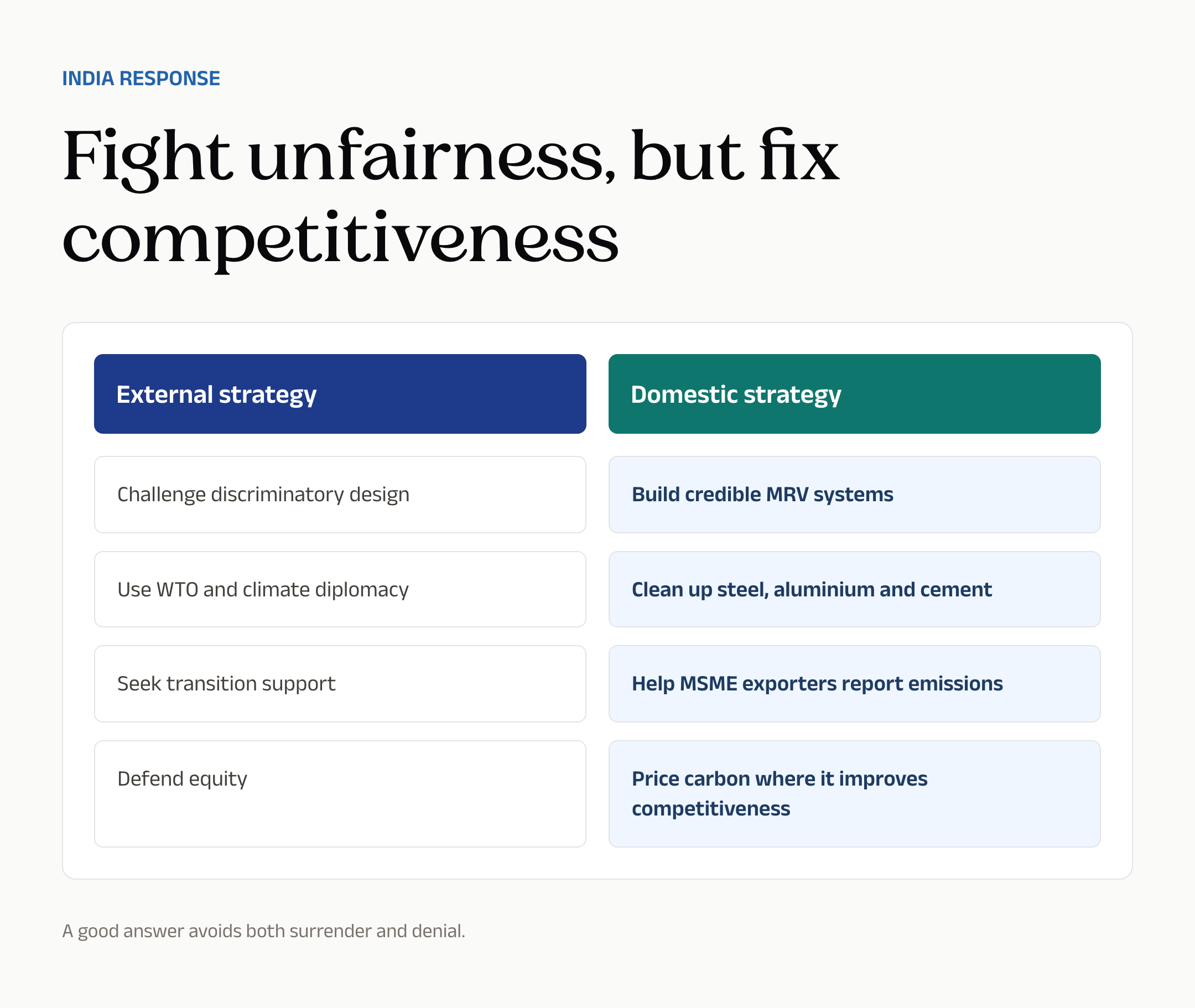
First, India should build a robust domestic MRV architecture for product-level emissions. This is not glamorous, but it is essential. Measurement, reporting and verification will decide whether an exporter is treated as clean, dirty or unverifiable. Unverifiable may become the most expensive category.
Second, India should align its domestic carbon market with export competitiveness. A domestic carbon price or crediting system will be useful only if it is credible to trading partners and fair to Indian industry. Weak credits will not protect exporters. The concept background in CBAM and the wider Paris Agreement architecture should be read together.
Third, government support should focus on hard-to-abate sectors. Steel, cement and aluminium need technology roadmaps, green procurement, cheaper clean power and transition finance. Small exporters need shared testing, auditing and reporting infrastructure.
Fourth, India should keep contesting CBAM’s unfair elements through climate diplomacy and WTO-consistent arguments. But the argument should be precise: equity, revenue use, technology access, transition period and recognition of domestic policies.
Finally, UPSC answers should avoid both extremes. CBAM is neither pure climate virtue nor pure protectionism. It is a climate-trade instrument with distributional consequences. India’s answer should be resistance plus readiness.
For Your Mains Answer
GS paper mapping: GS3: environment, industry, economy; GS2: international relations and global governance.
Likely question frames: – CBAM is climate policy through trade rules. Discuss its implications for India. – How should India balance climate justice objections with the need to improve carbon competitiveness? – Explain the role of MRV systems in future carbon-linked trade.
Quotable data points: – CBAM transitional phase: 1 October 2023 to 31 December 2025. – Definitive regime starts from 2026. – Covered sectors include cement, iron and steel, aluminium, fertilisers, electricity and hydrogen. – EU importers surrender certificates linked to EU ETS carbon prices. – Domestic carbon price paid in the exporting country can be adjusted against CBAM. – The first risk is concentrated in carbon-intensive material exports.
Keywords to use: carbon leakage, green protectionism, MRV, embedded emissions, climate justice, hard-to-abate sectors, industrial policy.
Syllabus linkages: Environmental conservation, Indian economy, Effects of policies of developed countries on India, Bilateral and global groupings.
Balanced conclusion line: India should contest unfair carbon border rules while building the measurement and clean-industry capacity that future trade will demand.
How to Build the Answer
Start with the central tension, not a textbook definition. For this topic, the tension is: CBAM is climate policy through trade rules. Discuss its implications for India. That opening immediately tells the examiner that you understand both the policy problem and the value conflict. A definition can come in the second or third sentence. The first sentence should frame the debate.
Use data early, but do not dump data. A good first body paragraph can carry three numbers: CBAM transitional phase: 1 October 2023 to 31 December 2025. Definitive regime starts from 2026. Covered sectors include cement, iron and steel, aluminium, fertilisers, electricity and hydrogen. Then explain what those numbers prove. UPSC rewards the move from fact to inference. The number is the anchor; the inference is the mark-scoring part.
The second body paragraph should handle the other side fairly. If your stance supports reform, first admit why the existing approach has a rationale. If your stance criticises a policy, first say what problem the policy was trying to solve. This is how an answer becomes balanced without becoming vague.
The way forward should be grouped, not scattered. Use headings such as institutional reform, fiscal design, citizen impact, federal coordination and technology. Use the topic’s own vocabulary: carbon leakage, green protectionism, MRV, embedded emissions, climate justice. These words help the answer sound like governance analysis rather than a newspaper summary.
Close by returning to the syllabus link: Environmental conservation, Indian economy, Effects of policies of developed countries on India. The last line should not repeat the introduction. It should show judgment. One useful pattern is: ‘The goal is not X alone, but X with Y.’ That pattern lets you balance reform with rights, growth with equity, and security with liberty.
Common Mistakes to Avoid
- Do not write only the newspaper argument. Editorials are starting points. Mains answers need constitutional, economic, administrative or ethical structure.
- Do not overuse adjectives. Words like serious, grave, historic and transformative do not earn marks unless tied to evidence.
- Do not make the answer one-sided. Every topic in this batch has a real counter-argument. Steelman it in two or three lines before giving your final view.
- Do not end with a slogan. End with an implementable principle, a measurable reform, or a constitutional value.
- Do not forget the citizen. UPSC likes policy, but it rewards policy that names who gains, who loses and who needs protection.
A Compact Answer Spine
- Introduction: Open with the conflict in one sentence and define the key term in the next sentence.
- Evidence: Use two or three data points from the dossier and connect each to a policy implication.
- Arguments: Present the case for the current policy or trend, then the case against it. Keep both fair.
- Structural diagnosis: Explain the deeper administrative, economic, social or constitutional reason the issue persists.
- Way forward: Give four to five grouped reforms with clear actors: Union government, state government, regulator, court, market, municipality or citizen.
- Conclusion: Use the balanced conclusion line from this section and adapt it to the question wording.
Diagram or Flowchart Idea
Use one small diagram if the question is a 15-marker. Do not draw a decorative mind map. Draw a causal chain. The cleanest format is: problem trigger -> institutional gap -> citizen impact -> reform response. This works because the examiner can read the logic in five seconds.
For a 10-marker, skip the diagram unless it is genuinely simple. A table with two columns, ‘case for’ and ‘case against’, usually works better. The aim is not to show artistic effort. The aim is to make the answer easy to evaluate under time pressure.
Ethics and Governance Angle
Add one ethical line even in a GS2 or GS3 answer. Most current-affairs editorials are not only about efficiency. They also ask who bears the cost of policy failure. A migrant voter, an undertrial, an outdoor worker, a small exporter, a low-income commuter or an elderly citizen is often sitting silently inside the issue. Naming that citizen makes the answer sharper.
The governance angle should then convert empathy into design. Do not merely say ‘protect vulnerable groups’. Say how: targeted transfers, legal aid, local health surveillance, simplified compliance, public transport, transparent dashboards, or periodic judicial review. This is where many answers move from moral language to administrative maturity.
A useful sentence pattern is: ‘The policy is legitimate in aim, but its legitimacy depends on procedure, proportionality and capacity.’ This line works across many topics because it accepts the state’s objective without giving the state a blank cheque. It is especially useful for questions where the examiner expects balance.
How to Use Data Without Sounding Mechanical
Use fewer numbers than you know. Three well-explained data points beat ten scattered facts. Put the most important number near the beginning, use the second number to show contrast, and use the third number to justify the way forward. For example, one national number, one state or sector contrast, and one implementation gap is usually enough.
Never leave a statistic alone. Follow it with a sentence beginning with ‘This means…’ or ‘The policy implication is…’ That tiny move turns data into analysis. It also keeps the answer from reading like a fact sheet. In Mains, facts are raw material. Judgment is the finished answer.
End revision by asking one question: can this answer be understood by a tired examiner in one pass? If the answer needs rereading, simplify the structure. Keep the introduction short, give the data early, mark the two sides cleanly, and place the way forward in grouped points. Clarity is not a lower standard than depth. For UPSC writing, clarity is how depth becomes visible.
One final check: remove any line that sounds impressive but does no work. Replace it with a fact, a cause, a consequence or a reform. That habit is small, but it is the difference between an answer that feels informed and an answer that feels memorised.
Write for marks, not for noise. Every sentence should earn its place. Always be specific.
FAQ
What is CBAM?
CBAM is the EU Carbon Border Adjustment Mechanism, a system that prices embedded carbon in specified imports entering the European Union.
Which sectors are covered first?
The initial sectors are cement, iron and steel, aluminium, fertilisers, electricity and hydrogen.
Why does CBAM matter for India?
It can affect export competitiveness in carbon-intensive sectors and force Indian firms to produce credible emissions data.
Is CBAM green protectionism?
It has both climate and protectionist features. A strong answer should recognise carbon leakage concerns as well as equity and market-access risks.
Tell Google you want more of this.
Add Anantam IAS as a preferred sourceOne tap, and this site shows up more often in your own Top Stories, AI Overviews and AI Mode. Remove it any time.






