India and Turkey: Repairing a Strained Relationship
Why in News?
An Indian Express Explained feature reports that India and Turkey are quietly working to bring a badly strained relationship back from the brink, after a sharp downturn driven by Ankara’s open backing of Pakistan during the recent India-Pakistan military tensions and its repeated remarks on Jammu and Kashmir.
The recalibration is being pursued cautiously through trade channels and working-level diplomacy, signalling that both capitals see value in containing the damage even as the underlying strategic divergence on Kashmir and the Turkey-Pakistan axis persists.
- Ties hit a low after Turkey publicly sided with Pakistan in the latest India-Pakistan confrontation.
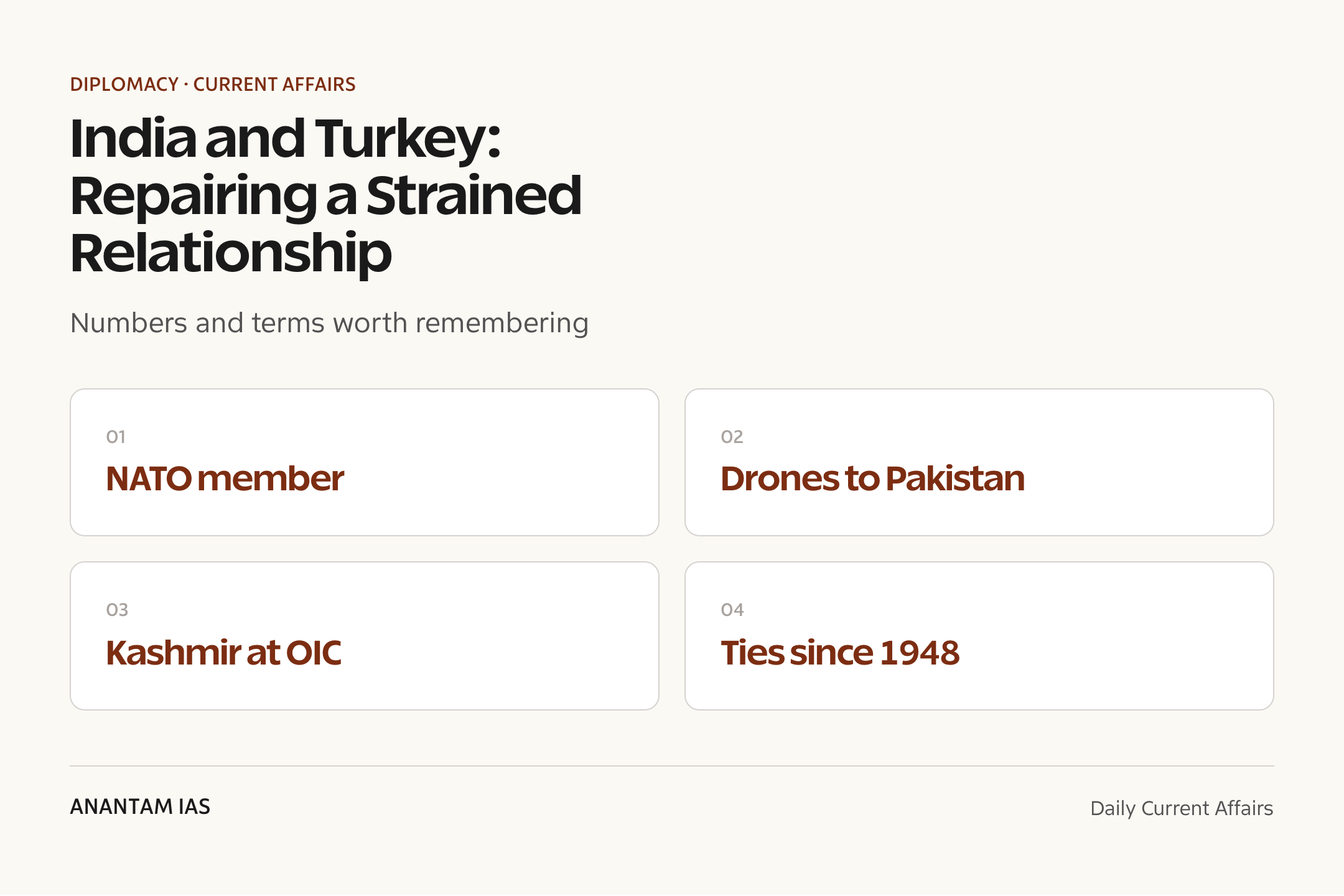
- Turkish-origin armed drones, including the Bayraktar TB2, have featured in Pakistan’s arsenal, deepening Indian unease.
- President Recep Tayyip Erdogan has repeatedly raised Kashmir in UN General Assembly speeches and at the OIC.
- India responded with calibrated pushback, including travel-advisory caution, scrutiny of Turkish firms, and deeper outreach to Greece, Cyprus and Armenia.
- Both sides retain sizeable bilateral trade and people-to-people links, giving each an incentive to stabilise relations.
The development matters in the context of:
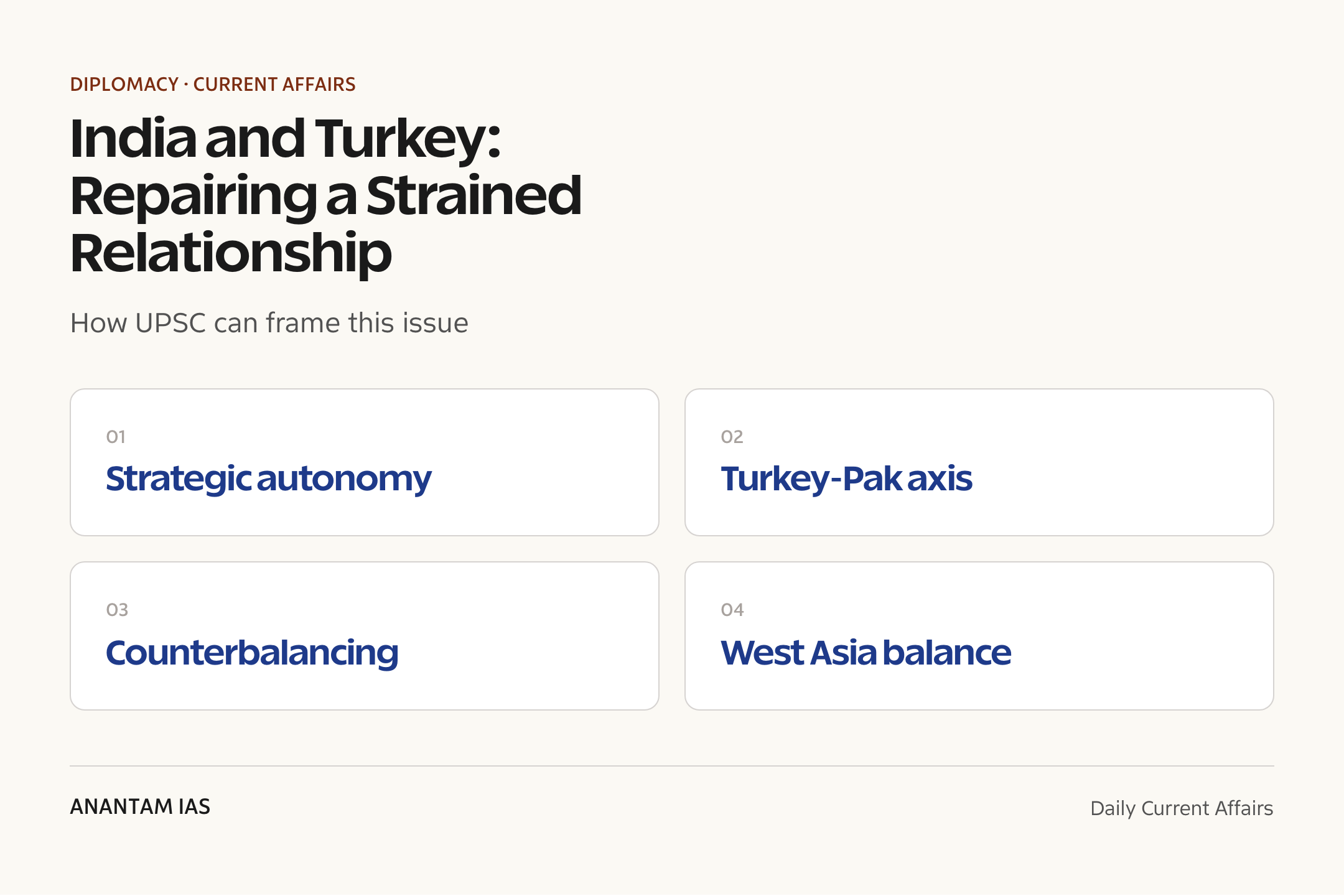
- Tests India’s doctrine of strategic autonomy and issue-based partnerships in a multipolar West Asia.
- Shows how a third country’s stance on Kashmir directly shapes the texture of a bilateral relationship.
- Illustrates the use of counterbalancing partnerships (Greece, Cyprus, Armenia) as a diplomatic tool.
UPSC Relevance
Prelims Relevance
- Turkey is a member of NATO but not of the EU; it straddles Europe and Asia across the Bosphorus and Dardanelles straits.
- The Organisation of Islamic Cooperation (OIC) is the forum where Turkey has often amplified the Kashmir issue.
- Bayraktar TB2 is a Turkish-made armed unmanned combat aerial vehicle (UCAV) produced by Baykar.
- Cyprus is divided; the internationally recognised Republic of Cyprus is an EU member, while northern Cyprus is recognised only by Turkey.
- Armenia has tense ties with Turkey and Azerbaijan; India has stepped up defence exports to Armenia.
- Greece and Turkey have long-running disputes in the Aegean Sea and Eastern Mediterranean.
- India and Turkey established diplomatic relations in 1948.
- The Bosphorus and Dardanelles straits, controlled by Turkey, are governed by the Montreux Convention.
Mains Relevance
GS Paper 2
- Assess how a third state’s position on Jammu and Kashmir shapes India’s bilateral diplomacy.
- Evaluate India’s strategy of building counterbalancing partnerships (Greece, Cyprus, Armenia) against the Turkey-Pakistan axis.
GS Paper 2
- Discuss the relevance of India’s strategic autonomy in managing relations with a NATO member like Turkey.
Essay
- Diplomacy is the art of restraint: managing rivalry without rupture.
- In a multipolar world, no friendship is permanent and no estrangement is final.
Background and Context
The roots of the strain
The downturn is structural, not episodic, anchored in Turkey’s strategic alignment with Pakistan.
- Turkey-Pakistan axis: deepening defence, diplomatic and ideological ties have made Ankara one of Islamabad’s most vocal backers.
- Kashmir at the UN and OIC: President Erdogan has repeatedly internationalised Kashmir, which India treats as an internal matter and a red line.
- Defence supplies: Turkish drones, including the Bayraktar TB2, and other systems have reached Pakistan, hardening Indian threat perceptions.
- Turkey’s bid for leadership of the Muslim world has positioned it against India’s interests on contested issues.
- Ankara’s ambition to be a pan-Islamic voice often clashes with the position of the Gulf states, with whom India enjoys warm ties, complicating Turkey’s appeal in West Asia.
- The relationship lacks the institutional ballast, such as a strong defence or strategic dialogue, that anchors India’s ties with many other powers.
How relations cooled after the latest tensions
Ankara’s stance during the recent India-Pakistan crisis pushed an already-cool relationship to a near-rupture.
- Public Turkish support for Pakistan during the confrontation triggered sharp Indian displeasure.
- Indian scrutiny fell on Turkish companies operating in sensitive sectors, including ground-handling at airports.
- Calls within India to limit tourism and trade with Turkey gained traction in public discourse.
- New Delhi signalled that strategic trust would have to be rebuilt before normal business resumed.
India's counterbalancing playbook
India has answered Turkey’s tilt by cultivating Turkey’s own regional rivals.
- Greece: upgraded political and defence engagement, with the Eastern Mediterranean as a shared strategic theatre.
- Cyprus: closer ties with the EU-member Republic of Cyprus, where Turkey backs the unrecognised north.
- Armenia: growing Indian defence exports to Yerevan, which faces pressure from the Turkey-Azerbaijan partnership.
- This issue-based hedging is a textbook application of strategic autonomy rather than bloc alignment.
Why both sides still want to talk
Beneath the friction lies a durable web of economic and connectivity interests.
- Bilateral trade spans engineering goods, chemicals, textiles, machinery and minerals, giving exporters on both sides a stake in stability.
- Turkey sits astride key trade and energy corridors linking Asia, Europe and West Asia.
- Indian firms and tourists, and Turkish construction and contracting interests, create people-to-people ballast.
- Diaspora, education and cultural links add a softer layer that survives political chill.
- Turkey is a major destination for Indian travellers, and any boycott hurts Turkish tourism revenues, giving Ankara a commercial reason to avoid open hostility.
- Both economies trade across multilateral platforms such as the G20, where Turkey and India have at times found common ground on development financing.
Where Turkey fits in India's West Asia balancing
India’s Turkey policy is one piece of a wider Mediterranean and Gulf calculus.
- India simultaneously deepens ties with the Gulf monarchies, Israel, Egypt and Iran, refusing to be boxed into any camp.
- Connectivity initiatives such as the India-Middle East-Europe Economic Corridor (IMEC) reshape the regional map without depending on Turkey.
- Turkey’s NATO membership and friction with the West give India room to engage Ankara on its own terms.
- The guiding principle is multi-alignment: many partners, no permanent adversaries.
Risks and limits of the thaw
Repair is real but fragile, and the structural divergence has not disappeared.
- Any fresh Turkish remark on Kashmir at the UN or OIC could reverse gains overnight.
- Continued arms flows to Pakistan would keep the security file unresolved.
- Domestic sentiment in India remains wary, constraining how far normalisation can go.
- The thaw is likely to stay transactional and trade-led rather than a strategic embrace.
Way Forward
Compartmentalise the relationship
- Insulate trade and people-to-people ties from the political dispute over Kashmir.
- Build working-level diplomatic channels that can absorb periodic friction.
Keep counterbalances in reserve
- Sustain partnerships with Greece, Cyprus and Armenia as durable leverage, not one-off signalling.
- Use these ties to raise the cost to Ankara of any anti-India posture.
Pursue quiet, issue-based engagement while holding firm on Kashmir as a non-negotiable, letting economic interdependence do the slow work of normalisation.
Conclusion
The India-Turkey reset is a study in pragmatic statecraft: neither capital pretends the strategic divergence has vanished, yet both recognise that an open rupture serves no one. Trade, connectivity and diaspora links give the relationship a floor beneath the political ceiling set by Kashmir and the Turkey-Pakistan axis.
For India, the episode reaffirms the logic of strategic autonomy and multi-alignment: engage where interests converge, counterbalance where they clash, and never mortgage core positions for short-term warmth. The repair will likely stay measured and reversible, a managed rivalry rather than a friendship.
UPSC Practice Questions
Prelims MCQ 1
With reference to Turkey and its regional relationships, consider the following statements:
- Turkey is a member of the North Atlantic Treaty Organisation (NATO).
- The Bayraktar TB2 is a Turkish-manufactured armed unmanned aerial vehicle.
- Turkey is a full member of the European Union.
How many of the above statements are correct?
(a) Only one (b) Only two (c) All three (d) None
Answer: (b) Only two
Explanation:
Turkey is a NATO member and makes the Bayraktar TB2 UCAV (statements 1 and 2 correct). Turkey is an EU candidate but not a full member, so statement 3 is wrong.
Prelims MCQ 2
India has stepped up defence and diplomatic engagement with which of the following as a counterbalance to the Turkey-Pakistan axis?
(a) Greece, Cyprus and Armenia (b) Azerbaijan and Pakistan (c) Saudi Arabia and Qatar only (d) Russia and Belarus
Answer: (a) Greece, Cyprus and Armenia
Explanation:
India has deepened ties with Greece, Cyprus and Armenia, all of which have their own tensions with Turkey or the Turkey-Azerbaijan partnership, as a calibrated counterbalance.
UPSC Mains Questions
- India’s relationship with Turkey illustrates how a third state’s position on Jammu and Kashmir can shape a bilateral equation. Discuss, with reference to India’s use of counterbalancing partnerships. (250 words)
- Examine how the doctrine of strategic autonomy guides India’s engagement with a NATO member like Turkey amid the Turkey-Pakistan axis. (250 words)
- Assess the role of trade and connectivity in stabilising politically strained bilateral relationships, using India-Turkey ties as a case study. (150 words)
Sources: The Indian Express (Explained) and Ministry of External Affairs.
Frequently Asked Questions
Why are India-Turkey relations strained?
Relations soured chiefly because Turkey openly backed Pakistan during recent India-Pakistan tensions and because President Erdogan repeatedly raised Jammu and Kashmir at the UN and the OIC, which India treats as an internal matter. Turkish-origin drones reaching Pakistan deepened the strategic distrust between the two capitals.
What is the Turkey-Pakistan axis?
It refers to the deepening defence, diplomatic and ideological partnership between Ankara and Islamabad. Turkey has become one of Pakistan’s most vocal international backers, supplying military hardware such as drones and supporting Pakistan’s positions on Kashmir at multilateral forums, which directly cuts against Indian interests.
How is India counterbalancing Turkey?
India has cultivated Turkey’s regional rivals: Greece and Cyprus in the Eastern Mediterranean, and Armenia, which faces pressure from the Turkey-Azerbaijan partnership. Deeper defence exports and political engagement with these states raise the diplomatic cost to Ankara of any anti-India posture, applying issue-based strategic autonomy.
What is the Bayraktar TB2?
The Bayraktar TB2 is a Turkish-made armed unmanned combat aerial vehicle produced by Baykar. Its presence in Pakistan’s arsenal, alongside other Turkish systems, has heightened Indian threat perceptions and become a concrete irritant in the security dimension of India-Turkey relations.
Why are the two countries still talking?
Despite the friction, India and Turkey retain sizeable bilateral trade in engineering goods, chemicals, textiles and machinery, plus connectivity, diaspora and people-to-people links. These interests give both sides an incentive to contain the damage and pursue a cautious, trade-led normalisation rather than a full rupture.
How does this relate to strategic autonomy?
India engages Turkey where economic interests converge while counterbalancing where they clash, and holds firm on Kashmir. Refusing to align with any single bloc and keeping many partners across West Asia reflects multi-alignment and strategic autonomy, the guiding principles of India’s foreign policy.