A country can pick its friends. It can’t always pick whether its friends go to war with each other. That’s the trap India woke up to when a large-scale conflict pulled the United States, Israel and Iran into open fighting in early 2026, shut the Strait of Hormuz, and forced New Delhi to answer a question it had spent two decades not answering: when your partners attack your partner, and the sea lane carrying your oil goes dark, what exactly is left of “strategic autonomy”? Strategic autonomy is the doctrine that India keeps its decisions its own, refusing to lock into any single bloc so it can deal with everyone on its own terms. The war put a price tag on the word, in barrels of crude and in the trust of half a dozen capitals at once.
This is the cleanest stress test of Indian foreign policy you’ll get in this cycle. India has spent years deepening defence ties with Israel, building investment platforms with the United States and the Gulf, and at the same time guarding a separate Iran channel for energy, a port, and an overland route into Central Asia. Those weren’t contradictions while everyone stayed at peace. The moment the shooting started, they became a single tightrope, and the answer to “which side is India on” had to be “neither, and here’s how” – said convincingly enough that nobody on any side felt betrayed.
The Issue, Framed
The dilemma isn’t whether India likes Iran more than Israel, or Washington more than Tehran. It’s structural. India has real, hard interests sitting on both sides of this war, and the war makes it costly to serve both at once.
Let’s fix the vocabulary first, because most confusion on this topic comes from people using big terms loosely. Strategic autonomy is India’s refusal to become anyone’s junior partner. It’s sometimes called multi-alignment or “non-alignment 2.0” – the idea that you align issue by issue with whoever serves your interest, rather than signing into one camp for everything. So India can buy Russian oil, American jet engines, and Israeli drones in the same year and call that a feature, not a contradiction.
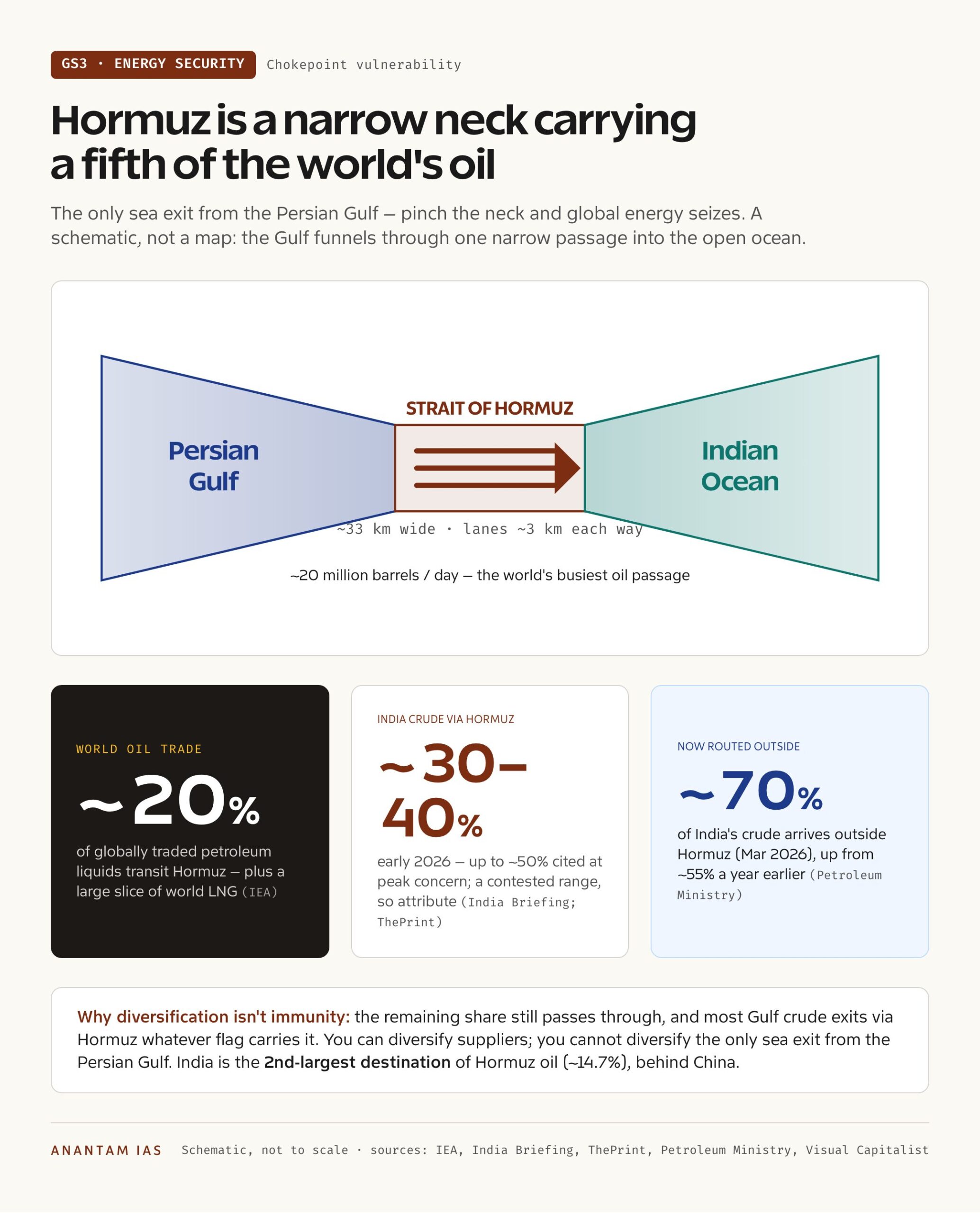
Now the geography that’s testing it. The Strait of Hormuz is a narrow sea passage between Iran to the north and Oman and the UAE to the south. It’s the only sea exit from the Persian Gulf, and at its tightest it’s about 33 km wide, with shipping lanes only a few kilometres across each way. Roughly 20 million barrels a day flow through it, about 20% of all the petroleum-liquids traded on Earth, plus a large slice of the world’s liquefied natural gas. Pinch that neck and global energy seizes up. India sits second only to China among the destinations of Hormuz oil, taking close to 15% of what passes through.
Then there’s the Iran channel India built deliberately. Chabahar is a port on Iran’s southeastern coast where India operates the Shahid Beheshti terminal. It matters because it’s India’s one overland gateway to Afghanistan and Central Asia that doesn’t cross Pakistan. The INSTC, the International North-South Transport Corridor, is the roughly 7,200-km ship-rail-road route running from India through Iran up to Russia and Europe, reckoned about 30% cheaper and 40% shorter than the Suez route. And on the other side of the ledger sits I2U2 – India, Israel, the UAE and the US – a 2022 grouping for joint investment in food, energy and technology.
So the issue, framed plainly: a war between India’s partners threatens the oil lane India depends on, freezes the Iran assets India spent a decade building, and tempts India to lean harder into the very axis that’s doing the fighting. Strategic autonomy isn’t a slogan here. It’s the thing under load.
What the Data Says
The numbers tell you why India can’t simply walk away from either side. Start with the dependence that gives Iran and the Gulf leverage over India whether India likes it or not.
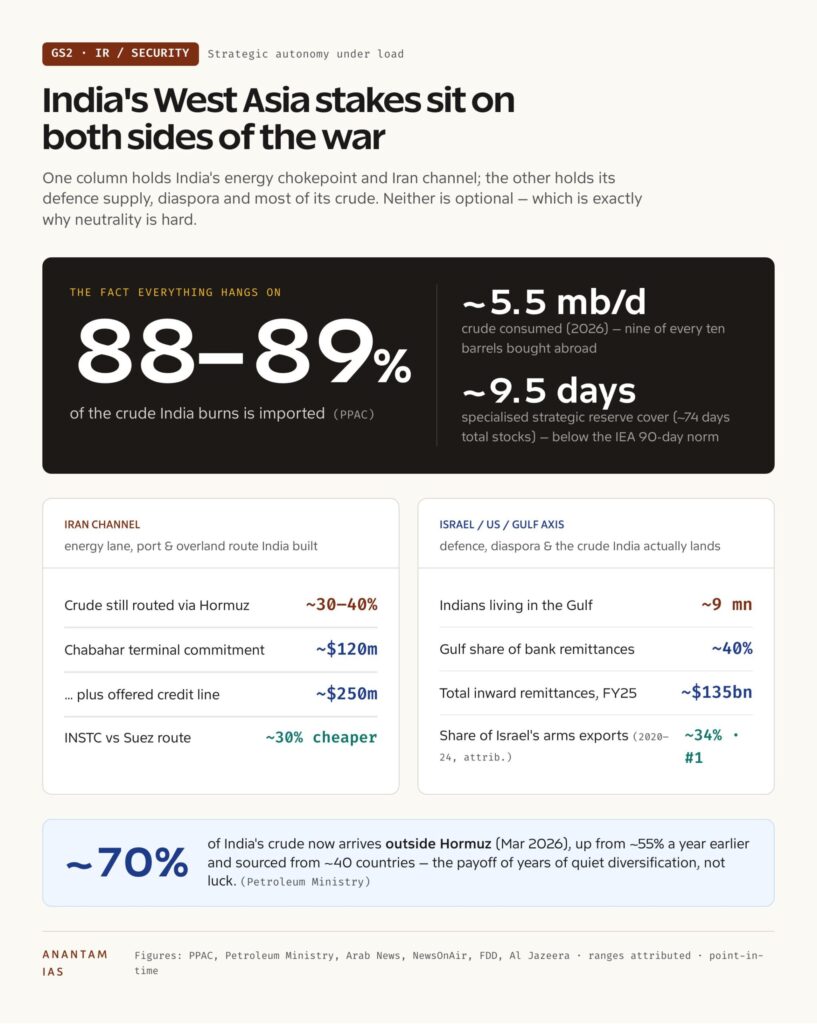
India imports about 88 to 89% of the crude oil it burns, and it burns a lot – roughly 5.5 million barrels a day in 2026. That import dependence is the single most important fact in this entire debate. When you buy nearly nine of every ten barrels from abroad, a shut chokepoint isn’t a headline. It’s a domestic inflation problem, a current-account problem, and a political problem, all arriving together.
How exposed is India to Hormuz specifically? Here the figures vary, so hold them as a range and date them. Around 30 to 40% of India’s crude still transited Hormuz in February-March 2026, while ThePrint cited a figure closer to 50% as anxiety peaked. The honest line for an answer is “roughly a third to a half, and contested” – not a single confident number.
But here’s the part that reframes the panic. India saw this coming and moved. By March 2026, about 70% of India’s crude was arriving via routes outside Hormuz, up from around 55% the year before, with crude now sourced from about 40 countries. So the diversification India had been quietly building – more Russian, American, Latin American and African barrels, routed around the Cape of Good Hope where needed – turned out to be the difference between a crisis and a scare. That’s the rare case where boring, years-long policy work paid off exactly when it was needed.
The other side of the ledger is just as concrete. About 9 million Indians live in the Gulf, and they send home close to 40% of India’s bank remittances, with the UAE alone accounting for roughly 19%. Total inward remittances hit a record of about $135 billion in FY25. To anchor that: $135 billion is larger than India’s entire annual defence budget, and it lands directly in households, not government coffers. On defence, India was Israel’s largest arms buyer between 2020 and 2024, taking about 34% of Israeli defence exports – drones, air defence, radar, loitering munitions.
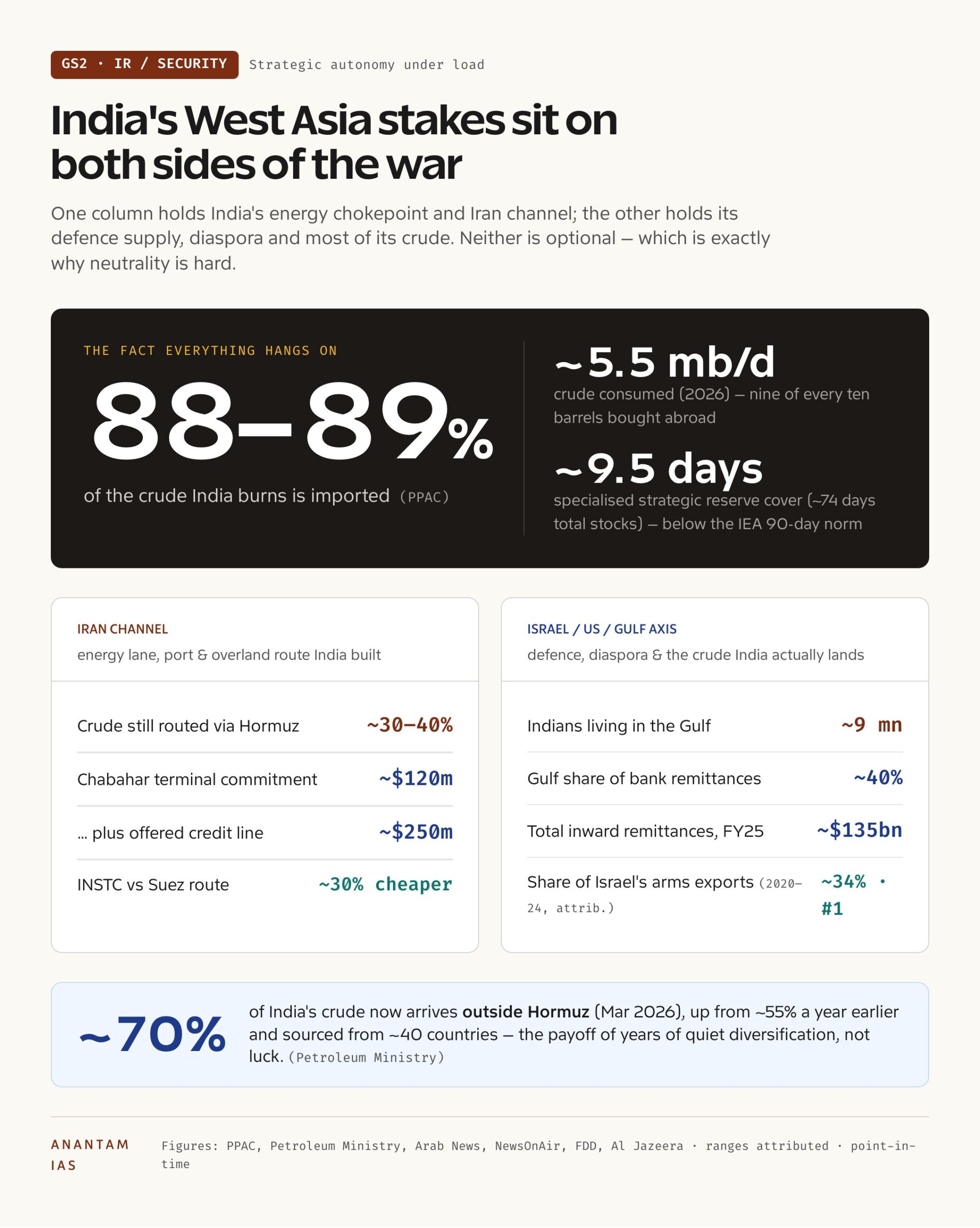
So read the two columns together. The Iran side holds India’s energy chokepoint, its Chabahar port, and its INSTC route. The Israel-US-Gulf side holds India’s defence supply, its biggest diaspora, 40% of its remittances, and most of its actual crude post-diversification. Neither column is optional. That’s the whole problem in one image.
The Case For
There’s a serious argument that India’s interests now lean toward the US-Israel-Gulf axis, and a strong answer states it at full strength before knocking it around. So let’s make the case honestly.
Defence and technology dependence is the heaviest weight. India relies on Israel for drones, air defence systems, radar and loitering munitions, and on the United States for high-end platforms, jet engines through the GE-HAL arrangement, and technology transfer. These aren’t luxuries. They’re the capabilities a country leans on when its own neighbourhood turns hot. So the side that supplies your hardest defence kit has a claim on your alignment that energy diplomacy can’t easily match.
The economic anchor has shifted Gulf-ward too. After diversification, most of India’s actual crude now comes from Gulf and non-Iran suppliers, and the Gulf is also where 9 million Indians work and where 40% of remittances originate. I2U2 adds a forward-looking layer: the UAE committed about $2 billion to integrated food parks in India, alongside clean-energy and space projects, knitting India into a US-anchored techno-economic club. So the prosperity case and the security case point the same way.
Connectivity to Europe leans this way as well. The IMEC – the India-Middle East-Europe Economic Corridor, signed at the 2023 G20 in New Delhi – offers India a Suez-alternative trade spine running through the Gulf and Israel to Europe. But IMEC’s overland leg only works if the Gulf-Israel stretch stays stable, which in practice means staying close to the states that control it. So the corridor India wants for the next decade has a built-in tilt baked into its map.
And counter-terror and intelligence cooperation rounds it out. Israel and the US are central partners on intelligence-sharing and cyber, which matters in India’s Pakistan-facing threat environment. So the case for tilting isn’t reckless. It’s the natural pull of where India’s hardest assets and deepest dependencies have migrated. The question the next section asks is whether yielding to that pull would cost more than it saves.
The Case Against
Here’s what the tilt argument walks past. The Iran channel isn’t sentimental attachment – it’s irreplaceable infrastructure, and some of it can’t be bought anywhere else at any price.
Start with the chokepoint India can’t insure against. Even with 70% of crude now routed outside Hormuz, the remaining share still passes through it, and – this is the part people miss – most Gulf crude exits via Hormuz regardless of which flag carries it. So antagonising Iran raises the risk on a passage India can’t relocate. You can diversify suppliers. You can’t diversify the only sea exit from the Persian Gulf.
Then there’s Chabahar, which is strategically one of a kind. It’s the only port giving India an overland route to Afghanistan and Central Asia that doesn’t run through Pakistan. Abandon it and you don’t just lose a port – you cede that ground to China, which runs the rival Gwadar port and the China-Pakistan Economic Corridor a short distance up the same coast. So Chabahar is less about Iran and more about not handing Beijing a monopoly on the region’s connectivity. The same logic carries the INSTC: that 30%-cheaper, 40%-shorter route to Russia and Eurasia runs across Iranian soil, and a Moscow-origin cargo train reaching Iran in November 2025 showed the corridor maturing, not fading.
The doctrinal cost is real too. Picking a side in a hot war is the opposite of strategic autonomy. It would shrink India’s room to bargain with Russia, China and the Global South, and it would dent the non-aligned brand India trades on. That brand isn’t abstract: as the 2026 BRICS chair, India found it couldn’t get a joint statement out of the foreign ministers’ meeting in New Delhi in mid-May, because Iran wanted the US and Israel named as initiators while the UAE demanded condemnation of Iranian strikes on Gulf states. India could only issue a chair’s statement. An overt tilt toward a US-Israel war on a developing nation would have made even that thin consensus impossible – and would have cost India exactly the Global South credibility it was trying to protect.
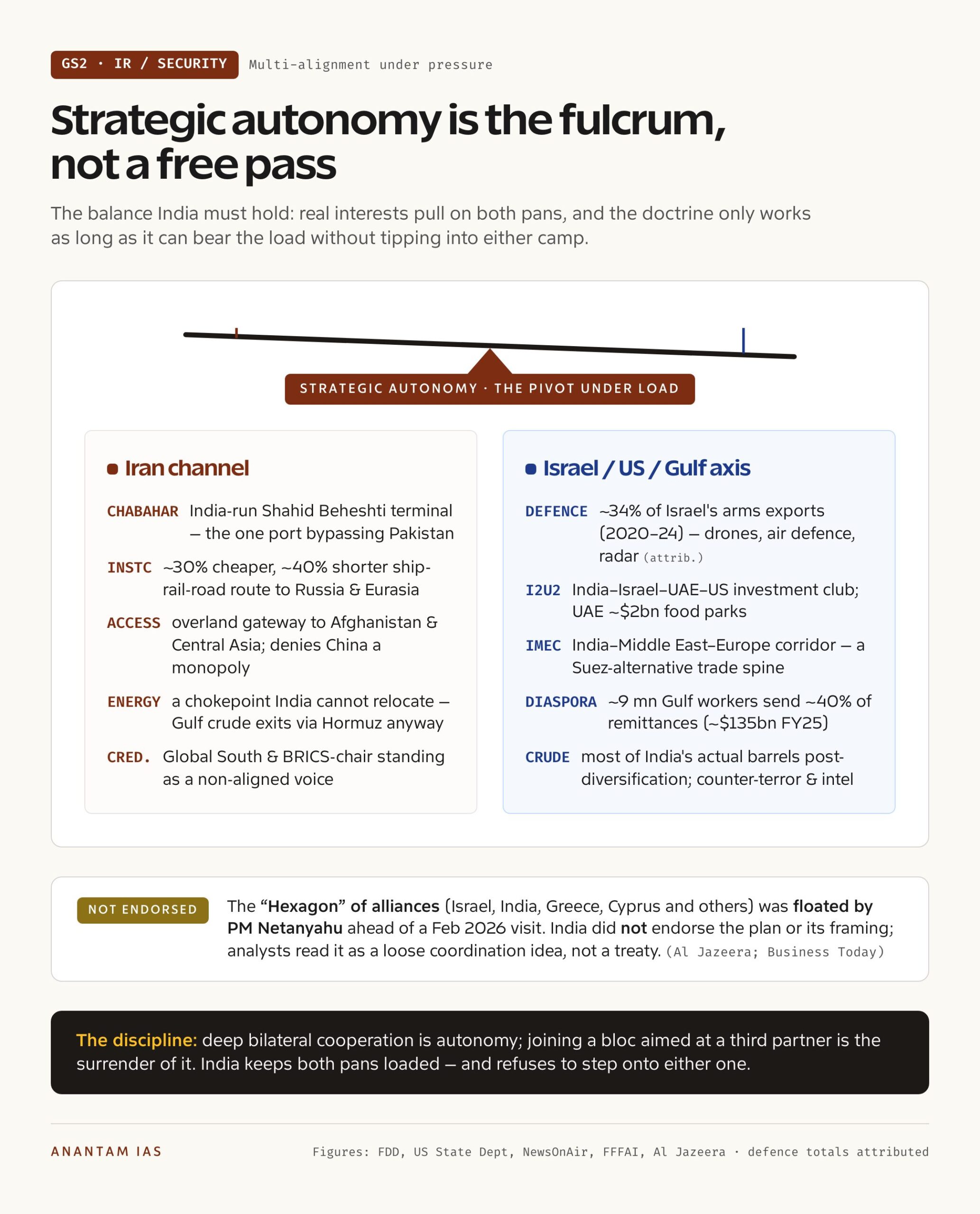
One more thread belongs here, attributed carefully. Ahead of a high-level India-Israel visit in late February 2026, Israeli Prime Minister Netanyahu floated a “Hexagon” of alliances – Israel, India, Greece, Cyprus and unnamed others – positioning India near its core. India did not endorse it. No Indian government statement signed on to the plan or its sectarian framing, and analysts read it, at most, as a loose coordination idea rather than a treaty. That non-commitment is itself the case against tilting: India accepted the defence and investment ties while declining the bloc.
The Deeper Structural Read
Step back from the war’s daily headlines and the real shape of the problem appears. India isn’t choosing between two countries. It’s defending a method – and the war is testing whether that method survives contact with a crisis.
The method is multi-alignment, and its quiet assumption is that India’s partners won’t force a binary choice. For two decades that held. India bought Russian oil and American technology, courted Iran and Israel, sat in BRICS and the Quad, and nobody made it pick. Strategic autonomy works beautifully in peacetime because peacetime rarely sends the bill. A hot war between partners is precisely the event that sends the bill – and the Iran war is the first one in a long while big enough to test whether the doctrine is a strategy or just a comfortable habit.
What the data above really shows is that India had been buying insurance without calling it that. The crude diversification to 70% outside Hormuz, the multiple supplier countries, the Cape-routable supply share – those weren’t reactions to the 2026 war. They were years of hedging that happened to mature at the right moment. So the deeper lesson isn’t “India got lucky.” It’s that strategic autonomy is only real to the extent it’s pre-funded with hard capacity built in advance. Autonomy you haven’t paid for ahead of time is just a wish.
There’s a sharper structural point underneath. Sanctions are the mechanism through which one power’s foreign policy reaches into another’s. The Chabahar story makes this vivid. India signed a 10-year operating contract for the Shahid Beheshti terminal in 2024 and committed roughly $120 million in equipment plus an offered $250 million credit line. The US had granted a sanctions waiver to let that proceed – and that waiver lapsed on 26 April 2026. So a port India built on Iranian soil to bypass Pakistan now sits hostage to a decision made in Washington. India’s response has been telling: rather than openly defy the sanctions or fully abandon the asset, it’s reportedly weighing a reversible stake-transfer to an Iranian partner, structured so the asset can be reclaimed if sanctions ease. That’s strategic autonomy reduced to its hardest, most practical form – not defiance, not surrender, but keeping the option alive.
And here’s the part future administrators should sit with. The war exposed that India’s autonomy has a floor set by capacity it doesn’t fully control: a chokepoint it can’t move, a defence supply it can’t yet make at home, an energy bill it can’t shrink fast. Multi-alignment buys India room to manoeuvre, but the size of that room is fixed by how self-reliant India actually is. So the doctrine and the development agenda – energy, manufacturing, shipping – aren’t separate subjects. One is the promise; the other is what makes the promise affordable.
What Should Be Done
So what does threading this needle actually look like? Not a vague plea for “balance,” but a set of moves a foreign secretary could action this quarter. Five of them, and none requires India to pick a side.
- Lead de-escalation diplomacy, loudly and from the centre. Hold the “restraint, dialogue, civilian safety” line, and use the BRICS chair and G20 standing to push talks rather than take sides. Keep working channels open to Tehran, Tel Aviv, Washington and the Gulf at the same time. India’s value here is precisely that it talks to everyone – that’s an asset only as long as it spends none of it on partisanship. See how this links to India’s broader approach in India and the US-China-Russia Triangle.
- Treat energy security as the real national-security front. India’s strategic petroleum reserves cover only about 9.5 days of imports from the specialised SPR, and roughly 74 days even counting total industry stocks – below the IEA’s 90-day benchmark. So fast-track the SPR Phase II expansion toward about 22 days, deepen sourcing from Russia, the US, Latin America and Africa, and keep growing the share of crude that can route around Hormuz entirely. The 70%-outside-Hormuz figure should become 80%, then 85%. More on this tension in The Price of Strategic Autonomy: Russian Oil and US Pressure.
- Protect Chabahar without breaching sanctions. Pursue the reversible stake-transfer or standstill arrangement so the asset survives the sanctions winter and can be reclaimed if the climate thaws. Quietly make the case to Washington for a renewed waiver framed around Afghanistan humanitarian access and Central Asia connectivity – a framing the US has accepted before. Losing the port outright would be the one move that’s genuinely hard to reverse.
- Hedge, don’t bandwagon. Keep IMEC, I2U2 and defence ties advancing strictly on their economic and technical merits, while declining the “Hexagon” framing and any formal anti-Iran security bloc. The distinction matters: deep bilateral cooperation is autonomy; joining a bloc aimed at a third partner is the surrender of it.
- Protect citizens and shipping as a standing capability, not a scramble. Sustain land-route evacuation, ship-extraction and travel advisories, and pre-position contingency plans for a prolonged Hormuz closure. The capacity India built during the June 2025 evacuation should be a permanent muscle, not something rebuilt from scratch each crisis.
Every one of these keeps India out of the war while protecting what India actually needs from both sides. That’s not fence-sitting. It’s the disciplined version of the doctrine – autonomy as active management, not passive neutrality.
For Your Mains Answer
This topic is a GS2-meets-GS3 gift. It lets you connect foreign-policy doctrine to energy economics to internal-security spillovers in a single, tightly argued answer – exactly the kind of cross-paper integration that scores.
GS paper mapping: GS2 (IR): India’s foreign-policy doctrine of strategic autonomy and multi-alignment; bilateral, regional and global groupings (BRICS, I2U2, IMEC); effect of policies of developed and developing countries on India’s interests (US sanctions on Chabahar); India and its neighbourhood (Pakistan-bypass via Chabahar and INSTC); the Indian diaspora. GS3: energy security and resources (oil-import dependence, SPR, diversification); infrastructure (ports, corridors); economy (remittances, Gulf FDI); the security and economic fallout of chokepoint disruption.
Likely question frames:
- “Strategic autonomy is tested not in peacetime but when a country’s partners go to war with each other.” Examine with reference to India’s position during the 2026 West Asia conflict.
- Energy security and foreign-policy autonomy are two sides of the same coin for an import-dependent economy. Discuss in the context of India’s exposure to the Strait of Hormuz.
- Connectivity corridors are instruments of strategic competition, not just trade. Analyse with reference to Chabahar, the INSTC and IMEC.
Quotable data points:
- About 20% of globally traded petroleum liquids (~20 mb/d) transits the Strait of Hormuz.
- India imports ~88-89% of its crude and consumes ~5.5 mb/d.
- ~30-40% of India’s crude still passed through Hormuz in early 2026, with ~50% cited at peak concern – a contested range, so attribute.
- ~70% of India’s crude now arrives outside Hormuz (March 2026), up from ~55% a year earlier, sourced from ~40 countries.
- ~9 million Indians in the Gulf send ~40% of India’s bank remittances; total inward remittances ~$135 billion in FY25.
- India was Israel’s largest arms buyer, ~34% of its defence exports, 2020-24.
- Chabahar 2024 deal: 10-year operating contract, ~$120m equipment plus ~$250m credit line; US waiver lapsed 26 April 2026.
- INSTC via Chabahar is ~30% cheaper and ~40% shorter than the Suez route.
- India’s SPR covers only ~9.5 days (specialised SPR), ~74 days total – below the IEA 90-day norm.
Keywords to use: strategic autonomy, multi-alignment, chokepoint vulnerability, oil-import dependence, energy security, connectivity corridors, sanctions exposure, de-escalation diplomacy, Global South.
Syllabus linkages: India’s foreign policy and groupings; effect of foreign-state policies on India; the diaspora; energy security and resource management; infrastructure and the economy; external dimensions of internal security.
Balanced conclusion line: India’s task in West Asia isn’t to choose between Iran and the Israel-US-Gulf axis but to keep both channels open while widening the hard capacity – diversified energy, deeper reserves, domestic defence – that makes neutrality affordable; strategic autonomy survives a war between partners only to the extent it was pre-funded before the war began.
How to Build the Answer
Open with the dilemma, not a definition. The strongest first sentence names the structural trap – India has hard interests on both sides of this war – and only then defines strategic autonomy in the second sentence. That ordering signals you understand the problem before reaching for the glossary. The examiner is looking for grasp, not recall.
Bring data in early, but ration it. A strong opening body paragraph can carry three figures: 88-89% crude dependence, ~70% now routed outside Hormuz, and ~40% of remittances from the Gulf. Then state what they prove – that India can’t abandon either axis. UPSC rewards the move from fact to inference, so the “this means” matters more than the number.
Steelman the tilt before you reject it. If your stance defends autonomy, first concede why leaning toward the US-Israel-Gulf axis is tempting: defence dependence, the diaspora, IMEC. An answer that fairly states the opposing case reads as judgment; one that strawmans it reads as a rant.
Group the way forward, don’t scatter it. Cluster the prescriptions: de-escalation diplomacy, energy-security hardening, protecting Chabahar reversibly, hedging without bandwagoning, and standing evacuation capacity. Use the topic’s own vocabulary – chokepoint, sanctions exposure, multi-alignment – so the answer sounds like statecraft analysis.
Close on the syllabus link and a judgment, not a summary. The last line should connect autonomy to self-reliance and end on the idea that neutrality must be paid for in advance. Don’t echo the introduction.
Common Mistakes to Avoid
- Don’t take a side in the war. The whole point is India’s balancing act. An answer that argues who’s right in the conflict misreads the question and breaches the neutral register UPSC expects.
- Don’t conflate the two wars. The June 2025 “Twelve-Day War” – and the Operation Sindhu evacuation tied to it – is distinct from the larger 2026 conflict. Merging their facts is an easy, visible error.
- Don’t state contested facts as settled. Casualty figures, the status of Iran’s leadership, and the state of its nuclear program are disputed across sources. Attribute and hedge.
- Don’t treat diversification as luck. Frame the 70%-outside-Hormuz figure as the payoff of deliberate, years-long policy – that’s the analytical insight.
- Don’t forget GS3. This is not a pure IR answer. The energy, SPR and remittance dimensions are where the cross-paper marks live.
A Compact Answer Spine
- Introduction: Open with the partners-at-war trap in one sentence; define strategic autonomy and the Hormuz exposure in the next.
- Evidence: Use two or three attributed figures – crude dependence, Hormuz share, remittances – each tied to a policy implication.
- Arguments: The case for leaning toward the US-Israel-Gulf axis, then the case for protecting the Iran channel. Keep both fair.
- Structural diagnosis: Multi-alignment works until partners force a binary; autonomy is only as large as the hard capacity behind it.
- Way forward: Four to five grouped moves, each with a clear actor – MEA, ISPRL, India Ports Global, the Cabinet Committee on Security.
- Conclusion: Adapt the balanced conclusion line to the exact question wording.
Diagram or Flowchart Idea
For a 15-marker, draw a balance beam with India at the fulcrum: on one pan, the Iran-axis pull (Hormuz oil, Chabahar, INSTC, Pakistan-bypass, Global South credibility); on the other, the Israel-US-Gulf pull (defence tech, IMEC, I2U2, diaspora and remittances, Gulf crude). Label the fulcrum “strategic autonomy.” The examiner reads the whole tension in five seconds.
For a 10-marker, skip the diagram and use a two-column table – “Iran channel” against “Israel-US-Gulf axis” – listing two or three interests each. It’s faster to draw and faster to mark under time pressure.
Ethics and Governance Angle
Add one line on the human stakes, even in a GS2-GS3 answer. The people most exposed to a West Asia war aren’t policymakers – they’re the 9 million Indians working in the Gulf and the seafarers on the 13 Indian-flagged vessels India moved to extract from Hormuz in 2026. Naming that cohort turns an abstract autonomy debate into a duty-of-care question, which sharpens the answer.
Then convert it into governance. The state’s first obligation in a crisis like this is protecting citizens and securing essential supply – energy, food, medicine. So the prescription isn’t only diplomatic; it’s institutional: standing evacuation capacity, a deeper strategic reserve, and shipping-protection plans treated as permanent functions, not crisis improvisations. That’s the move from values to administrative maturity.
How to Use Data Without Sounding Mechanical
Use fewer numbers than you know. Three well-placed figures beat ten scattered ones. Lead with one big anchor (88-89% crude dependence, the fact everything else hangs on), use a second for contrast (70% now routed outside Hormuz), and a third for human scale ($135 billion in remittances, larger than India’s defence budget).
Never leave a statistic standing alone. Follow each with “this means” or “the implication is.” That single move turns a fact sheet into analysis – in Mains, the figure is raw material and the judgment is the finished product.
Finish with a clarity check: can a tired examiner follow this in one pass? Short introduction, data early, two sides marked cleanly, grouped way forward, a judgment to close. If a sentence sounds impressive but does no work, cut it and replace it with a fact, a cause, a consequence, or a reform. Always be specific.
FAQ
Why is the Strait of Hormuz so important to India?
The Strait of Hormuz is the only sea exit from the Persian Gulf and carries about 20% of the world’s traded petroleum liquids. India imports roughly 88-89% of its crude, so any disruption there raises prices, freight and insurance costs at home. Even after diversifying about 70% of its crude to non-Hormuz routes by March 2026, India still relies on Gulf suppliers whose oil exits through the strait regardless of carrier.
What is strategic autonomy, and how did the 2026 war test it?
Strategic autonomy is India’s policy of keeping its decisions independent and aligning issue by issue rather than joining any single bloc. The 2026 West Asia war tested it because India has deep ties with Israel, the US and the Gulf on one side and an energy-and-connectivity channel with Iran on the other. With partners at war, India had to protect both without taking sides – managing the squeeze through de-escalation diplomacy and a chair’s statement at the BRICS meeting rather than alignment.
What is the status of India’s Chabahar port investment?
India signed a 10-year contract in 2024 to operate Iran’s Shahid Beheshti terminal at Chabahar, committing about $120 million in equipment plus an offered $250 million credit line. The US sanctions waiver that allowed this lapsed on 26 April 2026. India is reportedly winding down its exposure through a reversible stake-transfer arrangement, structured so the asset can be reclaimed if sanctions ease – preserving the only India-run port that bypasses Pakistan for Central Asia access.
Did India endorse Netanyahu’s “Hexagon” alliance?
No. The “Hexagon” – a proposed coordination network of Israel, India, Greece, Cyprus and others – was floated by Israeli Prime Minister Netanyahu ahead of a February 2026 visit. India did not publicly endorse the plan or its framing, and analysts read it as, at most, a loose coordination idea rather than a treaty. The non-commitment is consistent with India deepening bilateral ties while declining to join any bloc aimed at a third partner.
Tell Google you want more of this.
Add Anantam IAS as a preferred sourceOne tap, and this site shows up more often in your own Top Stories, AI Overviews and AI Mode. Remove it any time.