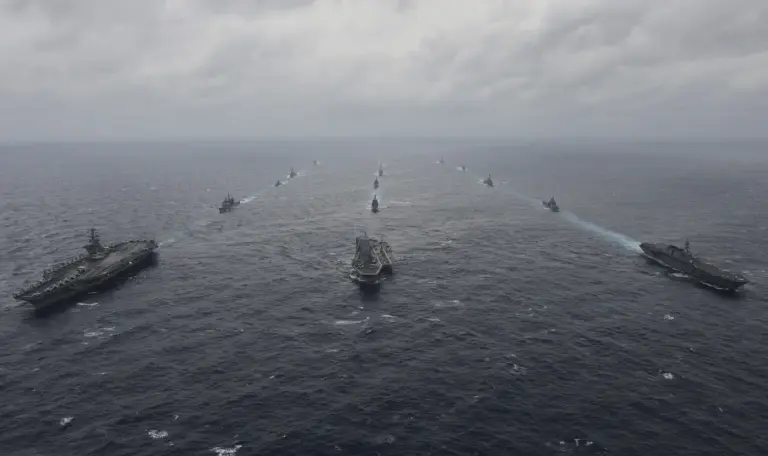
NATO stands for North Atlantic Treaty Organization. It's the world's most powerful military alliance — 32 member states that have committed to mutual defence under the principle that an attack on one is an attack on all.
NATO was born from the ruins of World War II, shaped by the beginning of the Cold War. Decades later, it remains at the centre of European security and global power politics. For UPSC, NATO is essential for International Relations — especially in the context of Russia-Ukraine conflict, India’s strategic positioning, and Western alliance dynamics.
NATO Full Form and Founding
The North Atlantic Treaty Organization was established on 4 April 1949 when the North Atlantic Treaty (also called the Washington Treaty) was signed in Washington, D.C.
The founding was driven by anxiety over Soviet expansion in Eastern Europe after World War II. The Berlin Blockade of 1948–49 accelerated the process. Twelve countries signed the original treaty.
Headquarters: Brussels, Belgium (since 1967; previously Paris)
Supreme Allied Commander Europe (SACEUR): Traditionally held by a US general
Secretary-General: The political head; traditionally a European
Founding Members (1949)
Belgium, Canada, Denmark, France, Iceland, Italy, Luxembourg, Netherlands, Norway, Portugal, United Kingdom, United States
France withdrew from NATO's integrated military command in 1966 under de Gaulle (rejoined fully in 2009), though it remained a political member.
Article 5: The Core of NATO
Article 5 of the Washington Treaty is the heart of the alliance. It states that an armed attack against one or more members in Europe or North America shall be considered an attack against them all, and each ally will take action it deems necessary, including the use of armed force.
Key clarifications:
- Article 5 doesn't require automatic military response — each member decides what "action it deems necessary" means
- The only invocation of Article 5 was after 9/11 (2001), when the US was attacked and NATO allies invoked collective defence to support the US
- Article 5 applies in Europe and North America — defined territories
Other Key Articles
| Article | Content |
|---|---|
| Article 2 | Peaceful relations, economic collaboration between members |
| Article 3 | Members maintain and develop individual and collective defence capacity |
| Article 4 | Members consult when any feels territorial integrity or security is threatened |
| Article 5 | Collective defence — attack on one = attack on all |
| Article 6 | Defines the geographic scope of Article 5 |
| Article 10 | Invitation to accession — new members can be invited by unanimous agreement |
Article 4 consultations have been invoked by Turkey multiple times (regarding Syria, Iraq) without triggering Article 5.
Related: UPSC Full Form: Union Public Service Commission Guide
NATO Member Countries: Full List
NATO has expanded from 12 founding members in 1949 to 32 members as of 2024.
| Country | Year Joined | Region |
|---|---|---|
| Belgium, Canada, Denmark, France, Iceland, Italy, Luxembourg, Netherlands, Norway, Portugal, UK, USA | 1949 | Founding |
| Greece, Turkey | 1952 | Mediterranean |
| West Germany | 1955 | Central Europe |
| Spain | 1982 | Iberian Peninsula |
| Czech Republic, Hungary, Poland | 1999 | Central/Eastern Europe |
| Bulgaria, Estonia, Latvia, Lithuania, Romania, Slovakia, Slovenia | 2004 | Eastern Europe/Baltic |
| Albania, Croatia | 2009 | Balkans |
| Montenegro | 2017 | Balkans |
| North Macedonia | 2020 | Balkans |
| Finland | 2023 | Nordic |
| Sweden | 2024 | Nordic |
Note: Germany was reunified in 1990; unified Germany remained in NATO. Finland and Sweden joined after Russia's full-scale invasion of Ukraine in 2022, ending decades of Nordic neutrality.
NATO Expansion: The Core Controversy
NATO's eastward expansion after the Cold War is the central point of contention in Russia-West relations.
When the Soviet Union dissolved and the Warsaw Pact ended (1991), Russia claims it received assurances (informal, disputed) that NATO would not expand eastward. NATO and Western governments deny any binding commitment was made.
The expansion timeline that Russia objects to:
- 1999: Czech Republic, Hungary, Poland (former Warsaw Pact members)
- 2004: Baltic states (Estonia, Latvia, Lithuania — former Soviet republics)
- 2008: Bucharest Summit — NATO declared Ukraine and Georgia "will become members"
Russia views NATO expansion as a direct threat to its security buffer zone. Western allies argue every country has the right to choose its security arrangements.
The Ukraine Context
Russia's annexation of Crimea (2014) and recognition of Donbas separatists were, in part, responses to Ukraine's westward tilt. Russia's full-scale invasion of Ukraine on 24 February 2022 was explicitly justified by Putin as a response to NATO's expansion and Ukraine's potential membership.
NATO's response to the Ukraine war:
- Massive weapons supply to Ukraine (without direct military engagement)
- Finland and Sweden's rapid accession (2023–24)
- Increased NATO presence in Eastern Europe (battlegroups in Baltic states, Poland)
- Raised defence spending commitments (2% of GDP target reaffirmed)
Ukraine itself is not a NATO member. Article 5 therefore does not apply. NATO's careful calibration — support without direct confrontation — reflects the alliance's attempt to avoid escalation to a Russia-NATO war.
NATO's Structure and Command
Political Structure
- North Atlantic Council (NAC): The principal political decision-making body. Meets at various levels — heads of state (summits), foreign ministers, defence ministers, ambassadors (permanent representatives). Decisions require consensus — every member has a veto.
- Secretary-General: Chairs NAC, manages day-to-day political work. Recent holders: Anders Fogh Rasmussen (Denmark), Jens Stoltenberg (Norway), Mark Rutte (Netherlands, from 2024).
Military Structure
- Military Committee: Highest military authority; chiefs of defence from all member states.
- SACEUR (Supreme Allied Commander Europe): Heads Allied Command Operations (ACO). Always a US general. Current command is at SHAPE (Supreme Headquarters Allied Powers Europe) in Mons, Belgium.
- SACT (Supreme Allied Commander Transformation): Heads Allied Command Transformation in Norfolk, USA. Always a European officer.
NATO's Defence Spending
The 2% of GDP target for defence spending was agreed at the Wales Summit (2014) — each member should spend at least 2% of its GDP on defence. This has been a constant source of tension, particularly between the US and European allies.
In 2023, only 11 of 31 members met the 2% target. The US consistently spends far more (3.5%) and bears a disproportionate share of collective costs.
India and NATO
India is not a member of NATO and has consistently maintained strategic autonomy. India's relationship with NATO members is complex:
India's Strategic Position
- India is a Major Defence Partner of the United States (2016) — a unique designation that enables technology transfer and defence cooperation without being an ally
- India has Logistics Exchange Memorandum of Agreement (LEMOA) with the US (2016), Communications Compatibility and Security Agreement (COMCASA) (2018), and Basic Exchange and Cooperation Agreement (BECA) (2020) — the "foundational agreements" for defence cooperation
- India participates in the Quad (Quadrilateral Security Dialogue with US, Japan, Australia) — seen as an informal security grouping in the Indo-Pacific
India's Stance on Russia-NATO Conflict
India has maintained a carefully balanced position on the Russia-Ukraine war:
- Abstained on UN General Assembly resolutions condemning Russian invasion
- Continued purchasing Russian oil (Urals crude) at discounted prices post-sanctions
- Called for diplomatic resolution and ceasefire
- Did not condemn Russia's actions in the UNSC
- Simultaneously maintained and deepened defence partnerships with the US and Europe
India frames this as "strategic autonomy" — not alignment with any bloc. India's approach reflects its historical non-alignment tradition, dependence on Russian defence equipment (~50% of military hardware), energy interests, and growing importance as a counterweight to China.
Western allies have pressed India to take a stronger anti-Russia position; India has resisted, arguing it acts in its national interest.
NATO vs Warsaw Pact: Historical Context
The Warsaw Pact (1955–1991) was the Soviet-led military alliance that mirrored NATO — a mutual defence treaty among the USSR and Eastern European communist states. When the Soviet Union collapsed and Eastern European democracies emerged, the Warsaw Pact dissolved. Former Warsaw Pact members subsequently joined NATO — a geopolitical reversal Russia views as an encirclement.
Frequently Asked Questions About NATO
What is the full form of NATO?
NATO stands for North Atlantic Treaty Organization. It's a military alliance of 32 North American and European countries founded in 1949, committed to collective defence under the North Atlantic Treaty signed in Washington, D.C.
When was NATO established?
NATO was established on 4 April 1949 when the North Atlantic Treaty was signed. It was formed as a collective defence organization in response to Soviet expansionism following World War II. 4 April is observed as NATO Day.
What is Article 5 of NATO?
Article 5 is the collective defence clause — an armed attack against any NATO member is considered an attack against all. Each member must take action it deems necessary, including armed force. Article 5 has been invoked once — after the September 11 attacks on the United States in 2001.
How many countries are in NATO?
As of 2024, NATO has 32 member countries. The most recent additions are Finland (2023) and Sweden (2024), which joined following Russia's full-scale invasion of Ukraine in 2022, ending decades of Nordic non-alignment.
Is India a member of NATO?
No, India is not a NATO member. India maintains strategic autonomy and does not belong to any military alliance. India has defence partnerships with several NATO members (especially the US) but has resisted full alignment with either Western or Russian blocs.
Tell Google you want more of this.
Add Anantam IAS as a preferred sourceOne tap, and this site shows up more often in your own Top Stories, AI Overviews and AI Mode. Remove it any time.