India’s New Climate Goals: Nationally Determined Contribution (2031-2035)
Why in News?
Recently, the Union Cabinet has approved India’s updated Nationally Determined Contribution (NDC) for 2031-2035. The new targets commit to enhanced climate ambition under the United Nations Framework Convention on Climate Change (UNFCCC) and the Paris Agreement.
| UPSC Relevance: (GS-3 Environment and Ecology: International Agreements; Climate Change) Prelims & Mains: Nationally Determined Contribution; Paris Climate deal; India’s climate commitments. |
What are Nationally Determined Contributions (NDCs)?
- NDCs are submitted every five years to the UNFCCC secretariat. They specify how much a country will reduce greenhouse gas (GHG) emissions and how it will adapt to climate change.
- NDCs are climate action plans prepared by each country under the UNFCCC (United Nations Framework Convention on Climate Change) as part of the Paris Agreement (COP21).
India’s Nationally Determined Contribution (2031-2035):
- The new NDC (2031-2035) enhances the climate pledges set in India’s first NDC (2015), which were further revised and updated in 2021-2022.
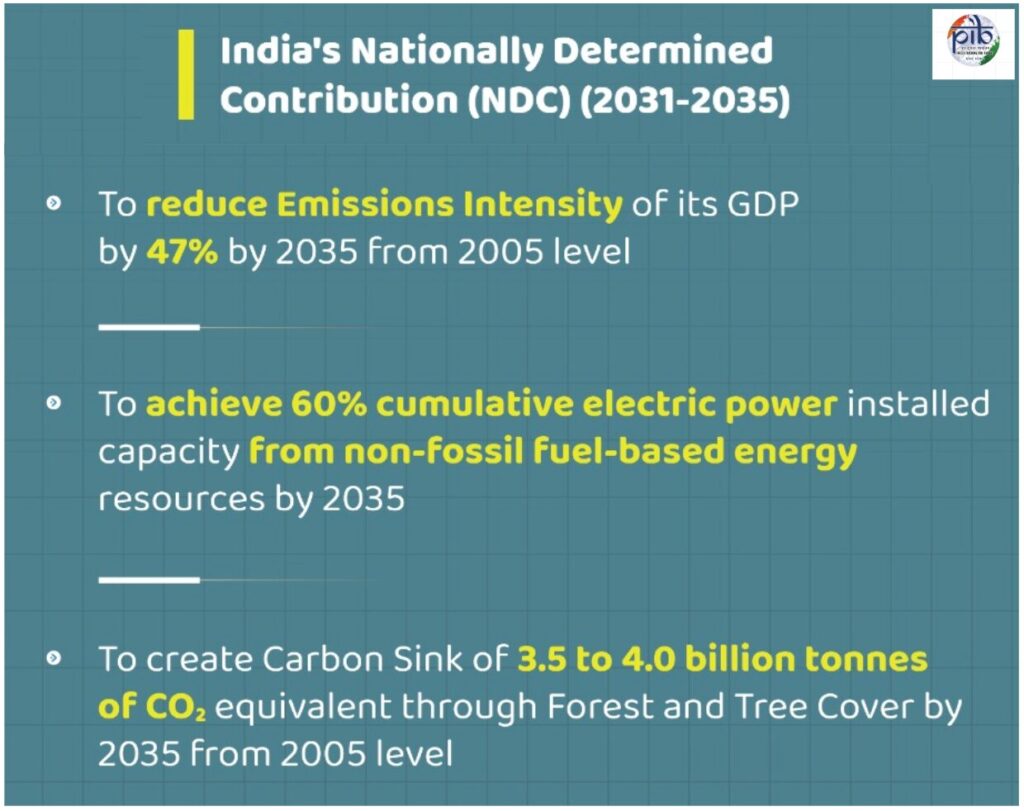
Table of Comparison across successive NDC commitments:
| Targets | First NDC (2015) | Updated NDC (2022) | Updated NDC (2026) |
| Emission Intensity Reduction | Reduce emissions intensity of GDP by 33-35%below 2005 levels | Reduce the emissions intensity of GDP by 45% below 2005 levels by 2030 | Target reduction in emissions intensity of GDP by 47% below 2005 levels by 2035 |
| Share of Non-fossil fuels in installed electricity capacity | Achieve 40% of installed electric power capacity from non-fossil sources by 2030 | Achieve 50% ofcumulative installed power capacity from non-fossil sources by 2030 | Achieve 60% of cumulative installed electricity capacity from non-fossil sources by 2035 |
| Carbon Sink (forests) | Create 2.5 to 3 billion tonnes of additional carbon sink through forest and tree cover | Same | Create a 3.5 to 4 billion tonnes of CO2 equivalent carbon sink through forest and tree cover by 2035 from the 2005 level |
Other Climate Goals:
Apart from the three major commitments, the government laid out other climate goals, including:
- Climate-friendly and cleaner path of economic development
- Resilient infrastructure to combat climate change effects like sudden rain and cloudbursts
- Promoting the Prime Minister’s Lifestyle for Environment (LiFE) mission that urges people to adopt sustainable daily habits
- Developing low-cost, long-term finance mechanisms for green energy
- Capacity building and research and development through technology and international collaborations.
UPSC Prelims PYQ (2016)
Q. With reference to the Agreement at the UNFCCC Meeting in Paris in 2015, which of the following statements is/are correct?
- The Agreement was signed by all the member countries of the UN, and it will go into effect in 2017.
- The Agreement aims to limit the greenhouse gas emissions so that the rise in average global temperature by the end of this century does not exceed 2°C or even 1.5°C above pre-industrial levels.
- Developed countries acknowledged their historical responsibility in global warming and committed to donate $1000 billion a year from 2020 to help developing countries to cope with climate change.
Select the correct answer using the code given below.
(a) 1 and 3 only
(b) 2 only
(c) 2 and 3 only
(d) 1, 2 and 3
Answer: (b)
UPSC Mains PYQ (2021)
Q. Describe the major outcomes of the 26th session of the Conference of the Parties (COP) to the United Nations Framework Convention on Climate Change (UNFCCC). What are the commitments made by India in this conference?