Integrated Battle Groups: Army’s First Mountain Strike Reform
Why in News?
Indian Express reported that the Indian Army is set to establish and operationalize its first Integrated Battle Groups by next month, with the first formations carved out of the Panagarh-based XVII Corps, the mountain strike corps facing China.
The report matters because IBGs turn a long-discussed restructuring idea into a live operational reform: smaller, self-contained, combined-arms formations that can move faster in mountain terrain than a full corps-level mobilization.
- Reported timeline: the plan has reportedly moved from September to July 1, 2026 for the first operationalization step.
- Formation base: the first IBGs are to be carved from XVII Mountain Strike Corps, including the 59 Division and 23 Division.
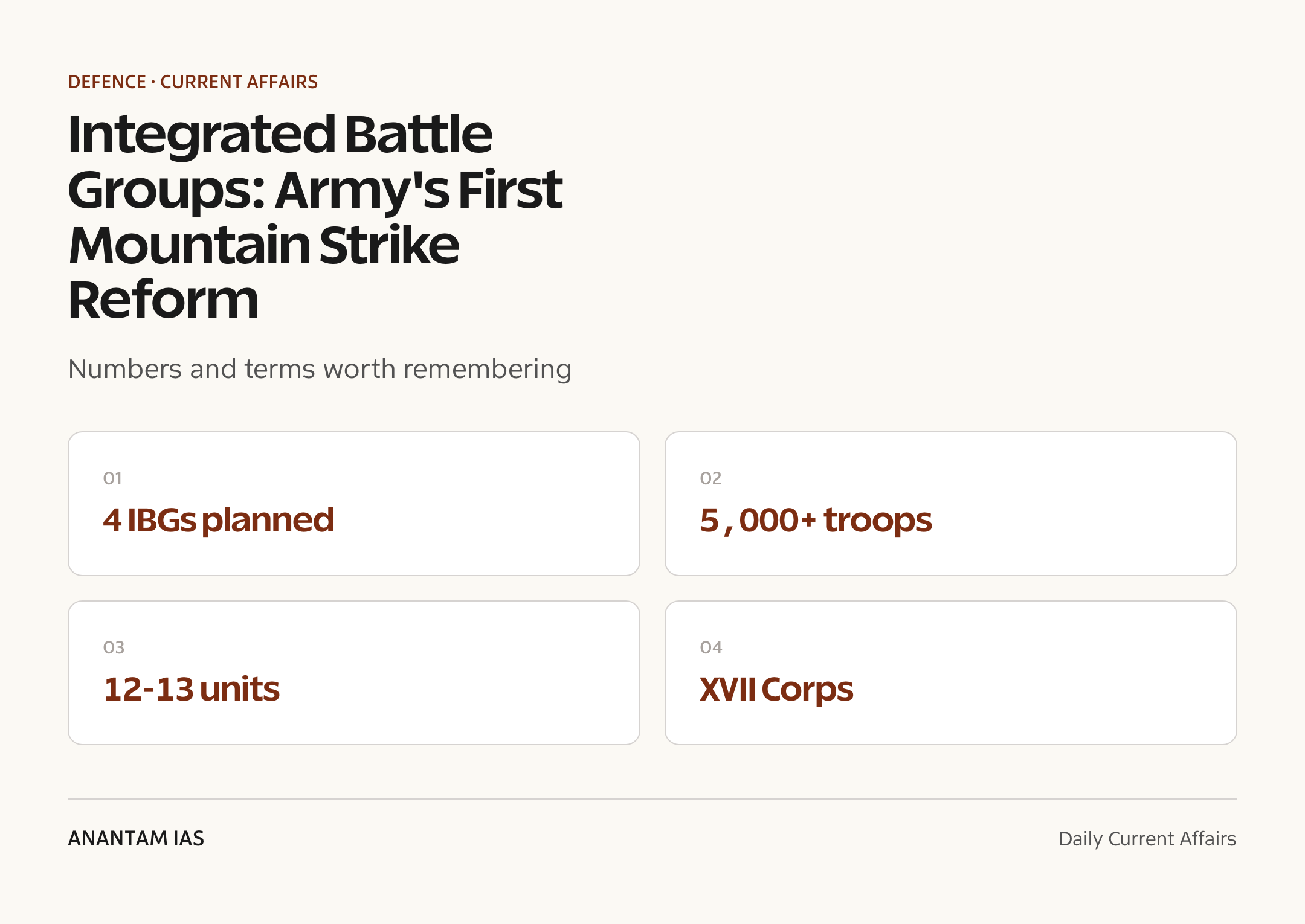
- Planned structure: four IBGs and one fire support group are reported under XVII Corps.
- Command level: each IBG or fire support group is expected to be commanded by a Major General rank officer.
- Combat mix: each IBG may have over 5,000 troops across 12-13 units, including infantry, artillery, engineers, EME, supply and medical elements.
The development matters in the context of:
- This matters in the context of India-China border management, where terrain, weather and logistics make speed as important as numbers.
- It links with defence modernisation, because the Army is moving from large, slower formations to modular groups built for fast combined-arms action.
- It also connects to theatre commands, since IBGs can later be placed under specific integrated commands if India’s jointness reforms mature.
UPSC Relevance
Prelims Relevance
- Integrated Battle Group: a self-contained combined-arms formation meant for faster deployment and operational flexibility.
- XVII Corps: Panagarh-based mountain strike corps associated with India’s eastern and China-facing posture.
- Mountain Strike Corps: a formation designed for offensive and defensive operations in difficult high-altitude terrain.
- Combined arms: coordinated use of infantry, artillery, engineers, logistics, communication, air defence and support services.
- Fire support group: a grouping that can hold artillery and other firepower assets directly under corps-level control.
- EME: Corps of Electronics and Mechanical Engineers, responsible for maintenance and technical support of equipment.
- Exercise HimVijay: one of the exercises in which the IBG concept was reportedly tried in the eastern theatre.
- Rudra brigades and Bhairav battalions: other restructuring ideas mentioned with the wider Army reform package.
Mains Relevance
GS Paper 3
- Internal security and border management: IBGs show how military organization adapts to terrain-specific threats along contested borders.
- Defence modernisation: the reform tests whether India can combine manpower, firepower, logistics and technology in ready-to-move formations.
- Science and technology in security: future IBGs will need drones, secure communications, surveillance, air defence and precision fires.
GS Paper 2
- Governance of defence reforms: IBGs sit beside theatreisation, CDS-led jointness and civil-military coordination.
- India-China relations: the reform reflects operational learning from a more active Himalayan security environment.
Essay
- Security reforms are not only about more weapons; they are about faster institutions.
- Mountains reward preparation, logistics and command clarity more than headline troop strength.
Background and Context
What an Integrated Battle Group Means
An IBG is best understood as a ready, modular, combined-arms formation rather than a normal administrative grouping.
- Integrated: the formation brings fighting arms and support services together before a crisis, instead of assembling them after mobilization begins.
- Battle group: it is designed around a mission, terrain and threat profile, not around a rigid one-size-fits-all template.
- Combined-arms logic: infantry can hold ground, artillery can provide fire support, engineers can clear obstacles, logistics can sustain movement and medical units can support casualties.
- Self-contained design: the reported plan gives each IBG enough support elements to operate with less dependence on a full division or corps structure.
- Mission tailoring: an IBG can be shaped for a particular sector, terrain and task, which is different from treating every formation as identical across plains, deserts and mountains.
- Pre-crisis integration: the value lies in training together before a crisis, because units that meet for the first time during mobilization lose time in coordination.
- Exam point: the core idea is speed with cohesion, not just downsizing the Army.
Why XVII Corps Is Central
The first reported IBGs coming from XVII Corps makes the reform especially important for mountain warfare.
- XVII Corps is based at Panagarh and is widely described as India’s mountain strike corps facing the China sector.
- Mountain terrain compresses movement, slows reinforcement and makes road, bridge, airlift and supply lines decisive.
- Full corps mobilization can take longer because a corps may have very large troop strength, multiple divisions and heavy support echelons.
- IBGs are meant to reduce this lag by placing the fighting and enabling units under a smaller, ready command structure.
- Forward sustainment becomes central in the Himalayas because weather windows, road capacity and altitude sickness can affect combat power as much as enemy action.
- Border infrastructure and force design have to move together; a modular formation is useful only if it can reach, hold and be supplied in its assigned sector.
- Strategic signal: India is trying to create formations that can respond quickly without waiting for the entire corps to move.
Reported Structure of the First IBGs
The reported plan is specific enough to make the topic useful for Prelims and Mains answers.
- Four IBGs and one fire support group are reported under the XVII Mountain Strike Corps plan.
- Major General command is expected for each IBG and the fire support group, which places them above a normal brigade in command weight.
- Troop strength is reported at over 5,000 troops per IBG, with about 12-13 units in each formation.
- Support elements include artillery regiments, Combat Engineers, the Corps of Electronics and Mechanical Engineers, Army Service Corps and field hospital support.
- Chief Operations Officer: the report says a Brigadier-rank officer may hold this role inside each IBG, adding a dedicated operational coordination layer.
- Division source: the first IBGs are expected from the 59 Division and 23 Division, showing that the reform reorganizes existing formations rather than creating a force from scratch.
- Fire support group is likely to remain under corps headquarters and may include newer artillery-related groupings such as Divyastra batteries.
How IBGs Differ From Larger Formations
The reform is about reducing the gap between a brigade’s agility and a corps’ depth.
- Brigade: usually smaller and more agile, but it may depend on higher formations for several support functions.
- Division: larger and more capable, but not always as quick to move as a compact mission-tailored group.
- Corps: powerful but heavy; Indian Express noted that a corps can have up to a lakh troops and takes longer to deploy.
- IBG: sits between these layers by combining combat, firepower, engineering, logistics and medical support under a ready command.
- Modularity: one IBG need not mirror another exactly; the mix can vary by terrain, threat, roads, air support and firepower needs.
- Accountability: a named battle group can make training, readiness and equipment gaps easier to track than a loose ad hoc grouping.
- Answer hook: IBGs are not a replacement for the Army’s hierarchy; they are a faster operational package inside it.
Doctrinal Shift Behind the Reform
IBGs point to a broader change in how the Army thinks about readiness and deterrence.
- Mobilization time is now a capability in itself, especially where short-warning crises can unfold along a contested border.
- Capacity-based planning in the report means building formations that are useful across scenarios, rather than designing them only around one named adversary.
- Offensive and defensive roles both matter: an IBG may blunt an adversary’s attack or carry out limited offensive tasks if ordered.
- HimVijay and IX Corps trials show that the idea has moved through exercises before the first formal operationalization.
- Deterrence value: if an adversary knows India can move credible combat power quickly, the cost of a limited provocation rises.
- Crisis stability: faster formations can help avoid panic mobilization, but they also need political control and clear escalation rules.
- Institutional memory: the IBG idea was linked to one of the restructuring studies initiated under then Army Chief General Bipin Rawat.
Link With Theatreisation and Jointness
IBGs will matter more if they fit into India’s wider command reform instead of staying as isolated Army units.
- Theatreisation seeks to place land, air and naval assets under integrated theatre commands for specific geographic or functional areas.
- The reform connects naturally with India’s debate on theaterisation of the military, because IBGs could become ready land packages for a theatre commander.
- Chief of Defence Staff reforms are relevant because joint command needs common planning, not separate service-level silos.
- For background, see the Anantam IAS explainer on the Chief of Defence Staff and why jointness is difficult in practice.
- Common communications will be essential because a theatre commander cannot use IBGs effectively if Army, Air Force and intelligence systems do not talk to each other.
- Resource allocation also matters: IBGs need assured artillery, aviation, surveillance and logistics support without weakening other sectors.
- Air-land coordination will be crucial in mountains because fire support, surveillance, casualty evacuation and logistics often need air assets.
Technology and New Battlefield Units
The IBG story should be read with other reported Army reforms, not as a stand-alone naming exercise.
- Bhairav battalions, Rudra brigades, Divyastra batteries and Shaktibaan units indicate a wider attempt to create specialized, modular formations.
- Drones and loitering systems can help IBGs with surveillance, target acquisition and terrain awareness, especially when visibility and roads are limited.
- Secure communications matter because a smaller, faster formation becomes vulnerable if command links fail during dispersed mountain operations.
- Precision fires and air defence will decide whether IBGs can survive against a technologically advanced adversary.
- Counter-drone defence must travel with the formation because small units can be exposed to surveillance and strikes in narrow valleys.
- Electronic warfare can disrupt navigation, radios and drones, so IBG training has to include degraded-network operations.
- The reform also links with defence innovation ecosystems such as iDEX, where startups can support sensors, autonomy, communications and logistics tools.
Limits and Risks to Watch
The reform’s success will depend less on the label and more on training, sustainment and command clarity.
- Logistics risk: a fast formation can still stall if fuel, ammunition, spares, bridges, roads and evacuation channels are weak.
- Command overlap: IBGs must have clear reporting lines with division, corps and future theatre command structures.
- Fire support balance: centralizing artillery under a fire support group can improve coordination, but the IBGs must still get timely fires.
- Human-resource challenge: officers and units need repeated training to operate inside mixed combat-service formations.
- Civil-military lesson: Parliament and the executive must track whether restructuring improves readiness without creating avoidable duplication.
- Budget pressure: a new structure needs compatible radios, vehicles, drones, spares and training time; without funding, it becomes a paper reform.
- Escalation control: faster offensive options need political direction, because tactical speed should not outrun strategic judgement.
- For a wider future-war lens, see Anantam IAS notes on Indian defence vision 2047.
Way Forward
Make the Command Chain Unambiguous
- IBG authority should be clearly defined across peace, mobilization and combat stages.
- Division and corps roles must be redesigned so that IBGs do not become another layer in an already heavy hierarchy.
- Theatre command planning should treat IBGs as ready force packages with known tasks, assets and logistics profiles.
Harden Mountain Logistics
- Roads, bridges and airlift should be planned with IBG movement tables, not only broad corps-level movement plans.
- Ammunition, fuel and winter stores need pre-positioning where terrain and weather can cut last-mile access.
- Field hospitals and evacuation chains must be rehearsed because medical support is part of the reported IBG structure.
Train for Combined-Arms Cohesion
- Infantry, artillery, engineers and logistics need repeated joint drills before a crisis, because integration cannot be improvised.
- Mountain exercises should test deployment time, communication reliability, casualty evacuation and fire-support responsiveness.
- After-action reviews should feed back into force design, equipment lists and command procedures.
Add Technology Without Overloading the Formation
- Drones, sensors and secure radios can raise situational awareness, but they must be rugged enough for high altitude.
- Electronic warfare resilience should be built into IBG communications from the start.
- Procurement reform should prioritize interoperable systems rather than scattered platform purchases.
Conclusion
Integrated Battle Groups are important because they change the Army reform debate from size to readiness. For UPSC, the main point is simple: in mountain warfare, a smaller formation with the right combat, logistics and fire support mix may be more useful than a larger formation that reaches late.
The reported XVII Corps rollout should be watched as a test case, not treated as a finished reform. Its success will depend on command clarity, logistics, jointness, technology integration and repeated field validation.
A strong Mains answer should balance the promise of rapid deployment with the hard constraints of mountain logistics, civil-military oversight and integration with future theatre commands.
UPSC Practice Questions
Prelims MCQ 1
With reference to Integrated Battle Groups, consider the following statements:
- They are designed as self-contained combined-arms formations for faster deployment.
- The reported first IBGs are to be carved out of the Panagarh-based XVII Corps.
- They may include infantry, artillery, engineers, EME, supply and medical support elements.
How many of the above statements are correct?
(a) Only one (b) Only two (c) All three (d) None
Answer: (c) All three
Explanation:
All three statements are correct. The reported IBG model combines combat and support elements, with the first formations linked to XVII Mountain Strike Corps.
Prelims MCQ 2
Which one of the following best explains the significance of Integrated Battle Groups in mountainous areas?
(a) They replace all corps-level formations with police-style border units (b) They reduce mobilization delay by grouping combat and support elements under a ready command (c) They are meant only for ceremonial deployment in peacetime (d) They remove the need for artillery and logistics in high-altitude operations
Answer: (b) They reduce mobilization delay by grouping combat and support elements under a ready command
Explanation:
IBGs are meant to improve speed and cohesion in difficult terrain. They do not replace all corps structures, and they still need artillery, logistics and medical support.
UPSC Mains Questions
- Integrated Battle Groups represent a shift from mass mobilization to modular readiness in India’s defence planning. Discuss their significance for border management and the challenges of operationalizing them in mountainous terrain.
- The success of Army restructuring depends as much on logistics and command clarity as on combat power. Examine this statement with reference to Integrated Battle Groups and theatreisation.
- How can technology, jointness and civil-military oversight improve the effectiveness of India’s new military formations without creating duplication in the command structure?
Source: Indian Express.
Frequently Asked Questions
What is an Integrated Battle Group?
An Integrated Battle Group is a self-contained combined-arms formation that brings together infantry, artillery, engineers, logistics, technical support and medical elements for faster deployment. Its purpose is to reduce mobilization delay and improve battlefield cohesion, especially in terrain where moving a full corps can take longer.
Why is XVII Corps important?
XVII Corps is the Panagarh-based mountain strike corps associated with India’s China-facing posture. The reported first IBGs being carved out of this corps makes the reform relevant to high-altitude operations, where speed, terrain familiarity, logistics and fire support decide how quickly forces can respond.
How many IBGs are planned first?
Indian Express reported an existing plan for four Integrated Battle Groups and one fire support group under XVII Mountain Strike Corps. Each IBG is expected to have over 5,000 troops across 12-13 units and be commanded at Major General level.
How are IBGs different from brigades?
A normal brigade is agile but may depend on higher formations for several support functions. An IBG is meant to be more self-contained, with combat arms and support services grouped before a crisis. That makes it more independent than a standard brigade, but lighter than a full corps.
Why do IBGs matter for UPSC?
IBGs connect GS3 defence, internal security, border management, science and technology, and GS2 governance reforms. They help explain how India is trying to modernize force structure, reduce mobilization time, improve combined-arms coordination and prepare for future theatre commands.
What risks can affect IBG success?
The main risks are weak mountain logistics, unclear command lines, insufficient joint training, delays in fire support, communications disruption and duplication with future theatre commands. A new name will not improve readiness unless the formation is repeatedly exercised, supplied and integrated with wider defence reform.