Cockroach Janta Party (CJP): Origin, Demands and the Jantar Mantar Protests
The Cockroach Janta Party began on 16 May 2026 after a remark by the Chief Justice of India and grew past 23 million followers. Full timeline, demands and UPSC relevance.
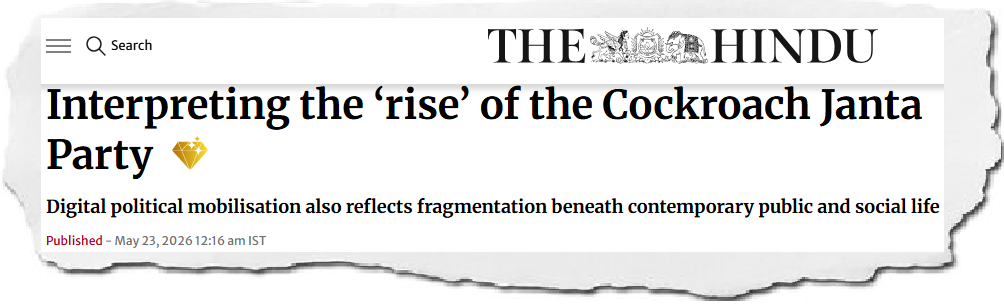
The Cockroach Janta Party (CJP), also spelt Cockroach Janata Party, is a satirical, unregistered political movement founded in India on 16 May 2026 by Abhijeet Dipke. The Cockroach Janta Party took shape one day after Chief Justice of India Surya Kant referred in open court to unemployed “youngsters like cockroaches” who turn to activism. Within three days the movement crossed 11 million Instagram followers, and by July 2026 it had over 23 million, more than any registered Indian political party.
This note explains what the Cockroach Janta Party is, how it grew, what it demands, how the state responded, and what an aspirant should carry into the examination hall from it. The facts below are current to 24 July 2026.
Why in News?
The Cockroach Janta Party moved from social media satire to sustained street protest between May and July 2026. What began as a joke on X became a nationwide agitation at Jantar Mantar over the 2026 NEET paper leak and CBSE On-Screen Marking irregularities, drew a Section 69A blocking order against its social media account, invited a Delhi High Court intervention, and ended a 26-day hunger strike by Sonam Wangchuk with written assurances from the Union Government on 23 July 2026.
The episode matters for three reasons:
- It is the clearest recent case of a digital-first, leaderless political formation acquiring mass scale without registering as a political party or fighting an election.
- It tested the constitutional boundary between Article 19(1)(a) speech rights and executive blocking powers under the Information Technology Act, 2000.
- It forced a policy response on examination integrity, an issue that recurs across GS Paper II governance and GS Paper IV ethics.
Cockroach Janta Party at a Glance
The following table summarises the core facts on the Cockroach Janta Party as of 24 July 2026.
| Particular | Detail |
|---|---|
| Name | Cockroach Janta Party (CJP), also written Cockroach Janata Party |
| Founded | 16 May 2026 |
| Founder | Abhijeet Dipke, 30, a political communications strategist and Boston University public relations graduate who earlier worked with the Aam Aadmi Party |
| Trigger | A remark by Chief Justice of India Surya Kant in open court on 15 May 2026 referring to unemployed “youngsters like cockroaches” |
| Meaning of the name | A parody of the Bharatiya Janata Party. The movement reclaims the slur, translating roughly as the “Cockroach People’s Party” |
| Launch method | A post on X captioned “Main Bhi Cockroach”, followed by a Google Form and website within 24 hours |
| Reach | Over 11 million Instagram followers within three days and more than 350,000 sign-ups; over 23 million followers by July 2026 |
| Registration status | Not registered with the Election Commission of India. The founder has publicly refused to convert it into a political party |
| Core demand | Resignation of Union Education Minister Dharmendra Pradhan and accountability for the 2026 NEET paper leak |
| Main protest site | Jantar Mantar, New Delhi, from 6 June 2026 |
| State action | Account blocked under Section 69A of the IT Act on 21 June 2026; unblocking ordered by the Delhi High Court on 7 July 2026 |
| Status | Protest continuing. Dharmendra Pradhan has not resigned |
UPSC Relevance
Prelims Relevance
- Section 69A, Information Technology Act, 2000: power to block public access to information
- Article 19(1)(a) and the reasonable restrictions under Article 19(2)
- Shreya Singhal v. Union of India (2015) on online speech
- Section 29A, Representation of the People Act, 1951: registration of political parties with the Election Commission of India
- Writ jurisdiction of High Courts under Article 226
Mains Relevance
GS Paper I:
- Social empowerment, youth and social change
- Effects of globalisation and technology on Indian society
GS Paper II:
- Role of pressure groups, civil society and formal or informal associations in the polity
- Government policies and interventions, and issues arising from their design and implementation
- Statutory bodies: Election Commission of India; separation of powers and judicial conduct
GS Paper III:
- Role of social media in internal security challenges
- Awareness in the field of IT, and regulation of digital platforms
GS Paper IV:
- Ethics in public administration; accountability and responsibility of public servants
- Emotional intelligence, and the ethics of dissent and protest
Essay: Democracy and dissent; technology and society; the aspirations of young India.
How the Cockroach Janta Party Started
The Cockroach Janta Party began with a courtroom sentence. On 15 May 2026, during an open hearing at the Supreme Court, Chief Justice of India Surya Kant referred to “youngsters like cockroaches, who don’t get any employment or have any place in the profession” and turn to activism. Clipped and circulated within hours, the phrase read to millions of young Indians as a judge calling the unemployed parasites.
Chief Justice Surya Kant later clarified that his remark was directed at persons practising on fraudulent degrees, not at India’s youth, whom he described as the pillars of a developed India. The clarification arrived after the phrase had already acquired an independent life online, which is itself a study in how digital outrage outruns correction.
On 16 May 2026, Abhijeet Dipke, a 30-year-old political communications strategist and Boston University public relations graduate who had earlier worked with the Aam Aadmi Party, posted a joke on X announcing a platform for “all the cockroaches out there”, captioned Main Bhi Cockroach. A website and a Google Form followed within 24 hours. The membership criteria were deliberately absurd: unemployed, lazy, chronically online, and a professional ranter.
Why the name matters
The name parodies the Bharatiya Janata Party, and translates roughly as the “Cockroach People’s Party”. The rhetorical move is old and effective. A group takes the insult aimed at it and wears it as identity, which converts humiliation into membership. The cockroach also carries a second meaning the movement uses deliberately: it survives what is designed to kill it.
Timeline: From a Courtroom Remark to Jantar Mantar
The Cockroach Janta Party compressed the life cycle of a social movement, from insult to agitation to negotiated assurance, into ten weeks. The timeline below tracks that arc.
| Date (2026) | Development |
|---|---|
| 15 May | Chief Justice of India Surya Kant makes the “youngsters like cockroaches” remark in open court. He later clarifies that he meant holders of fraudulent degrees |
| 16 May | Abhijeet Dipke launches the Cockroach Janta Party on X with the caption “Main Bhi Cockroach”; a website and Google Form follow within 24 hours |
| 19 May | The Instagram account crosses 11 million followers and membership sign-ups pass 350,000 |
| 23 May | The founder alleges that the movement’s website was taken down |
| 6 June | Protests begin at Jantar Mantar, New Delhi, over the 2026 NEET paper leak and CBSE On-Screen Marking irregularities, demanding the resignation of Union Education Minister Dharmendra Pradhan |
| 21 June | The Ministry of Electronics and Information Technology orders the blocking of the movement’s X account under Section 69A of the Information Technology Act, 2000, citing national security |
| 28 June | Ladakhi activist Sonam Wangchuk begins an indefinite hunger strike at Jantar Mantar alongside student activists |
| 7 July | The Delhi High Court orders the account unblocked, holding the security rationale no longer sustainable |
| 18 July | Delhi Police remove Sonam Wangchuk to Safdarjung Hospital on the twentieth day of his fast |
| 20 July | The “Sansad Chalo March” towards Parliament is stopped with lathi charge, tear gas and water cannon. Delhi Police report 118 personnel injured; hospitals report more than 100 injured protesters |
| 23 July | Sonam Wangchuk ends his 26-day fast at Medanta Hospital, Gurugram, in the presence of Union Ministers J. P. Nadda and Dr Jitendra Singh, after written assurances from the Union Government |
What the Cockroach Janta Party Demands
The Cockroach Janta Party operates on two levels: an immediate agitational demand, and a broader manifesto of institutional reform.
Immediate demands
- Resignation of Union Education Minister Dharmendra Pradhan
- Accountability and prosecution for the 2026 NEET paper leak and CBSE On-Screen Marking failures
- Compensation for the families of students who died by suicide in the wake of the paper leak
- Structural reform of competitive examination administration
- No criminal cases against peacefully protesting students
Manifesto demands
- A bar on post-retirement Rajya Sabha seats for Chief Justices of India
- Accountability for deletions from electoral rolls
- Fifty per cent reservation for women in Parliament and the Union Cabinet
- Scrutiny of large corporate holdings in the media sector
- A twenty-year bar on contesting elections for legislators who defect
Note the shape of the list. Every demand targets an institution rather than a policy outcome, which is characteristic of accountability movements rather than programmatic parties. Compare this with the structured, negotiable demands of the 2020-21 farmers’ protest, where a specific set of laws gave the agitation a clear terminal point.
The Jantar Mantar Protests and the State Response
The Jantar Mantar phase converted an online following into a physical constituency, and it is the part of the Cockroach Janta Party story that carries the most examinable content. Protests began on 6 June 2026 with a few hundred participants and grew to tens of thousands by the “Sansad Chalo March” of 20 July, which police stopped short of Parliament using lathi charge, tear gas and water cannon.
The blocking order and the judicial check
On 21 June 2026 the Ministry of Electronics and Information Technology directed the blocking of the movement’s X account under Section 69A of the Information Technology Act, 2000, citing national security. On 7 July 2026 the Delhi High Court ordered the account restored, holding that the security justification no longer held. The sequence is a textbook illustration of executive blocking power meeting judicial review, and it belongs beside Article 19 of the Indian Constitution in your polity notes.
The negotiated outcome
Sonam Wangchuk’s hunger strike, begun on 28 June 2026, gave the agitation a moral focal point that a leaderless online movement could not generate on its own. He ended the 26-day fast on 23 July 2026 after the Union Government furnished written assurances on three counts: that accountability in the examination system would be discussed on the floor of Parliament, that families of students who died by suicide after the NEET paper leak would receive adequate compensation, and that no cases would be registered against peacefully protesting students. The Prime Minister separately announced fast-track courts for paper-leak cases.
Dharmendra Pradhan has not resigned, and the Cockroach Janta Party has stated that the Jantar Mantar protest will continue until he does. The movement therefore secured procedural assurances but not its headline demand, which is the usual settlement point for agitations without electoral leverage.
Why the Cockroach Janta Party Matters: Synchronisation versus Solidarity
The Cockroach Janta Party is significant less for what it achieved than for what it revealed about how political energy now assembles in India. The analytical frame below separates the movement’s speed from its durability.
The power and limits of digital synchronisation
Social media has democratised political expression by allowing isolated individuals to experience collective intensity quickly. A single meme or slogan can generate the feeling of participation within hours, which is how CJP gathered 11 million followers in three days. This synchronisation, an emotional alignment around a common enemy, differs fundamentally from solidarity, which requires sustained organisation, institutional memory, trust and a shared vision.
The distinction is worth an analogy. Synchronisation is thousands of people clapping at the same moment in a concert hall: overwhelming, and over. Solidarity is an orchestra that has rehearsed together for years, which requires discipline, division of labour and a common score. The Cockroach Janta Party managed the first at extraordinary scale. Whether it can build the second is the open question.
Erosion of collective social life
The deeper crisis lies in the weakening of institutions that once produced belonging: campuses, trade unions, student unions, neighbourhood associations and public spaces. Consumerist societies organised around individual choice have expanded private life at the cost of public engagement. The result is a population of emotionally underserved individuals who find temporary relief in digitally mediated outrage. The vacuum left by civil society organisations and NGOs is precisely the space a movement like CJP fills.
India’s demographic position sharpens this. Persons aged 15 to 29 form close to a quarter of the population, and educated unemployment remains the most politically combustible category in the unemployment data for India. High aspiration meeting blocked mobility is the standard precondition for reactive politics.
Lessons from Bangladesh, Nepal and elsewhere
Youth movements in Bangladesh, Nepal, Sri Lanka and Kenya have demonstrated that reactive digital energy can genuinely challenge entrenched regimes. They have also demonstrated the three standard endings: the swarm gets institutionalised into a party, gets redirected by an existing political formation, or simply exhausts itself. The Indian experience with the CJP should be read with the same caution, rather than as proof of a permanent new model of politics. The founder’s refusal to register a party makes the first ending unlikely by design.
Material and structural contradictions
Contemporary societies face a paradox. Citizens emotionally desire decentralisation and anti-establishment politics, yet they live inside highly centralised systems: energy grids, digital platforms, financial networks and megacities. Those systems structurally favour the concentration of power even as politics appears distributed. A movement that lives on two or three privately owned platforms is, in the end, dependent on them, as the June 2026 blocking order demonstrated.
Lacan’s warning: during the French student protests of 1968, the psychoanalyst Jacques Lacan suggested that revolts against authority often end by producing a new authority, because people seek certainty and a master. The observation is a useful check on the assumption that anti-establishment outrage automatically yields better governance.
Constitutional, Legal and Governance Dimensions
- Constitutional perspective: Article 19(1)(a) guarantees freedom of speech and expression, and covers digital expression. Article 19(2) permits reasonable restrictions, and the Supreme Court in Shreya Singhal v. Union of India (2015) struck down Section 66A while upholding Section 69A with procedural safeguards. The June-July 2026 blocking and unblocking of the CJP account sits squarely inside that framework.
- Right to assembly: Article 19(1)(b) protects peaceful assembly, subject to reasonable restrictions. The policing of the Sansad Chalo March raises proportionality questions that recur in every mass-protest question paper.
- Electoral law: Section 29A of the Representation of the People Act, 1951 governs the registration of political parties. The Cockroach Janta Party is not registered, so it enjoys none of the recognitions, and carries none of the disclosure obligations, that attach to a registered party. That gap is the governance question the episode poses.
- Governance dimension: the movement is a symptom of declining trust in formal institutions and of the rise of what scholars call networked governance. It behaves much like a pressure group in Indian democracy, but without membership rolls, office bearers or accountability.
- Judicial conduct: the trigger was a remark from the bench. Judicial language in open court is not merely procedural, and the episode is a live example of how institutional speech shapes public legitimacy.
- Comparative dimension: from the Arab Spring to recent movements in Sri Lanka and Kenya, digitally organised youth mobilisation is a global feature of late modernity rather than an Indian exception.
Challenges and Criticisms
A balanced answer must state the case against the Cockroach Janta Party as clearly as the case for it.
- The trigger was partly a misreading: Chief Justice Surya Kant clarified that his remark referred to persons practising on fraudulent degrees. A movement founded on a clipped quote inherits a problem of factual foundation.
- Sustainability: outrage-driven movements typically fade when the trigger fades. Search interest in CJP fell sharply between May and July 2026 even as the street protest continued.
- Accountability deficit: an unregistered formation with 23 million followers has influence without any of the disclosure, audit or internal-democracy requirements that bind registered parties.
- Risk of populism: reliance on a symbolic enemy polarises debate and crowds out the negotiation that policy change actually requires.
- Digital divide and manipulation: the movement empowers the connected and excludes those without access or digital literacy, and platform algorithms can amplify misinformation as readily as grievance.
- Institutional erosion: continuous reactive politics can further weaken political parties and parliamentary processes, which remain the load-bearing structures of a stable democracy.
- Material reality: even decentralised movements must eventually engage centralised state structures for welfare delivery, regulation and redress, as the July 2026 negotiation showed.
Way Forward
- Rebuild collective institutions: strengthen student unions, Panchayats, municipalities and civil society platforms that sustain dialogue instead of episodic outrage.
- Fix the examination system at its root: the assurances of 23 July 2026 on parliamentary discussion, compensation and fast-track courts must translate into statutory reform of examination administration, not a single news cycle.
- Digital literacy and proportionate regulation: build digital citizenship into school curricula, and ensure that blocking powers under Section 69A carry reasoned orders and time limits so that judicial correction is not the only safeguard.
- Youth-centric policy: expand Skill India, the Prime Minister’s Employment Generation Programme and the National Youth Policy with explicit attention to aspiration management and mental health.
- Hybrid political models: parties should adopt digital tools for participation while retaining organisational depth, internal democracy and ideological clarity.
- Channel energy into solidarity: community initiatives through the National Service Scheme and Nehru Yuva Kendra Sangathan can convert episodic emotion into social capital.
- Evidence-based research: commission studies on digital political behaviour through NITI Aayog or the Ministry of Youth Affairs and Sports.
- Ethical leadership on all sides: restraint in institutional speech, and the ethics of protest and civil disobedience, apply equally to the bench, the executive and the movement.
Conclusion
The Cockroach Janta Party is symptomatic of a deeper transformation in Indian society, the tension between individualised aspiration and an unmet hunger for collective meaning. In ten weeks it converted an offhand judicial remark into 23 million followers, a sustained occupation of Jantar Mantar, a constitutional test of Section 69A, and written assurances from the Union Government. It did not obtain the resignation it demanded, and it has refused to become a party that could contest for the power to compel one.
That combination is the lesson. Digital tools have widened the democratic sphere, but converting fleeting synchronisation into enduring solidarity remains the unsolved problem. As India works towards its 2047 goals, the gap between emotional energy and institutional capacity is the gap that mature democratic governance has to close.
UPSC Practice Questions
Q1. Consider the following statements regarding the Cockroach Janta Party:
- It is registered with the Election Commission of India under the Representation of the People Act, 1951.
- It emerged in 2026 following a remark made by the Chief Justice of India in open court.
- Its stated core demand during the 2026 Jantar Mantar protests was the resignation of the Union Education Minister.
Which of the statements given above are correct?
(a) 1 and 2 only
(b) 2 and 3 only
(c) 1 and 3 only
(d) 1, 2 and 3
Answer: (b) 2 and 3 only
Explanation: The Cockroach Janta Party is not registered with the Election Commission of India, and its founder has publicly declined to convert it into a political party, so statement 1 is incorrect. It was launched on 16 May 2026, a day after the Chief Justice of India’s remark in open court, and its headline demand at Jantar Mantar was the resignation of Union Education Minister Dharmendra Pradhan.
Q2. With reference to Section 69A of the Information Technology Act, 2000, consider the following statements:
- It empowers the Central Government to direct blocking of public access to information in the interest of, among other grounds, the sovereignty and integrity of India.
- It was struck down by the Supreme Court in Shreya Singhal v. Union of India (2015).
- Orders issued under it are amenable to judicial review by the High Courts.
Which of the statements given above are correct?
(a) 1 and 2 only
(b) 2 and 3 only
(c) 1 and 3 only
(d) 1, 2 and 3
Answer: (c) 1 and 3 only
Explanation: In Shreya Singhal v. Union of India (2015) the Supreme Court struck down Section 66A but upheld Section 69A along with the associated blocking rules, subject to procedural safeguards. Statement 2 is therefore incorrect. Blocking orders remain reviewable, as the Delhi High Court demonstrated on 7 July 2026 when it ordered the restoration of the CJP account.
Q3. Which of the following best describes the constitutional basis of digital political expression in India?
(a) Article 14
(b) Article 19(1)(a)
(c) Article 21
(d) Article 32
Answer: (b) Article 19(1)(a)
Explanation: Freedom of speech and expression under Article 19(1)(a) extends to expression through digital and online media, subject to the reasonable restrictions enumerated in Article 19(2).
Q4. Consider the following statements about the registration of political parties in India:
- Registration is granted by the Election Commission of India under Section 29A of the Representation of the People Act, 1951.
- An unregistered political association cannot lawfully hold public meetings or campaign on public issues.
- Registration is a precondition for a party to claim a reserved election symbol.
Which of the statements given above are correct?
(a) 1 and 2 only
(b) 1 and 3 only
(c) 2 and 3 only
(d) 1, 2 and 3
Answer: (b) 1 and 3 only
Explanation: Section 29A of the Representation of the People Act, 1951 provides for registration with the Election Commission of India, and symbol allotment under the Election Symbols (Reservation and Allotment) Order, 1968 flows from registered status. Statement 2 is incorrect: an unregistered association retains the ordinary rights of speech and assembly under Articles 19(1)(a) and 19(1)(b), as the Cockroach Janta Party episode illustrates.
Q5. In the context of contemporary political mobilisation, “synchronisation” is best distinguished from “solidarity” on the ground that synchronisation:
(a) requires formal membership and elected office bearers
(b) denotes momentary emotional alignment without sustained organisation
(c) refers exclusively to protest conducted under judicial supervision
(d) is recognised as a category under the Representation of the People Act, 1951
Answer: (b) denotes momentary emotional alignment without sustained organisation
Explanation: Synchronisation describes the rapid emotional alignment of dispersed individuals around a common grievance, typically mediated by digital platforms. Solidarity, by contrast, requires organisation, institutional memory, trust and a shared long-term vision.
UPSC Mains Questions
- “In the age of social media, Indian democracy is witnessing a shift from institutional politics to reactive digital mobilisation.” Discuss the causes and implications of this shift for democratic governance in India. (250 words)
- Examine the challenges in transforming digitally synchronised public outrage into sustainable collective action addressing youth aspirations in India. Suggest measures to bridge this gap. (250 words)
- Blocking orders under Section 69A of the Information Technology Act, 2000 seek to balance national security with the freedom of speech and expression. Critically evaluate the adequacy of existing safeguards in the light of recent judicial pronouncements. (150 words)
- Unregistered mass movements can command a larger following than registered political parties without carrying any of their accountability obligations. Discuss the implications for electoral law and democratic accountability in India. (150 words)
Sources: Supreme Court of India proceedings of 15 May 2026 as reported in the national press; Ministry of Electronics and Information Technology blocking order of 21 June 2026; Delhi High Court order of 7 July 2026; Government of India assurances of 23 July 2026. Facts verified against contemporaneous reporting by the BBC, Al Jazeera, NDTV and Business Standard.
Frequently Asked Questions
What is the Cockroach Janta Party?
The Cockroach Janta Party (CJP) is a satirical, unregistered political movement founded in India on 16 May 2026 by Abhijeet Dipke. It grew out of a remark by Chief Justice of India Surya Kant comparing unemployed youth to cockroaches, and it campaigns on unemployment, examination integrity, press freedom and institutional accountability rather than contesting elections.
Who founded the Cockroach Janta Party?
Abhijeet Dipke, a 30-year-old political communications strategist and Boston University public relations graduate who previously worked with the Aam Aadmi Party, founded CJP on 16 May 2026 with a post on X captioned “Main Bhi Cockroach”.
Why is it called the Cockroach Janta Party?
The name parodies the Bharatiya Janata Party and translates roughly as the “Cockroach People’s Party”. It reclaims the Chief Justice of India’s courtroom reference to “youngsters like cockroaches”, turning an insult into a badge of identity and survival.
Is the Cockroach Janta Party a registered political party?
No. CJP is not registered with the Election Commission of India under Section 29A of the Representation of the People Act, 1951. Its founder has publicly refused to convert it into a political party, describing electoral contestation as pointless in the present circumstances.
What are the Cockroach Janta Party’s demands?
Its immediate demand is the resignation of Union Education Minister Dharmendra Pradhan and accountability for the 2026 NEET paper leak. Its wider manifesto seeks a bar on post-retirement Rajya Sabha seats for Chief Justices, accountability for electoral roll deletions, 50 per cent women’s reservation in Parliament and the Cabinet, scrutiny of corporate media holdings, and a 20-year election bar for defectors.
What happened at the 2026 Jantar Mantar protests?
Protests began at Jantar Mantar in New Delhi on 6 June 2026 over the NEET paper leak and CBSE On-Screen Marking irregularities. The “Sansad Chalo March” of 20 July 2026 was stopped with lathi charge, tear gas and water cannon, with police reporting 118 personnel injured and hospitals more than 100 injured protesters.
Was the Cockroach Janta Party’s social media account blocked?
Yes. On 21 June 2026 the Ministry of Electronics and Information Technology ordered the blocking of the movement’s X account under Section 69A of the Information Technology Act, 2000, citing national security. The Delhi High Court ordered the account restored on 7 July 2026.
Did the Cockroach Janta Party protests achieve anything?
Partly. On 23 July 2026 Sonam Wangchuk ended a 26-day hunger strike after the Union Government gave written assurances on parliamentary discussion of examination accountability, compensation for families of students who died by suicide, and no cases against peaceful protesters. The Prime Minister announced fast-track courts for paper-leak cases. Dharmendra Pradhan has not resigned, and the protest continues.
Why is the Cockroach Janta Party relevant for the UPSC examination?
It links GS Paper I social change, GS Paper II pressure groups and electoral law, GS Paper III social media and internal security, and GS Paper IV ethics of dissent. Prelims-relevant hooks include Section 69A of the IT Act, Article 19(1)(a), Shreya Singhal (2015) and Section 29A of the Representation of the People Act, 1951.