Civil Society & NGOs: Role in Indian Democracy
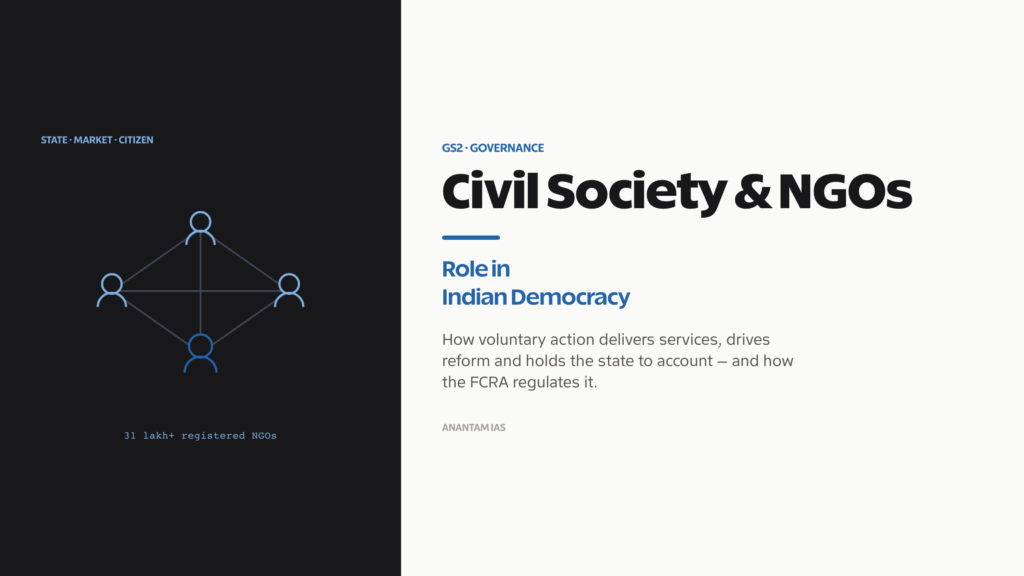
Civil society is the arena of uncoerced collective action around shared interests, purposes, and values — distinct from the state, the market, and the family. In India, civil society encompasses non-governmental organisations (NGOs), community-based organisations, trade unions, professional associations, media, religious groups, and social movements. With over 31 lakh registered NGOs (per a 2015 CBI estimate), India has one of the world’s most vibrant voluntary sectors. Understanding civil society’s role, regulation, and challenges is essential for UPSC GS-II and Essay papers.
What Is Civil Society?
Civil society occupies the space between the individual/family and the state. It includes:
- NGOs and voluntary organisations: Registered bodies working on specific social issues
- Community-based organisations (CBOs): Grassroots groups formed by communities for local development
- Social movements: Organised collective action for social change (farmers’ movements, environmental movements)
- Media: Plays a watchdog role in democracy
- Professional associations: Bar councils, medical associations, teacher unions
- Religious and cultural organisations
- Trade unions and labour organisations
- Think tanks and research institutions
The key characteristic: civil society organisations operate outside the state apparatus and market economy, though they interact with both.
Types of NGOs in India
Based on Registration
| Type | Registering Law | Features |
|---|---|---|
| Society | Societies Registration Act, 1860 | Most common form; governed by a managing committee; must have minimum 7 members |
| Trust | Indian Trusts Act, 1882 (private trusts); state-level public trusts acts | Governed by trustees; common for religious and charitable organisations |
| Section 8 Company | Companies Act, 2013 (Section 8) | Not-for-profit company; can’t distribute profits to members; more structured governance |
Based on Function
Operational NGOs: Directly implement projects — running schools, hospitals, livelihood programmes, disaster relief. Example: Pratham (education), SEWA (women’s self-employment).
Advocacy NGOs: Focus on influencing policy through research, campaigns, lobbying, and litigation. Example: Centre for Science and Environment (environmental policy), PUCL (civil liberties).
Hybrid NGOs: Combine operational work with advocacy. Example: Oxfam India, Greenpeace India.
Based on Orientation
| Orientation | Focus | Examples |
|---|---|---|
| Charitable | Service delivery — relief, welfare | Missionaries of Charity, Akshaya Patra |
| Service | Development programmes — education, health, livelihood | Pratham, Goonj, Barefoot College |
| Participatory | Community empowerment and self-help | SEWA, Gram Vikas |
| Empowerment | Rights-based approach, structural change | MKSS, Narmada Bachao Andolan |
Role of Civil Society in Indian Democracy
Positive Contributions
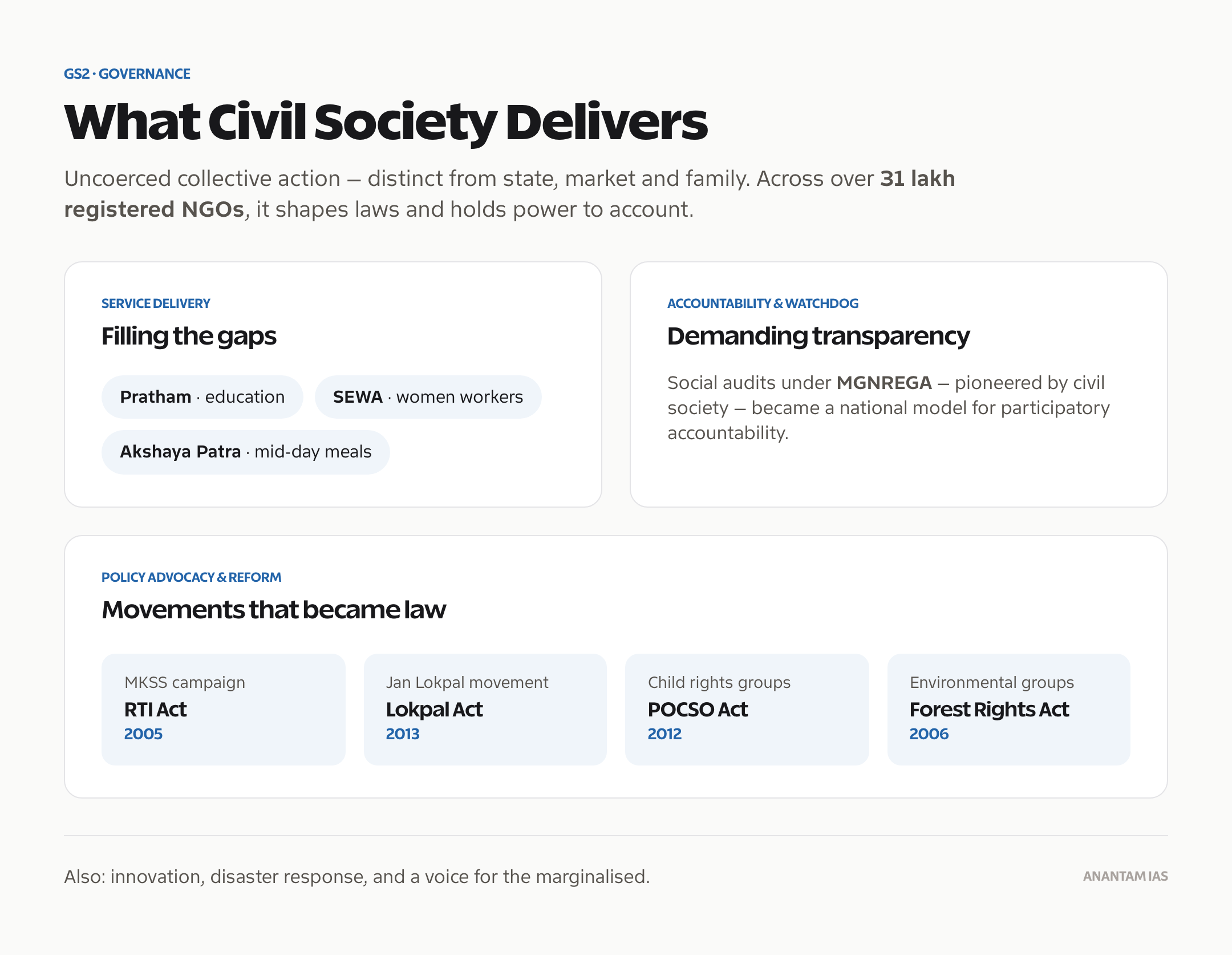
Service Delivery and Development: NGOs fill gaps where government services are inadequate. Organisations like Pratham (education quality), SEWA (women workers’ rights), and Akshaya Patra (mid-day meals) serve millions.
Policy Advocacy and Reform: Civil society has driven major legislative reforms:
- Mazdoor Kisan Shakti Sangathan (MKSS) campaigned for the RTI Act, 2005
- Jan Lokpal movement contributed to the Lokpal and Lokayuktas Act, 2013
- Child rights organisations advocated for the Protection of Children from Sexual Offences (POCSO) Act, 2012
- Environmental groups influenced the Forest Rights Act, 2006
Accountability and Watchdog Function: Civil society monitors government performance, exposes corruption, and demands transparency. Social audits under MGNREGA, pioneered by civil society organisations, have become a model for participatory accountability.
Innovation and Experimentation: NGOs pilot innovative approaches that governments later scale. Arvind Eye Care’s model, SEWA’s microfinance approach, and Barefoot College’s solar engineering programme for rural women are examples adopted or replicated nationally and internationally.
Disaster Response: Civil society organisations often provide the first response during disasters. Their local presence, flexibility, and community networks make them effective first responders — as demonstrated during the Kerala floods (2018), COVID-19 pandemic (2020–21), and Odisha cyclones.
Voice for the Marginalised: Civil society amplifies the voices of communities that lack political power — tribal groups, women, children, persons with disabilities, LGBTQ+ individuals, and migrant workers.
Criticisms and Concerns
Accountability Gap: Many NGOs lack internal transparency and accountability. Financial management is often opaque, and there’s limited public disclosure of activities and outcomes.
Foreign Influence: The FCRA debate centres on whether foreign-funded NGOs advance foreign agendas that may conflict with national interest. The government has argued that some NGOs funded by foreign sources have opposed developmental projects.
Political Co-optation: Some NGOs become fronts for political parties or vested interests, compromising their independence and credibility.
Elitism: Critics argue that many NGOs are urban, English-speaking, middle-class organisations disconnected from the communities they claim to serve.
Parallel Governance: When NGOs take over service delivery functions, it can weaken government accountability and create dependency rather than systemic change.
Regulatory Framework
Foreign Contribution (Regulation) Act (FCRA), 2010
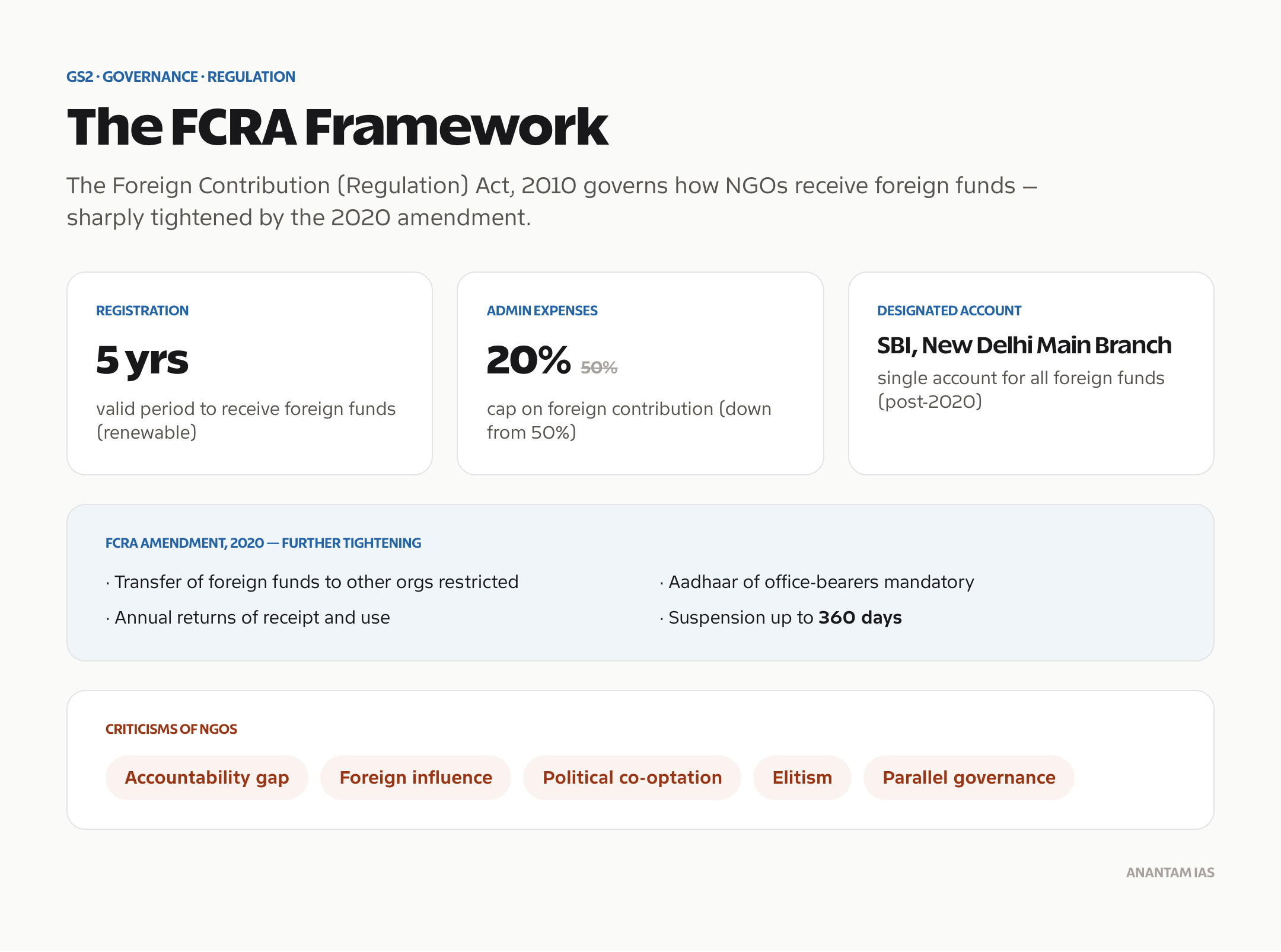
The FCRA regulates the acceptance and utilisation of foreign contributions by NGOs and associations. Key provisions:
- NGOs must register under FCRA to receive foreign funding
- Registration is valid for 5 years (renewable)
- Foreign contributions must be received in a designated FCRA account at a specified bank branch (State Bank of India, New Delhi Main Branch — post 2020 amendment)
- Organisations can use maximum 20% of foreign contributions for administrative expenses (reduced from 50% by 2020 amendment)
- Annual returns must be filed showing receipt and utilisation
FCRA Amendment Act, 2020: Tightened regulations significantly:
- All foreign contributions must be received in a single designated SBI account in New Delhi
- Administrative expenses capped at 20%
- Transfer of foreign funds to other organisations restricted
- Aadhaar-based identification of office bearers mandatory
- Government can suspend FCRA registration for 360 days (earlier 180 days)
Other Regulatory Mechanisms
| Regulation | Purpose |
|---|---|
| Income Tax Act (Section 12A, 80G) | Tax exemption for charitable organisations; tax deduction for donors |
| Companies Act, 2013 (CSR provisions) | Mandates 2% profit spending on CSR — many companies partner with NGOs |
| NGO Darpan (NITI Aayog) | Voluntary registration portal for NGOs receiving government grants |
| State-level Charity Commissioners | Regulate trusts and societies at the state level |
Comparison: Civil Society Regulation Across Countries
| Feature | India | USA | UK | China |
|---|---|---|---|---|
| Primary Law | Societies Act, Trusts Act, Companies Act | State nonprofit laws + IRC 501(c) | Charities Act, 2011 | Law on Administration of Activities of Overseas NGOs |
| Foreign Funding | FCRA — strict regulation | Minimal regulation | Minimal regulation | Extremely restrictive |
| Tax Benefits | Sections 12A, 80G | 501(c)(3) tax exemption | Gift Aid, tax relief | Limited |
| Government Oversight | MHA (FCRA), Income Tax, State authorities | IRS, State Attorneys General | Charity Commission | Ministry of Public Security |
| Operational Freedom | Moderate (restricted by FCRA) | High | High | Very restricted |
Landmark Civil Society Movements in India
| Movement | Leaders/Organisations | Achievement |
|---|---|---|
| Chipko Movement (1973) | Sunderlal Bahuguna, Gaura Devi | Forest conservation policy; environmental awareness |
| Narmada Bachao Andolan (1985) | Medha Patkar | Displacement and rehabilitation policy reform |
| RTI Movement (1990s–2005) | MKSS, Aruna Roy | Right to Information Act, 2005 |
| Anti-Corruption Movement (2011) | Anna Hazare, India Against Corruption | Lokpal and Lokayuktas Act, 2013 |
| Nirbhaya Movement (2012) | Spontaneous civic response | Criminal Law (Amendment) Act, 2013 |
| Farmers’ Movement (2020–21) | 40+ farmer unions | Repeal of three farm laws |
Self-Regulatory Mechanisms
Recognising the accountability deficit, some NGOs have adopted self-regulatory measures:
- Credibility Alliance: Sets minimum norms for governance and accountability
- GuideStar India: Provides a platform for NGO transparency and information sharing
- Give India: Conducts due diligence on listed NGOs
- Voluntary Codes of Conduct: Adopted by networks of NGOs for ethical practices
Way Forward
Strengthening civil society requires balancing regulation with freedom. Key recommendations include:
- Transparent, objective criteria for FCRA registration and cancellation
- Simplified compliance requirements for smaller, grassroots organisations
- Encouraging self-regulation through credibility standards
- Government-NGO partnership models rather than adversarial relationships
- Strengthening state-level regulatory bodies
Pressure Groups in India RTI Act 2005 E-Governance in India
Frequently Asked Questions
What is the difference between civil society and NGOs?
Civil society is the broader ecosystem of voluntary, non-state, non-market associations — including NGOs, media, trade unions, religious organisations, social movements, and community groups. NGOs are a specific subset of civil society: formally registered organisations working on social, developmental, or advocacy issues. All NGOs are part of civil society, but civil society encompasses much more than NGOs.
How does the FCRA regulate NGOs in India?
The FCRA, 2010 (amended 2020) requires NGOs to register with the Ministry of Home Affairs before receiving foreign contributions. All foreign funds must be received in a designated SBI account in New Delhi. Administrative expenses are capped at 20%. NGOs must file annual returns detailing receipt and utilisation. The government can cancel or suspend FCRA registration for violations. The Act aims to prevent foreign influence on India’s internal affairs.
How many NGOs are there in India?
According to a 2015 CBI estimate filed with the Supreme Court, India has approximately 31 lakh registered NGOs — roughly one NGO for every 400 citizens. However, many registered organisations are dormant. The actual number of active, functioning NGOs is significantly lower. NITI Aayog’s NGO Darpan portal has registered over 1.5 lakh NGOs seeking government grants.
Can NGOs receive foreign funding without FCRA registration?
No. Any association, trust, or Section 8 company receiving foreign contributions must have valid FCRA registration or prior permission from the Ministry of Home Affairs. Receiving foreign funds without FCRA clearance is a criminal offence. The 2020 amendment further tightened this by mandating a single designated SBI bank account and restricting fund transfers between organisations.
Tell Google you want more of this.
Add Anantam IAS as a preferred sourceOne tap, and this site shows up more often in your own Top Stories, AI Overviews and AI Mode. Remove it any time.