Keeladi Excavations: New Brick Structures Deepen the Sangam-Age Record
Why in News?
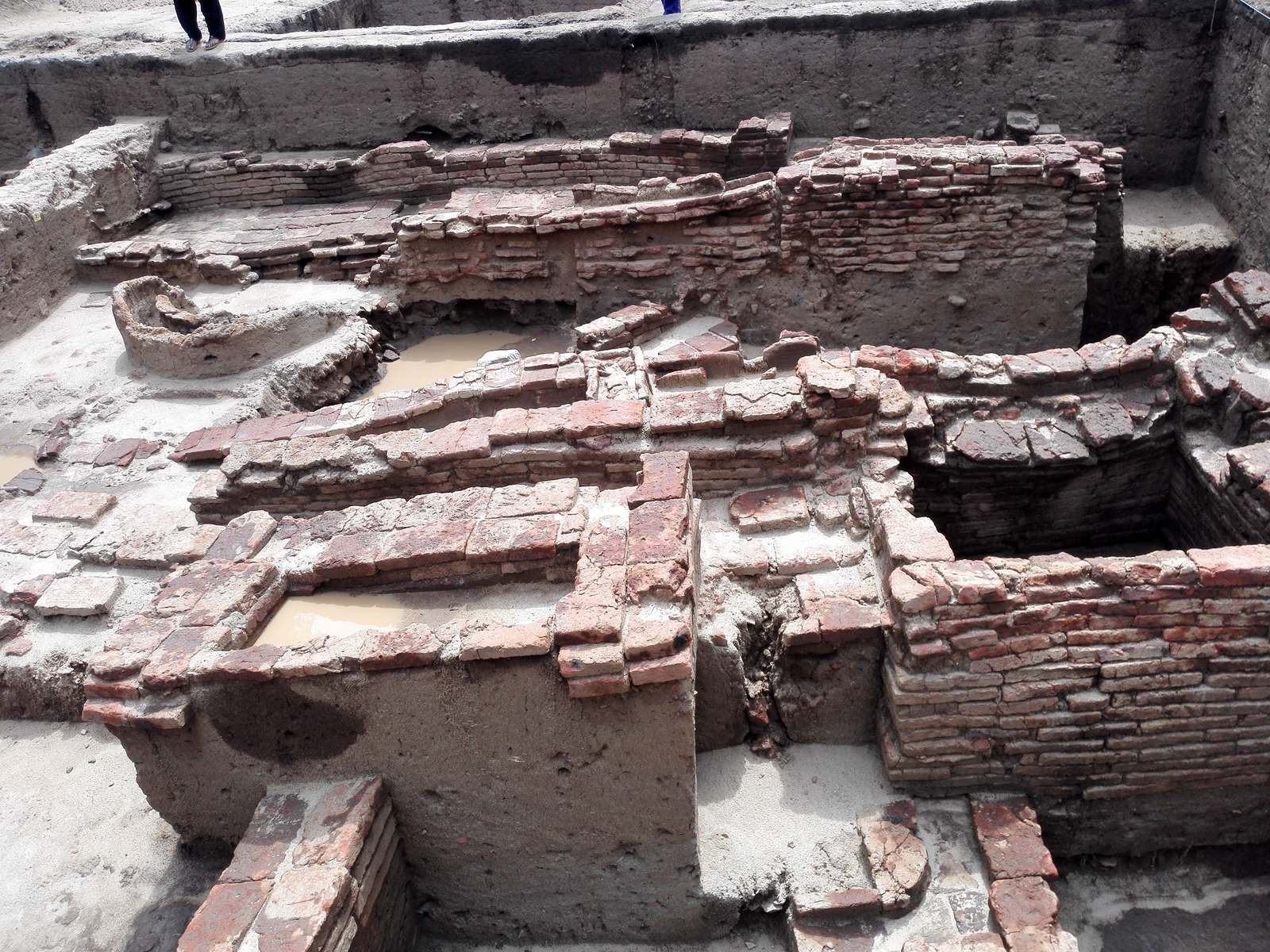
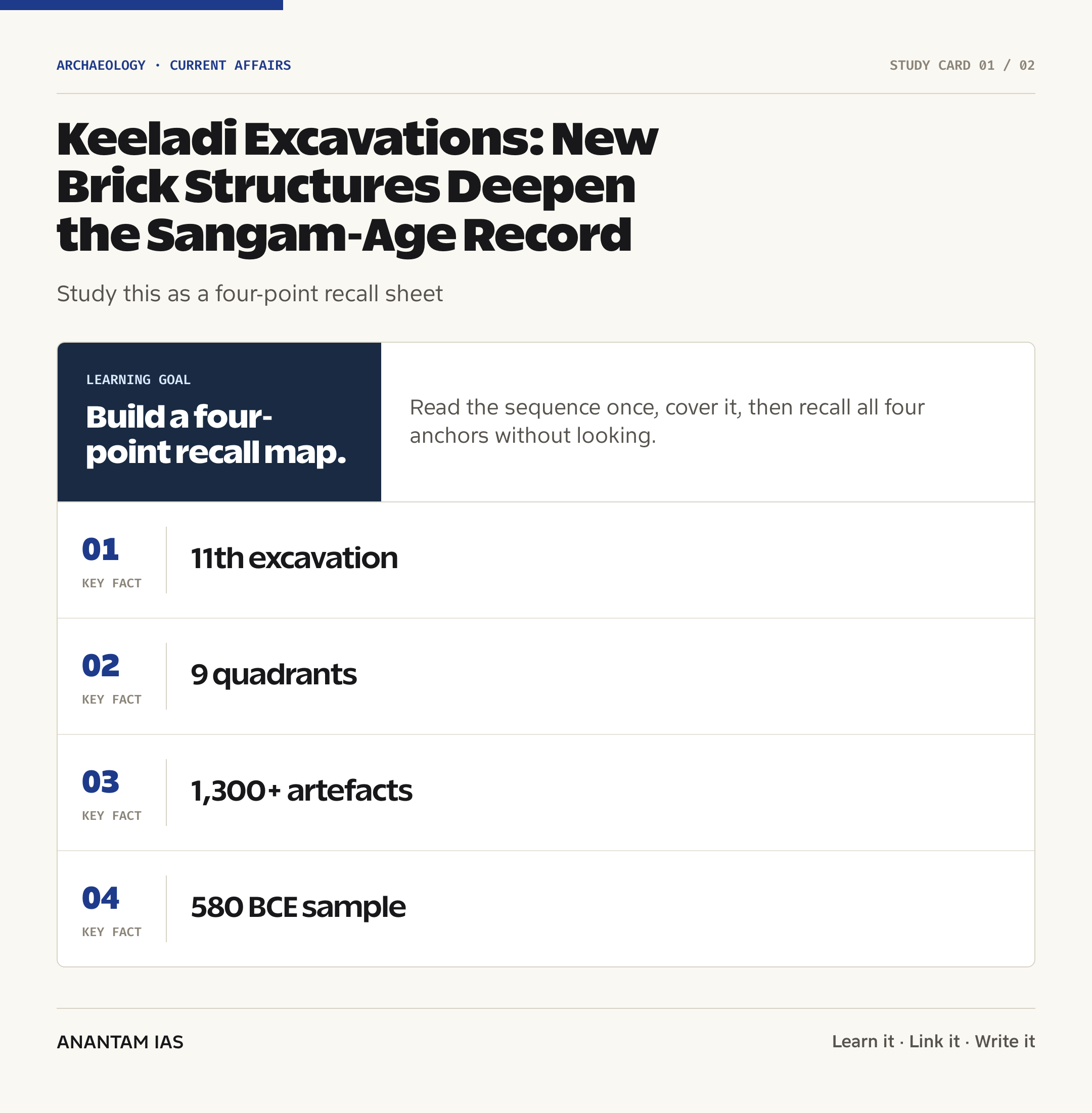
The Hindu reported that the 11th phase of excavation at Keeladi in Tamil Nadu’s Sivagangai district has exposed continuous brick structures across all nine excavated quadrants, along with more than 1,300 artefacts.
The discoveries add fresh material to the study of an early historic settlement in the Vaigai valley, but the function and date of the newly exposed structures must await complete excavation, stratigraphic study and scientific dating.
- The current phase began on 18 March 2026 in an area south of Keeladi’s on-site museum.
- Excavators found continuous brick remains in all nine quadrants; the exposed alignment appears to continue beyond the excavated area towards the west and north.
- One quadrant yielded a terracotta pipeline and a closed drain, while an open drainage feature was also identified in the excavation area.
- The 1,300-plus artefacts include terracotta objects, iron implements, semi-precious stones, ivory dice, tiny gold ornaments and intact pottery.
- One intact pot has a handle, and another carries a fish symbol on its shoulder; these observations need contextual study before wider conclusions are drawn.
- Organic material from the present phase is to undergo radiocarbon dating, so the new structures should not yet be assigned a precise date.
The development matters in the context of:
- The finds matter in the context of debates on early urbanism outside the middle Gangetic plain and the material foundations of Sangam-age society.
- Keeladi allows historians to compare excavated evidence with the society, trade and political geography described in Sangam-age literature.
- The excavation also shows why archaeology works through a chain of context, stratigraphy, dating and publication, rather than through spectacular objects alone.
UPSC Relevance
Prelims Relevance
- Keeladi, also written Keezhadi, is an early historic habitation site in Sivagangai district, near Madurai in Tamil Nadu.
- The site lies in the Vaigai river valley; the Tamil Nadu archaeology department places the cultural mound about 13 km southeast of Madurai.
- The Archaeological Survey of India conducted the first three excavation phases, while the Tamil Nadu State Department of Archaeology has led the subsequent phases.
- The present work is the 11th excavation phase; it began on 18 March 2026 and may continue according to field and weather conditions.
- Earlier Keeladi finds include brick walls, ring wells, roof tiles, drains, iron objects, beads, spindle whorls, graffiti sherds and Tamil-Brahmi-inscribed pottery.
- An earlier radiocarbon result cited by the Tamil Nadu department placed a sample at 580 BCE; this date belongs to a tested sample and cannot automatically date every structure or artefact.
- Tamil-Brahmi is an early adaptation of the Brahmi script used for the Tamil language; inscribed potsherds provide evidence about names, ownership and writing practices.
- The Ancient Monuments and Archaeological Sites and Remains Act, 1958 and its rules form part of the legal framework governing protected archaeology and licensed excavations in India.
- Material remains should be read by provenance, meaning the precise location and context in which an object was recovered, not merely by the object’s appearance.
Mains Relevance
GS Paper 1
- Use Keeladi to discuss how archaeology complements literary sources in reconstructing the history of early Tamilakam.
- Assess the evidence for settlement planning, craft production, exchange and literacy in Sangam-age south India.
- Explain the limits of equating brick architecture or drainage features with a fully demonstrated urban system without settlement-scale analysis.
- Connect Keeladi with the broader geography of the Vaigai valley, Madurai and the Chera-Chola-Pandya world described in early Tamilakam.
- Evaluate the role of scientific dating, conservation and timely excavation reports in credible heritage governance.
Essay
- Objects and texts tell different parts of the past; a responsible history makes them test, refine and sometimes challenge one another.
- Cultural pride becomes durable when it rests on open evidence, careful method and room for scholarly revision.
Background and Context
Keeladi and the Vaigai Valley
Keeladi is valuable because it preserves the material remains of an early historic community close to Madurai, a major centre in the literary geography of Tamilakam.
- The site is in Thiruppuvanam taluk of Sivagangai district, on a cultural mound in the wider Vaigai river landscape.
- The Tamil Nadu department describes the mound as extending over more than 110 acres, which makes settlement-scale investigation more useful than treating a single trench as the whole site.
- Its location near Madurai creates a productive comparison with Sangam texts associated with Pandyan country, but proximity alone doesn’t prove that every literary description refers directly to Keeladi.
- Keeladi, the burial site of Konthagai, and nearby localities such as Agaram and Manalur are often studied as a connected archaeological landscape of habitation, mortuary practice and production.
- For revision, place Keeladi within Sangam-age society, while remembering that archaeological periods and literary chronologies don’t always align neatly.
- Reconstructing the ancient landscape also requires geomorphology and palaeoenvironmental evidence, because river movement, erosion and later land use affect what survives and where archaeologists can find it.
What the Eleventh Phase Has Found
The strongest new evidence is the combination of connected structural remains, water-management features and a varied artefact assemblage recovered from recorded excavation contexts.
- Continuous brick structures were reported across nine quadrants, with the alignment continuing beyond the open trenches towards the north and west.
- A terracotta pipeline and a closed brick drainage feature occurred in one quadrant; an open drain was also noted elsewhere in the excavation area.
- The artefact assemblage includes terracotta hopscotch pieces, beads and spindle whorls, which point towards recreation, ornamentation and textile-related activity.
- Reported iron finds include knives, chisels, swords and nails; each object requires conservation and contextual analysis before its exact function can be fixed.
- Semi-precious materials include amethyst, carnelian, agate and banded agate, alongside ivory dice and tiny gold ornaments measuring less than a centimetre.
- Intact pots were found in four locations; a handled vessel and a pot bearing a fish symbol are notable, but a symbol should not be assigned a political or religious meaning without comparative evidence.
- The relationship between a wall, floor, drain and sealed artefact layer is more informative than proximity alone: stratigraphic contact helps establish which features were contemporary and which were later additions.
Brick Structures and the Urbanism Question
Permanent architecture is an important indicator of organised settlement, yet the label urban requires a bundle of evidence rather than one impressive wall.
- Earlier seasons exposed brick walls, fine-clay floors, post-holes, roof tiles, ring wells and drains; the new continuous structures extend this built-environment record.
- The department’s earlier material analysis found silica and lime in bricks and roof tiles, while a previously exposed wall measured 13 metres and used bricks in regular proportions.
- Drains and pipelines can indicate water disposal, household management or production activity; their slope, connections, residue and surrounding features help distinguish these uses.
- A settlement is usually assessed as urban through the combined presence of density, spatial planning, specialised crafts, exchange networks, social differentiation and administrative or written practices.
- The excavation director’s suggestion that part of the area may have been industrial is a working hypothesis. The report itself says confirmation depends on completed studies.
- A good answer should state that Keeladi strengthens the case for complex early historic settlement in the south without presenting every interpretive claim as settled fact.
- Comparisons with Gangetic or Harappan cities should identify the particular variable being compared, such as drainage, craft specialisation or settlement density, instead of treating urbanism as one universal architectural template.
Writing, Symbols and Historical Inference
Keeladi’s inscribed pottery links everyday objects with the history of writing in early south India, but graffiti marks and readable script are separate categories.
- The Tamil Nadu department reports 56 Tamil-Brahmi-inscribed potsherds from its earlier Keeladi excavations, some bearing personal names or name fragments.
- Many Keeladi inscriptions were scratched after firing, which may suggest marks made by users or owners rather than only by potters during manufacture.
- Graffiti symbols are non-linguistic or not securely deciphered marks on pottery; they should not automatically be described as an alphabet or translated like an inscription.
- The correct method combines palaeography, stratigraphy, ceramic association and absolute dating, since letter form alone can provide only a relative chronological argument.
- For the larger epigraphic framework, compare the site with inscriptions in ancient India, including Brahmi records on pottery, caves and monuments.
- Evidence of writing broadens the picture of communication and identity, but the frequency, social distribution and functions of literacy need more than a count of inscribed sherds.
- A potsherd carrying a name may reflect ownership, workshop marking, exchange or another practice; the reading of the letters doesn’t by itself settle why, where or by whom the inscription was made.
Everyday Life, Craft and Exchange
The small finds are historically powerful because they reveal work, consumption, play and connectivity that monumental architecture can hide.
- Spindle whorls are associated with spinning fibre, while iron chisels and knives can be examined for craft and household use through wear and residue studies.
- Carnelian, agate and other semi-precious stones may indicate bead production or exchange, but provenance studies are needed to identify sources and trade routes.
- Dice and hopscotch pieces suggest recreational practices; they also show how familiar objects can survive in archaeological deposits even when their rules or meanings change.
- Roof tiles, nails, floors, vessels and drains collectively document ordinary habitation, making Keeladi a social-history site rather than only a collection of prestige objects.
- Sangam poetry describes towns, merchants, artisans, agriculture and overseas exchange. Archaeology can test these themes through ceramics, botanical remains, faunal material, metals and beads.
- A comparison with Vadnagar’s excavated settlement layers shows how stratified deposits can track continuity and change without assuming that two sites followed the same urban path.
- Plant remains, animal bones and microscopic residues can test claims about diet, cultivation, livestock and production; spectacular metal or gold finds cannot answer these subsistence questions on their own.
How Archaeologists Build a Reliable Chronology
A date becomes persuasive when the sample, layer and associated finds are documented and the laboratory result is interpreted within the site’s stratigraphy.
- The department cites an earlier Keeladi carbon sample with a date of 580 BCE, supporting a sixth-century-BCE horizon at the site.
- That result does not mean every artefact, wall or drain at Keeladi dates to 580 BCE; a multi-period settlement can contain features from different occupational phases.
- The new organic samples proposed for radiocarbon testing must be checked for secure archaeological association, contamination and the old-wood effect where relevant.
- Accelerator Mass Spectrometry can date small quantities of carbon-bearing material, but calibration converts radiocarbon measurements into probability ranges rather than an exact calendar birthday.
- Ceramic typology, archaeobotany, zooarchaeology, residue analysis and material science supply independent lines of evidence that can support or question a chronological interpretation.
- Full trench records and laboratory methods allow other scholars to review the inference, which is why final reports matter as much as discovery announcements.
- A sequence of dates from multiple secure layers is stronger than one headline result. Bayesian chronological modelling can combine radiocarbon ranges with the known order of strata to narrow occupational phases responsibly.
Institutions, Conservation and Public History
Keeladi also illustrates how field archaeology, state institutions and public interpretation interact in a politically visible heritage project.
- The ASI, under the Union Ministry of Culture, carried out the first three phases; the Tamil Nadu State Department of Archaeology has conducted the later phases.
- Excavation is destructive in the technical sense because soil layers cannot be replaced after removal, so recording, sampling and conservation must accompany digging.
- Brick structures exposed to sun and monsoon need drainage, compatible protective materials and monitoring; premature display can damage the archaeological fabric.
- Museums and open-site interpretation should distinguish the object recovered, the inference proposed and the uncertainty remaining.
- Open catalogues, digital trench plans and prompt final reports make heritage evidence available beyond a small group of excavators and reduce the gap between public claim and scholarly verification.
- Responsible public history can celebrate Tamilakam’s past while keeping methodological caution visible, especially where archaeological findings enter modern identity debates.
- Local communities should be partners in site protection, visitor management and interpretation, since long-term conservation depends on everyday stewardship beyond the excavation season.
Way Forward
Complete the Scientific Record
- Expose the structural alignments only as far as conservation capacity permits, and document stratigraphic relationships between walls, drains, floors and artefact-bearing layers.
- Use radiocarbon dating, residue studies, archaeobotany and material analysis on samples with a clear chain of provenance.
Publish Evidence Promptly
- Release phase-wise trench plans, catalogues, laboratory reports and uncertainty ranges so that independent specialists can assess chronology and function.
- Separate preliminary media statements from peer-reviewed conclusions, while still giving the public accessible updates.
Study the Wider Landscape
- Integrate Keeladi with Konthagai, Agaram, Manalur and the Vaigai basin through settlement surveys, environmental reconstruction and route analysis.
- Compare habitation, burial and production areas without assuming that every nearby site belonged to one politically uniform civilisation.
Conserve Before Display
- Prepare a monsoon-sensitive conservation plan for exposed brickwork, with site drainage, shelters and condition monitoring.
- Use museum labels and digital reconstructions to mark clearly what is observed, reconstructed or still debated.
Conclusion
The 11th phase makes Keeladi’s archaeological case richer through connected brick structures, drainage features and a diverse artefact assemblage. These finds illuminate an organised early historic settlement and the texture of daily life in the Vaigai valley.
Its larger significance will depend on the next steps: secure dating, contextual analysis, conservation and full publication. Keeladi is most persuasive not as a slogan, but as a growing body of evidence that can refine India’s account of regional urbanism, literacy and exchange.
UPSC Practice Questions
Prelims MCQ 1
With reference to Keeladi, consider the following statements:
- It is located in Sivagangai district in the Vaigai river valley.
- The Archaeological Survey of India conducted the first three excavation phases, and the Tamil Nadu State Department of Archaeology conducted the later phases.
- Every brick structure at the site has been conclusively dated to 580 BCE.
How many of the above statements are correct?
(a) Only one (b) Only two (c) All three (d) None
Answer: (b) Only two
Explanation:
Statements 1 and 2 are correct. The 580 BCE result cited by the State department relates to an earlier tested carbon sample; it cannot automatically date every structure or layer at Keeladi.
Prelims MCQ 2
Which one of the following best describes Tamil-Brahmi?
(a) An undeciphered graffiti system found only at Keeladi (b) A medieval script used exclusively for Sanskrit inscriptions (c) An early adaptation of Brahmi used to write the Tamil language (d) A pottery type imported from the Roman Mediterranean
Answer: (c) An early adaptation of Brahmi used to write the Tamil language
Explanation:
Tamil-Brahmi occurs on pottery and in cave inscriptions across early historic Tamil Nadu. It must be distinguished from graffiti marks that aren’t securely read as linguistic script.
UPSC Mains Questions
- Archaeological discoveries at Keeladi have widened the source base for writing the history of early Tamilakam. Discuss how brick structures, inscriptions, craft objects and scientific dating can be combined with Sangam literature, while noting the limits of each category of evidence.
- The identification of an ancient settlement as urban requires more than permanent architecture. Examine this statement with reference to Keeladi’s structural remains, water-management features, craft indicators and the methodological need for settlement-scale excavation and publication.
Sources: Tamil Nadu State Department of Archaeology and The Hindu.
Frequently Asked Questions
Where is Keeladi located?
Keeladi, also written Keezhadi, lies in Sivagangai district of Tamil Nadu, near Madurai and within the wider Vaigai river landscape. The State archaeology department describes the cultural mound as extending over more than 110 acres. Its location helps historians compare excavated settlement evidence with the early historic world represented in Sangam literature.
What did the eleventh phase discover?
The 11th phase exposed continuous brick structures across nine excavated quadrants, a terracotta pipeline, closed and open drainage features, and more than 1,300 artefacts. Reported objects include terracotta play pieces and spindle whorls, iron implements, semi-precious stones, ivory dice, tiny gold ornaments and intact pots, including one with a fish symbol.
Does Keeladi prove early urbanisation?
Keeladi provides strong evidence for a complex early historic settlement, including permanent architecture, drains, craft-related objects, writing and exchange materials. But urban status is assessed through the combined evidence of settlement size, density, planning, specialisation and social organisation. The new structures strengthen the case; they don’t remove the need for full analysis.
Why is 580 BCE important?
The Tamil Nadu archaeology department cites an earlier radiocarbon result of 580 BCE, supporting a sixth-century-BCE occupational horizon at Keeladi. The date belongs to a particular tested sample and archaeological context. It shouldn’t be extended automatically to every wall, drain or artefact, especially at a site that may contain more than one occupational phase.
What is Tamil-Brahmi?
Tamil-Brahmi is an early adaptation of the Brahmi script used to write Tamil. At Keeladi, inscribed potsherds include personal names or fragments, often scratched after firing. Such finds inform debates on writing and identity, but their date and social reach must be assessed through stratigraphy, palaeography and securely associated scientific samples.
Why are final excavation reports necessary?
A final report connects a discovery to its trench, layer, measurements, associated finds and laboratory results. Without that chain, a striking object can be detached from the evidence needed to date and interpret it. Published plans, catalogues and methods also allow specialists to test claims, compare Keeladi with other sites and improve future conservation.