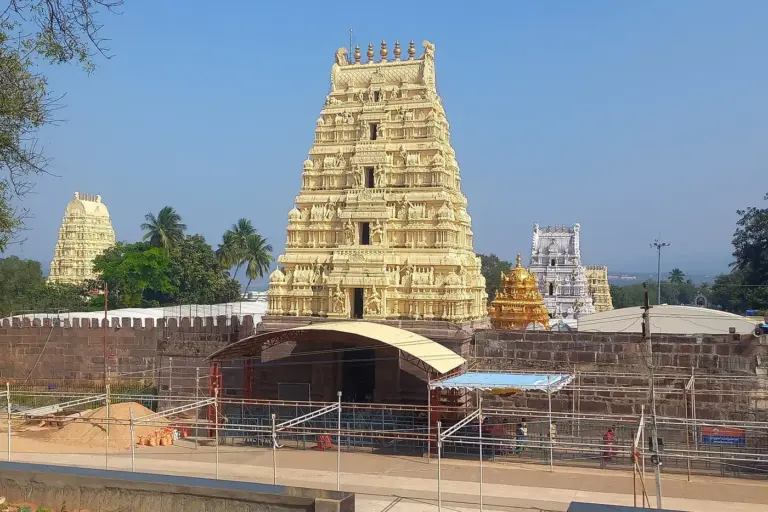
The Sangam age refers to the early historic period of south India, broadly dated from the 3rd century BCE to the 3rd century CE, during which a distinctive Tamil civilisation flourished in the region known as Tamilakam. The era takes its name from the Sangams, literary academies said to have been patronised by the Pandyan kings at Madurai, where poets composed a vast body of Tamil classical literature. Politically, the age was dominated by three crowned kings – the Cheras, Cholas and Pandyas – collectively called the Muvendar – alongside numerous minor chieftains, the velirs. Sangam texts and later archaeological finds make this one of the best-documented early phases of Indian history and an essential topic for UPSC aspirants.
What the Sangam Age Means
The word Sangam (from Sanskrit Sangha, assembly) denotes an academy of poets and scholars. Tamil tradition speaks of three Sangams:
- First Sangam – said to have been held at Then-Madurai; works of this phase are lost.
- Second Sangam – held at Kapatapuram; only Tolkappiyam, a treatise on Tamil grammar and poetics, survives.
- Third Sangam – held at Madurai; most surviving Sangam literature belongs to this phase.
Historians use the term Sangam age for the period reflected in this literature, roughly 300 BCE-300 CE. The tradition of three Sangams itself is legendary, but the body of poetry it preserves is real and forms the primary source.
Sangam Literature
Sangam literature is secular in tone, composed by over 470 poets, including women such as Avvaiyar. It is classified into two themes:
- Akam – interior, dealing with love and personal life.
- Puram – exterior, dealing with war, valour, politics and public life.
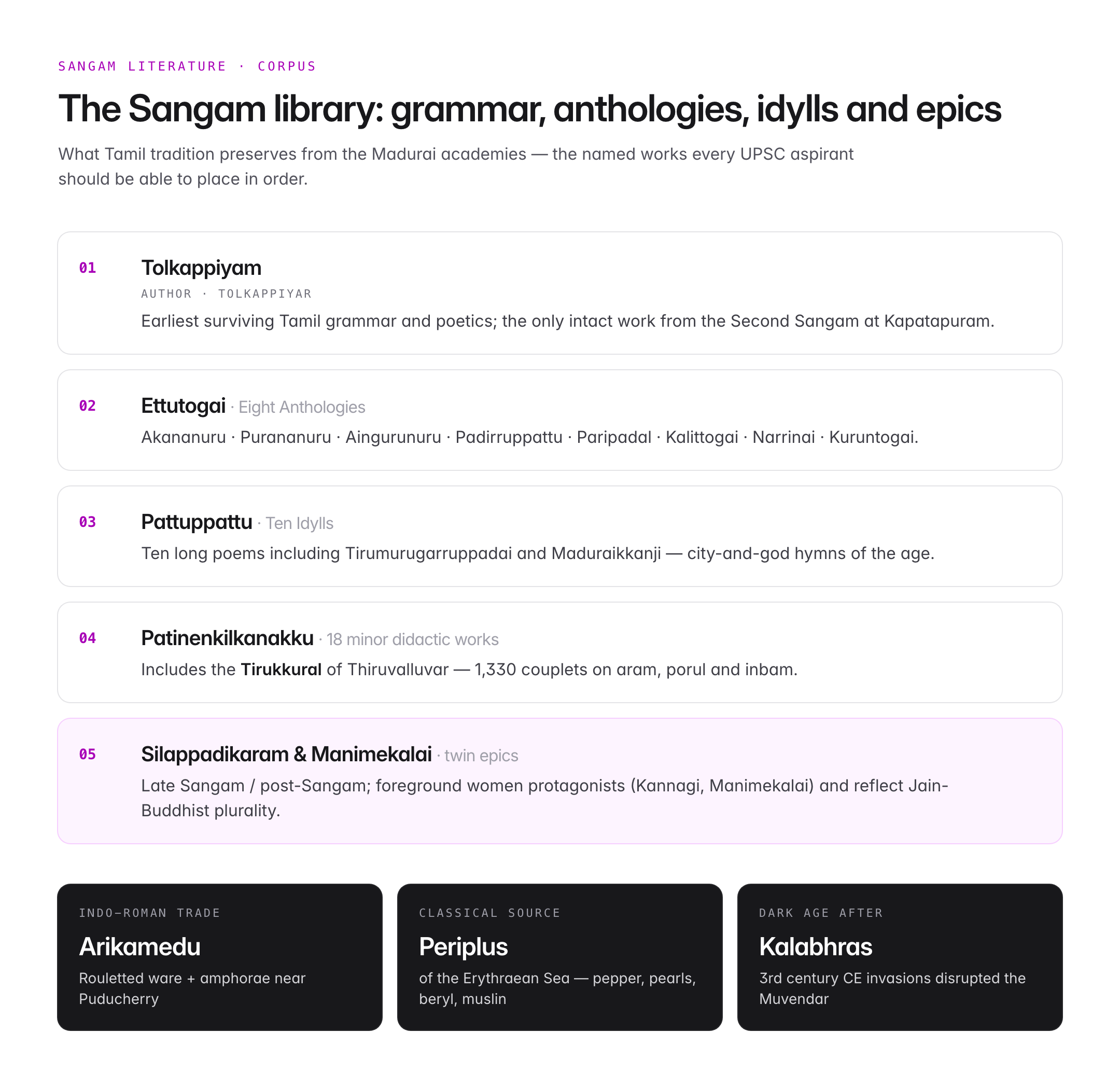
The corpus includes:
| Work | Nature |
|---|---|
| Tolkappiyam | Earliest Tamil grammar and poetics (attributed to Tolkappiyar) |
| Ettutogai (Eight Anthologies) | Akananuru, Purananuru, Aingurunuru, Padirruppattu, Paripadal, Kalittogai, Narrinai, Kuruntogai |
| Pattuppattu (Ten Idylls) | Ten long poems, including Tirumurugarruppadai, Maduraikkanji |
| Patinenkilkanakku | Eighteen minor didactic works, including Tirukkural of Thiruvalluvar |
| Silappadikaram and Manimekalai | Twin epics of later Sangam/post-Sangam era |
The Tirukkural, a 1,330-couplet treatise on aram (ethics), porul (polity/wealth) and inbam (love), remains one of the most influential works in Indian literature.
The Three Crowned Kingdoms
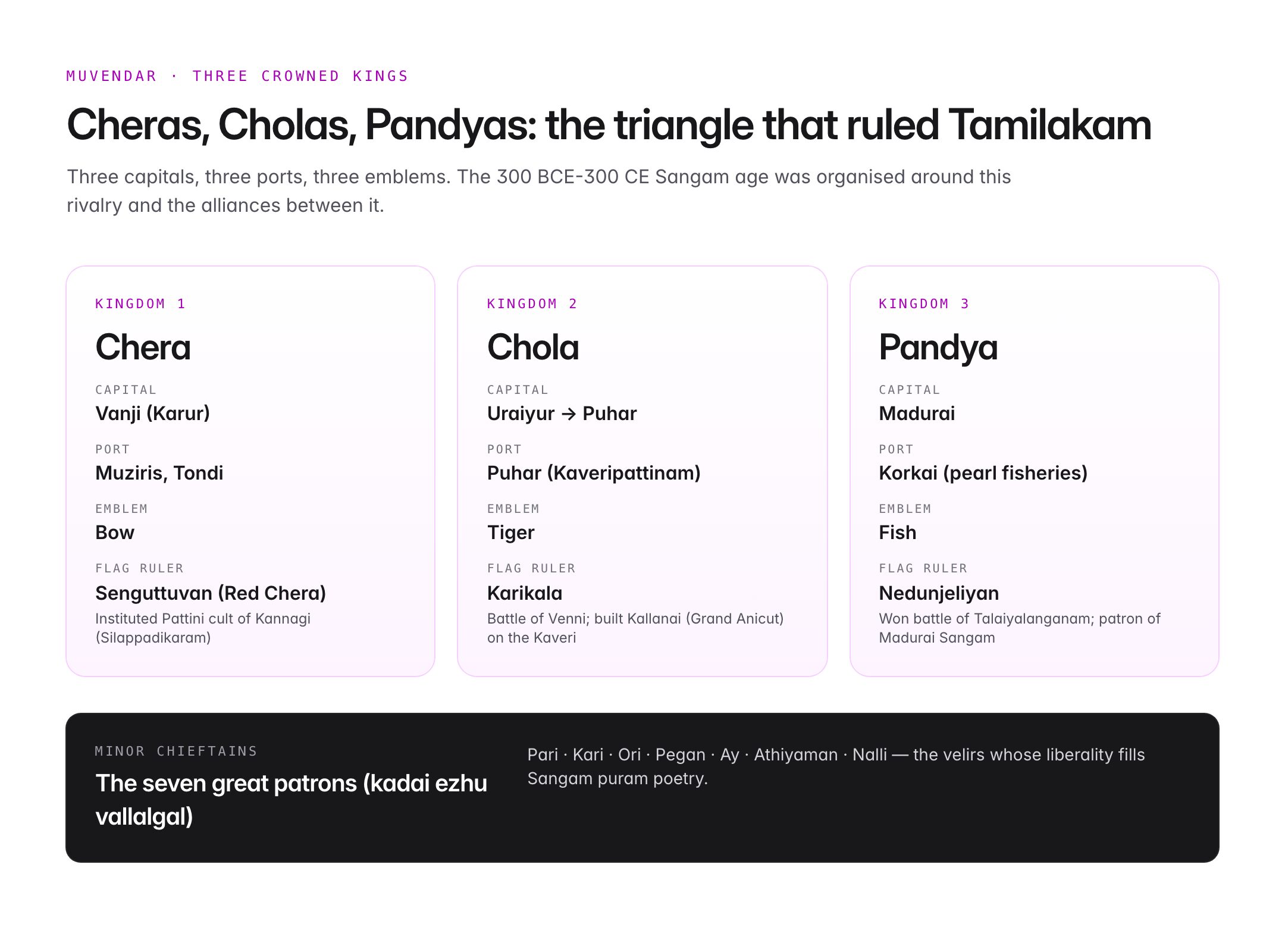
Tamilakam was ruled by three dynasties, often jointly called the Muvendar (three crowned kings), along with minor chieftains.
| Kingdom | Capital | Port | Emblem |
|---|---|---|---|
| Chera | Vanji (Karur) | Muziris, Tondi | Bow |
| Chola | Uraiyur; later Puhar (Kaveripattinam) | Puhar | Tiger |
| Pandya | Madurai | Korkai | Fish |
Notable rulers include:
- Cheras – Senguttuvan (Red Chera), credited in Silappadikaram with instituting the Pattini cult of Kannagi.
- Cholas – Karikala, famed for the battle of Venni, building of the Kallanai (Grand Anicut) on the Kaveri, and promotion of irrigation and trade.
- Pandyas – Nedunjeliyan, remembered for the battle of Talaiyalanganam and patronage of Madurai.
Minor chieftains – the velirs – such as Pari, Kari, Ori, Pegan, Ay, Athiyaman and Nalli, are celebrated as the seven great patrons (kadai ezhu vallalgal) of Sangam poets.
Tinai: Landscape and Society
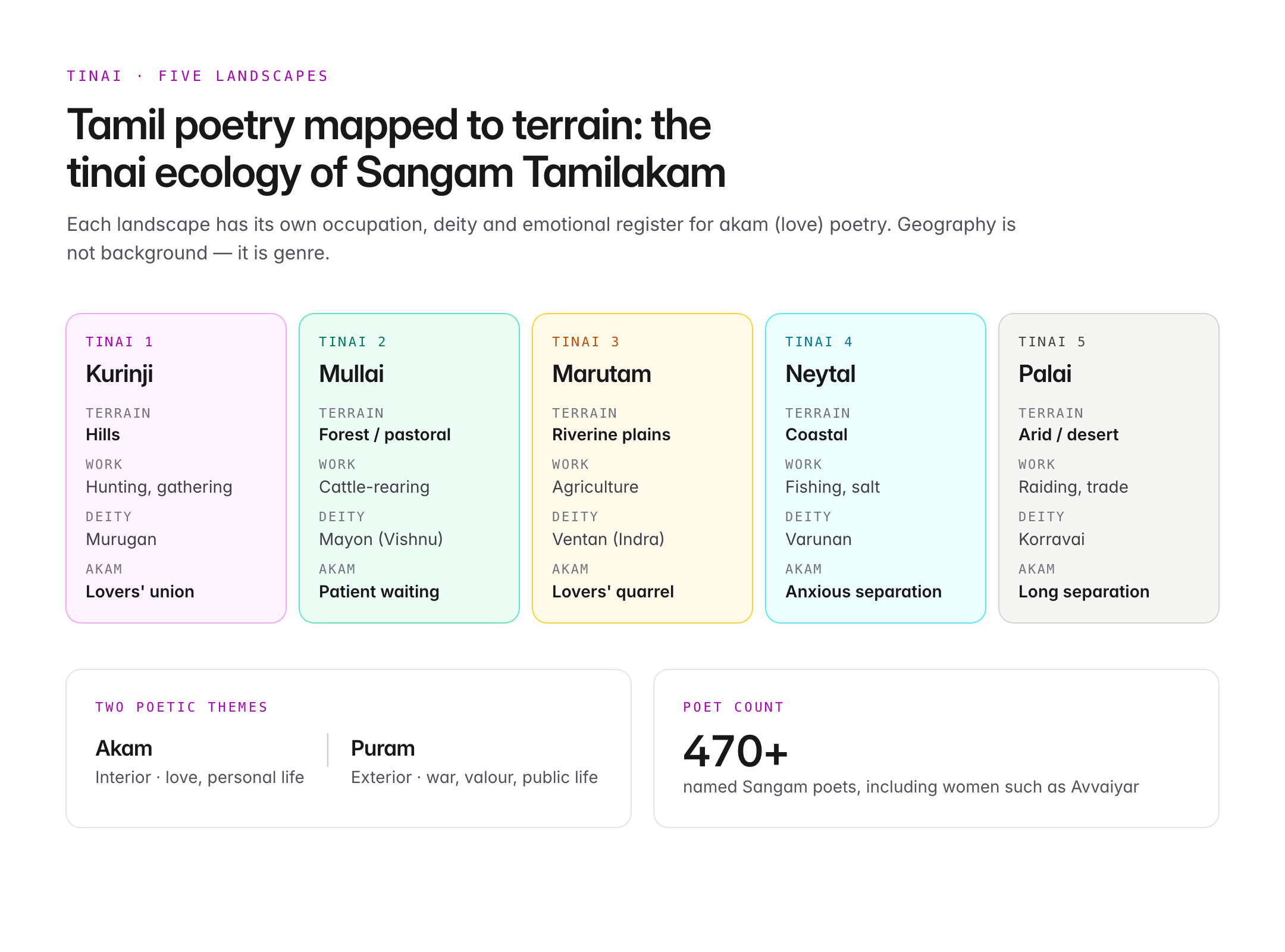
A distinctive feature of Sangam thought is the tinai classification – five ecological-emotional zones that frame both geography and poetry.
| Tinai | Terrain | Occupation | Deity | Akam theme |
|---|---|---|---|---|
| Kurinji | Hills | Hunting, gathering | Murugan | Lovers' union |
| Mullai | Forest/pastoral | Cattle-rearing | Mayon (Vishnu) | Patient waiting |
| Marutam | Riverine plains | Agriculture | Ventan (Indra) | Lovers' quarrel |
| Neytal | Coastal | Fishing, salt | Varunan | Anxious separation |
| Palai | Arid/desert | Raiding, trade | Korravai | Long separation |
Society included four-fold occupational groups – arasar (rulers), vellalar (farmers), vanikar (traders) and the pulaiyar – along with early signs of varna influence from the north. Women participated in poetry and public life more visibly than in many later periods.
Economy and Trade
The Sangam economy was unusually open. Trade with the Mediterranean world is confirmed by:
- Roman coin hoards found across Tamil Nadu and Kerala (e.g., Karur, Coimbatore, Arikamedu).
- Classical texts such as the Periplus of the Erythraean Sea and Pliny's Natural History, which describe exports of pepper, pearls, beryl, muslin and ivory from Muziris and Korkai.
- Arikamedu near Puducherry, an Indo-Roman trading station with rouletted ware and amphorae.
Internal exchange used barter and early coinage, including Pandyan and Chera punch-marked and die-struck coins. The Cholas developed extensive Kaveri irrigation, while the Pandyas controlled pearl fisheries at Korkai.
Polity, Religion and Decline
Kingship was hereditary but constrained by assemblies and the ethical code of the vallal (generous patron). Key administrative features:
- Avai – royal court of poets and ministers.
- Five councils – ministers, priests, envoys, spies, commanders.
- Taxation from agriculture, trade tolls (ulgu) and war tribute.
Religiously, early Sangam literature shows worship of Murugan, Mayon (Vishnu), Korravai (Durga), Varunan and Indra, alongside hero-stones (nadukkal) commemorating warriors. Jainism and Buddhism spread through merchant patronage; later epics (Silappadikaram, Manimekalai) reflect this plurality.
By the 3rd century CE, a long phase of invasions by the Kalabhras – referred to in later Tamil sources as a "dark age" – disrupted the three kingdoms and ended the classical Sangam phase.
UPSC Relevance
Prelims focus
- Three Sangams and their venues; the Muvendar and their emblems and capitals.
- Key works: Tolkappiyam, Ettutogai, Pattuppattu, Tirukkural, Silappadikaram, Manimekalai.
- Karikala Chola and the Kallanai; Senguttuvan and the Pattini cult.
- Ports: Muziris, Puhar, Korkai; Indo-Roman trade via Arikamedu.
- Five tinai and their landscapes.
Mains GS-I angle
Sangam material supports questions on early Indian society, position of women, regional variations in polity, and Indo-Roman trade. A typical angle: "Discuss the distinctive features of Sangam society and polity vis-a-vis contemporary north Indian kingdoms." Points to use: secular literature, tinai ecology, guild-based trade, strong maritime orientation, and relative fluidity in social and gender roles.
Sample PYQ angle – questions on "Sangam literature as a source of Tamil history" or "Indo-Roman trade" directly map to this period. Cite both textual evidence (Periplus) and archaeological sites (Arikamedu, Pattanam near Muziris) for a full-marks answer.
The Sangam age is the cultural bedrock of Dravidian India; mastering it means understanding how language, ecology and trade can together shape a civilisation.
Tell Google you want more of this.
Add Anantam IAS as a preferred sourceOne tap, and this site shows up more often in your own Top Stories, AI Overviews and AI Mode. Remove it any time.