Almost everything we think we know about kings, dates and dynasties in early India rests on writing scratched into stone, metal and clay. Coins help, monuments help, and the great texts help — but a literary work can be copied, edited and recopied across centuries until nobody is sure what the original said. An inscription cannot. It is fixed in the moment it was carved, in the language and script of its day, often with the name of the ruler and sometimes the very year. That is why epigraphy — the study of inscriptions — sits at the foundation of ancient Indian history, and why a single weathered rock at Junagadh or a polished pillar at Prayagraj can settle arguments that thousands of pages of later legend cannot.
These inscriptions are not just dating tools. They are the closest thing we have to the unfiltered voice of ancient India speaking about itself — a Mauryan emperor confessing his remorse after a war, a foreign-origin ruler boasting in flawless Sanskrit about repairing a dam, a court poet immortalising his king’s conquests in verse. They record administration, religion, irrigation, land grants, military campaigns and even the changing fortunes of languages and scripts. For an aspirant, the great inscriptions are not a list to memorise so much as a thread to follow — pull on it, and the whole story of how India learned to write its own history comes loose.
What Epigraphy Is and Why Inscriptions Matter
Epigraphy is simply the study of inscriptions — writing deliberately engraved on a hard, durable surface so it would last. The closely related field of palaeography studies the scripts themselves, how the shapes of letters changed over time, which lets historians date an undated inscription just by the way its characters are formed. Together these two disciplines turn a scatter of carved stones into a usable chronology, and they are reckoned among the most reliable of all sources for the ancient period precisely because the evidence is contemporary, durable and hard to forge.
Inscriptions come in several physical types, and the type often tells you something about its purpose. Rock edicts and cave inscriptions were carved onto natural boulders and cliff faces, usually meant for public proclamation. Pillar inscriptions were cut into free-standing monolithic columns, the most famous being Ashoka’s polished sandstone pillars. Copper-plate inscriptions, which became common from the Gupta period onward, were engraved on sheets of copper and were almost always legal records of land grants — a king gifting a village or a field to a Brahmin or a temple, with the boundaries and privileges spelled out so there could be no later dispute. There are also inscriptions on temple walls, statues, seals and pottery. Each kind survives in different numbers and tells historians different things, but all share the same virtue: they were meant to be permanent, and many of them were.
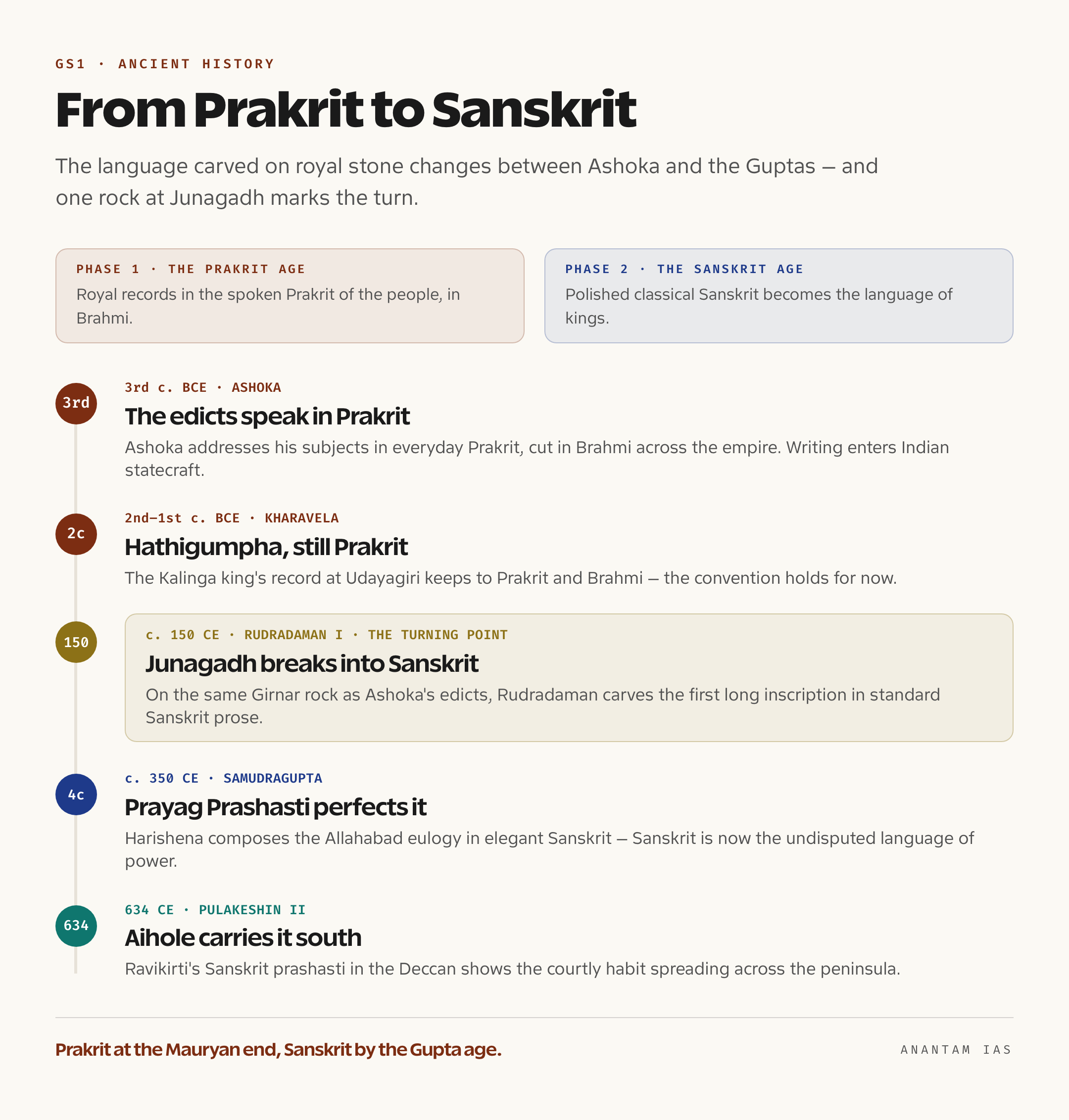
What makes them so valuable is the sheer range of what they preserve. They give us firm political history — the names, titles and conquests of rulers who would otherwise be shadows. They reveal administration and economy through land grants, tax remissions and donations. They track religion as kings shift their patronage between Buddhism, Jainism and the Brahmanical faiths. And they are a living record of language and script, showing the slow journey from Prakrit to Sanskrit and the gradual evolution of Brahmi into the many regional scripts of India. The catch is that inscriptions often flatter their patrons — a royal eulogy will exaggerate victories and stay silent about defeats — so historians read them critically, cross-checking against coins, texts and archaeology rather than taking every boast at face value.
The Great Inscriptions of Ancient India
The story really begins with Ashoka in the third century BCE, whose edicts are the earliest deciphered inscriptions in the subcontinent and the first time an Indian ruler used writing to address his subjects directly. Spread across Major Rock Edicts, Minor Rock Edicts and a famous series of Pillar Edicts, they were carved in the Prakrit language and the Brahmi script across most of his empire, with versions in Kharosthi in the northwest and even Greek and Aramaic on the frontier near Kandahar. In them Ashoka speaks of his Dhamma, his remorse after the Kalinga war, his welfare measures and his appeals for tolerance — the single richest window we have onto the Mauryan state. For centuries nobody could read them, until the British scholar James Prinsep cracked the Brahmi script in 1837, an act of decipherment that reopened the door to the entire ancient past.
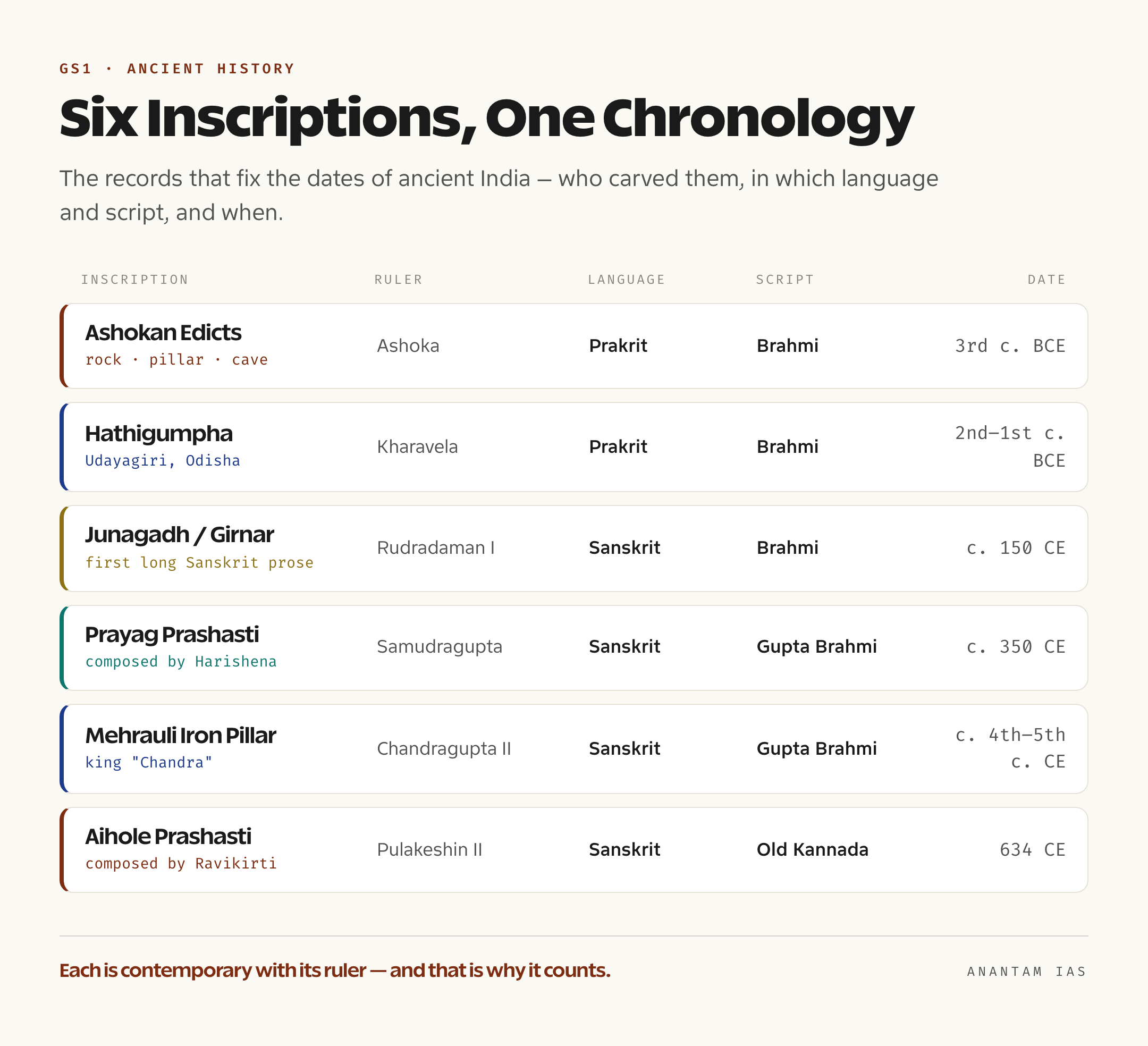
After the Mauryas, inscriptions begin to tell the story of the powers that followed. In Odisha, the Hathigumpha inscription in the Udayagiri caves near Bhubaneswar, written in Prakrit and Brahmi around the second or first century BCE, records the reign of the Kalinga king Kharavela — a Jain ruler whose military campaigns and public works it lists in seventeen weathered lines. Then comes a landmark of a different kind. The Junagadh rock inscription of Rudradaman I, the Western Satrap ruler, was carved around 150 CE on the same Girnar boulder that already bore Ashoka’s edicts, and it is celebrated as the first long inscription in fairly standard Sanskrit to survive. It records the repair of the Sudarshana lake, an artificial reservoir originally built in the Mauryan age under Chandragupta Maurya and improved under Ashoka — a remarkable chain of record-keeping where one inscription preserves the memory of works done four centuries earlier. That single rock at Junagadh, carrying Ashoka, Rudradaman and later the Gupta emperor Skandagupta, is itself a layered history of changing rulers and languages.
The Gupta Age and the Triumph of Sanskrit
By the time of the Guptas, Sanskrit had become the language of royal record, and the inscriptions of the age are among the finest pieces of writing ancient India produced. The supreme example is the Allahabad Pillar inscription, also called the Prayag Prashasti, composed by the court poet and minister Harishena in honour of Samudragupta, who ruled roughly from 335 to 375 CE. Written in elegant classical Sanskrit and engraved in the refined Gupta variety of Brahmi, it was, with deliberate symbolism, inscribed onto a pillar that already carried Ashoka’s edicts — a Gupta emperor writing his glory beneath a Mauryan one. The prashasti, a word that means eulogy or “in praise of,” catalogues Samudragupta’s conquests across northern and southern India and is rightly called the single most important document of the classical Gupta age. It tells us more about the political map of fourth-century India than any text.
The Mehrauli iron pillar in Delhi belongs to the same world. Its six-line Sanskrit inscription, in Gupta-era Brahmi, celebrates the conquests of a king named simply “Chandra,” whom most historians identify with the Gupta emperor Chandragupta II Vikramaditya. The pillar is famous twice over — once for the inscription that records his far-reaching campaigns, and once for the metallurgical marvel of the pillar itself, which has resisted rust for some sixteen centuries and stands as proof of ancient India’s mastery of ironworking. Here the inscription and the object carry the message together: a king’s fame and a civilisation’s technical skill fused in a single column of metal.
The tradition of the verse prashasti carried on into the post-Gupta south. The Aihole inscription in Karnataka, dated 634 CE, was composed by the Jain poet Ravikirti to glorify his patron, the Chalukya emperor Pulakeshin II, on the wall of the Meguti temple. In polished Sanskrit it records Pulakeshin’s victories — including his famous check of Harshavardhana on the banks of the Narmada — and it shows how the inscriptional habit had spread from a Mauryan imperial tool into a refined courtly art practised by kingdoms across the peninsula. From copper-plate land grants by the score to towering eulogies in stone, the centuries after the Guptas left a dense epigraphic record that lets historians reconstruct regional history in detail the earlier periods rarely allow.
What Inscriptions Tell Historians
Set side by side, these inscriptions do something no single source could. They build a skeleton of dated political history — Ashoka in the third century BCE, Kharavela soon after, Rudradaman around 150 CE, Samudragupta and Chandragupta II in the fourth century, Pulakeshin II in the seventh — that anchors the floating chronology of texts and legends to firm ground. Because each one is contemporary with the ruler it names, it carries an authority that later literature, written generations afterward, simply cannot match. This is why historians treat a securely dated inscription as a kind of fixed point around which everything else is arranged.
Beyond dates, they open a window onto society that royal chronicles tend to close. Land-grant inscriptions reveal who owned what, how revenue was assigned, and how religious institutions grew rich on royal generosity. Donative inscriptions at stupas and caves name ordinary donors — merchants, guilds, monks, women — and let us glimpse a society far below the level of kings. Religious patronage is visible in the same stones: Ashoka’s Buddhist leanings, Kharavela’s and Ravikirti’s Jainism, the Brahmanical revival under the Guptas, all written into the record by the very people who lived it. And the slow shift of language and script across these centuries — Prakrit giving way to Sanskrit, Brahmi branching into the ancestors of every modern Indian script — is itself a history of culture told in letterforms.
There is one more reason epigraphy matters so much for India specifically. Ancient Indian writers were famously uninterested in chronological history of the kind the Greeks or Chinese produced; the subcontinent left no continuous dated annals. So inscriptions fill the gap. They are, quite literally, how India recovered its own past — from Prinsep reading Ashoka’s forgotten letters to modern epigraphists piecing together dynasties from a handful of copper plates. To study ancient India seriously is to learn to listen to its stones.
For Your Mains Answer
Inscriptions are a core topic for GS Paper 1, under “Indian culture — salient aspects of art forms, literature and architecture” and the history of ancient India. Questions on the sources of ancient Indian history, on Ashokan edicts, on the evolution of scripts, or on the Gupta age as a golden period of Sanskrit can all draw on this material. It is also a reliable supply of concrete, datable examples for any answer that needs to show command of primary evidence rather than vague generalisation. The skill examiners reward here is precision — naming the right inscription, ruler, language and script, and explaining what each one actually tells us.
How to Build the Answer
Open by defining epigraphy and stating plainly why inscriptions are the firmest source for ancient India — contemporary, durable, hard to forge. Then move chronologically through the marquee examples: Ashoka’s Prakrit edicts in Brahmi, the Hathigumpha record of Kharavela, Rudradaman’s Junagadh inscription as the first long Sanskrit prose, the Prayag Prashasti by Harishena, the Mehrauli pillar, and the Aihole prashasti of Pulakeshin II. Close by stepping back to what inscriptions collectively reveal — political chronology, administration, religion, and the Prakrit-to-Sanskrit language shift — and add the critical caveat that royal eulogies must be read against other evidence. That arc — define, illustrate, evaluate — fits almost any inscriptions question.
Common Mistakes to Avoid
Don’t muddle the languages: Ashoka’s edicts are in Prakrit, while Rudradaman’s Junagadh inscription and the Gupta records are in Sanskrit — that distinction is the heart of the topic. Don’t call the Junagadh inscription Pali; it isn’t. Don’t forget that the Junagadh rock and the Allahabad pillar each carry more than one ruler’s words, layered across centuries. Don’t credit the Prayag Prashasti to Samudragupta himself when it was composed by Harishena. And don’t treat eulogies as neutral fact — note that they flatter their patrons.
A Compact Answer Spine
Epigraphy = study of inscriptions, the most reliable contemporary source for ancient India → Ashoka (3rd c. BCE): earliest edicts, Prakrit in Brahmi, deciphered by Prinsep in 1837 → Hathigumpha: Kharavela of Kalinga, Prakrit-Brahmi → Junagadh (c. 150 CE): Rudradaman I, first long Sanskrit prose, Sudarshana lake → Prayag Prashasti: Harishena on Samudragupta, classical Sanskrit on an Ashokan pillar → Mehrauli iron pillar: king “Chandra” (Chandragupta II) → Aihole (634 CE): Ravikirti on Pulakeshin II → significance: dated political history, administration, religion, Prakrit-to-Sanskrit shift; read critically.
Diagram or Flowchart Idea
Sketch a simple timeline from the third century BCE to the seventh century CE with the six key inscriptions plotted on it, each labelled with ruler, language and script. A second small column can show the language shift — Prakrit at the Ashokan end, Sanskrit at the Gupta-and-after end. This single visual captures both the chronology and the central theme of the topic at a glance.
A Balanced-Conclusion Line
A line that lands the marks: “If ancient India wrote little formal history, it wrote a great deal of itself into stone and metal — and it is from these inscriptions, read carefully and against the grain of their own praise, that the subcontinent’s earliest chronology and society have been recovered.”
How to Use Data Without Cramming
You need only a handful of anchors, not a catalogue: Ashoka in the third century BCE with Prinsep’s 1837 decipherment, Rudradaman’s Junagadh inscription around 150 CE as the first long Sanskrit prose, Harishena’s Prayag Prashasti on Samudragupta, and the Aihole inscription of 634 CE. Attach each to its language and script and you have enough to write with authority. Attribute them plainly — “the Junagadh inscription of Rudradaman, around 150 CE” — rather than reciting dates without anchors.
FAQ
What is the difference between epigraphy and palaeography? Epigraphy is the study of inscriptions — writing engraved on durable surfaces like rock, pillars, copper plates and seals. Palaeography is the study of ancient scripts and how their letterforms changed over time. The two work together: epigraphy reads the content of an inscription, while palaeography uses the shape of its letters to help date it, even when no year is given.
Why are inscriptions considered the most reliable source for ancient Indian history? Because they are contemporary with the events they record, engraved in durable materials, and very hard to alter or forge after the fact. Unlike literary texts, which were copied and edited across centuries, an inscription is fixed at the moment of its carving. This makes inscriptions especially important for India, whose ancient writers left no continuous dated chronicles, so the firm chronology of kings and dynasties rests largely on epigraphic evidence.
Which inscription is the first long record in Sanskrit? The Junagadh rock inscription of Rudradaman I, the Western Satrap ruler, carved around 150 CE on the Girnar rock in Gujarat, is regarded as the first long inscription in fairly standard Sanskrit. It records the repair of the Sudarshana lake and marks the point at which Sanskrit began to replace Prakrit as the language of royal inscriptions — a shift completed by the Gupta age.
What is the Prayag Prashasti and who composed it? The Prayag Prashasti, also called the Allahabad Pillar inscription, is a Sanskrit eulogy of the Gupta emperor Samudragupta (ruled c. 335-375 CE), composed by his court poet and minister Harishena. Engraved in the Gupta variety of the Brahmi script onto a pillar that already bore Ashoka’s edicts, it lists Samudragupta’s conquests and is considered the single most important document of the classical Gupta age.
Practice Questions
Prelims MCQs
- The edicts of Ashoka were primarily written in which language and script?
(a) Sanskrit in the Gupta script
(b) Prakrit in the Brahmi script
(c) Pali in the Kharosthi script
(d) Tamil in the Grantha script
Answer: (b) Ashoka’s edicts were mainly in Prakrit written in Brahmi, with Kharosthi used in the northwest and Greek and Aramaic on the frontier near Kandahar. - The Junagadh (Girnar) rock inscription carries the records of which rulers?
(a) Ashoka, Kharavela and Harsha
(b) Ashoka, Rudradaman I and Skandagupta
(c) Chandragupta Maurya, Samudragupta and Pulakeshin II
(d) Rudradaman I, Harishena and Ravikirti
Answer: (b) The Girnar rock bears Ashoka’s edicts, Rudradaman I’s Sanskrit inscription of about 150 CE, and a later record of the Gupta emperor Skandagupta. - The Prayag Prashasti (Allahabad Pillar inscription) was composed by which person?
(a) Ravikirti
(b) Kharavela
(c) Harishena
(d) Banabhatta
Answer: (c) It was composed in classical Sanskrit by Harishena, the court poet and minister of Samudragupta, and engraved on a pillar that already carried Ashoka’s edicts. - The Hathigumpha inscription, found in the Udayagiri caves near Bhubaneswar, is associated with which ruler?
(a) Pulakeshin II
(b) Kharavela of Kalinga
(c) Rudradaman I
(d) Chandragupta II
Answer: (b) The Hathigumpha inscription, in Prakrit and Brahmi, records the reign of the Jain Kalinga king Kharavela, around the second or first century BCE. - The Mehrauli iron pillar inscription records the conquests of a king named “Chandra,” most commonly identified with which ruler?
(a) Chandragupta Maurya
(b) Chandragupta II Vikramaditya
(c) Samudragupta
(d) Skandagupta
Answer: (b) The six-line Sanskrit inscription in Gupta-era Brahmi is generally taken to celebrate Chandragupta II Vikramaditya, and the rust-resistant pillar also showcases ancient Indian metallurgy.
Mains Practice Questions
- “Inscriptions are the firmest foundation of ancient Indian history.” Examine this statement with reference to the major epigraphic records of the period. (15 marks, 250 words)
- Trace the shift from Prakrit to Sanskrit as the language of royal inscriptions in ancient India, illustrating your answer with specific examples. (15 marks, 250 words)
- Discuss the different types of ancient Indian inscriptions and explain what each type reveals to historians about polity, economy and religion. (15 marks, 250 words)
- The Ashokan edicts opened a new chapter in the use of writing by Indian rulers. Evaluate their significance as a source of Mauryan history. (10 marks, 150 words)
- Royal prashastis such as the Prayag Prashasti and the Aihole inscription are valuable yet problematic sources. Critically assess their use in reconstructing ancient Indian history. (15 marks, 250 words)
Tell Google you want more of this.
Add Anantam IAS as a preferred sourceOne tap, and this site shows up more often in your own Top Stories, AI Overviews and AI Mode. Remove it any time.