Article 317 in Action: Karnataka Governor Suspends KPSC Chairperson
Why in News?
The Governor of Karnataka, Thaawarchand Gehlot, on 13 July 2026 suspended Shivashankarappa S. Sahukar, Chairperson of the Karnataka Public Service Commission (KPSC), pending an inquiry into alleged misconduct linked to the selection of his daughters through the KPSC’s own recruitment.
The Hindu reported that the Governor has recommended that the President of India refer the allegations to the Supreme Court under Article 317(1) — the only route for removing a Public Service Commission chairperson or member for misbehaviour. The senior-most member will function as Acting Chairperson until the President’s orders.
- The suspension runs “until further orders from the President’s office” — tracking Article 317(2), which lets the Governor suspend a State PSC chairperson while a Presidential reference is in play.
- On 10 July, police registered an FIR against Suma S. Sahukar, the chairperson’s daughter: her certificate declared the family’s annual income as ₹40,000 to claim Karnataka’s 3B-category reservation for a Junior Engineer (Civil) post in March 2024.
- During that selection, her father was KPSC Chairperson drawing about ₹2.25 lakh a month — the basis for calling the certificate false.
- Also on 10 July, the High Court of Karnataka stayed a 19 June resolution by other KPSC members asking the chairperson to resign on moral responsibility.
- Complaints allege the chairperson facilitated the selection of his two daughters as Industrial Extension Officers without recusal or a declared conflict of interest.
- A Karnataka government order of 30 March 2002 bars children of the PSC chairperson from backward-classes reservation.
The development matters in the context of:
- A live, worked-out use of Article 317 — usually taught only as bare text under constitutional bodies.
- A clean illustration of the appointment–removal asymmetry: the Governor appoints the State PSC chairperson but only the President can remove, after a Supreme Court inquiry.
- Strong GS4 crossover: conflict of interest, recusal, probity, and misuse of the OBC creamy-layer exemption.
UPSC Relevance
Prelims Relevance
- Articles 315–323 (Part XIV) govern Public Service Commissions — UPSC, State PSCs and Joint State PSCs.
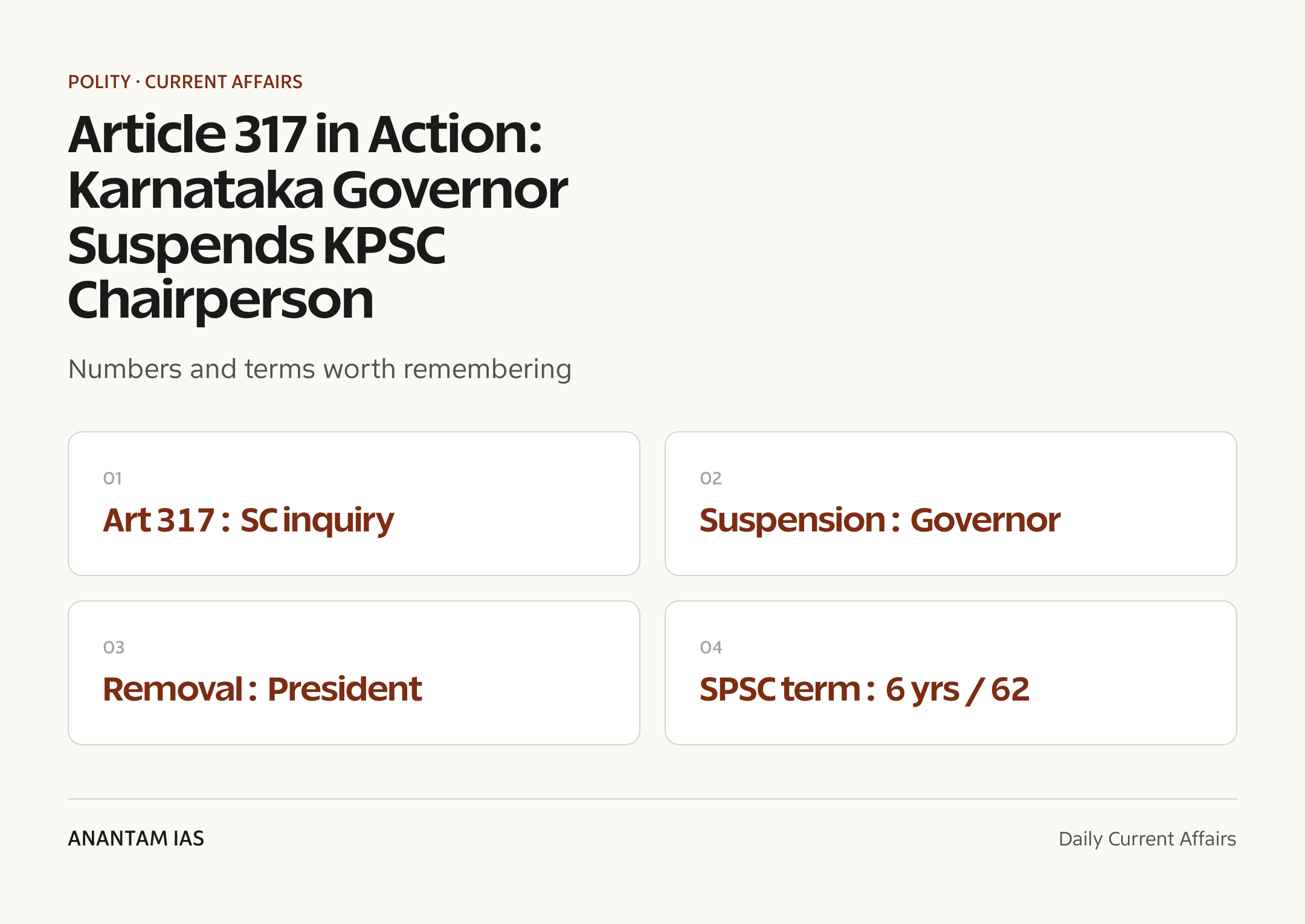
- State PSC chairperson and members: appointed by the Governor (Article 316); removed only by the President (Article 317).
- Removal for misbehaviour needs a Presidential reference to the Supreme Court; the Court’s inquiry report is binding on the President.
- Article 317(2): the Governor may suspend a State PSC chairperson or member pending the Court’s report; for UPSC and JSPSC, the President.
- Article 317(3): direct Presidential removal — no Court reference — for insolvency, paid outside employment, or infirmity of mind or body.
- Article 317(4): interest in a government contract is deemed misbehaviour.
- Term of a State PSC member: 6 years or age 62, whichever is earlier (65 for UPSC).
- Conditions of service cannot be varied to a member’s disadvantage after appointment (Article 318); PSC expenses are charged on the state’s Consolidated Fund (Article 322).
- Post-tenure bar (Article 319): a State PSC chairperson may only become UPSC chairperson or member, or chairperson of another State PSC.
Mains Relevance
GS Paper 2
- Article 317 as an insulation device: appointment by the Governor, removal only by the President after judicial inquiry — separating patronage from punishment.
- Health of State Public Service Commissions: recurring recruitment scandals versus the safeguards meant to keep merit-based selection credible.
- Comparative removal design: judicial inquiry for PSC members versus parliamentary address for judges — what each protects against.
GS Paper 4
- Conflict of interest and the duty to recuse: the head of a recruiting body whose dependants compete in its examinations.
- Probity in public life: the Supreme Court’s standard that PSC chairpersons must command public confidence, not merely avoid conviction.
Essay
- Institutions are only as strong as the integrity of those who run them.
- Merit in public recruitment as the foundation of citizens’ trust in the state.
Background and Context
What happened in Karnataka: the sequence
The episode moved from an internal KPSC revolt to a full constitutional process in under a month.
- 19 June 2026: other KPSC members resolve that the chairperson should resign on moral responsibility; the High Court of Karnataka stays this resolution on 10 July.
- 10 July: on a KPSC complaint, police register an FIR against Suma S. Sahukar over a certificate declaring family income of ₹40,000 a year, used for 3B-category reservation in a Junior Engineer (Civil) selection of March 2024.
- Verification showed it was false: her father was then KPSC Chairperson on about ₹2.25 lakh a month.
- The Governor’s Secretariat says the chairperson allegedly facilitated the selection of his two daughters as Industrial Extension Officers, and neither recused himself nor declared a conflict of interest.
- 13 July: the Governor suspends the chairperson, recommends a Presidential reference to the Supreme Court under Article 317(1), and directs the senior-most member to act as chairperson.
- The Secretariat framed the alleged suppression of material facts as misbehaviour warranting constitutional action.
Article 317: the removal architecture
Article 317 deliberately makes removing a PSC chairperson hard, and puts the Supreme Court — not any government — at the centre.
- Article 317(1): removal for misbehaviour only by order of the President, and only after the Supreme Court, on a Presidential reference, has inquired and reported that removal is warranted.
- The Court’s report is binding: if it clears the incumbent, the President cannot remove — a judicial determination, not executive discretion.
- Article 317(2): pending the report, the President may suspend a UPSC or Joint PSC chairperson or member; the Governor may suspend a State PSC chairperson or member — the power Karnataka’s Governor used.
- Article 317(3): direct Presidential removal, no reference needed, for insolvency, paid employment outside office, or infirmity of mind or body.
- Article 317(4): any interest in a government contract is deemed misbehaviour.
- Contrast the removal of judges, which needs a special-majority address by Parliament under Article 124(4) — for PSC members the legislature plays no role at all.
Appointed by the Governor, removable only by the President
The appointment–removal asymmetry is the most-tested feature of State Public Service Commissions.
- Article 316: the Governor appoints the State PSC chairperson and members; as nearly as may be, one-half of the members must have held government office for at least 10 years.
- Tenure: 6 years or age 62, whichever is earlier (UPSC: 65). The Constitution prescribes no other qualifications for members — a long-flagged design gap.
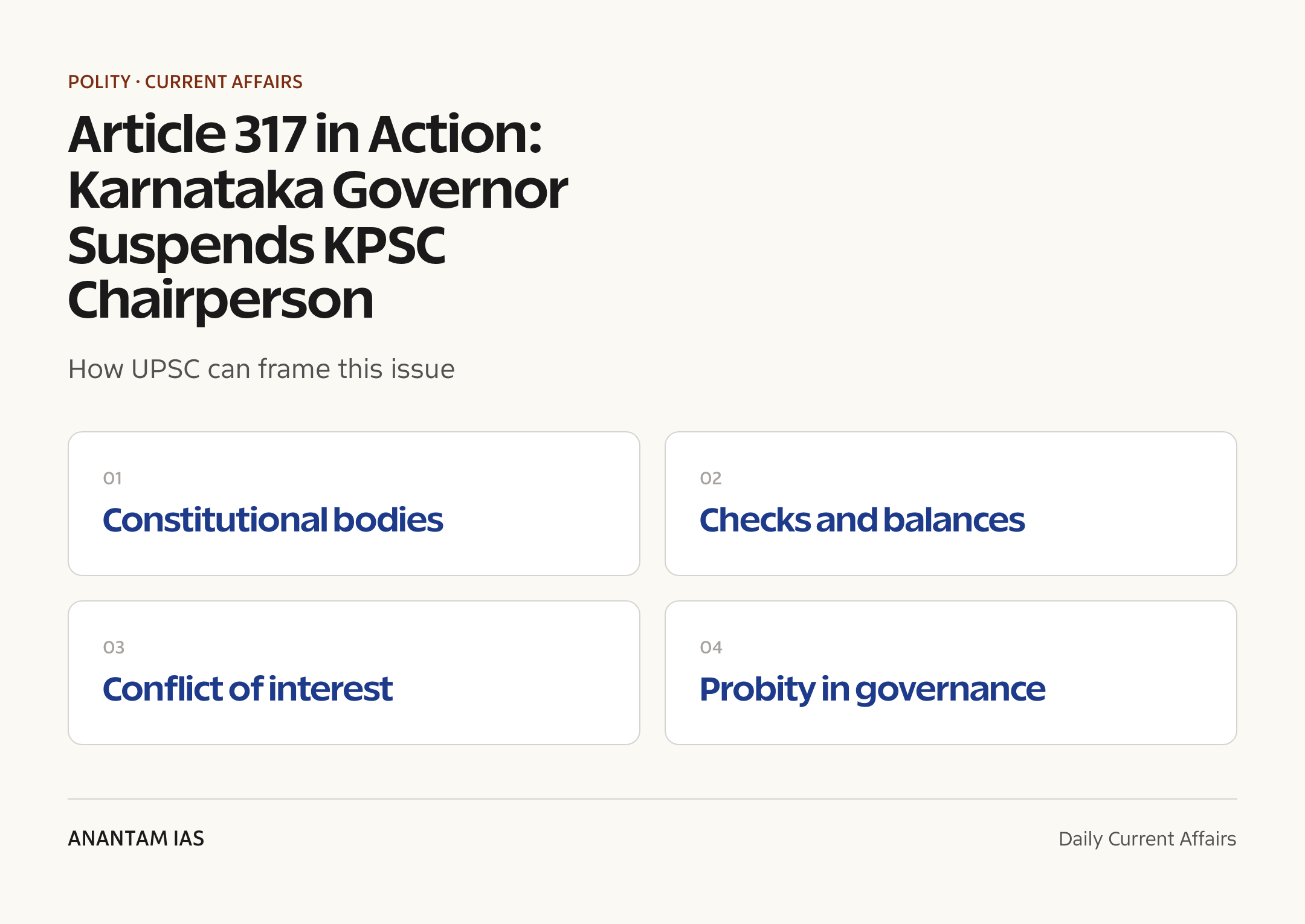
- The Governor who appoints cannot remove: removal is the President’s alone, on the Supreme Court’s finding — shielding commissions from the state government whose recruitment they police.
- Article 318: conditions of service cannot be varied to a member’s disadvantage after appointment — a judicial-style protection.
- Article 319: after office, a State PSC chairperson may only become UPSC chairperson or member, or chairperson of another State PSC — no other government employment.
- Article 322: salaries and pensions are charged on the Consolidated Fund of the state — payable without a legislative vote.
What counts as 'misbehaviour': the Supreme Court's reading
The Constitution never defines misbehaviour; the Supreme Court has filled the gap, and read it widely.
- In In Re Ram Ashray Yadav (2000), the Bihar PSC reference, the Court held that a PSC chairperson must maintain the highest standards of probity — the office runs on public confidence.
- In In Re Mehar Singh Saini (2010), the Haryana PSC reference, the Court read misbehaviour broadly: conduct eroding the dignity, integrity or credibility of the institution qualifies, even short of proven criminality.
- On that reading, suppression of material facts and using the office to benefit family fall squarely within misbehaviour — the framing Karnataka’s Raj Bhavan has used.
- Article 317 has form: the Punjab PSC cash-for-jobs scandal (2002) and the Haryana reference of 2010 are the standard precedents.
- The safeguard cuts both ways: because only the Supreme Court’s finding can trigger removal, honest incumbents are protected from motivated complaints too.
The reservation angle: creamy layer and false certificates
The FIR at the heart of this case turns on a familiar prelims theme — the OBC creamy layer.
- The chairperson’s daughter allegedly claimed OBC (3B) reservation with a creamy-layer exemption on a certificate showing family income of ₹40,000 a year — while her father held a high constitutional office.
- Karnataka’s order of 30 March 2002 makes children of the PSC chairperson ineligible for backward-classes reservation — mirroring the creamy-layer rules, which exclude children of constitutional post-holders from OBC benefits regardless of income.
- A false income or caste certificate invites criminal prosecution and cancellation of the appointment obtained through it.
- Two parallel tracks are moving at once: criminal law (the FIR) for the beneficiary, the constitutional process (Article 317) for the chairperson.
Why PSCs get this insulation — and why it is straining
Public Service Commissions are the constitutional gatekeepers of merit in government jobs; the design assumes probity at the very top.
- Article 320: PSCs conduct recruitment exams and are consulted on appointments, promotions, transfers and disciplinary matters.
- Article 323: a State PSC reports annually to the Governor; the report goes before the legislature with a memorandum explaining every case where the commission’s advice was rejected.
- State PSC recruitments touch lakhs of aspirants; a tainted selection at the top corrodes faith in the merit system — among constitutional bodies, PSCs are the most citizen-facing.
- The structural gap: no statutory conflict-of-interest or recusal code binds PSC members, and the Constitution sets no selection criteria beyond the 50% official-experience rule.
- Wide gatekeeping power, thin entry filters, near-immovability — that mix is why Punjab (2002), Haryana (2010) and now Karnataka (2026) keep recurring.
Way Forward
Codify integrity safeguards
- A statutory conflict-of-interest and recusal code for PSC members — written declarations and automatic recusal whenever a relative enters any recruitment the commission conducts.
- Laid-down criteria and a search-committee process for appointing State PSC members, filling the Constitution’s silence on qualifications.
Speed up the Article 317 route
- Time-bound Presidential references and Supreme Court inquiries, so commissions are not left under acting heads for years.
- Publish the action taken on Governors’ recommendations — the reference stage is opaque today.
Harden the recruitment pipeline
- End-to-end digital audit trails for evaluation, interviews and selection lists, with independent audit of PSC examinations.
- Mandatory pre-appointment verification of income and caste certificates, with cancellation and prosecution where forgery is established.
Conclusion
The Karnataka suspension is a textbook demonstration of Article 317 working as designed. The Governor who appointed the chairperson cannot remove him; he can only suspend him and set the Presidential–Supreme Court machinery in motion. Removal now turns on a judicial inquiry, not any government’s preference.
For aspirants, the case stitches three syllabus threads around one live event: the removal design for constitutional bodies (GS2), creamy-layer and certificate rules (prelims), and conflict of interest (GS4). File it as your standing example for Articles 315–323.
UPSC Practice Questions
Prelims MCQ 1
With reference to the Chairperson of a State Public Service Commission, consider the following statements:
- The Chairperson is appointed by the Governor of the state.
- The Chairperson can be removed from office by the Governor on the ground of misbehaviour.
- The Governor can suspend the Chairperson pending the Supreme Court’s inquiry on a Presidential reference.
How many of the above statements are correct?
(a) Only one (b) Only two (c) All three (d) None
Answer: (b) Only two
Explanation:
Statements 1 and 3 are correct (Articles 316 and 317(2)). Statement 2 is wrong: only the President can remove — for misbehaviour, only after the Supreme Court’s inquiry on a Presidential reference under Article 317(1). The Governor appoints and may suspend, never removes.
Prelims MCQ 2
Under Article 317(1) of the Constitution, the inquiry into alleged ‘misbehaviour’ of the Chairperson of a State Public Service Commission is conducted by:
(a) The High Court of the state concerned (b) The Supreme Court, on a reference made by the President (c) A committee constituted by the state legislature (d) The Union Public Service Commission
Answer: (b) The Supreme Court, on a reference made by the President
Explanation:
Removal for misbehaviour requires the President to refer the matter to the Supreme Court; the Court’s report that removal is (or is not) warranted binds the President. Neither the High Court, the legislature nor UPSC has any role.
UPSC Mains Questions
- The removal procedure under Article 317 insulates Public Service Commissions from executive pressure, yet recurring recruitment scandals suggest insulation alone cannot guarantee integrity. Examine with reference to recent instances, and suggest reforms to protect the credibility of State Public Service Commissions.
- “A recruiting institution fails the moment its own selections need policing.” In the light of conflict-of-interest allegations against heads of State Public Service Commissions, discuss the safeguards needed in bodies that control entry into public service.
Source: The Hindu.
Frequently Asked Questions
What is Article 317 of the Constitution?
Article 317 lays down how the chairperson or a member of a Public Service Commission is removed. For misbehaviour, the President must refer the matter to the Supreme Court, and removal follows only if the Court’s inquiry says it is warranted. Insolvency, outside paid employment or infirmity allow direct Presidential removal.
Who can remove a State PSC chairperson?
Only the President of India. The Governor appoints the chairperson under Article 316 but has no power of removal. For misbehaviour, removal needs a Supreme Court inquiry on a Presidential reference, and the Court’s finding binds the President. The asymmetry insulates State PSCs from state-level political pressure.
Can the Governor suspend a State PSC chairperson?
Yes. Under Article 317(2), the Governor may suspend the chairperson or a member of a State Public Service Commission once a Presidential reference to the Supreme Court is in motion, until the President passes final orders on the Court’s report. Karnataka’s Governor used exactly this power in July 2026.
Why was the KPSC chairperson suspended?
The Governor acted on complaints that chairperson Shivashankarappa S. Sahukar facilitated the selection of his daughters through KPSC recruitment without recusing himself. One daughter allegedly used a false income certificate to claim OBC reservation. He was suspended, and a Presidential reference to the Supreme Court has been recommended.
What counts as misbehaviour under Article 317?
The Constitution does not define it. In references such as In Re Ram Ashray Yadav (2000) and In Re Mehar Singh Saini (2010), the Supreme Court read it broadly: conduct eroding the integrity, dignity or public credibility of the commission, plus the deemed case of interest in a government contract under Article 317(4).
How does PSC removal differ from a judge’s removal?
A Supreme Court or High Court judge is removed by the President after Parliament passes a special-majority address under Article 124(4). A PSC chairperson’s removal skips the legislature entirely: the President refers the case to the Supreme Court, and the Court’s inquiry report decides the outcome.