Manipur Violence: Border Villages and Internal Security Risks
Why in News?
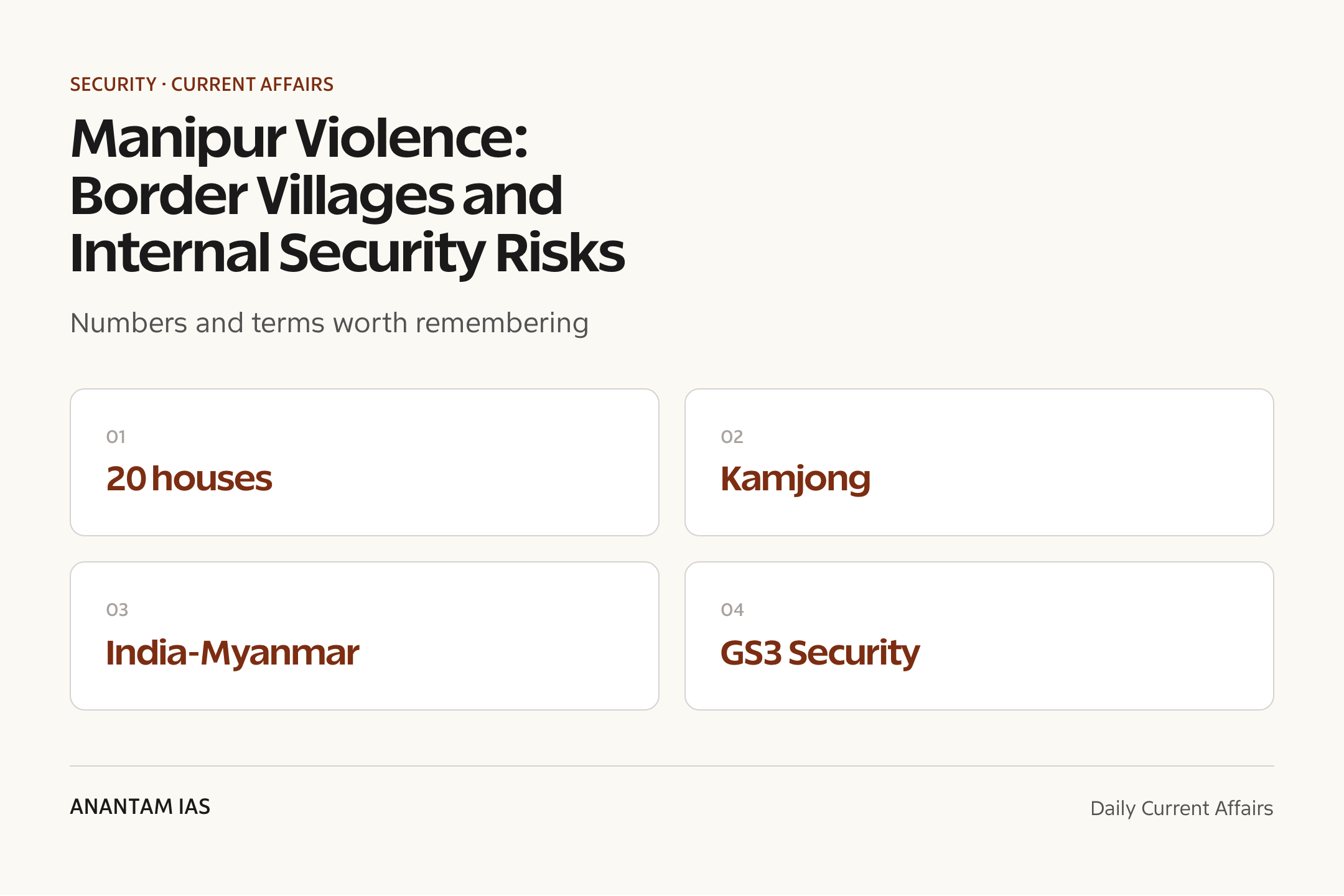
The Hindu reported that armed groups set fire to about 20 houses along the India-Myanmar border in Manipur’s Kamjong district on July 1, 2026.
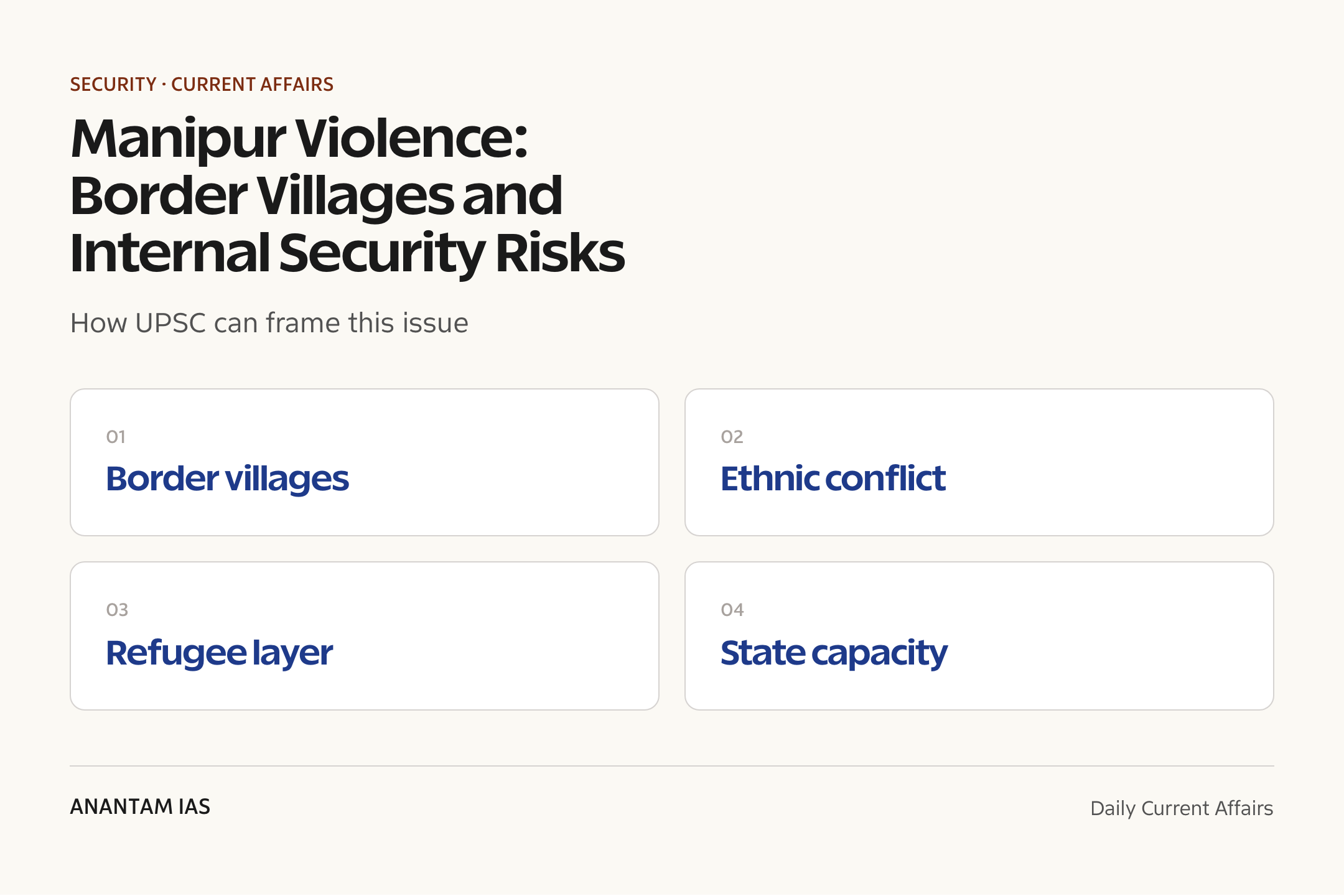
The incident matters because it connects ethnic conflict, porous border management, refugee presence, village-level security gaps and the governance challenge of restoring trust in a hill district.
- Location: Kamjong district lies in Manipur’s eastern hill belt and borders Myanmar, making it a location-in-news topic for map-based prelims.
- Immediate trigger: Kuki and Naga organisations made competing allegations about who torched houses in and around Phaimol, Huimin Thana and Kherongram.
- Security vacuum claim: Kuki organisations alleged the attack followed the vacation of an Assam Rifles security post at Phaimol.
- Cross-border angle: The Hindu report referred to allegations involving Myanmar-based armed groups, making the issue relevant to transnational insurgency and border surveillance.
- Displacement layer: A Naga organisation claimed that camps sheltering 365 Burmese refugees at Kherongram were also torched.
- Durable syllabus: The case belongs to GS3 internal security, but also links with GS2 governance, Centre-State coordination and humanitarian administration.
The development matters in the context of:
- Manipur’s conflict has moved beyond a single valley-hill divide and now shows overlapping ethnic, territorial and border-security claims.
- Border villages face a double burden: local community insecurity and exposure to armed movement across difficult terrain.
- Myanmar’s instability has produced refugee flows and armed-group movement that complicate policing, intelligence and humanitarian management.
- Administrative credibility depends on neutral protection, quick relief, fair investigation and visible restraint by security forces.
UPSC Relevance
Prelims Relevance
- Kamjong district is in Manipur and shares proximity with the India-Myanmar border.
- India-Myanmar border touches four Indian States: Arunachal Pradesh, Nagaland, Manipur and Mizoram.
- Assam Rifles is a central armed force with a major role in Northeast border security and counter-insurgency support.
- NSCN (Isak-Muivah) refers to the Isak-Muivah faction of the National Socialist Council of Nagalim.
- Free Movement Regime historically allowed limited movement by border communities across the India-Myanmar border.
- Internal security questions often combine insurgency, porous borders, illegal arms movement, refugees and local alienation.
- Refugees from Myanmar raise a governance challenge because India has no single national refugee law.
- Border management uses fencing, surveillance, intelligence, road connectivity, local policing and community confidence-building.
- Ethnic conflict can become a security challenge when community militias, misinformation and territorial claims interact.
Mains Relevance
GS Paper 3
- Internal security: ethnic violence, insurgency networks, porous borders and the role of central armed forces.
- Border management: fencing, surveillance, intelligence coordination and community-sensitive policing along the India-Myanmar frontier.
- Security-development link: poor connectivity, refugee pressure and weak village protection can widen the space for armed actors.
GS Paper 2
- Governance: rule of law, relief, rehabilitation and neutral state response in a communally sensitive zone.
- Federal coordination: Centre-State roles in policing, paramilitary deployment, border policy and refugee documentation.
- Rights balance: protect civilians, prevent collective punishment and ensure due process during security operations.
Essay
- Security without trust can pacify territory but not rebuild society.
- Borders are lived spaces, not just lines on a map.
- Peacebuilding requires justice, development and credible institutions.
Background and Context
What Happened in Kamjong
The incident is best read as a security-governance problem, not only as a local arson case.
- The Hindu reported a village-burning incident in Kamjong district on July 1, 2026, with about 20 houses set on fire.
- Kuki organisations, including the Committee on Tribal Unity and the Kuki CSO Working Committee, alleged that armed groups linked to the NSCN coordinated a targeted attack.
- Naga groups made a counter-claim that Kuki armed groups used the Phaimol arson as a pre-planned basis to attack nearby Tangkhul Naga settlements.
- Phaimol, Huimin Thana and Kherongram appear in the report as the immediate village cluster around the violence.
- Assam Rifles is relevant because one allegation says a security post at Phaimol was vacated shortly before the attack.
- UPSC takeaway: in conflict zones, the factual question is not only who attacked, but whether the state can provide equal protection and credible investigation.
Why Kamjong Matters as a Border District
Kamjong’s geography turns a local conflict into an internal security issue with an external dimension.
- Kamjong lies in eastern Manipur and is part of the hill belt adjoining Myanmar.
- District Administration Kamjong identifies the area with the Tangkhul community and records its historic cultural links with Myanmar and neighbouring hill communities.
- Terrain in the eastern hills is difficult for policing because village settlements, forests, hill roads and border tracks complicate surveillance.
- Border villages are not only security posts; they are lived communities with kinship, trade, church, clan and refugee relationships across the frontier.
- Location-in-news angle: Manipur borders Myanmar; nearby Northeast States sharing the Myanmar border include Nagaland, Mizoram and Arunachal Pradesh.
- Static link: revise Indian States, Boundaries and International Borders with this case as a Manipur example.
Internal Security Risks
The incident shows how local violence can create multiple security risks at once.
- Insurgent overlap: allegations name armed groups with roots in ethnic politics, territorial claims and cross-border sanctuaries.
- Arms movement is a recurring risk in porous border zones because illegal weapons can move through informal routes and forest tracks.
- Retaliatory violence can spread faster than formal policing if villages believe that the state protects one community more than another.
- Refugee camps add a humanitarian layer; the claim about camps for 365 Burmese refugees at Kherongram shows why documentation and protection matter.
- Misinformation can deepen panic when competing community statements circulate before a neutral investigation is complete.
- Security doctrine: counter-insurgency in populated areas must separate armed actors from civilians without treating the entire community as suspect.
- Static link: connect this with Internal Security of India for insurgency, border and policing frameworks.
Border Management Challenge
The India-Myanmar border requires a blend of security control and community sensitivity.
- India-Myanmar border is a high-sensitivity frontier because it intersects with ethnicity, insurgency, trade, migration and refugee flows.
- Free Movement Regime was designed to acknowledge cross-border ethnic and familial ties, but the same openness can be misused by armed groups and traffickers.
- Fencing alone cannot solve the problem if village protection, roads, intelligence, policing and trust remain weak.
- Assam Rifles, State Police, intelligence units and civil administration need interoperable communication in border villages.
- Community intelligence works only when people believe their information will not expose them to revenge or biased enforcement.
- Static link: revise Border Management: India’s Land and Maritime Borders for integrated border management concepts.
Governance and Humanitarian Dimension
Violence in a border village creates immediate governance duties beyond criminal investigation.
- Relief and shelter must be quick, non-partisan and documented, especially when homes or refugee camps are damaged.
- Rehabilitation requires land records, household verification, compensation norms and temporary housing before the next monsoon or winter stress.
- Due process is crucial because rival allegations can make arrests appear partisan unless evidence is independently documented.
- Refugee management needs biometric documentation, humanitarian protection and coordination with national security agencies.
- Local administration must maintain school access, health services, food supply and road movement while security forces handle the threat environment.
- Static link: use India Refugee Policy to revise why India handles refugees through executive and administrative measures rather than a single refugee law.
Centre-State Coordination
Manipur’s conflict requires layered coordination because powers and capabilities are distributed across institutions.
- Law and order is primarily a State subject, but border security, central armed forces and foreigner management involve the Union.
- Home Ministry decisions on border policy, armed-group talks and central force deployment shape the security environment in Manipur.
- State Police retains the frontline role in FIRs, investigation, arrests and local intelligence collection.
- District administration handles relief, civil supplies, documentation and village-level confidence-building.
- Security forces need clear rules of engagement, human rights safeguards and accountability channels.
- UPSC angle: Centre-State coordination is not abstract federalism here; it decides whether a border village feels protected or abandoned.
Way Forward
Immediate Security Response
- Area domination should prioritise village protection, safe return routes and prevention of retaliatory attacks.
- Joint command rooms should integrate State Police, Assam Rifles, intelligence inputs and district administration updates.
- Evidence preservation through videography, witness protection and forensic documentation can reduce allegation-driven policing.
- Neutral communication by officials should state verified facts, casualty status, relief steps and investigation progress.
Civilian Protection and Relief
- Relief camps should separate humanitarian registration from security profiling so genuine victims don’t avoid the state.
- Compensation should be tied to verified damage assessment, not community pressure or media visibility.
- Special attention is needed for women, children, elderly people and refugees affected by village burnings.
- Public services such as health, school access, food distribution and mobile connectivity should be restored early.
Border Governance Reform
- Smart surveillance should combine patrols, drones where lawful, sensors, road access and local intelligence.
- Border policy must balance fencing and regulation with the social reality of divided ethnic communities.
- Community liaison committees should include village elders, women representatives, youth groups and district officials.
- Refugee documentation should be accurate, humane and security-aware, with periodic verification.
Long-Term Peacebuilding
- Truth-based inquiry into village attacks can reduce rumor cycles and collective blame.
- Dialogue mechanisms should include Kuki, Naga, Meitei and smaller community concerns without allowing armed groups to monopolise representation.
- Development-security convergence should focus on roads, telecom, livelihoods, health and border trade facilities.
- Rule of law should be visible through fair prosecution of arson, arms movement and intimidation across all communities.
Conclusion
The Kamjong violence shows that Manipur’s crisis is not only about identity; it is also about state capacity in vulnerable border spaces.
For UPSC, the case is a strong example of how internal security, border management, refugee administration and local governance converge in one district.
A durable response must protect civilians first, investigate impartially, secure the border intelligently and rebuild trust village by village.
UPSC Practice Questions
Prelims MCQ 1
With reference to Kamjong district and the India-Myanmar border, consider the following statements:
- Kamjong district is located in Manipur.
- Manipur shares an international border with Myanmar.
- The India-Myanmar border touches only Manipur and Mizoram among Indian States.
How many of the above statements are correct?
(a) Only one (b) Only two (c) All three (d) None
Answer: (b) Only two
Explanation:
Statements 1 and 2 are correct. Statement 3 is incorrect because the India-Myanmar border touches Arunachal Pradesh, Nagaland, Manipur and Mizoram.
Prelims MCQ 2
Which of the following best explains why violence in Manipur’s Kamjong district is relevant to GS3 Internal Security?
(a) It concerns only municipal administration in an urban district (b) It links ethnic conflict, border management, armed groups and displacement (c) It is primarily a monetary policy issue (d) It relates only to coastal security
Answer: (b) It links ethnic conflict, border management, armed groups and displacement
Explanation:
Kamjong is a border district where local ethnic violence intersects with cross-border armed movement, refugee presence and state security response.
UPSC Mains Questions
- Violence in border villages often reflects both local grievances and cross-border security vulnerabilities. Examine this statement with reference to Manipur’s Kamjong district and India’s internal security framework.
- Border management along the India-Myanmar frontier requires more than fencing. Discuss the role of community trust, refugee documentation, intelligence coordination and local governance.
- How should the Indian state balance security operations and humanitarian responsibilities in ethnic-conflict zones? Use Manipur as a case study.
Sources: The Hindu and Kamjong District Administration.
Frequently Asked Questions
Why is Kamjong in news?
Kamjong is in news because The Hindu reported that about 20 houses were set on fire in border villages of the district on July 1, 2026. Kuki and Naga organisations made rival allegations, turning the incident into a larger internal security and governance issue.
Where is Kamjong district?
Kamjong district is in Manipur’s eastern hill region near the India-Myanmar border. Its location makes the incident important for location-in-news, border management, ethnic conflict and Northeast security questions.
Why is this a GS3 topic?
It is a GS3 Internal Security topic because it links armed groups, porous borders, ethnic violence, refugee presence, local policing and central armed force deployment. The issue goes beyond law and order because it affects national border security.
What is the governance angle?
The governance angle includes neutral investigation, relief for affected families, refugee documentation, Centre-State coordination, protection of civilians and restoration of public trust in a conflict-hit border district.
What is the India-Myanmar border issue?
The India-Myanmar border is difficult to manage because it passes through hilly terrain and communities with cross-border ethnic ties. Security agencies must address insurgency, illegal arms movement, refugee flows and local livelihoods together.
Should this issue have a map?
A map can help locate Kamjong and the India-Myanmar frontier, but this draft omits a map because the two study graphics are enough and the prompt asks to avoid optional map or image fields unless necessary.