Medical Devices Rules: Licensing Reform for India’s Health-Tech Sector
Why in News?
PIB said the Ministry of Health and Family Welfare has proposed draft amendments to the Medical Devices Rules, 2017 to simplify and speed up the licensing process for medical devices.
The reform seeks to reduce statutory timelines while keeping compliance with quality, safety and performance standards at the centre of the regulatory process.
- The draft rules were notified through the Gazette of India after consultation with the Drugs Technical Advisory Board.
- The proposal comes under the legal framework of the Drugs and Cosmetics Act, 1940 and the Medical Devices Rules, 2017.
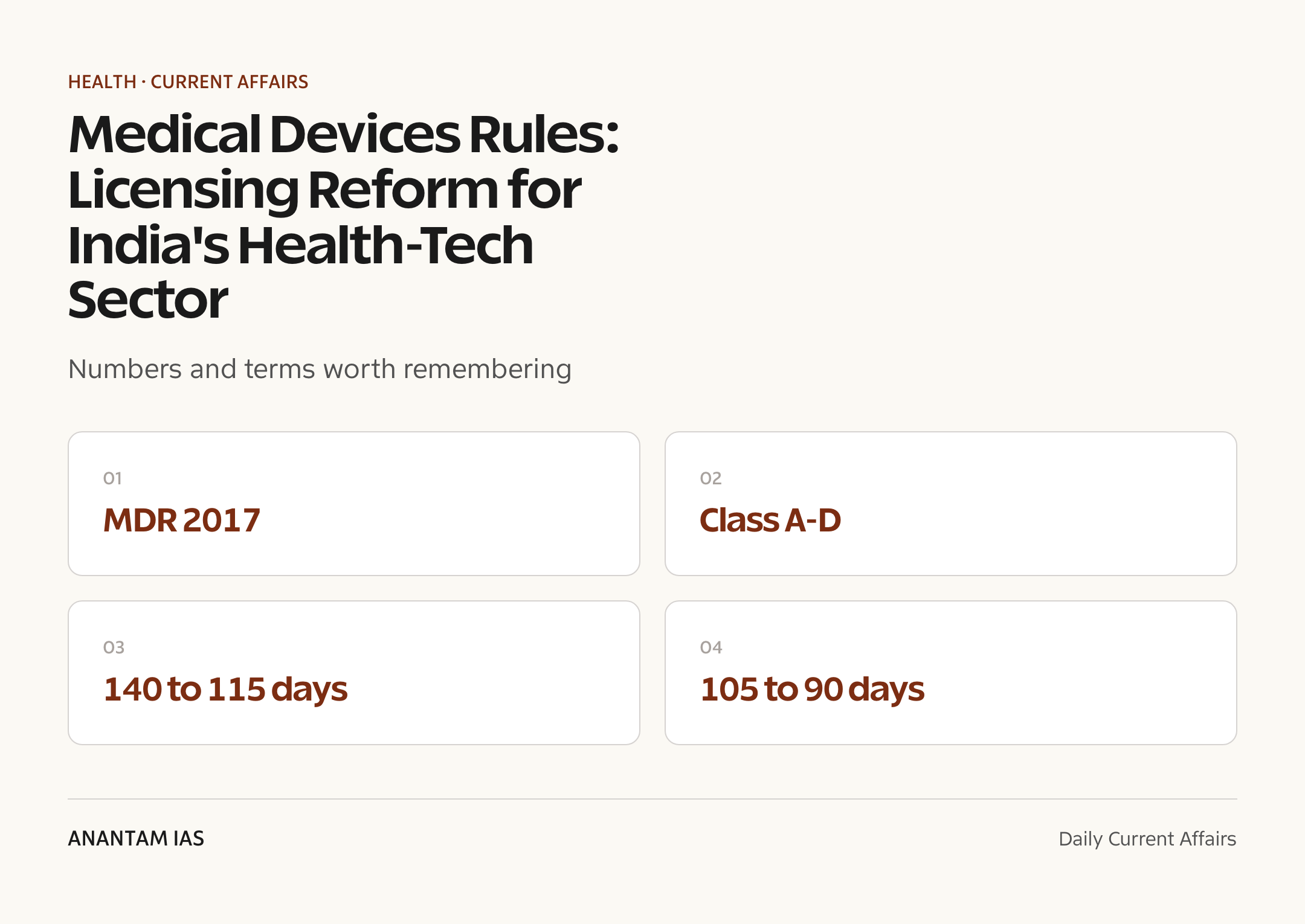
- PIB highlighted that Class B licensing time is proposed to fall from 140 days to 115 days.
- For Class C and Class D devices, the licensing time is proposed to fall from 105 days to 90 days.
- The draft also sets clearer stage-wise timelines for application scrutiny, notified-body audit, compliance verification and issue of licence.
- Stakeholders can send objections or suggestions within the specified 30-day consultation window.
The development matters in the context of:
- Medical devices sit at the intersection of public health, industrial policy, import regulation and patient safety.
- The reform matters because a licensing delay affects domestic manufacturers, hospitals, importers, start-ups and patients waiting for reliable devices.
- The governance test is whether India can cut delay without weakening risk-based oversight or post-market accountability.
UPSC Relevance
Prelims Relevance
- Medical Devices Rules, 2017 regulate medical devices under the Drugs and Cosmetics Act framework.
- CDSCO is the national regulatory authority for drugs, cosmetics and medical devices under the Health Ministry.
- Class A, B, C and D are risk classes; Class A is low risk and Class D is high risk.
- Class B examples cited by PIB include blood pressure monitors, hypodermic needles and pulse oximeters.
- Class C and D examples cited by PIB include cardiac stents, hip implants, knee implants and other orthopaedic implants.
- Notified Bodies are used for audits in the regulatory architecture, especially for lower-risk manufacturing-site checks.
- Quality Management System requirements under the Fifth Schedule are central to manufacturing-site compliance.
- SUGAM is the online portal used for many medical-device regulatory applications.
Mains Relevance
GS Paper 2
- Health governance: balancing patient safety, timely access and accountable regulation.
- Regulatory reform: reducing procedural delay while preserving statutory checks and transparency.
- Centre-State coordination: licensing roles involve central and state regulators under a common legal framework.
GS Paper 3
- Science and technology: medical devices are part of India’s health-tech and diagnostics ecosystem.
- Manufacturing policy: predictable approvals can support domestic firms, MSMEs and innovation-led production.
- Economic regulation: faster market entry must be matched with quality assurance and surveillance.
Essay
- Regulation and innovation: good rules should protect citizens while allowing useful technologies to reach them.
- Health security: a country needs dependable devices, skilled regulators and responsible manufacturers.
- Trust in institutions: speed matters, but public trust depends on credible checks.
Background and Context
What the draft amendments propose
The draft is not a deregulation move; it is a timeline-rationalisation proposal within the existing statutory framework.
- PIB says the objective is to simplify and speed up medical-device licensing while ensuring full compliance with quality, safety and performance standards.
- For Class B devices, the headline licensing timeline is proposed to reduce from 140 days to 115 days.
- For Class C and Class D devices, the headline licensing timeline is proposed to reduce from 105 days to 90 days.
- The draft notification also clarifies timelines for scrutiny, notified-body audit, compliance verification and final licensing steps.
- The central message is administrative predictability: applicants know the expected sequence, regulators keep the checks, and patients may get quicker access to quality devices.
Medical Devices Rules, 2017: basic architecture
India regulates medical devices through a drug-law framework, but the 2017 Rules created a separate device-focused regulatory route.
- The Medical Devices Rules, 2017 were framed under the Drugs and Cosmetics Act, 1940 to cover medical devices and in-vitro diagnostics.
- A medical device can include an instrument, apparatus, appliance, implant, material, software or accessory used for diagnosis, prevention, monitoring, treatment or support of anatomy or physiology.
- The Rules classify devices by risk into Class A, Class B, Class C and Class D.
- Class A is low risk, Class B is low-moderate risk, Class C is moderate-high risk, and Class D is high risk.
- This architecture matters because a thermometer, a pulse oximeter, an implant and a cardiac stent do not carry the same level of patient risk.
Who regulates the sector
The system combines central regulation, state licensing work and third-party audit capacity.
- CDSCO, under the Directorate General of Health Services, is India’s central drug and medical-device regulator.
- The Central Licensing Authority handles key permissions such as import licences, Class C and D manufacturing licences, clinical investigation permissions and new-device approvals.
- State Licensing Authorities play an important role in domestic manufacturing licences for lower-risk device categories.
- Notified Bodies, registered under the Rules, audit manufacturing sites and help verify quality-system compliance.
- This divided structure needs clear timelines because manufacturers often interact with more than one regulatory actor before market entry.
Why licensing matters
Licensing is the gate between a product claim and real use on patients.
- A licence confirms that a device has passed required checks for quality, safety and performance before it enters the market.
- For patients, licensing reduces the risk of unsafe implants, inaccurate diagnostics, poor sterilisation or devices with weak manufacturing controls.
- For hospitals, it gives a baseline of regulatory trust while procuring devices used in diagnosis, surgery, intensive care and routine care.
- For manufacturers, predictable licensing reduces uncertainty around launch timelines, investments, supply-chain planning and market access.
- For regulators, the challenge is to avoid both extremes: slow approvals that block useful technology and weak approvals that allow unsafe products.
Ease of doing business angle
The draft tries to convert regulatory efficiency into industrial competitiveness without dropping the safety bar.
- Medical devices are a high-value sector for Make in India, import substitution, hospital supply chains and health-tech start-ups.
- Shorter timelines can help domestic firms plan production cycles and product launches with less regulatory uncertainty.
- Clearer stage-wise timelines reduce discretion because applicants can track whether the file is at scrutiny, audit, compliance verification or licence issue.
- The reform also helps importers and hospitals because delayed approvals can affect availability of critical devices and replacement parts.
- The key test is capacity: faster timelines work only when regulators, notified bodies and inspection teams have enough skilled staff and digital systems.
Patient safety and accountability
Speed is useful only if the regulator keeps the device-safety chain intact.
- The draft keeps the language of compliance with quality, safety and performance standards, which is important for exam analysis.
- Quality checks must cover design controls, manufacturing-site hygiene, sterilisation where relevant, traceability, labelling and risk management.
- Licensing is only the first stage; India also needs stronger post-market surveillance, adverse-event reporting and recall systems.
- The Materiovigilance Programme of India is relevant here because device failures can harm patients even after approval.
- For a related health-regulation theme, see medical equipment notified as drugs.
Why this is a governance topic
The issue is not just technical; it is a live example of rule design in a welfare state.
- A good regulator must be predictable, technically competent and independent enough to resist both industry pressure and bureaucratic delay.
- Medical-device governance affects access to diagnostics, surgery, chronic-care monitoring, emergency care and assistive technologies.
- The topic connects with wider debates on biosimilars, digital health, device software and clinical validation.
- Emerging tools such as digital twins will make device regulation more complex because software, data and hardware increasingly overlap.
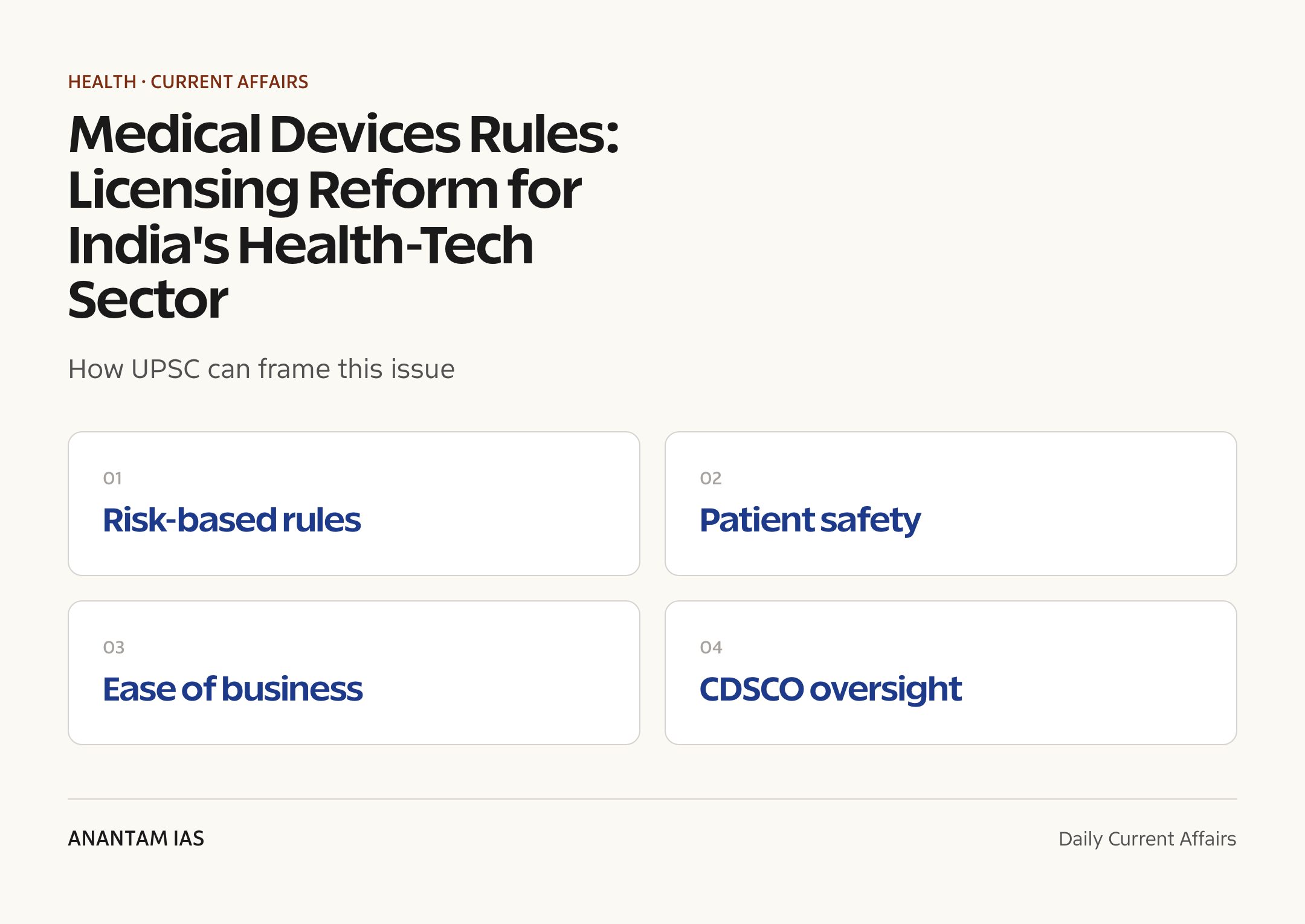
- For Mains, the best answer frame is not pro-industry versus pro-safety; it is risk-based regulation with transparent timelines and strong surveillance.
Way Forward
Build capacity before compressing timelines
- Increase trained reviewers, inspectors and device-domain experts in CDSCO, State Licensing Authorities and notified-body ecosystems.
- Publish service-level dashboards for each licensing stage so delay can be tracked without weakening scrutiny.
Strengthen risk-based oversight
- Keep deeper review for Class C and Class D devices where failure can cause serious patient harm.
- Use checklists and standard operating procedures for Class A and B devices so lower-risk approvals become faster and more consistent.
Improve post-market safety
- Link licence data with adverse-event reporting, field safety corrective action, recall alerts and hospital procurement systems.
- Make manufacturers responsible for traceability, complaint handling and timely reporting of device failures.
Make consultation meaningful
- Use the 30-day comment window to collect feedback from manufacturers, doctors, hospitals, patient groups, notified bodies and state regulators.
- Publish a response matrix after finalisation so stakeholders can see which concerns were accepted, rejected or deferred.
Conclusion
The proposed amendment to the Medical Devices Rules, 2017 is a useful case study in health-sector regulatory reform: timelines are being shortened, but the language of quality, safety and performance remains central.
For exam answers, avoid treating this as a routine ease-of-business update. The real issue is how India can build a risk-based medical-device regime that supports manufacturing, protects patients and keeps regulation predictable.
UPSC Practice Questions
Prelims MCQ 1
With reference to medical-device regulation in India, consider the following statements:
- Medical devices are regulated under the Drugs and Cosmetics Act, 1940 and the Medical Devices Rules, 2017.
- Class D devices are treated as the lowest-risk category under the Medical Devices Rules, 2017.
- The draft licensing reform proposes to reduce the Class B licensing timeline from 140 days to 115 days.
How many of the above statements are correct?
(a) Only one (b) Only two (c) All three (d) None
Answer: (b) Only two
Explanation:
Statements 1 and 3 are correct. Class D is the highest-risk category, while Class A is the low-risk category.
Prelims MCQ 2
Which of the following is India’s central regulatory authority for drugs, cosmetics and medical devices under the Health Ministry?
(a) Central Drugs Standard Control Organisation (b) National Accreditation Board for Hospitals (c) Indian Council of Medical Research (d) National Health Authority
Answer: (a) Central Drugs Standard Control Organisation
Explanation:
CDSCO, under the Directorate General of Health Services, is the central regulatory authority for drugs, cosmetics and medical devices.
UPSC Mains Questions
- The proposed amendments to the Medical Devices Rules, 2017 seek faster licensing without diluting quality, safety and performance standards. Discuss how India can balance ease of doing business with patient safety in a risk-based medical-device regime.
- Medical-device regulation is both a health-governance issue and an industrial-policy issue. Examine this statement with reference to CDSCO, risk classification, notified-body audits and domestic manufacturing.
- Predictable timelines improve regulatory efficiency, but weak scrutiny can damage public trust. Suggest institutional measures to make medical-device licensing faster, transparent and accountable.
Sources: PIB, Ministry of Health and Family Welfare and Gazette of India draft notification.
Frequently Asked Questions
What are Medical Devices Rules, 2017?
The Medical Devices Rules, 2017 are India’s device-focused rules under the Drugs and Cosmetics Act framework. They regulate manufacturing, import, testing, clinical investigation, licensing, quality systems and risk classification for medical devices and in-vitro diagnostics.
What did the Health Ministry propose?
The Health Ministry proposed draft amendments to simplify licensing and reduce timelines. PIB says Class B licensing may fall from 140 days to 115 days, while Class C and D licensing may fall from 105 days to 90 days.
What is risk-based classification?
Risk-based classification groups devices by possible patient harm. Class A is low risk, Class B is low-moderate risk, Class C is moderate-high risk and Class D is high risk. Higher-risk devices need stricter scrutiny.
Why are notified bodies important?
Notified Bodies audit manufacturing sites and help verify quality-system compliance under the Rules. They add technical capacity to the licensing process, but their credibility depends on accreditation, conflict-of-interest control and regulatory supervision.
Does faster licensing mean weaker safety?
Not by itself. The draft keeps the requirement of compliance with quality, safety and performance standards. The concern is implementation: faster timelines need trained reviewers, reliable audits, digital tracking and strong post-market surveillance.
Why does this topic matter?
This topic links health governance, regulatory reform, ease of doing business, domestic manufacturing, patient safety and science-tech policy. It shows how a welfare state can make approvals predictable while keeping strong safeguards.