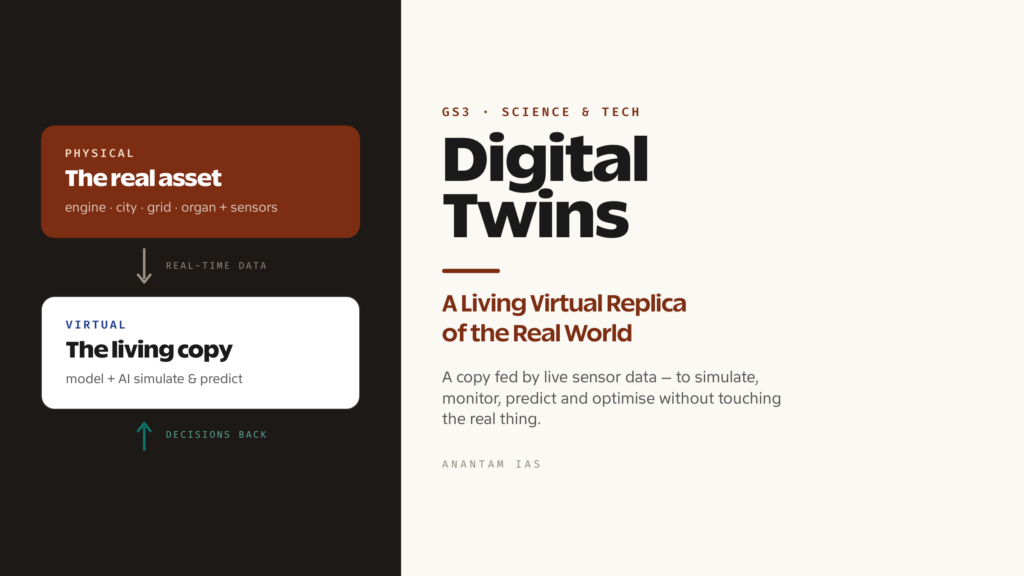
Picture an aircraft engine cruising at 38,000 feet over the Atlantic, and a perfect copy of that same engine running at the same moment on a screen in an operations centre on the ground. The copy isn’t a drawing or a one-off simulation. It is a living mirror, fed every few seconds by hundreds of sensors on the real engine — temperature, vibration, fuel flow, pressure — so that the version on the ground heats up, strains and ages in step with its physical twin in the sky. When the model spots a bearing starting to wear, an engineer can schedule maintenance before the part ever fails. That mirror has a name, and over the past few years it has quietly moved from aerospace labs into factories, hospitals, power grids and entire cities. It is called a digital twin.
A digital twin is a dynamic virtual replica of a physical asset, process or system, kept in sync with its real-world counterpart by a constant stream of live data. The idea matters far beyond engineering trivia, and that’s why it has become a staple of the science and technology section that UPSC keeps expanding. Digital twins sit at the meeting point of three forces the syllabus already cares about — the Internet of Things, big-data analytics and artificial intelligence — and they are reshaping how India plans cities, runs power networks, builds infrastructure and even imagines healthcare. For an aspirant, this is one of those topics where a clear definition, a couple of vivid examples and an honest list of limits can carry an answer a long way.
What a Digital Twin Is and How It Works
Start with the word itself, because the metaphor is exact. You have a “twin” — a virtual entity that looks and behaves like a real one — and the link between them is “digital”, a live data connection rather than a one-time blueprint. The whole point is that the copy stays faithful over time, not just on the day it was built. So a static 3D model of a building is not a digital twin. A simulation you run once and switch off is not a digital twin. A digital twin is alive, updating itself from its physical original throughout that object’s working life.
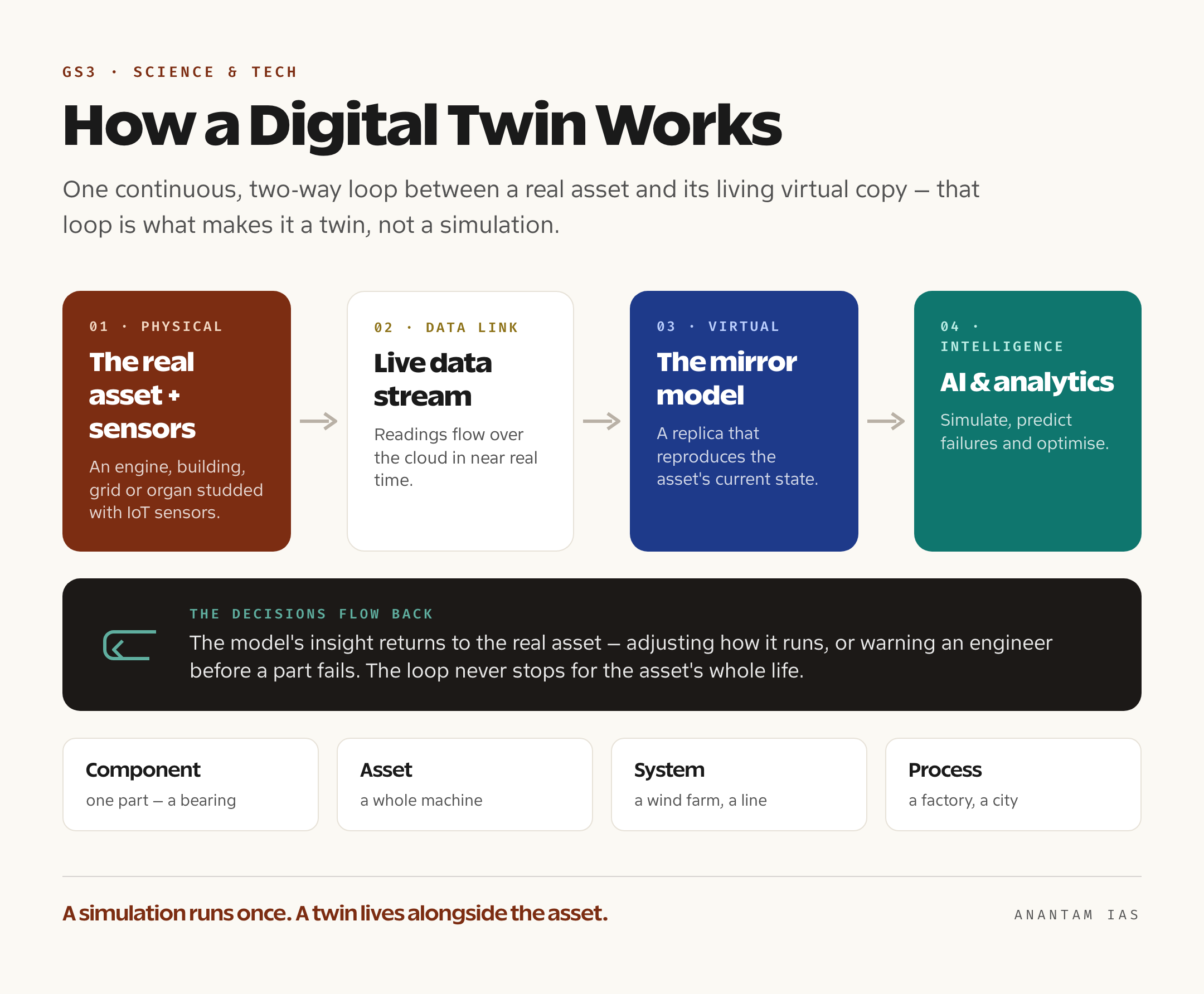
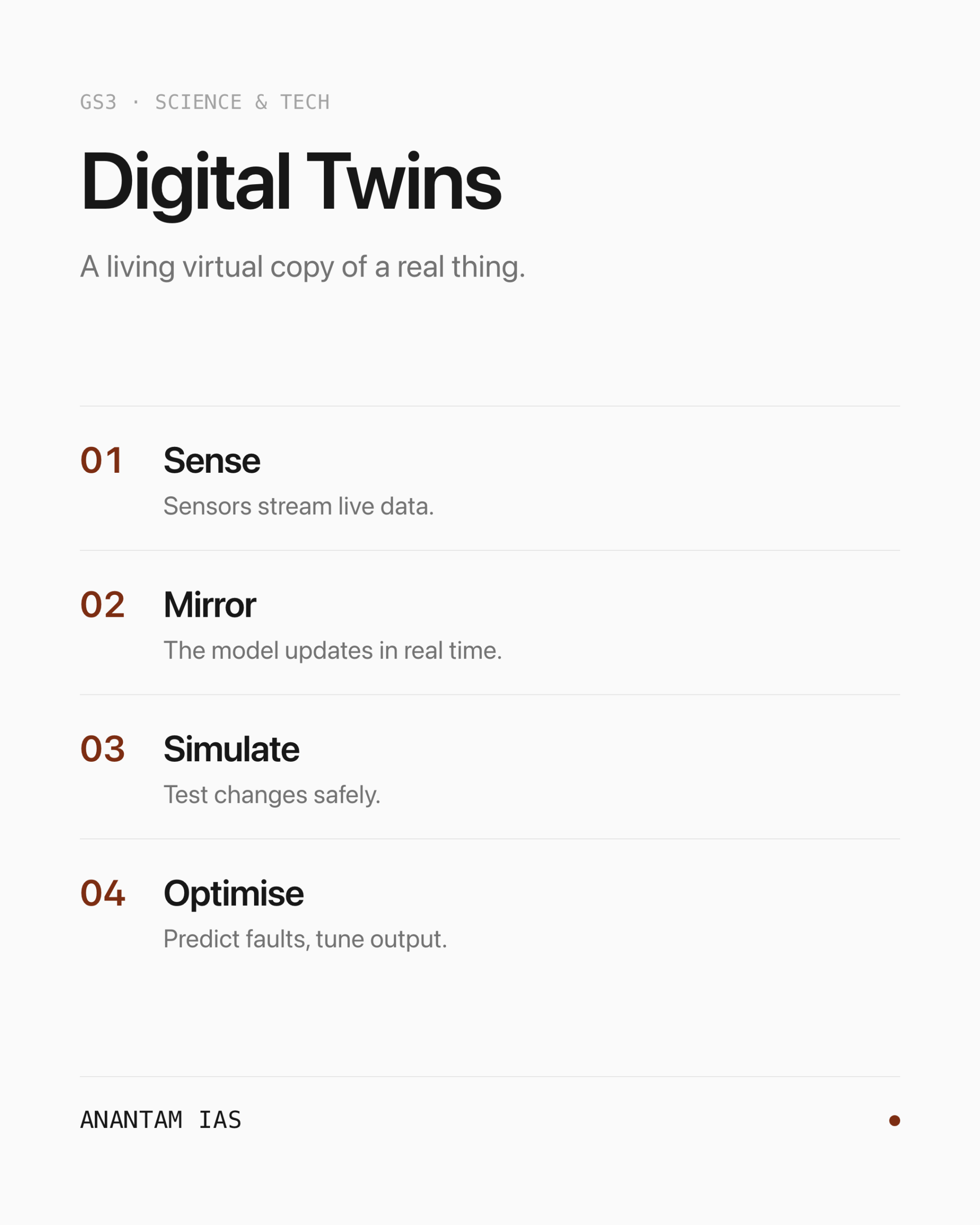
Four layers make it work, and it helps to picture them stacked. First comes the physical asset itself, studded with sensors and Internet of Things devices that measure whatever matters — heat, motion, stress, flow, location. Second is the data link, the pipeline that streams those readings, usually over the cloud, from the real object to its virtual copy in near real time. Third is the virtual model, a physics-based or data-driven replica that takes the incoming numbers and reproduces the asset’s current state on a screen. And fourth is the intelligence layer, where analytics and increasingly artificial intelligence run simulations on the model — testing “what if we push this harder?” or “what breaks next?” — and turn the answers into insight. As explainers from IBM and AWS both put it, the twin lets you ask questions of a machine without ever touching the machine.
What truly separates a digital twin from an ordinary simulation is that the connection runs both ways and never stops. A simulation is a snapshot — you feed in assumptions and watch a scenario play out once. A digital twin is a feedback loop — real data flows in continuously, and the lessons the model learns can flow back out as instructions to the physical asset, adjusting how it runs. That live, bidirectional loop is the heart of the concept, and it is the single distinction most worth memorising. The technology also comes in a spectrum of scale, climbing from small to vast. A component twin mirrors a single part, like a bearing or a valve. An asset twin (or product twin) models a whole working object, such as that jet engine or a wind turbine. A system twin stitches many assets together — every turbine in a wind farm, every train on a line. And a process twin models an entire operation end to end, like a full factory or a city’s traffic flow, so managers can see how the parts interact as one. The idea isn’t new, either: NASA pioneered the spirit of it in the 1960s by building paired physical spacecraft so engineers on the ground could mirror a craft in orbit — most famously when they used the ground twin to troubleshoot the crippled Apollo 13. The phrase “digital twin” was formalised by researcher Michael Grieves in the early 2000s and the label itself was coined by NASA’s John Vickers around 2010, before General Electric carried it into industry with its turbine and jet-engine twins.
Where Digital Twins Are Already at Work
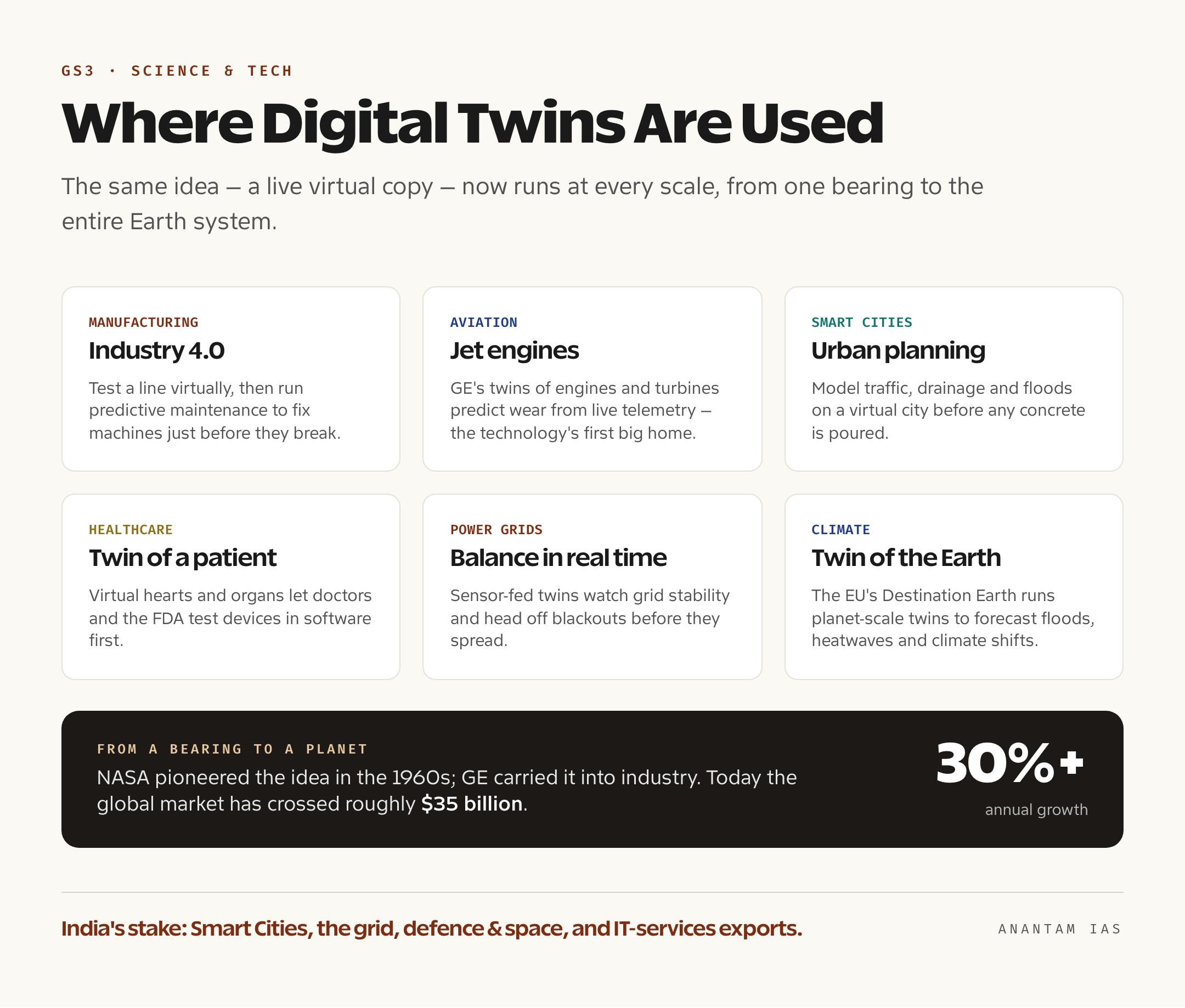
The first home of the digital twin was the factory floor, and it remains the biggest. In manufacturing and what’s now called Industry 4.0 — the fusion of machines, sensors and data into “smart” production — twins let companies test a new assembly line virtually before spending on steel, spot a failing motor before it halts the plant, and fine-tune output without stopping the line. The aviation example is the classic one: General Electric built digital twins of its jet engines and gas turbines, running a virtual copy of each unit in the field so it could predict wear and plan maintenance from telemetry rather than guesswork. This kind of predictive maintenance — fixing things just before they break, not on a fixed calendar and not after a costly failure — is the bread-and-butter payoff of the technology, and it shows up everywhere from oil refineries to railway fleets. The savings are real and double-sided: you avoid the cost of a sudden breakdown, and you avoid the waste of replacing a part that still had life left in it. And because the testing happens on the copy, a company can try a riskier, more aggressive operating setting on the twin first, learn what would break, and only then apply the safe version to the real machine.
From single machines the twins have scaled all the way up to cities and the planet. Smart cities and urban planning are a fast-growing arena: planners build a virtual model of a district or a whole city — its buildings, roads, drains, power lines and traffic — and test ideas on the copy first. Where should a new flyover go? How will a monsoon flood the stormwater network? What happens to air quality if a corridor turns car-free? You answer on the twin before you dig. Healthcare has produced some of the most striking work, with researchers building a “digital twin of a patient” and of individual organs. The Living Heart Project, led by Dassault Systèmes since 2014, creates lifelike virtual hearts that doctors and regulators use to test devices and treatments in software; it has since expanded to the lungs, liver, brain and other organs, and the US Food and Drug Administration has even co-authored guidance on running “in-silico clinical trials” — testing a treatment on virtual patients before, or alongside, real ones. Power grids use twins to monitor and balance electricity flow in real time. Agriculture uses field-and-crop twins to optimise irrigation and yield. And at the grandest scale of all, the European Union’s flagship Destination Earth programme is building digital twins of the whole planet — a Climate Change Adaptation twin and a Weather Extremes twin, operational since 2024 and running global simulations at a resolution of a few kilometres — to forecast floods, heatwaves and long-term climate shifts. The technology that began by mirroring one spacecraft now reaches from a single bearing to the entire Earth system, and the global market for it has swelled past $35 billion, growing at better than 30 per cent a year.
The engine under all of this is the same set of technologies the syllabus already tracks. Sensors and the Internet of Things supply the live data; cloud computing carries and stores it; and artificial intelligence turns the flood of readings into predictions a human can act on. A digital twin is, in a sense, where those threads are tied into a single usable knot — which is exactly why it sits so neatly in a modern science-and-technology answer.
India’s Stake in the Digital Twin
India is not a bystander here, and the home angle is what lifts an answer from generic to specific. The most visible push is in urban governance through the Smart Cities Mission, where several cities have begun building geospatial digital twins — three-dimensional, data-rich models of the urban fabric that knit together mapping data with detailed building information so planners can simulate traffic, drainage, utilities and disaster response before committing concrete. A city twin can warn a planner that a proposed road will choke an intersection, show how floodwater will pool in a low-lying ward during a cloudburst, or model where heat will build up as the city grows denser — questions that are slow, costly or impossible to answer by trial in the real world. Industry bodies and the government have run multi-year work on a national digital-twin strategy for infrastructure, pairing geospatial data with Building Information Modelling so that highways, metros and large public projects can be planned, built and maintained against a living virtual model rather than static drawings. For a country building infrastructure at India’s pace, the appeal is obvious: catch a design clash or a flood risk on the screen, not on the ground.
The technology reaches into India’s strategic and scientific institutions too. The national power grid is being wired with thousands of phasor measurement units — sensors that report the grid’s state many times a second — which is precisely the kind of live data feed a grid-scale digital twin needs to monitor stability and head off blackouts. Defence and space research organisations use twin-style virtual modelling to design and test aircraft, missiles and launch vehicles in software before any costly physical trial, shrinking both risk and cost. Manufacturing firms, especially in the auto and heavy-engineering belts, are adopting factory twins as part of their move toward Industry 4.0. And India’s large information-technology services companies have become global builders of digital twins for overseas clients, from virtual hearts to industrial plants, which means the country is exporting the skill even as it adopts it. The thread running through all of it is self-reliance: a digital twin lets you test, fail and learn cheaply and safely at home, which fits squarely with India’s drive to build its own design and engineering muscle.
The Hurdles That Hold Digital Twins Back
For all the promise, a digital twin is only as good as the data feeding it, and that’s where the trouble starts. The first and deepest problem is data quality. A twin that runs on patchy, delayed or inaccurate sensor readings will mirror a fiction, not reality, and decisions made on a wrong twin can be worse than decisions made on no twin at all. Building a faithful model also demands enormous quantities of clean, well-labelled data, which many organisations simply don’t have. So the old computing warning applies with full force here: garbage in, garbage out.
The second hurdle is interoperability — the ability of different systems to talk to one another. A real factory or city is a patchwork of equipment from many vendors, often running on legacy systems that were never built to share data, and a digital twin has to stitch all of it into one coherent model. With few common standards and lots of proprietary, locked-in formats, that stitching is expensive and fragile, and a twin built for one setting rarely transfers to another. Cost is the third barrier and it compounds the rest: a serious digital twin needs sensors everywhere, fast data pipelines, cloud or edge computing, modelling software and skilled people to run it, which puts full-scale twins out of reach for smaller firms and cash-strapped municipalities. Then comes cyber-security, which grows more serious the more important the twin becomes. A digital twin is a constant two-way data stream and a detailed blueprint of a critical asset, so a breach could let an attacker steal sensitive operational secrets or, worse, feed false data into the loop and push the real machine — a turbine, a grid, a hospital device — into failure. Privacy rounds out the list, especially for healthcare and city twins: a twin of a patient or of a neighbourhood holds intensely personal information, and India’s still-young data-protection regime has yet to settle how such living models of people and places should be governed. None of these problems is fatal, but together they explain why the technology, for all its hype, is still spreading unevenly rather than everywhere at once.
For Your Mains Answer
This is a high-value topic for GS Paper 3, which covers science and technology, developments and their applications, and the role of new technologies in everyday life. Digital twins map onto questions about the Internet of Things, Industry 4.0, artificial intelligence, awareness in the fields of IT and computers, and the use of technology in governance, infrastructure and healthcare. The topic also offers a clean illustration for GS Paper 2 (technology in service delivery and urban governance) and even for the Essay paper on themes of technology, sustainability and the virtual world. The skill examiners reward is the one this article models: define the thing crisply, separate it from a plain simulation, give two or three concrete applications including an Indian one, and finish with a balanced look at the limits.
How to Build the Answer
Open with a one-line definition — a live virtual replica of a physical asset kept in sync by real-time data — and immediately mark what makes it special: the continuous, two-way loop that a static model or one-off simulation lacks. Then move in a logical chain: how it works (sensors → data link → virtual model → AI/analytics), the spectrum of scale (component → asset → system → process), the major applications (manufacturing, aviation, smart cities, healthcare, Earth-system climate twins), India’s stake (Smart Cities Mission, grid, defence and space, IT exports), and finally the challenges (data quality, interoperability, cost, cyber-security, privacy). Close by judging where the technology genuinely adds value versus where it is over-hyped. That arc — define, distinguish, build, apply, localise, critique — fits almost any digital-twin question.
Common Mistakes to Avoid
Don’t equate a digital twin with a simulation or a 3D model — the live, bidirectional data link is the whole point, and missing it loses the core mark. Don’t keep the answer foreign; an examiner wants the Indian hook, so name the Smart Cities Mission, the power grid sensors or India’s IT-services exports. Don’t oversell it as magic; a twin built on bad data is worse than useless, and saying so shows judgment. And don’t forget the security and privacy angle — a detailed virtual copy of a critical asset or a patient is a tempting target and a real ethical question, not an afterthought.
A Compact Answer Spine
Digital twin = dynamic virtual replica of a physical asset/process/system, synced by real-time IoT data → four layers: physical asset + sensors → data link → virtual model → AI/analytics → key difference from simulation: live, continuous, two-way loop → spectrum: component → asset → system → process twin → applications: Industry 4.0 and predictive maintenance, GE jet engines, smart cities, “digital twin of a patient” and organs, power grids, agriculture, Earth/climate twins (EU’s Destination Earth) → India: Smart Cities geospatial twins, grid sensors, defence/space modelling, IT-services exports → challenges: data quality, interoperability/standards, cost, cyber-security, privacy → verdict: a powerful convergence technology, but only as good as its data and its governance.
Diagram or Flowchart Idea
Draw the closed loop: a box for the physical asset with little sensor dots, an arrow labelled real-time data flowing to a box for the virtual model, an AI/analytics box reading that model, and a feedback arrow labelled decisions/control running back to the physical asset. A simple four-box cycle like this captures the defining two-way loop at a glance and is quick to sketch under time pressure.
A Balanced-Conclusion Line
A line that lands the marks: “A digital twin turns a physical asset into something you can question, test and improve without ever touching it — but it remains a mirror, faithful only as far as its data and its safeguards allow, so India’s gains from it will depend less on the technology than on the quality of the data and the governance behind it.”
How to Use Data Without Cramming
You need only a handful of anchors, not a market report: that NASA pioneered the idea in the 1960s and the term was formalised around 2002-2010; that GE applied it to jet engines and turbines; that the EU’s Destination Earth runs planet-scale climate twins operational since 2024; and that the global market has crossed roughly $35 billion. Drop those into the right sentences and the answer reads as informed without turning into a list of figures.
Frequently Asked Questions
What is a digital twin in simple terms?
A digital twin is a living virtual copy of a real-world object, process or system — a machine, a building, an organ, even a whole city — that stays connected to its physical original through a constant stream of sensor data. Because it updates in real time, engineers can watch how the real thing is behaving, run “what if” tests on the copy, and predict problems before they happen, all without touching or risking the actual asset.
How is a digital twin different from a simulation?
A simulation is usually a one-time experiment: you set assumptions, run a scenario, and read the result. A digital twin is permanent and two-way — real-time data flows continuously from the physical asset into the virtual model, and the insights can flow back out to adjust how the real asset runs. That live, bidirectional loop, lasting the whole working life of the asset, is what makes a twin different from an ordinary model or simulation.
Where are digital twins used?
Almost everywhere data-rich machines and systems exist. Manufacturing and Industry 4.0 use them for predictive maintenance and process tuning; aviation pioneered them for jet engines and turbines; smart cities use them for urban planning and disaster response; healthcare is building “digital twins” of patients and organs to test treatments; power grids, agriculture and even Earth-system climate models all rely on them — the European Union’s Destination Earth is building twins of the whole planet.
Is India using digital twin technology?
Yes. Several Indian cities under the Smart Cities Mission are building geospatial digital twins for urban planning; the national power grid is being fitted with sensors that feed grid-scale twins; defence and space organisations use virtual modelling to design and test aircraft, missiles and launch vehicles; manufacturers are adopting factory twins; and India’s large IT-services firms build digital twins for clients worldwide, making the country both an adopter and an exporter of the technology.
Practice Questions
Prelims MCQs
- With reference to a “digital twin”, which of the following best describes it?
(a) A static three-dimensional design drawing of a machine
(b) A dynamic virtual replica of a physical asset kept in sync by real-time data
(c) A backup copy of a software programme stored on the cloud
(d) A duplicate physical machine kept as a spare
Answer: (b) A digital twin is a live virtual copy of a physical asset, process or system, continuously updated by real-time sensor data, unlike a static drawing or a spare physical unit. - What primarily distinguishes a digital twin from an ordinary computer simulation?
(a) A digital twin uses more colourful graphics
(b) A simulation runs faster than a digital twin
(c) A digital twin maintains a continuous, two-way link with the physical asset, while a simulation is typically a one-time scenario
(d) A simulation can only model machines, not buildings
Answer: (c) The defining feature of a digital twin is its live, bidirectional connection to the physical asset throughout its working life, whereas a simulation is usually a single, static experiment. - The technologies most central to making a digital twin work include which of the following?
(a) The Internet of Things and sensors, real-time data links, and AI/analytics
(b) Blockchain, cryptocurrency and quantum computing only
(c) Social media platforms and search engines
(d) Satellite navigation alone
Answer: (a) A digital twin relies on IoT sensors to gather live data, a data pipeline to carry it, a virtual model to mirror the asset, and AI or analytics to generate predictions. - The “Destination Earth” initiative, often cited in the context of digital twins, is associated with which of the following?
(a) A NASA mission to Mars
(b) The European Union’s programme to build digital twins of the planet for climate and weather forecasting
(c) India’s Smart Cities Mission
(d) A private company’s satellite-internet project
Answer: (b) Destination Earth is the European Union’s flagship effort to create planet-scale digital twins — including a climate-adaptation twin and a weather-extremes twin — to model and forecast Earth’s systems. - Which of the following is correctly listed as a challenge in deploying digital twins?
(a) They reduce the need for any data
(b) Poor data quality, weak interoperability, high cost, and cyber-security and privacy risks
(c) They make assets impossible to monitor
(d) They work only without any sensors
Answer: (b) Digital twins depend on large volumes of clean data, struggle with systems that don’t share standards, cost a great deal to build, and create security and privacy exposure because they stream detailed data about critical assets.
Mains Practice Questions
- “A digital twin is a mirror that is only as faithful as the data behind it.” Explain how digital twin technology works and critically examine the challenges that limit its adoption. (15 marks, 250 words)
- Discuss the applications of digital twin technology across manufacturing, urban planning and healthcare. How can this technology strengthen India’s infrastructure and service delivery? (15 marks, 250 words)
- Distinguish between a digital twin and a conventional simulation. Why is the convergence of the Internet of Things, big data and artificial intelligence central to the rise of digital twins? (10 marks, 150 words)
- Examine the role of digital twins in India’s Smart Cities Mission and critical infrastructure such as the power grid. What governance and cyber-security safeguards should accompany their use? (15 marks, 250 words)
- Emerging technologies promise efficiency but raise fresh risks of data security and privacy. Evaluate this statement with reference to digital twins of patients, assets and cities. (15 marks, 250 words)
Tell Google you want more of this.
Add Anantam IAS as a preferred sourceOne tap, and this site shows up more often in your own Top Stories, AI Overviews and AI Mode. Remove it any time.