India’s First Deep-Tech Startup Push: Funding the Hard-Technology Frontier
Why in News?
India’s deep-tech ecosystem is in focus as the National Deep Tech Startup Policy (NDTSP) framework — first proposed by a working group under the office of the Principal Scientific Adviser — moves toward implementation, and Tamil Nadu in January 2026 unveiled a state-first dedicated deep-tech startup policy.
The push targets startups built on hard science and engineering — artificial intelligence, quantum, biotech, space, semiconductors and advanced materials — that need long gestation periods, deep intellectual property (IP) and patient capital the regular venture market rarely supplies.
- Deep-tech ventures commercialise frontier research and engineering, with R&D-heavy products, long timelines and defensible patents, unlike consumer-app or services startups.
- The NDTSP framework proposes patient capital, shared R&D infrastructure, IP facilitation and stronger academia-industry linkages.
- Tamil Nadu’s January 2026 policy is the first state-level deep-tech blueprint, with sector funds, lab access and incubation support.
- It complements Startup India (2016) and the Anusandhan National Research Foundation (ANRF), the new apex body for funding research.
- Anchored in the goal of technology sovereignty — owning, not just importing, critical frontier technologies.
The development matters in the context of:
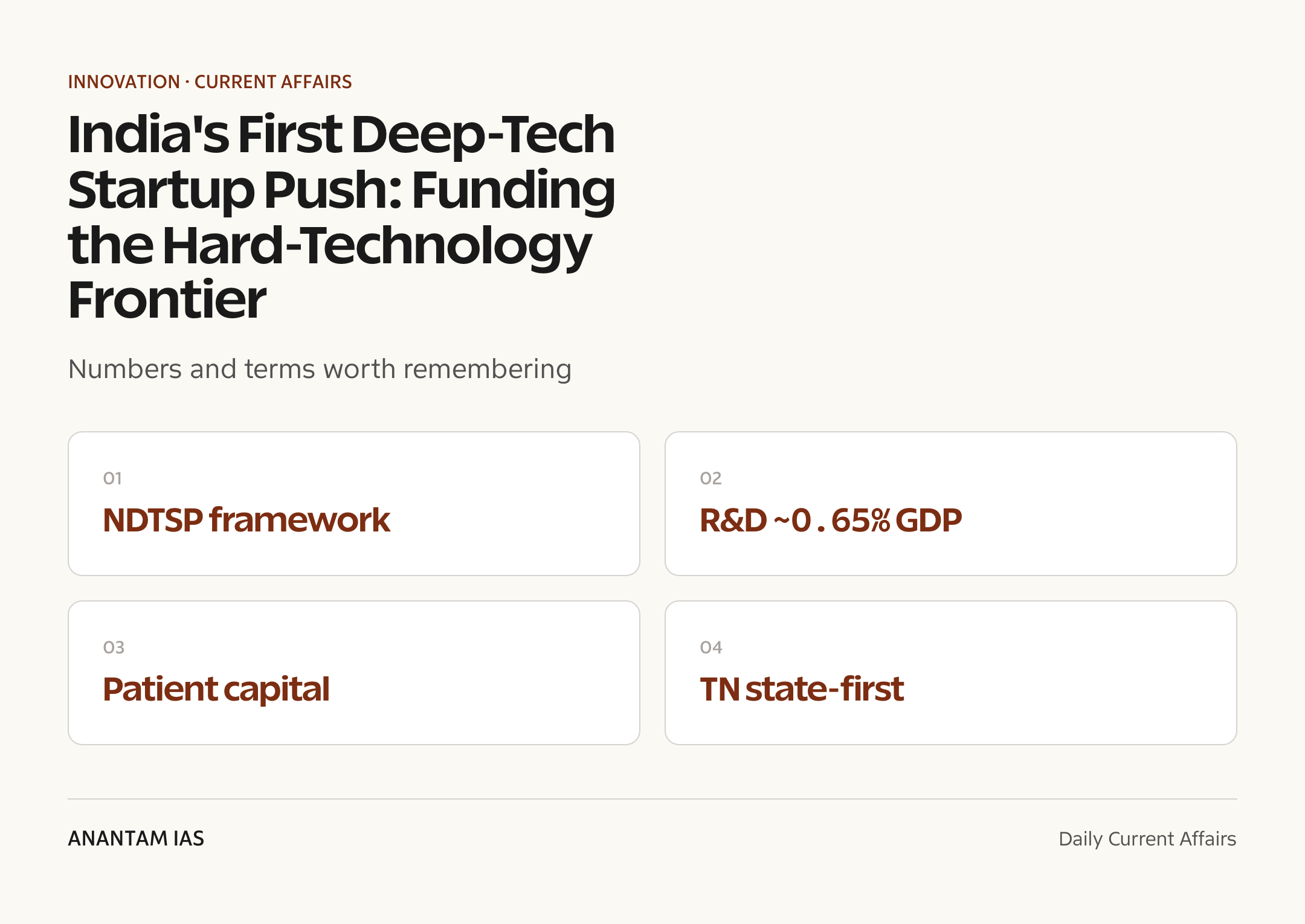
- India’s gross expenditure on R&D is low at about 0.65% of GDP, well below peers like China, South Korea and the US.
- Most Indian startup capital chases quick-return consumer and fintech models, leaving a funding gap for slow, capital-intensive deep tech.

UPSC Relevance
Prelims Relevance
- NDTSP originated from a working group under the Principal Scientific Adviser, not the RBI or NITI Aayog
- Deep-tech domains: AI, quantum, biotech, space, semiconductors, advanced materials, robotics
- ANRF created by the Anusandhan National Research Foundation Act, 2023; subsumed the erstwhile SERB
- Startup India launched 2016; DPIIT recognises eligible startups
- India’s R&D spend is roughly 0.65% of GDP (GERD); private-sector share is comparatively low
- Patient capital — long-horizon funding that tolerates delayed returns
- India AI Mission, National Quantum Mission and India Semiconductor Mission as enabling sectoral programmes
- Tamil Nadu’s 2026 deep-tech policy is the first sub-national dedicated framework
Mains Relevance
GS Paper 3
- Why deep tech needs a distinct policy from a generic startup push — long gestation, IP intensity and patient-capital gap.
- How NDTSP, ANRF, Startup India and sectoral missions fit together to build an innovation ecosystem.
- R&D financing in India — the structural reasons GERD stays near 0.65% of GDP and how to lift private-sector spend.
GS Paper 2
- Cooperative federalism in innovation policy — the role of state-led blueprints like Tamil Nadu’s deep-tech policy.
Essay
- Technology sovereignty and the cost of importing the future.
- Can patient capital be engineered, or must it be cultivated?
Background and Context
What deep tech means
Deep tech is defined by what it is built on, not by the app it ships.
- Ventures that commercialise frontier science and engineering rather than business-model innovation.
- Core domains span artificial intelligence, quantum technologies, biotech, space, semiconductors, advanced materials and robotics.
- Marked by long gestation from lab to market, high upfront R&D cost and heavy reliance on patents and proprietary IP.
- Products solve fundamental technical problems, so the moat is the technology itself, not just scale or marketing.
- This profile makes deep tech high-risk for ordinary venture capital, which prefers faster, lighter returns.
Why a dedicated policy was needed
India’s broader startup boom did not naturally fund the hard-technology frontier.
- Startup India (2016) seeded a large startup base, but capital concentrated in consumer, e-commerce and fintech ventures.
- Deep-tech founders face a funding gap — no revenue for years while the science matures, which deters short-horizon investors.
- They also lack affordable access to expensive R&D infrastructure such as fabrication labs, testing rigs and compute.
- Weak academia-industry translation leaves much publicly funded research stranded in journals rather than products.
- A generic startup framework cannot fix these structural gaps, so a deep-tech-specific policy was proposed.
What the NDTSP framework proposes
The National Deep Tech Startup Policy is built around the bottlenecks unique to frontier ventures.
- A patient-capital pool — long-horizon, risk-tolerant funding through dedicated funds and fund-of-funds support.
- Shared R&D infrastructure — open access to national labs, testing facilities and prototyping centres so founders skip heavy capex.
- IP facilitation — faster, cheaper patent filing and support so startups can protect and license their inventions.
- Stronger academia-industry linkages and technology-transfer offices to move research from campus to company.
- Sectoral focus areas, skilling support and a single-window approach to align the many existing schemes.
Where it sits in the ecosystem
NDTSP is an integrating layer over a set of existing programmes and bodies.
- Startup India and DPIIT — the recognition, tax and ease-of-doing-business base for all startups.
- Anusandhan National Research Foundation (ANRF) — the apex research-funding body created in 2023, which subsumed the Science and Engineering Research Board (SERB).
- Sectoral missions — the India AI Mission, the National Quantum Mission and the India Semiconductor Mission supply demand and capability in specific frontiers.
- Atal Innovation Mission incubators and academic tech-transfer cells feed the early-stage pipeline.
- NDTSP tries to stitch these into one innovation ecosystem rather than scattered, overlapping schemes.
The Tamil Nadu first-mover
A state has moved ahead of the national rollout with its own deep-tech blueprint.
- Tamil Nadu in January 2026 unveiled the first state-level deep-tech startup policy.
- It proposes dedicated sector funds and co-investment to crowd in private patient capital.
- It offers access to state and academic laboratories, prototyping facilities and incubation space.
- It leverages the state’s strong manufacturing and engineering-talent base to anchor hardware deep tech.
- It is a test of cooperative federalism — states tailoring innovation policy to local strengths ahead of a national template.
The R&D-financing backdrop
Deep-tech ambition runs into India’s long-standing under-investment in research.
- India’s gross expenditure on R&D (GERD) is about 0.65% of GDP, far below China, South Korea, Israel and the US.
- The private sector contributes a smaller share of R&D in India than in those economies, where firms drive most spending.
- Public funding has historically dominated, channelled through agencies the ANRF now seeks to coordinate and scale.
- Patient capital and shared infrastructure are partly an attempt to de-risk private R&D so corporates and funds invest more.
- Without lifting overall R&D intensity, even a strong policy may struggle to sustain a deep-tech pipeline.
Significance and the critique
The stakes are strategic, but design and execution risks are real.
- Deep tech underpins technology sovereignty — owning critical capabilities in AI, chips and quantum rather than importing them.
- Domestic frontier ventures create high-skill jobs and reduce dependence on foreign IP and hardware.
- But patient capital is hard to mandate; if funds chase faster exits, public money may end up carrying most of the risk.
- Shared infrastructure and IP support can stall on bureaucratic access rules and slow patent processing.
- Success needs sustained funding, real academia-industry translation and a rise in overall R&D intensity, not a one-time scheme.
Way Forward
Engineer genuine patient capital
- Use blended finance and fund-of-funds support to crowd in private long-horizon money, not just public grants.
- Tie incentives to deep-tech outcomes — patents, prototypes and revenue from frontier products.
Open the R&D base
- Make access to national labs, fabs and compute simple, time-bound and affordable for startups.
- Fund and staff technology-transfer offices so campus research reaches companies.
Lift R&D intensity
- Push GERD decisively above the long-stuck 0.65% of GDP, with stronger private-sector spend.
- Sequence NDTSP with ANRF and the sectoral missions so funding, research and demand reinforce one another.
Conclusion
India’s deep-tech turn recognises a hard truth — the startup boom that produced unicorns rarely funded the slow, IP-heavy science that decides technology sovereignty. The NDTSP framework and Tamil Nadu’s state-first policy go after the specific bottlenecks of frontier ventures: patient capital, shared R&D infrastructure, IP support and academia-industry translation.
The test will be whether the country can engineer genuine long-horizon capital and lift its R&D intensity above the long-stuck 0.65% of GDP. If it can, deep tech can move India from a buyer of frontier technology to a builder of it. If patient capital stays scarce and labs stay closed, the policy risks remaining ambition without a pipeline.
UPSC Practice Questions
Prelims MCQ 1
With reference to deep-tech startups and India’s innovation ecosystem, consider the following statements:
- Deep-tech ventures are typically characterised by long gestation periods and heavy intellectual-property intensity.
- The Anusandhan National Research Foundation (ANRF) was set up to coordinate and fund research and subsumed the Science and Engineering Research Board.
- The National Deep Tech Startup Policy is administered by the Reserve Bank of India.
How many of the above statements are correct?
(a) Only one (b) Only two (c) All three (d) None
Answer: (b) Only two
Explanation:
Statements 1 and 2 are correct. Statement 3 is wrong — the deep-tech policy framework emerged from a working group under the Principal Scientific Adviser and the startup-policy apparatus (DPIIT/Startup India), not the RBI.
Prelims MCQ 2
Which one of the following is NOT typically classified as a deep-tech domain?
(a) Quantum computing (b) Advanced materials (c) Food-delivery aggregation (d) Semiconductors
Answer: (c) Food-delivery aggregation
Explanation:
Food-delivery aggregation is a consumer business-model innovation, not deep tech. Quantum computing, advanced materials and semiconductors are frontier hard-technology domains built on deep science and engineering.
UPSC Mains Questions
- India’s startup boom produced scale but little frontier science. Examine why deep-tech ventures need a policy distinct from a generic startup push, and discuss how the National Deep Tech Startup Policy seeks to address their specific bottlenecks.
- Discuss how the National Deep Tech Startup Policy, the Anusandhan National Research Foundation and India’s sectoral technology missions can together build an innovation ecosystem. What role can state-led blueprints play in this effort?
- Technology sovereignty requires building, not buying, critical capabilities. Critically analyse this statement with reference to India’s low R&D intensity and its deep-tech financing challenge.
Sources: Department for Promotion of Industry and Internal Trade (DPIIT) and Press Information Bureau.
Frequently Asked Questions
What is a deep-tech startup?
A deep-tech startup commercialises frontier science and engineering rather than a new business model. Its products are built on hard technologies such as artificial intelligence, quantum, biotech, space, semiconductors or advanced materials. These ventures are defined by long gestation periods, high upfront R&D cost and heavy reliance on patents and proprietary intellectual property, which makes them harder to fund than consumer or services startups.
What is the National Deep Tech Startup Policy?
The National Deep Tech Startup Policy (NDTSP) is a framework, first proposed by a working group under the office of the Principal Scientific Adviser, to support hard-technology ventures. It focuses on the bottlenecks unique to deep tech — patient long-horizon capital, shared R&D infrastructure, faster intellectual-property facilitation and stronger academia-industry linkages — and seeks to align the many existing startup and research schemes into one ecosystem.
How is deep tech different from a normal startup?
A normal startup usually innovates on the business model — how a service is delivered or priced — and can reach the market quickly. Deep tech innovates on the underlying science and engineering, so its products take years to mature, demand expensive R&D infrastructure and depend on defensible patents. This profile creates a funding gap because ordinary venture capital prefers faster, lighter returns.
What is patient capital and why does deep tech need it?
Patient capital is long-horizon, risk-tolerant funding that accepts delayed returns while a technology matures. Deep-tech ventures may earn no revenue for years as the science is proven and prototypes are built. Without patient capital they cannot survive that gap, so the deep-tech policy push tries to engineer such funding through dedicated funds, fund-of-funds support and blended finance that crowds in private money.
How does the deep-tech push relate to ANRF and Startup India?
Startup India and DPIIT provide the recognition, tax and ease-of-business base for all startups. The Anusandhan National Research Foundation, created in 2023, is the apex body for funding and coordinating research and subsumed the earlier Science and Engineering Research Board. The deep-tech policy tries to integrate these with sectoral missions in AI, quantum and semiconductors so funding, research and demand reinforce one another.
Why is India’s R&D spending considered low?
India’s gross expenditure on research and development is about 0.65% of GDP, far below peers such as China, South Korea, Israel and the United States. A large share is public, with the private sector contributing less than in those economies, where firms drive most spending. This low R&D intensity is a core reason deep-tech ventures struggle for funding and why patient capital and shared infrastructure are seen as ways to de-risk private investment.