

On 7 February 2026, a Quantum Valley opened on the edge of Amaravati, anchored by what’s billed as India’s largest quantum computer. The same month, a different government department quietly published a roadmap for defending the country against quantum computers. Read those two events side by side and you’ve got the whole story in miniature. India is now building the machine and bracing for it in the same calendar year. So the question has shifted. It’s no longer whether India should be in this race. It’s whether India is running at the speed and scale the race actually demands.
That’s a harder question, and a more honest one. A mission can be the right bet and still be under-resourced. A country can produce its first quantum chips and still trail the field by a decade. The National Quantum Mission is genuinely the correct call. What’s contestable is whether the funding, the talent depth, and the urgency of the defensive piece match the size of the prize. Get those three right and India leads in chosen niches. Get them wrong and the mission becomes a respectable way to avoid lagging, which is not the same thing as winning.
The Issue, Framed
Let’s settle the vocabulary first, because almost every confused argument about quantum technology comes from people who haven’t pinned down what a qubit even is.
A classical computer stores information in bits, each of which is either a 0 or a 1. A qubit, or quantum bit, is the quantum version, and it can hold 0 and 1 at the same time, in a blend called superposition. Stack qubits together and you don’t get a faster ordinary computer. You get a fundamentally different one that explores many possibilities at once. There’s a second trick called entanglement, where two qubits become linked so that measuring one instantly tells you about the other, no matter the distance. Superposition and entanglement together are why a quantum machine can, in principle, crack problems that would take a classical supercomputer longer than the age of the universe.
Here’s the part most coverage skips. Quantum technology isn’t one thing. It splits into three lanes, and they barely overlap. Quantum computing builds those qubit machines to solve hard problems. Quantum communication uses quantum physics to send messages that can’t be secretly intercepted, the headline use being quantum key distribution, which flags any eavesdropper because the act of measuring quantum states disturbs them. Quantum sensing uses the same delicate physics to measure things, time, magnetic fields, gravity, with extraordinary precision. A country serious about quantum has to play in all three. India decided to.
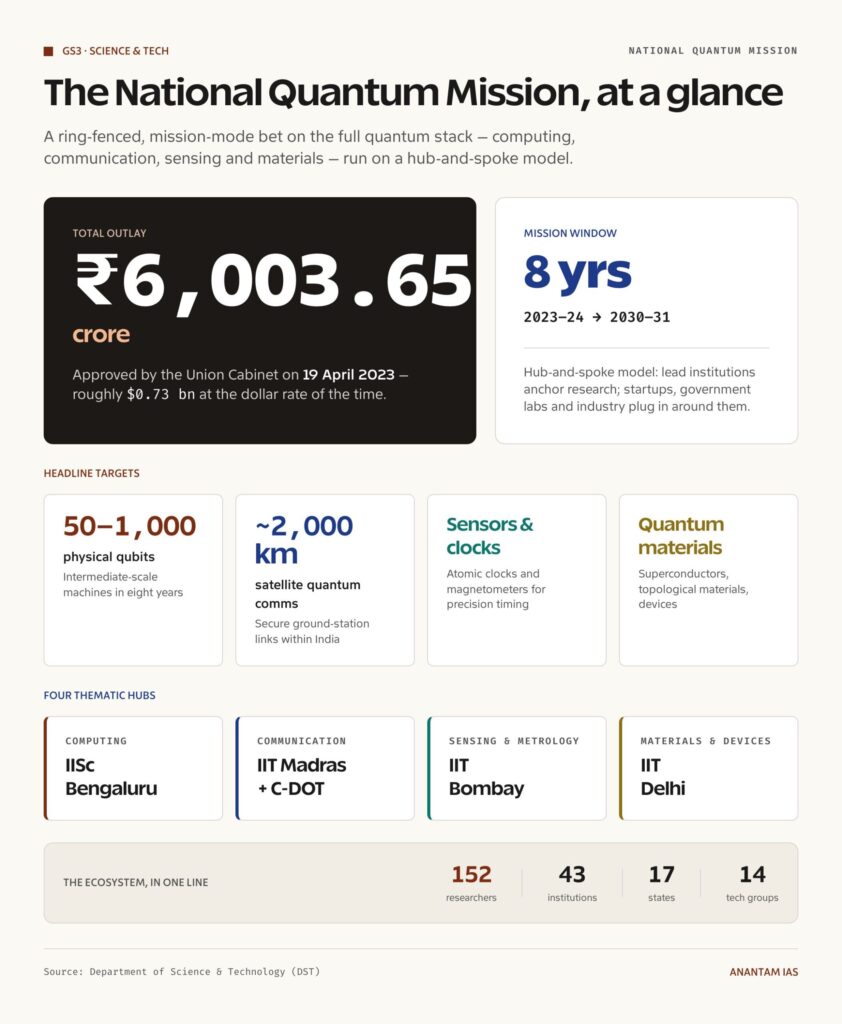
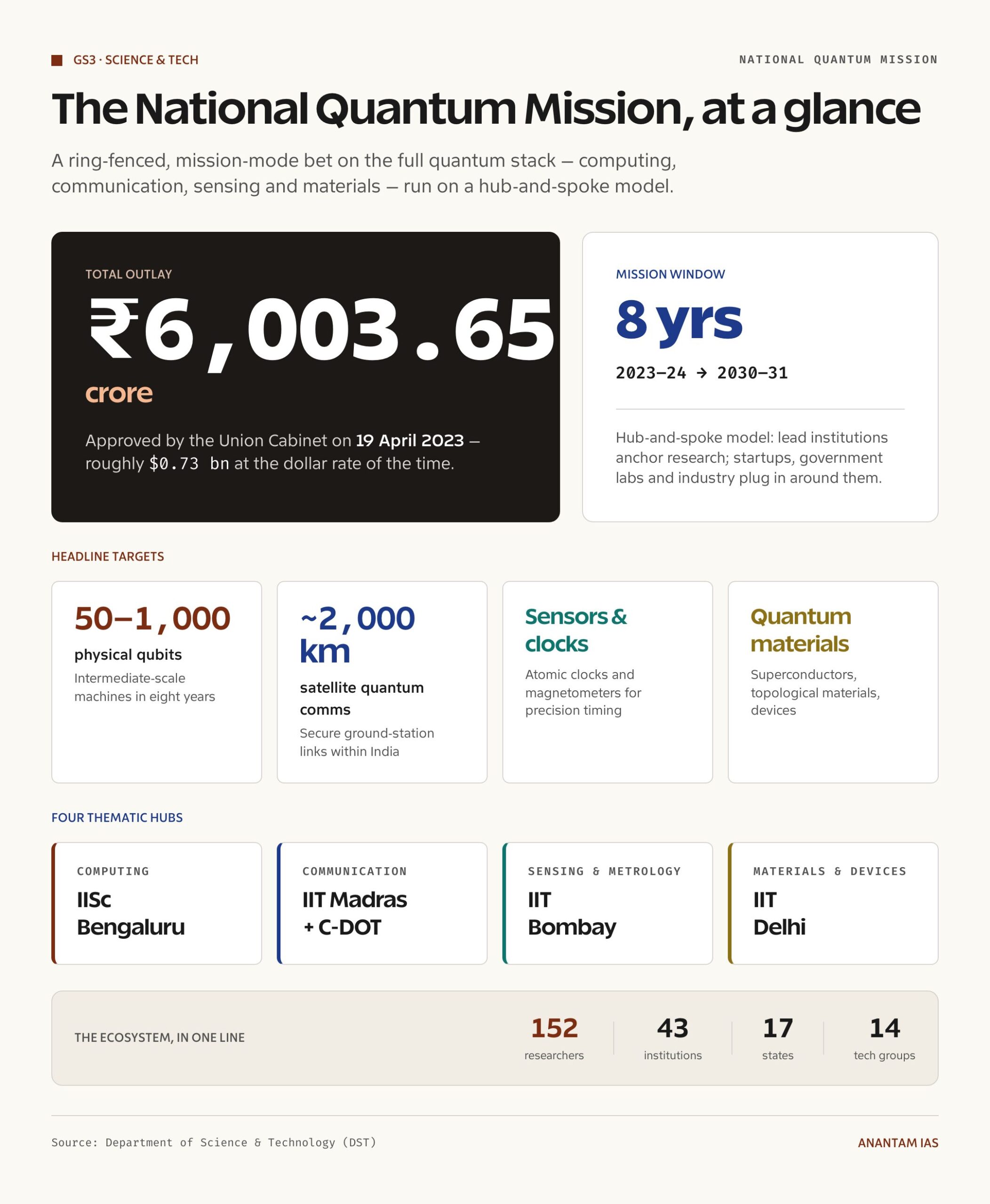
The instrument is the National Quantum Mission, approved by the Union Cabinet on 19 April 2023 with an outlay of ₹6,003.65 crore over eight years, from 2023-24 to 2030-31. That’s roughly $730 million at the dollar rate of the time. The headline computing target is intermediate-scale machines with 50 to 1,000 physical qubits in eight years, alongside satellite-based secure quantum communication over about 2,000 km within India, plus quantum sensors and quantum materials. It runs on a hub-and-spoke model, which simply means a few lead institutions anchor the research while startups, government labs, and industry plug in around them.
And there’s a defensive half that’s just as important and far less glamorous. Post-quantum cryptography, or PQC, is ordinary encryption redesigned so that even a future quantum computer can’t break it. Today’s internet security, the padlock on your banking app, the protection on Aadhaar and UPI data, rests on math that a powerful quantum machine could one day unravel. PQC swaps that math for problems quantum computers can’t easily solve. Building qubits and building PQC are two sides of the same coin, and the mission now touches both.
What the Data Says
Start with what India has actually built, because the mission is past the press-release stage. The ecosystem runs as four Thematic Hubs, each owning one lane: quantum computing at IISc Bengaluru, quantum communication at IIT Madras with C-DOT, quantum sensing and metrology at IIT Bombay, and quantum materials and devices at IIT Delhi. Underneath sit 14 technical groups and roughly 152 researchers drawn from 43 institutions across 17 states and 2 union territories. That’s a real academic spine, not a paper plan. Two dedicated quantum-fabrication facilities, the clean rooms where qubit chips get made, are coming up at IISc Bengaluru and IIT Bombay, with smaller ones at IIT Delhi and IIT Kanpur.
The hardware is moving too. On 14 April 2025, a Bengaluru startup called QpiAI released QpiAI-Indus, described as India’s first full-stack 25-qubit superconducting quantum computer, under the mission. A follow-on 64-qubit processor named Kaveri has been announced, targeted for commercial availability in 2026. Eight startups have been selected under the mission with reported support of around ₹30 crore each, one of them, Dimira Technologies, building indigenous cryogenic cables, the specialised wiring that carries signals into the deep-freeze environment qubits need to function. So the startup layer is producing components, not just slideware.
Then comes the marquee event. On 7 February 2026, the Amaravati Quantum Valley was launched at Uddandarayunipalem in Andhra Pradesh, with IBM, Tata Consultancy Services, and L&T as partners. It’s to be anchored by an IBM Quantum System Two, described as India’s largest quantum computer to date, with the first indigenous machine from Amaravati targeted for December 2026. One honest caveat here, and it’s worth carrying into an answer: the exact qubit count is unsettled. IBM’s May 2025 announcement specified a 156-qubit Heron processor, while some February 2026 launch reports cite 133 qubits. The cleaner move is to call it “IBM Quantum System Two, India’s largest” and not stake an answer on a single number.
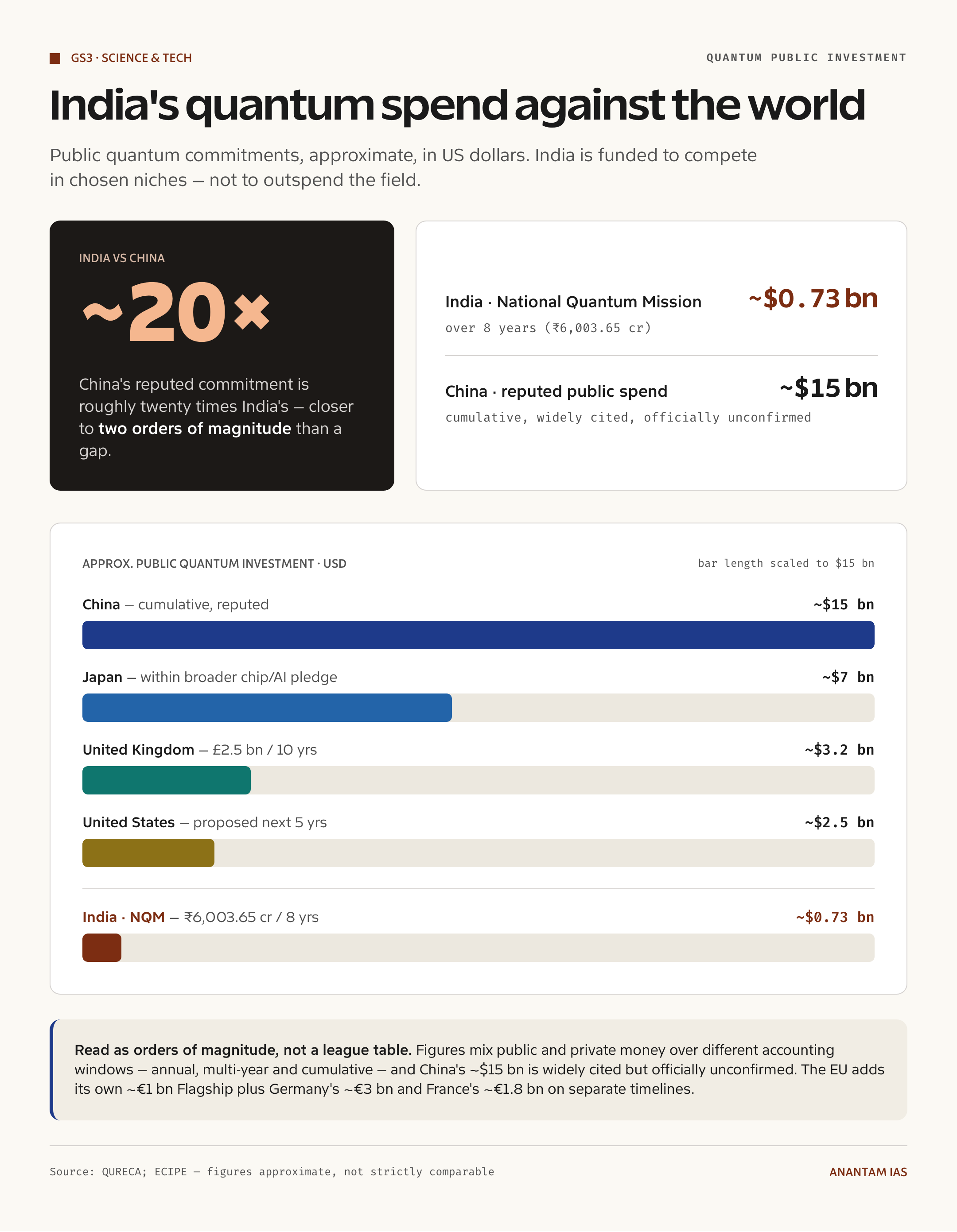
Now the number that reframes everything. India’s roughly $0.73 billion over eight years sits against China’s widely cited ~$15 billion in public quantum investment. That’s not a gap. That’s two orders of magnitude. The UK has committed £2.5 billion over ten years, the US runs programs in the $2.5 billion-plus range, and Germany alone announced around €3 billion. India is funded to compete selectively, in chosen niches, not to outspend anyone. Treat these figures as orders of magnitude rather than a precise league table, because countries count public and private money over different windows, and China’s $15 billion is reputed rather than officially confirmed.
On the defensive front, the global clock started on 13 August 2024, when the US standards body NIST finalised its first three post-quantum encryption standards, FIPS 203, 204, and 205. NIST’s Dustin Moody urged administrators to “start integrating them into their systems immediately, because full integration will take time.” India responded in February 2026 with a DST post-quantum-cryptography migration roadmap, phasing Critical Information Infrastructure, the systems whose failure would cripple defence, telecom, or power, toward full adoption by 2029, and general enterprises by 2033.
The Case For
Strip away the hype and the case that India is genuinely well-placed holds up. So let’s make it at full strength before we poke holes in it.
The first thing the mission gets right is the funding instrument. Quantum got its own ring-fenced line item with dedicated governance, not a scatter of small grants competing with every other research priority. That’s the same mission-mode design that delivered India’s space program and its digital public infrastructure, and it matters, because frontier science dies in a thousand committee meetings when the money isn’t protected. Eight years of guaranteed funding lets a fab get built and a chip get iterated. So the structure is sound even where the sum is small.
Second, the talent base is real and the division of labour is clean. Those 152 researchers across 43 institutions, anchored by IISc and the IITs, are a credible academic core, and the four-hub split means nobody’s duplicating effort. IISc owns computing, IIT Madras owns communication, IIT Bombay owns sensing, IIT Delhi owns materials. So India is building the full stack, the whole machine and its supporting science, rather than chasing qubit-count headlines alone. That’s a more durable strategy than it looks.
Third, the indigenous layer is shipping. QpiAI-Indus, a 25-qubit full-stack system from an Indian startup in April 2025, isn’t a frontier machine by global standards, and that’s fine. It proves the domestic ecosystem can integrate quantum processors, control stacks, and software into a working whole. The planned 64-qubit Kaveri pushes that further. So when India partners with IBM at Amaravati for frontier access, it’s negotiating from a position of growing capability, not pure dependence.
And the defensive posture is already moving, which is the most underrated point. A national PQC roadmap in February 2026 means India isn’t only chasing qubits. It’s started the unglamorous work of protecting Aadhaar-scale identity and UPI-scale payments before the threat fully matures. Most countries treated the quantum-security problem as tomorrow’s headache. India put a national clock on it. That’s the right instinct, even if the timeline is arguable.
The Case Against
Here’s what the optimism walks past. A mission can do everything structurally right and still be sized for second-tier outcomes. On the numbers that actually bind, this one has real exposure.
The funding gap is the headline problem, and it’s brutal once you do the arithmetic. India’s roughly $90 million a year sits against China’s reputed ~$15 billion cumulative. Even granting that these figures aren’t strictly comparable, the order-of-magnitude difference is the point. You can buy a respectable research program with $730 million over eight years. You can’t buy global leadership in a field where a single dilution refrigerator, the machine that chills qubits to near absolute zero, runs into crores, and where the frontier is set by who can afford to fail expensively, over and over.
The hardware dependence is the second hole. Qubit fabrication needs ultra-clean foundries, cryogenics, control electronics, and rare materials, and India imports most of that today. Dimira’s cryogenic cables are an encouraging start, but they’re a partial fix on a long list. And the flagship machine at Amaravati is an IBM system, which means it sits under US export-licence rules. So India’s most powerful quantum computer is, for now, a foreign machine on a foreign permission slip. That’s fine as a learning platform. It’s a problem if it’s mistaken for sovereignty.
The talent gap is structural, not cosmetic, and the mission’s own framing admits it. The Amaravati launch cited a need for around 2.5 lakh quantum-skilled experts by 2030 and an ambition to train 50 lakh youth. Hold that against the 152 researchers the mission currently fields. The distance between a few hundred specialists and a few lakh isn’t a rounding error you close with a few fellowships. It’s the binding constraint, and global firms are poaching the best Indian quantum talent the moment it ripens.
Then there’s the hype trap. The mission targets 50 to 1,000 physical qubits, and the word physical is load-bearing. Physical qubits are error-prone. The fault-tolerant, error-corrected machines that actually beat classical computers on useful problems need many physical qubits to build a single reliable logical one, and they remain years away everywhere on Earth. So promising near-term “quantum advantage” risks a disillusionment crash when the magic doesn’t arrive on schedule. Honest expectation-setting is part of the job here.
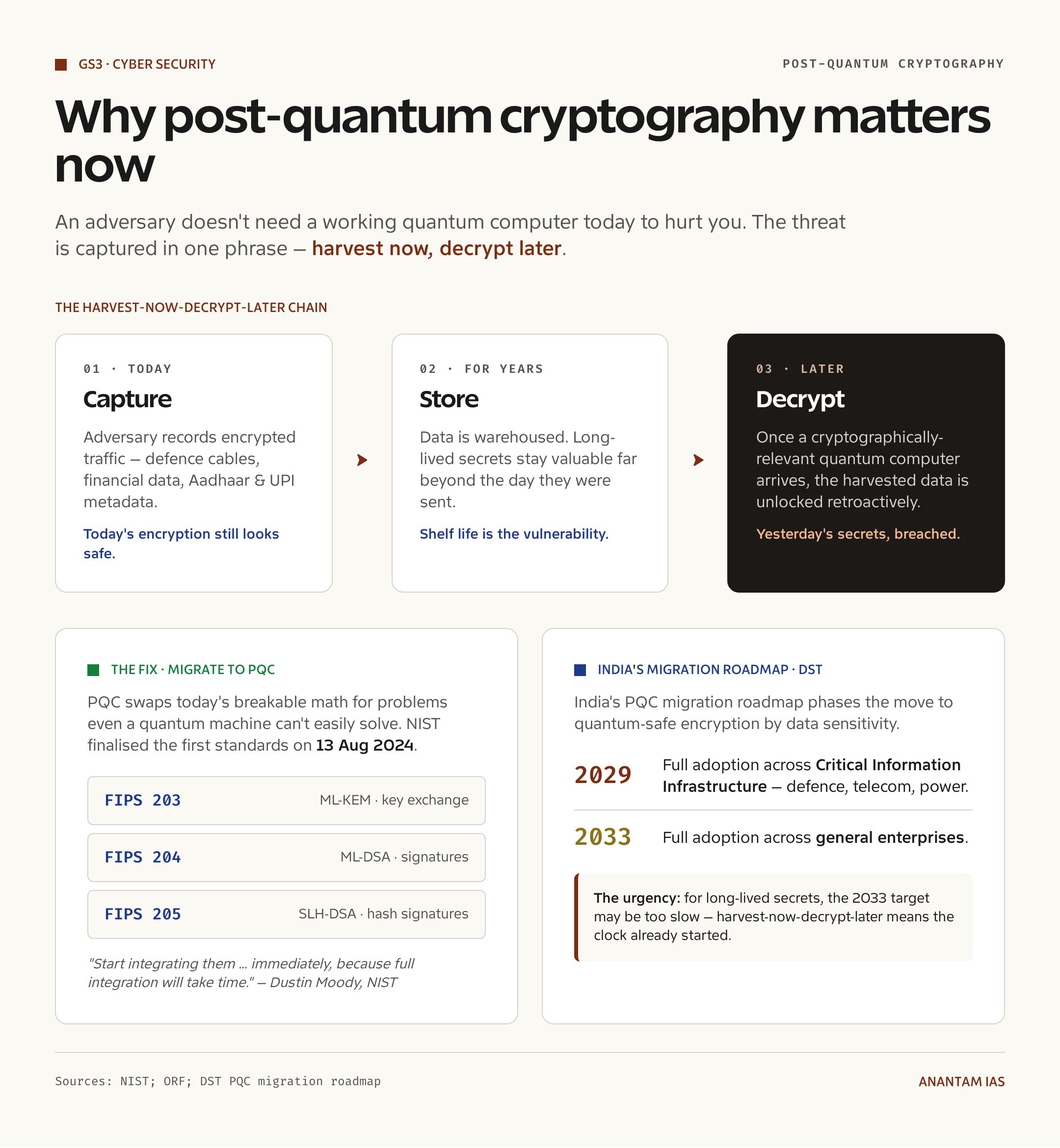
And the sharpest near-term risk isn’t on the computing side at all. It’s the defensive lag. The threat is captured in a phrase: harvest now, decrypt later. An adversary doesn’t need a working quantum computer today to hurt you. It just captures your encrypted traffic now, warehouses it, and decrypts it the day a capable quantum machine arrives. Anything with a long shelf life, defence cables, diplomatic traffic, health records, identity data, is already exposed if it’s travelling on today’s encryption. India’s full-adoption target of 2033 may simply be too slow for the most sensitive secrets, and the real risk is implementation slippage across a vast, federated public-IT estate that’s never moved fast on anything.
The Deeper Structural Read
Step back from the hardware and the deeper pattern shows up. India’s quantum problem is a sharper version of its whole deep-tech problem: the country is excellent at building the layer of applications and integration on top, and import-dependent on the foundational layer underneath.
Look at where India is strong. Software, systems integration, applied use-cases, a startup that can assemble a full-stack 25-qubit machine. TCS chasing quantum applications in drug discovery, materials, logistics, and finance. That’s the deep-tech application layer, and India plays it well, the same way it became a services and IT superpower. Now look at the foundational layer: the fab, the cryogenics, the dilution refrigerators, the rare materials, the frontier processor itself. There, India is buying, licensing, or waiting. The Amaravati machine being an IBM system isn’t an embarrassment. It’s a symptom of exactly this split.
That split has a strategic edge in quantum that it doesn’t have elsewhere, because quantum is dual-use by nature. The same technology that decrypts an adversary’s secrets can be used to decrypt yours. Quantum communication that secures your defence networks is the flip side of quantum computing that could one day break theirs. So this isn’t only an economic-growth or science story. It’s a cyber security and internal-security story, where falling behind doesn’t just cost market share, it costs the confidentiality of the state’s most sensitive data. That’s the real reason the funding gap should worry a strategist more than an economist.
And the mission-mode model itself carries a hidden assumption worth naming. Ring-fenced money only works if it’s actually spent at pace, milestones get hit, and talent gets retained against global poaching. The space program and the digital-public-infrastructure stack worked because the absorption capacity matched the ambition. Quantum’s absorption capacity is precisely what’s untested. Building a fab is slow. Training lakhs of specialists is slower. The mission’s eight-year clock is generous on paper and tight in practice, because the hardest inputs, deep talent and domestic fabrication, have lead times measured in years.
So the honest structural read is this. The National Quantum Mission is correctly designed and under-scaled for outright leadership, which means India’s realistic play is selective excellence, owning a few niches deeply, rather than parity across the board. The danger isn’t that the mission fails. It’s that it succeeds modestly, declares victory, and the country mistakes “not lagging” for “leading.”
What Should Be Done
So what closes the gap between a respectable mission and a winning one? Not more press releases. A set of specific moves, each with a clear owner, that strengthen the bet without pretending the constraints don’t exist.
- Start PQC migration now, sequenced by data lifetime, not by the 2033 calendar. The defensive lag is the cheapest gap to close and the most dangerous to ignore. Inventory cryptographic assets across Critical Information Infrastructure, prioritise long-lived secrets in defence, diplomacy, Aadhaar, and health, and build crypto-agility, the ability to swap encryption algorithms fast, into those systems first. Adopt the NIST FIPS 203, 204, and 205 standards as a working baseline while India builds its own certification through TEC, BIS, and MeitY. Harvest-now-decrypt-later means the clock already started.
- Convert the talent ambition into funded, time-bound programs. The 2.5 lakh and 50 lakh figures are aspirations until they’re budgeted. Fund quantum tracks across the IITs and NITs, create fellowships, hire faculty at pace, and build a serious diaspora-return scheme to pull senior Indian quantum researchers home. And tie hub funding to talent-output milestones, the number of trained specialists, not just papers published. Talent is the binding constraint, so the money should follow it.
- Secure the hardware supply chain deliberately. Extend the QpiAI and Dimira model into domestic cryogenics, control electronics, and photonics, and treat fab capacity as national infrastructure. Reduce single-vendor, export-licence exposure on the flagship machine by funding parallel indigenous builds, so the IBM system is a teacher, not a crutch.
- Focus use-cases where India uniquely has data and need. Drug discovery and genomics, given India’s disease burden and the Genome India dataset. Materials and energy, logistics, finance, and cyber security. Let applied teams chase quantum-relevant problems that matter to India rather than racing for qubit-count headlines that flatter nobody’s citizens.
- Deepen international partnerships, but hedged. Keep IBM-class frontier access for the learning it brings, then diversify across the EU Quantum Flagship, Japan, and like-minded blocs, while keeping critical IP and the most sensitive data workloads sovereign. Access and sovereignty aren’t opposites if you design the boundary deliberately.
- Publish honest annual progress and manage the hype. Report qubits, fidelity, fab yield, and PQC-migration coverage against targets every year. Accountability keeps a mission-mode program from drifting, and honest milestones are the best vaccine against the disillusionment crash that follows over-promising.
None of these need a bigger headline budget to start. They need pace, sequencing, and the discipline to treat the defensive half as seriously as the glamorous half. That’s what turns a bet from sensible into smart.
For Your Mains Answer
This is a GS3 staple that rewards range. It sits at the intersection of frontier science, indigenisation, cyber security, and the economics of mission-mode programs, so the same material flexes across several question types.
GS paper mapping: GS3, Science and Technology, developments and applications; indigenisation of technology and Atmanirbhar Bharat; cyber security and protection of critical information infrastructure; awareness in computers and IT; the economy and government budgeting of mission-mode programs.
Likely question frames:
- The National Quantum Mission positions India to compete in quantum technology, but funding and talent constraints temper that ambition. Critically examine.
- Quantum computing is both an opportunity and a security threat for India. Discuss with reference to post-quantum cryptography and the protection of critical information infrastructure.
- “India is strong in the application layer of deep technology and weak in the foundational layer.” Examine this proposition in the context of the National Quantum Mission.
Quotable data points:
- ₹6,003.65 crore, the National Quantum Mission outlay, 2023-24 to 2030-31, about $730 million.
- 50 to 1,000 physical qubits in eight years, the mission’s headline computing target.
- About 2,000 km, the target range for satellite-based secure quantum communication within India.
- Four hubs, 14 groups, 152 researchers, 43 institutions, 17 states and 2 UTs, the ecosystem in one line.
- 25 qubits, 14 April 2025, QpiAI-Indus, India’s first full-stack superconducting quantum computer.
- 7 February 2026, Amaravati Quantum Valley launched with IBM Quantum System Two, India’s largest, alongside TCS and L&T.
- About $0.73 billion for India against China’s reputed ~$15 billion, orders of magnitude apart.
- 13 August 2024, NIST finalised FIPS 203, 204, and 205, the first post-quantum encryption standards.
- Full PQC adoption targeted for 2029 across critical infrastructure and 2033 for enterprises.
- Around 2.5 lakh quantum-skilled experts needed by 2030, against 152 researchers fielded today.
Keywords to use: qubit, superposition, entanglement, physical versus logical qubits, quantum key distribution, post-quantum cryptography, harvest-now-decrypt-later, crypto-agility, critical information infrastructure, hub-and-spoke, indigenisation, sovereign compute.
Syllabus linkages: science and technology developments and their applications; indigenisation and developing new technology; achievements of Indians in science and technology; cyber security and money-laundering-adjacent data threats; internal and external security challenges; the economy and mission-mode government programs.
Balanced conclusion line: The National Quantum Mission is the right bet, soundly designed and honestly under-scaled; whether it makes India a leader or merely keeps it from lagging depends less on the qubits it builds than on the talent it trains and the defences it raises before harvest-now-decrypt-later turns today’s encrypted data into tomorrow’s breach.
How to Build the Answer
Open with the tension, not a definition. The sharpest framing is that India is building quantum computers and defending against them in the same year, and the real question is scale and speed, not whether to play. That single sentence shows the examiner you understand both halves of the topic. A crisp definition of a qubit can follow in the next line.
Bring data in early and make it earn its place. A strong opening body paragraph can carry three numbers: the ₹6,003.65 crore outlay, the 50 to 1,000 qubit target, and the $0.73 billion-versus-$15 billion gap against China. Then say what each proves. The funding figure shows commitment, the qubit target shows realism, the comparison shows the ceiling. UPSC marks the move from fact to inference, not the fact alone.
Steelman both sides before you land. If you back the mission, first concede the funding and talent gaps honestly. If you criticise the pace, first credit the mission-mode design and the early indigenous hardware. An answer that argues only one way reads thin, however confident it sounds.
Group the way forward, never scatter it. Cluster the reforms into defence first, PQC migration sequenced by data lifetime, then talent, then supply-chain sovereignty, then focused use-cases. Use the topic’s own vocabulary, crypto-agility, harvest-now-decrypt-later, critical information infrastructure, so the answer reads like technology-policy analysis rather than a news recap.
Close on judgment that maps to the syllabus. The last line should not echo the introduction. Show a verdict: right bet, under-scaled, leadership contingent on talent and defence. The reliable pattern is “the goal is not X alone, but X with Y,” which lets you balance ambition with execution.
Common Mistakes to Avoid
- Don’t confuse physical and logical qubits. Writing that 1,000 qubits will break encryption misses that error correction needs many physical qubits per logical one, and that fault-tolerant machines are years away. The distinction is itself a markable point.
- Don’t treat the investment figures as a clean league table. They mix public and private money over different windows. Present China’s ~$15 billion against India’s ~$0.73 billion as orders of magnitude, attributed, not as precise rankings.
- Don’t ignore the defensive half. Many answers cover quantum computing and forget post-quantum cryptography entirely. The harvest-now-decrypt-later threat is the sharpest near-term angle and signals depth.
- Don’t write techno-optimism without limits. Naming the talent gap, the fab dependence, and the hype trap is what makes the answer balanced rather than promotional.
- Don’t stake the answer on the Amaravati qubit count. It’s contested, 156 versus 133. Write “IBM Quantum System Two, India’s largest” and move on.
A Compact Answer Spine
- Introduction: Open with the build-and-defend-in-one-year tension; define qubit, superposition, and entanglement in a line.
- The mission: ₹6,003.65 crore, eight years, four hubs, the 50 to 1,000 qubit target, and the PQC roadmap.
- The case for: ring-fenced funding, academic spine, indigenous hardware, early defensive posture.
- The case against: the funding gap against China, hardware and fab dependence, the 2.5 lakh talent gap, the hype trap, and PQC-migration lag.
- Structural diagnosis: strong application layer, weak foundational layer; dual-use security stakes; absorption capacity as the real test.
- Way forward: PQC now, funded talent pipeline, supply-chain sovereignty, focused use-cases, hedged partnerships, honest annual reporting.
- Conclusion: Adapt the balanced conclusion line to the exact question wording.
Diagram or Flowchart Idea
For a 15-marker, draw the harvest-now-decrypt-later chain, because it’s the clearest causal logic in the topic: capture encrypted data today, warehouse it for years, decrypt it once a capable quantum computer arrives, with the fix branch reading “migrate to PQC standards now.” The examiner reads that threat model in five seconds, and it proves you understand why the defensive half is urgent.
For a 10-marker, skip the flow and use a compact box. A four-cell layout of the mission’s four hubs, computing, communication, sensing, materials, with the lead institution under each, conveys structure faster than prose and is quick to evaluate under time pressure.
Ethics and Governance Angle
Even a GS3 technology answer earns a line on governance. Mission-mode funding is a public-money choice, so accountability matters: who reports progress, against what milestones, and to whom. An over-hyped mission that quietly misses targets erodes public trust in science funding itself, which is a governance cost, not just a scientific one.
The deeper ethical thread is the dual-use nature of the technology. Quantum decryption is a tool for security and for surveillance, and a state that can break encryption can break its own citizens’ encryption too. So the same PQC migration that protects Aadhaar and UPI data is also a guardrail on state power, which is worth one sentence in a governance-aware answer.
A portable sentence travels across deep-tech topics: “The mission is legitimate in aim, but its payoff depends on execution, talent, and the discipline to fund the unglamorous defensive work as seriously as the headline hardware.” It credits the objective without handing the program a blank cheque, which is exactly the register an examiner rewards.
How to Use Data Without Sounding Mechanical
Use fewer numbers than you’ve memorised. Three well-placed figures beat ten dumped in a row. Lead with one scale number, the ₹6,003.65 crore outlay, contrast with one comparison, the $0.73 billion against China’s ~$15 billion, and justify the way forward with one gap, the 2.5 lakh talent shortfall against 152 researchers. One scale, one contrast, one gap is usually enough.
Never leave a statistic standing alone. Follow each with “this means” or “the implication is.” The 50-to-1,000-qubit target means meaningful R&D, not near-term encryption-breaking. The $15 billion comparison means India must pick niches, not chase parity. That tiny move turns a fact sheet into analysis.
Finish with one test: can a tired examiner follow this in a single read? If a sentence sounds impressive but does no work, cut it and replace it with a fact, a cause, a consequence, or a reform. For UPSC, clarity is how depth becomes visible, and a clean structure beats a clever phrase every time.
FAQ
What is the National Quantum Mission and how much does it cost?
The National Quantum Mission is India’s eight-year, ₹6,003.65 crore program, approved in April 2023 and running to 2030-31, to build quantum computing, communication, sensing, and materials capability. It works through four hubs at IISc Bengaluru, IIT Madras with C-DOT, IIT Bombay, and IIT Delhi, with a headline target of 50 to 1,000 physical qubits.
What was launched at Amaravati Quantum Valley in February 2026?
On 7 February 2026, the Amaravati Quantum Valley opened in Andhra Pradesh with IBM, TCS, and L&T, anchored by an IBM Quantum System Two billed as India’s largest quantum computer. The first indigenous quantum computer from Amaravati is targeted for December 2026, though the system’s exact qubit count, reported as either 156 or 133, isn’t settled.
Why does India need post-quantum cryptography now if quantum computers can’t break encryption yet?
Because of “harvest now, decrypt later.” Adversaries capture encrypted data today and decrypt it once a capable quantum computer exists, so long-lived secrets like defence, health, and identity data are already at risk. India’s DST roadmap of February 2026 phases migration to NIST’s post-quantum standards toward 2029 for critical infrastructure and 2033 for enterprises.
How does India’s quantum spending compare with other countries?
India’s roughly $0.73 billion over eight years is small against China’s reputed ~$15 billion, the UK’s £2.5 billion over ten years, and US programs in the $2.5 billion-plus range. These figures mix public and private money over different windows, so they’re best read as orders of magnitude, which still leaves India funded to compete in chosen niches rather than to lead on spend.
Tell Google you want more of this.
Add Anantam IAS as a preferred sourceOne tap, and this site shows up more often in your own Top Stories, AI Overviews and AI Mode. Remove it any time.






