Threatened Species SOP: NBA frames Section 38 process under Biodiversity Act
Why in News?
The National Biodiversity Authority (NBA), the apex body under the Ministry of Environment, Forest and Climate Change, has issued a Standard Operating Procedure (SOP) for the notification of threatened species under Section 38 of the Biological Diversity Act, 2002. The SOP gives states and union territories a single, uniform pathway to identify, assess and recommend species that are on the verge of extinction, replacing the earlier patchy, case-by-case approach.
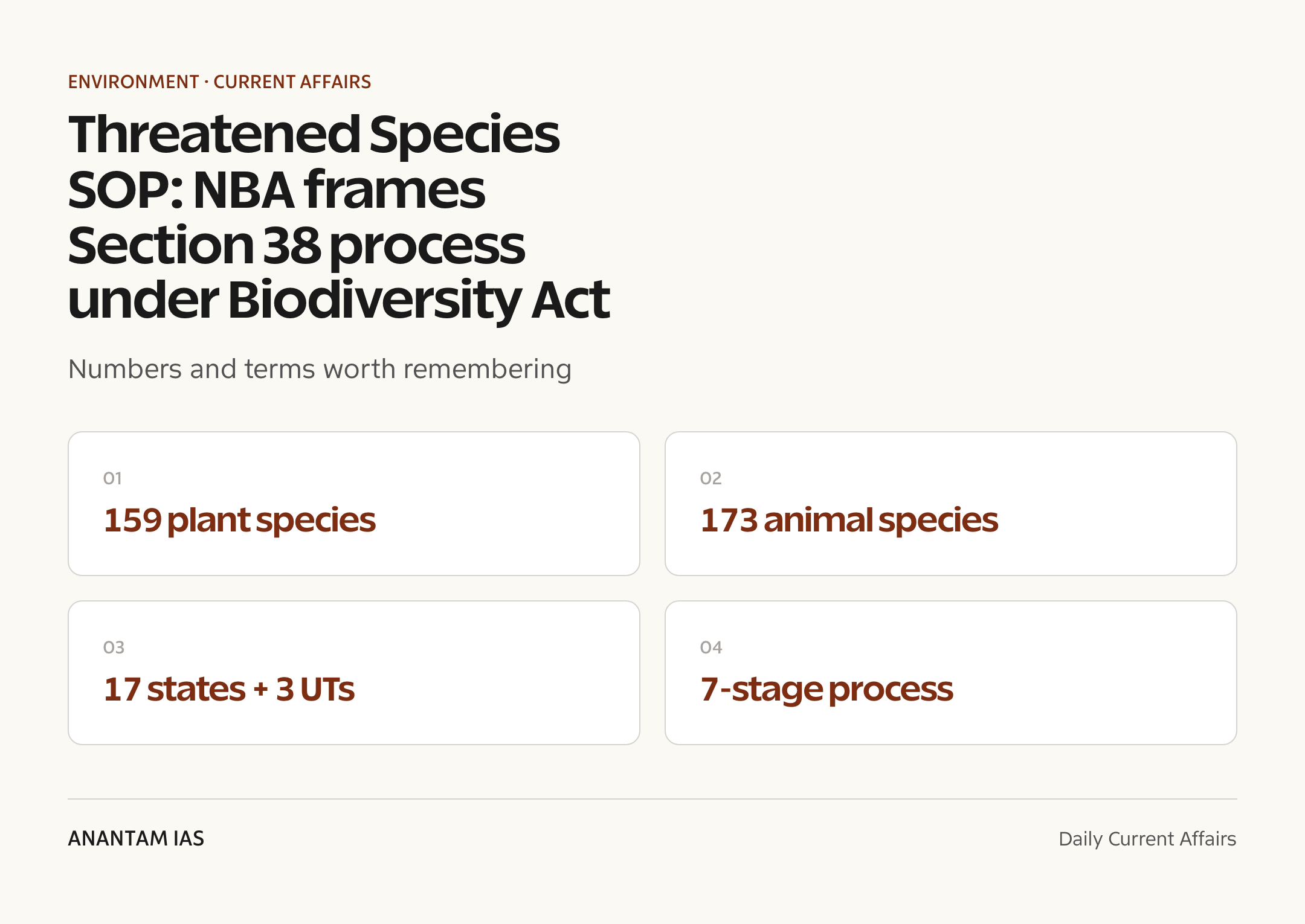
The move matters because Section 38 has so far been used unevenly. As per the Ministry, 159 plant species and 173 animal species have been notified as threatened across only 17 states and 3 union territories. By laying out a step-by-step process anchored in scientific evidence and stakeholder consultation, the SOP aims to make notification consistent, transparent and scientifically rigorous nationwide.
- NBA released an SOP operationalising Section 38 of the Biological Diversity Act, 2002 for notifying threatened species.
- Cumulative status cited: 159 plant and 173 animal species notified as threatened across 17 states and 3 UTs.
- SOP prescribes a seven-stage chain: scientific assessment, stakeholder consultation, validation, notification, conservation planning, monitoring and periodic review.
- State Biodiversity Boards and UT Biodiversity Councils are the nodal recommenders to state governments.
- Post-notification, species recovery and conservation action plans become mandatory, and collection can be regulated or prohibited.
The development matters in the context of:
- Section 38 lets the Central Government, in consultation with the concerned state, notify a species on the verge of extinction as a Threatened Species and regulate or prohibit its collection.
- The SOP draws on the Botanical Survey of India (BSI), Zoological Survey of India (ZSI), academic institutions, local communities and Biodiversity Management Committees (BMCs) for evidence.
- It dovetails with India’s commitments under the Kunming-Montreal Global Biodiversity Framework and the updated National Biodiversity Strategy and Action Plan (NBSAP) 2024-2030.
UPSC Relevance
Prelims Relevance
- Section 38 of the Biological Diversity Act, 2002 empowers the Centre, in consultation with the state, to notify a species as threatened and regulate/prohibit its collection.
- The NBA is a statutory autonomous body headquartered at Chennai, established in 2003.
- The Act has a three-tier structure: NBA (national), State Biodiversity Boards (state), and Biodiversity Management Committees (local).
- BMCs maintain People’s Biodiversity Registers (PBRs) documenting local flora, fauna and traditional knowledge.
- As cited by the Ministry, 159 plant and 173 animal species stand notified as threatened across 17 states and 3 UTs.
- The Kunming-Montreal Global Biodiversity Framework was adopted at CBD COP15 (2022) and sets 23 targets and 4 goals for 2030, including its 30×30 protected-area target.
- The Biological Diversity (Amendment) Act, 2023 decriminalised offences (civil penalties up to Rs 1 crore) and shifted the patent checkpoint to the pre-grant stage.
- The IUCN Red List is the global benchmark for extinction-risk categories (e.g., Critically Endangered, Endangered, Vulnerable), distinct from a Section 38 legal notification.
- Section 38 notification is separate from the Wildlife (Protection) Act, 1972 schedules; the two protection regimes can apply to overlapping species.
Mains Relevance
GS Paper 3
- Why standardising threatened-species notification matters for cooperative federalism in environmental governance, given that Section 38 use has been confined to 17 states and 3 UTs.
- How the SOP can translate India’s Kunming-Montreal GBF and NBSAP 2024-2030 commitments into measurable, on-ground species-recovery outcomes.
- The role of scientific institutions (BSI, ZSI), local communities and BMCs in building credible, participatory conservation processes.
Essay
- Conservation as a shared responsibility: science, the state and the citizen.
- Standardising the rules of the game to protect what cannot be replaced.
Background and Context
The Biological Diversity Act, 2002 and Section 38
The Act is India’s principal law for conserving biodiversity, sharing its benefits fairly, and regulating access to biological resources.
- Enacted to give effect to the 1992 Convention on Biological Diversity (CBD), which rests on three objectives: conservation, sustainable use, and fair benefit-sharing.
- It set up a three-tier architecture: the National Biodiversity Authority (NBA) at Chennai, State Biodiversity Boards (SBBs), and grassroots Biodiversity Management Committees (BMCs).
- Section 38 empowers the Central Government, in consultation with the concerned state, to notify any species on the verge of extinction, or likely to become extinct, as a Threatened Species.
- Once a species is notified, its collection can be regulated or prohibited, and rehabilitation and conservation measures can be mandated.
- Read the full primer on the Biological Diversity Act, 2002 for the institutional design and 2023 amendments.
What the new SOP actually does
The SOP converts a broad statutory power into a predictable, repeatable workflow that any state can follow.
- Establishes a uniform, transparent and scientifically rigorous process for identifying, assessing and notifying threatened species.
- Prescribes a step-by-step chain: scientific assessment and field-based evaluation, stakeholder consultation, validation, formal notification, conservation planning, monitoring and periodic review.
- Anchors decisions in the best available scientific evidence, field assessments and traditional knowledge rather than ad-hoc proposals.
- Makes species recovery and conservation action plans a mandatory follow-up after notification, with outcomes tracked over time.
- Brings in BSI, ZSI, academic institutions, subject experts, local communities and BMCs as participants in assessment and consultation.
NBA, State Boards and the chain of responsibility
The SOP clarifies who proposes, who validates and who finally notifies, reducing ambiguity between the Centre and states.
- State Biodiversity Boards and UT Biodiversity Councils identify candidate species and recommend them to their respective state governments.
- The Central Government retains the formal notification authority under Section 38, acting in consultation with the state.
- The NBA provides the overarching framework, scientific coordination and consistency across jurisdictions.
- BMCs, through People’s Biodiversity Registers, supply granular local data on rare and declining species.
- By naming each actor’s role, the SOP addresses the earlier problem of uneven, state-by-state application of Section 38.
Kunming-Montreal GBF and NBSAP 2024-2030
The SOP is a domestic instrument that helps deliver India’s global biodiversity promises.
- The Kunming-Montreal Global Biodiversity Framework, adopted at CBD COP15 in 2022, sets 4 goals and 23 targets for 2030.
- Its headline 30×30 target seeks to conserve 30 percent of land, inland waters and seas, while several targets focus on preventing extinctions.
- India’s updated National Biodiversity Strategy and Action Plan (NBSAP) 2024-2030 is the national roadmap aligning domestic action with the framework.
- A standardised threatened-species pipeline gives India auditable data to report progress on extinction-prevention targets.
- It complements other green laws such as the Wildlife (Protection) Amendment Act, 2022 and the Forest (Conservation) Amendment Act, 2023.
Significance and challenges
The SOP raises the floor for conservation practice, but its impact will depend on capacity and follow-through.
- Significance: shifts threatened-species protection from reactive, ad-hoc notification to a planned, evidence-led cycle with recovery plans.
- Significance: improves data quality and comparability, strengthening India’s biodiversity reporting under the CBD.
- Challenge: State Biodiversity Boards remain unevenly resourced, and weak boards may struggle with field assessments and validation.
- Challenge: a Section 38 notification is only as good as the funding and monitoring behind the recovery action plan that follows.
- Challenge: aligning the legal notification with the IUCN Red List and the Wildlife (Protection) Act, 1972 schedules to avoid duplication or gaps.
Way Forward
Strengthen state capacity
- Fund and staff under-resourced State Biodiversity Boards and UT Councils so they can run credible field assessments.
- Build standing scientific panels linking BSI, ZSI and universities to support validation.
Tie notification to funded recovery
- Make every Section 38 notification trigger a budgeted species recovery action plan with clear milestones.
- Use periodic review to retire, downgrade or escalate species status based on monitored outcomes.
Integrate data systems
- Cross-reference notifications with the IUCN Red List and People’s Biodiversity Registers to spot under-covered species.
- Report progress against NBSAP 2024-2030 and Kunming-Montreal targets through a single national dashboard.
Conclusion
The threatened-species SOP is a quiet but consequential reform. By converting a broad power under Section 38 into a clear seven-stage process, the NBA gives every state the same toolkit to find, protect and recover species before they slip away. The earlier picture, where only 17 states and 3 UTs had used the provision, reflected a gap in process as much as in will.
Its real test lies downstream. Notification is a beginning, not an end; without funded recovery plans, capable State Biodiversity Boards and honest periodic review, the SOP risks becoming paperwork. Handled well, it can anchor India’s Kunming-Montreal and NBSAP commitments in measurable, on-ground conservation rather than declarations.
UPSC Practice Questions
Prelims MCQ 1
With reference to the Biological Diversity Act, 2002, consider the following statements:
- Section 38 empowers the Central Government, in consultation with the concerned State Government, to notify a species as threatened.
- Biodiversity Management Committees function at the national level and advise the National Biodiversity Authority.
- The National Biodiversity Authority is headquartered at Chennai.
How many of the above statements are correct?
(a) Only one (b) Only two (c) All three (d) None
Answer: (b) Only two
Explanation:
Statements 1 and 3 are correct. Statement 2 is wrong: Biodiversity Management Committees operate at the local (panchayat/municipal) level, not the national level.
Prelims MCQ 2
The Kunming-Montreal Global Biodiversity Framework is associated with which of the following?
(a) The United Nations Framework Convention on Climate Change (b) The Convention on Biological Diversity (c) The Convention on International Trade in Endangered Species (d) The Ramsar Convention on Wetlands
Answer: (b) The Convention on Biological Diversity
Explanation:
The Kunming-Montreal Global Biodiversity Framework was adopted at COP15 of the Convention on Biological Diversity (CBD) in 2022, setting 4 goals and 23 targets for 2030.
UPSC Mains Questions
- The new SOP for notifying threatened species seeks to standardise a power that has been used unevenly across states. Examine how such standardisation can strengthen environmental federalism and India’s biodiversity commitments. (250 words)
- A legal notification of a threatened species is only the first step in conservation. Discuss the institutional and financial conditions needed to make Section 38 of the Biological Diversity Act, 2002 deliver real species recovery. (250 words)
Source: PIB, Ministry of Environment, Forest and Climate Change.
Frequently Asked Questions
What is Section 38 of the Biological Diversity Act, 2002?
Section 38 empowers the Central Government, in consultation with the concerned State Government, to notify any species that is on the verge of extinction or likely to become extinct as a Threatened Species. Once notified, the collection of that species can be regulated or prohibited, and conservation and rehabilitation measures can be ordered.
What does the new NBA SOP do?
The Standard Operating Procedure issued by the National Biodiversity Authority creates a uniform, step-by-step process for states to identify, assess and notify threatened species. It covers scientific assessment, stakeholder consultation, validation, notification, conservation planning, monitoring and periodic review, replacing the earlier ad-hoc approach.
How many species have been notified as threatened so far?
As cited by the Ministry of Environment, Forest and Climate Change, 159 plant species and 173 animal species have been notified as threatened under Section 38. This coverage spans only 17 states and 3 union territories, which is why a standardised process was considered necessary.
Who recommends a species for notification?
State Biodiversity Boards and Union Territory Biodiversity Councils identify candidate species and recommend them to their respective state governments. The Central Government then issues the formal notification under Section 38, drawing on inputs from the Botanical Survey of India, Zoological Survey of India, academics, local communities and Biodiversity Management Committees.
How does the SOP connect to global commitments?
It supports India’s obligations under the Kunming-Montreal Global Biodiversity Framework, adopted at CBD COP15 in 2022, and the updated National Biodiversity Strategy and Action Plan (NBSAP) 2024-2030. A standardised pipeline generates the data needed to report progress on extinction-prevention targets.
How is Section 38 notification different from the IUCN Red List?
The IUCN Red List is a global scientific assessment of extinction risk and carries no legal force on its own. A Section 38 notification is a domestic legal action that triggers protection and conservation duties within India. A species can appear on the Red List without being notified under Section 38, and vice versa.