First NDA Women Cadets Commissioned: A Milestone for Women in Uniform
Why in News?
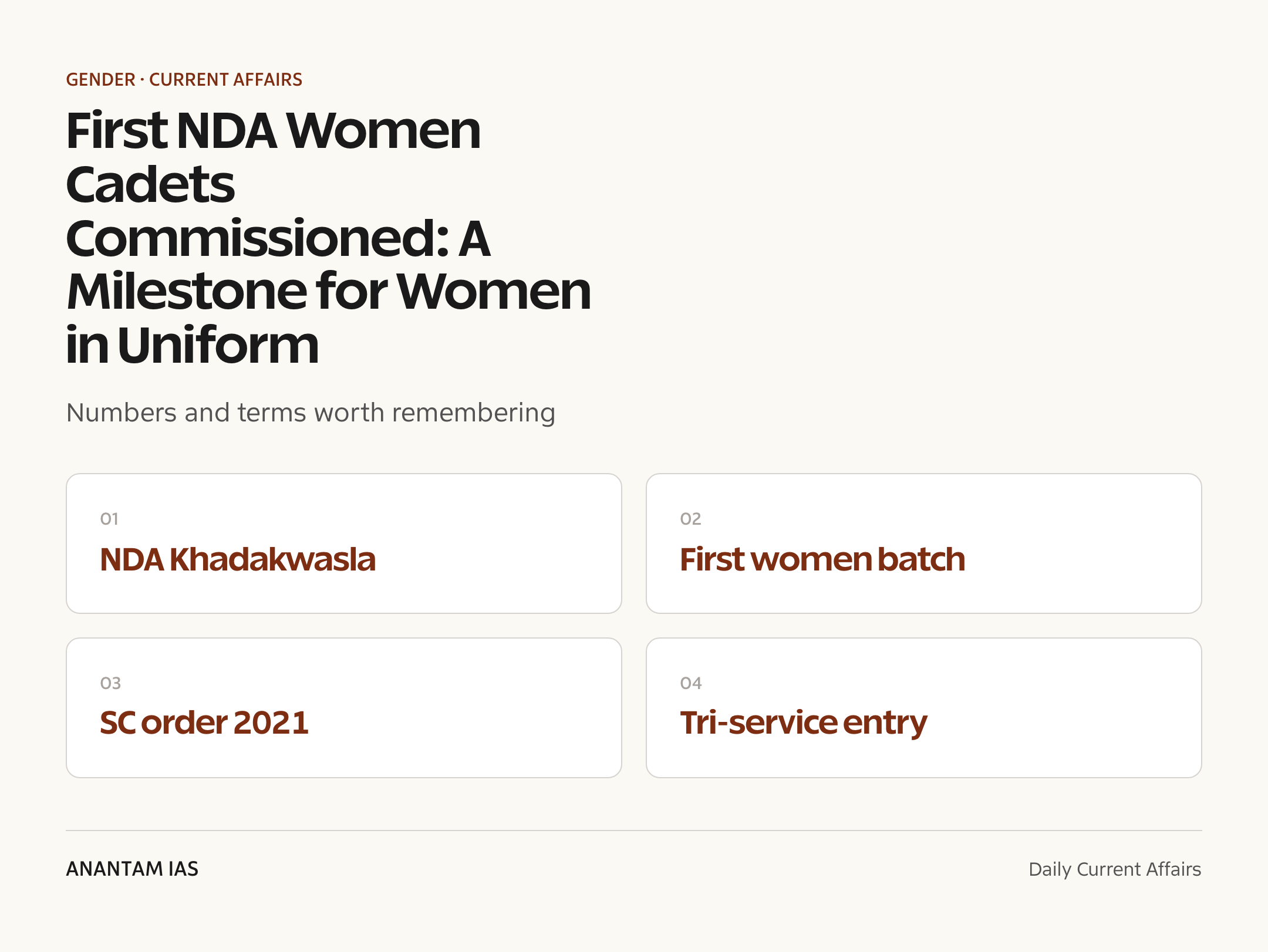
The Indian Express reported that the first batch of women cadets trained at the National Defence Academy (NDA), Khadakwasla, has been commissioned as officers. They are the maiden cohort to enter the tri-service academy through the regular cadet route rather than the short-service or specialist streams that women had used earlier.
Their commissioning closes a loop opened in August 2021, when the Supreme Court directed that women be allowed to sit the NDA entrance examination, ending a decades-old bar that had reserved the academy for male cadets.
- The cohort cleared the UPSC-conducted NDA & NA examination, the SSB interview (see our NDA exam guide), and roughly three years of training at Khadakwasla before pre-commission training at the respective service academies.
- Women were first admitted to the NDA in the 2022 (148th course) intake after the 2021 interim order; this batch reflects that pipeline maturing into commissioned officers.
- Cadets are commissioned into the Army, Navy and Air Force, the same tri-service split the NDA has always fed.
- The development builds on the Babita Puniya (2020) ruling on Permanent Commission for women in the Army.
The development matters in the context of:
- Why this matters for gender integration: regular-cadet entry signals women are being inducted into the core officer pipeline, not a parallel track.
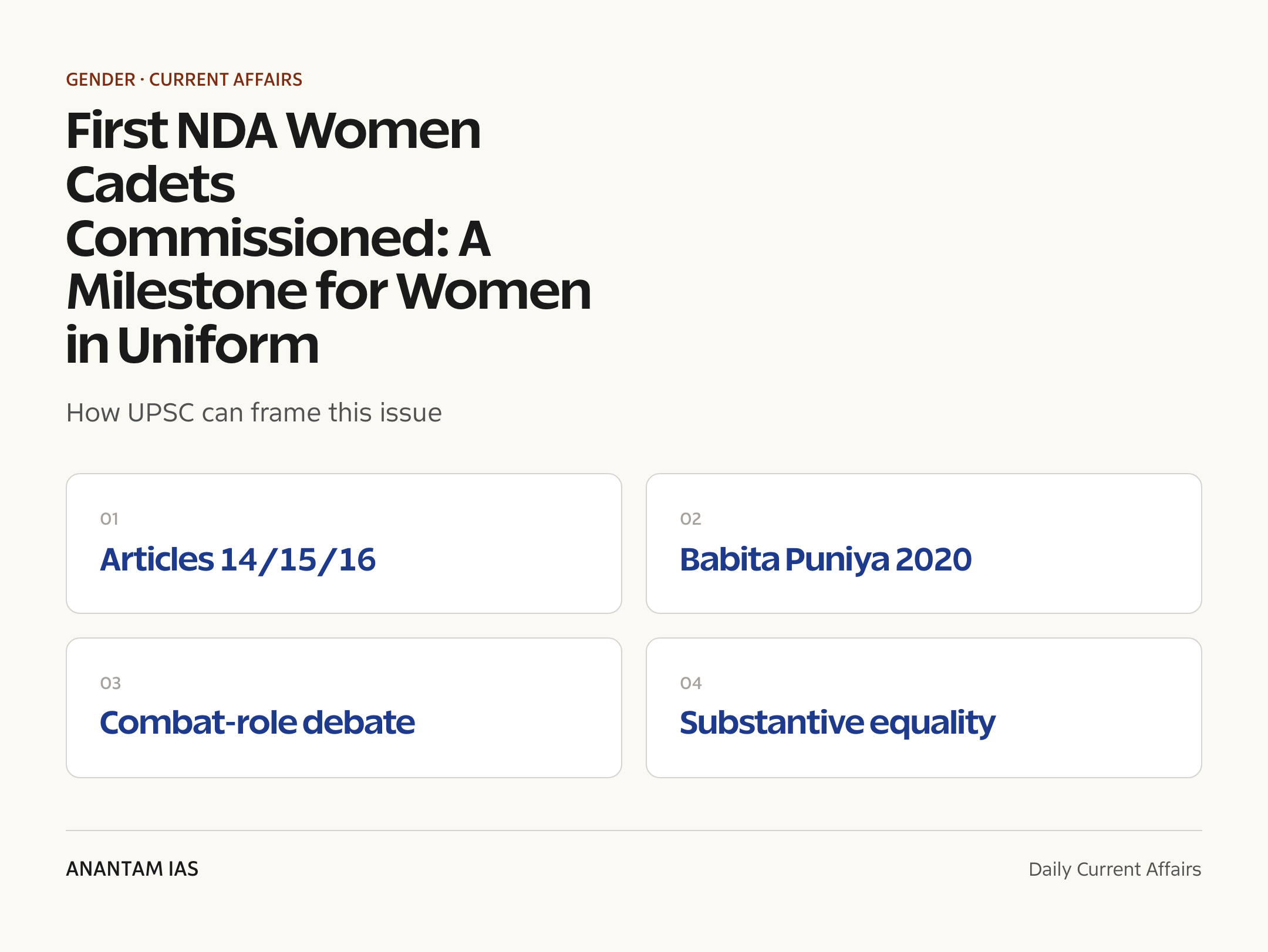
- Why this matters for equality jurisprudence: the change flowed from constitutional litigation under the fundamental rights in Articles 14, 15 and 16, not from policy alone.
UPSC Relevance
Prelims Relevance
- National Defence Academy (NDA) — tri-service academy at Khadakwasla, Pune; feeds Army, Navy, Air Force.
- The NDA & NA examination is conducted by the UPSC, twice a year.
- Kush Kalra v. Union of India (2021) — Supreme Court interim order admitting women to the NDA exam.
- Secretary, Ministry of Defence v. Babita Puniya (2020) — Permanent Commission for women Army officers.
- Article 14 (equality before law), Article 15 (no discrimination on sex), Article 16 (equal opportunity in public employment).
- Short Service Commission (SSC) vs Permanent Commission (PC) — tenure and pension distinction.
- Indian Military Academy (IMA), Dehradun; OTA Chennai; Indian Naval Academy, Ezhimala; Air Force Academy, Dundigal — pre-commission training institutions.
- Article 33 — Parliament may restrict fundamental rights of armed-forces members for discipline.
Mains Relevance
GS Paper 1
- Role of women and women’s organisations; social barriers to women in non-traditional, hierarchical institutions.
- Changing status of women in India and the symbolism of access to combat-arms careers.
GS Paper 2
- Judicial review and the role of the Supreme Court in advancing substantive equality in state employment.
- Government policies on gender inclusion in the armed forces and their implementation challenges.
Essay
- If development is not engendered, it is endangered — equal access to institutions of the state.
- Equality is not sameness: dismantling structural barriers versus formal non-discrimination.
Background and Context
The Supreme Court's 2021 NDA order
The opening of the academy was a court-driven reform, not an executive initiative.
- In Kush Kalra v. Union of India (2021), the Supreme Court passed an interim order permitting eligible women to write the NDA entrance examination, calling the exclusion a matter of policy inertia rather than operational necessity.
- The bench observed that the bar rested on a gender stereotype and was inconsistent with the constitutional guarantee of equal opportunity.
- Following the order, the UPSC opened the exam to women from the November 2021 sitting, and the first women cadets joined the 148th course (2022).
- The Centre later confirmed permanent induction of women through the NDA route rather than treating the order as a one-time concession.
From Babita Puniya to permanent commission
The NDA verdict sits on a chain of rulings that progressively widened women’s service in the forces.
- Secretary, Ministry of Defence v. Babita Puniya (2020) held that women SSC officers in the Army were entitled to Permanent Commission on par with men, rejecting arguments based on physiological limitations.
- A companion judgment extended Permanent Commission to women officers in the Indian Navy.
- The Court rejected blanket claims that troops would not accept women in command, terming such reasoning discriminatory.
- These rulings reframed the debate from whether women can serve to how the institution must adapt its structures to include them.
How the officer pipeline now works
Entry routes for women officers have widened across both the cadet and direct-entry streams.
- The NDA route is the youngest entry point, taking candidates straight after Class 12 for around three years of integrated training before service academies.
- Women already entered as officers via OTA Chennai (Short Service Commission) and specialist branches such as medical, legal, education and engineering.
- The 2024-2025 period saw women clear training and join arms previously closed to them, including Artillery and aviation streams.
- The Agnipath scheme also opened recruitment of women in some non-officer roles such as the Agniveer (Naval) entry.
The combat-role debate
Access to the academy reopens the older question of women in front-line combat arms.
- India inducts women across combat-support and combat-enabler roles, with phased entry into combat arms like Artillery still expanding.
- Debate continues on infantry and armoured postings, where critics cite logistics, prisoner-of-war risk and unit cohesion, and supporters cite merit and equal opportunity.
- The Indian Air Force has commissioned women fighter pilots since 2016, showing combat roles are not categorically barred.
- The constitutional principle established is that exclusion must be justified by genuine operational need, not assumption.
Constitutional and equality dimension
The milestone is best read through the lens of substantive equality, not mere formal access.
- Article 14 guarantees equality before the law; Article 15(1) bars discrimination on grounds of sex; Article 16 guarantees equal opportunity in public employment (read more on Articles 15 and 16).
- Courts have moved from formal equality (same rules) toward substantive equality (removing structural barriers that disadvantage women).
- Article 33 lets Parliament curtail some fundamental rights of forces personnel for discipline, but it does not authorise blanket gender exclusion from entry.
- The reform aligns with India’s commitments under the Convention on the Elimination of All Forms of Discrimination Against Women (CEDAW).
Why it matters beyond the parade ground
The significance is symbolic, institutional and developmental at once.
- It expands the aspirational horizon for young women and challenges occupational stereotypes early, at the school-leaving stage.
- It pressures the forces to invest in infrastructure — accommodation, equipment fit and posting policies — designed for a mixed cadre.
- It feeds the broader push for women’s leadership in hierarchical state institutions, complementing the wider agenda of women’s empowerment in India.
- It demonstrates the judiciary’s role as a catalyst when policy lags behind constitutional values.
Way Forward
Build for a mixed cadre
- Standardise gender-neutral infrastructure, equipment fit and accommodation across academies and field units.
- Set transparent, role-based physical standards rather than across-the-board exclusions.
Widen the pipeline and track outcomes
- Phase in remaining combat-arms openings with clear, reviewable criteria.
- Publish data on intake, retention and command appointments so progress is measurable, not anecdotal.
Pair structural reform with cultural change inside units, so integration is owned by the institution and not seen as a court-imposed mandate.
Conclusion
The commissioning of the first NDA-trained women officers marks the point where a constitutional promise became an operational reality. What began as litigation under the equality guarantees has produced officers entering the core tri-service pipeline.
The harder work now is institutional: building units, postings and a service culture that treat a mixed officer corps as the norm. Done well, the milestone becomes a baseline rather than a headline.
UPSC Practice Questions
Prelims MCQ 1
With reference to the entry of women into the armed forces, consider the following statements:
- The National Defence Academy & Naval Academy Examination is conducted by the Union Public Service Commission.
- Women were permitted to write the NDA entrance examination following a Supreme Court order in 2021.
- The Babita Puniya case (2020) dealt with Permanent Commission for women officers in the Indian Army.
How many of the above statements are correct?
(a) Only one (b) Only two (c) All three (d) None
Answer: (c) All three
Explanation:
The UPSC conducts the NDA & NA exam. The 2021 Supreme Court order (Kush Kalra) opened the exam to women, and the 2020 Babita Puniya verdict addressed Permanent Commission for women Army officers. All three are correct.
Prelims MCQ 2
Which of the following constitutional provisions is most directly invoked against the gender-based exclusion of women from a public-employment entry examination?
(a) Article 19 — freedom of speech and expression (b) Article 16 — equality of opportunity in public employment (c) Article 21 — protection of life and personal liberty (d) Article 25 — freedom of conscience and religion
Answer: (b) Article 16 — equality of opportunity in public employment
Explanation:
Article 16 guarantees equal opportunity in matters of public employment and bars discrimination on grounds including sex, making it the most directly relevant provision, read with Articles 14 and 15.
UPSC Mains Questions
- The induction of women into the National Defence Academy has been described as a court-driven reform. Examine how the judiciary has advanced substantive equality for women in the armed forces, and discuss the institutional challenges that remain. (250 words)
- Access is not the same as integration. Critically analyse the social and structural barriers to women’s full participation in India’s armed forces, with reference to the combat-role debate. (250 words)
- Discuss the evolution of women’s service in the Indian armed forces from short-service entry to permanent commission and cadet-route induction, and assess its significance for gender equality. (150 words)
Sources: Indian Express and Supreme Court of India.
Frequently Asked Questions
What is the National Defence Academy?
The National Defence Academy (NDA) is India’s tri-service academy at Khadakwasla near Pune, where cadets for the Army, Navy and Air Force train together after Class 12. The roughly three-year course is followed by pre-commission training at the respective service academies before officers are commissioned.
When were women allowed to take the NDA exam?
Women became eligible to write the NDA entrance examination after an interim Supreme Court order in August 2021 in the Kush Kalra case. The UPSC opened the exam to women from the November 2021 sitting, and the first women cadets joined the academy in the 2022 intake.
What was the Babita Puniya case about?
Secretary, Ministry of Defence v. Babita Puniya (2020) was a Supreme Court verdict holding that women Short Service Commission officers in the Army were entitled to Permanent Commission on the same terms as men. The Court rejected arguments based on physiological limits and stereotypes about command.
Can women serve in combat roles in India?
Women already serve across many combat-support and enabler roles, and the Air Force has commissioned women fighter pilots since 2016. Entry into combat arms such as Artillery has been expanding, while postings in infantry and armoured corps remain part of an ongoing, phased debate.
Which constitutional articles support women’s entry into the forces?
The reform rests on Article 14 (equality before law), Article 15 (no discrimination on grounds of sex) and Article 16 (equal opportunity in public employment). Courts have used these to move from formal non-discrimination toward substantive equality that removes structural barriers.
Who conducts the NDA examination?
The Union Public Service Commission (UPSC) conducts the NDA & Naval Academy examination twice a year. Candidates who clear the written exam face the Services Selection Board (SSB) interview and a medical examination before selection for training at the academy.