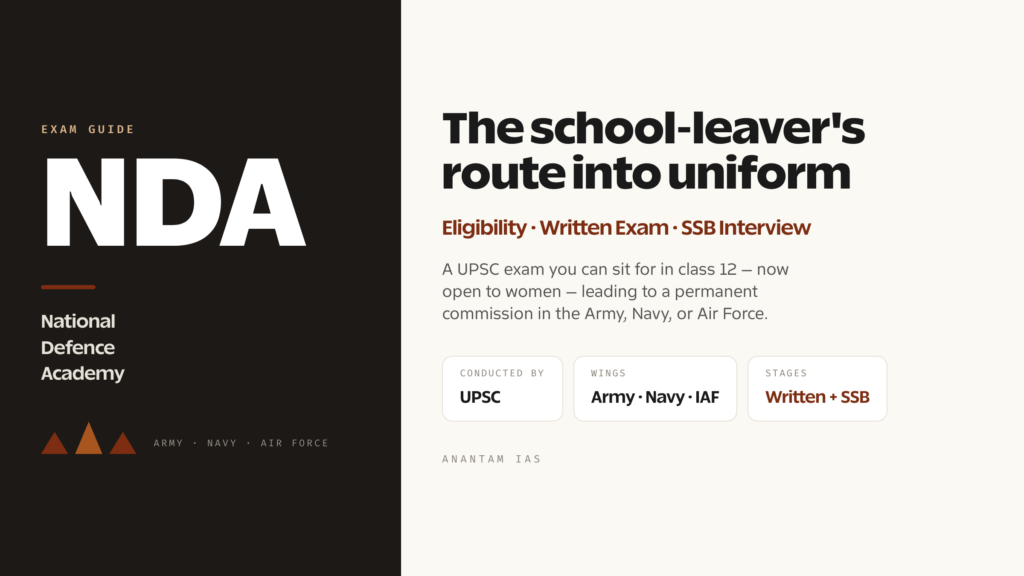
The NDA exam is the earliest gateway into a permanent commission in the Indian armed forces — you can clear it while you’re still in school. Conducted by the Union Public Service Commission twice every year, the National Defence Academy and Naval Academy Examination feeds cadets into the Army, the Navy, the Air Force, and the Indian Naval Academy.
For a class-12 student who already knows they want a life in uniform, no other route starts this early or commits this deeply. You write a two-paper objective test, face a five-day Services Selection Board interview, clear a medical, and then spend four years in training before you’re commissioned as an officer. This guide walks through the pattern, eligibility, syllabus, and a preparation plan that respects how little margin the NDA leaves for a casual attempt.
What Is the NDA Exam?
The NDA exam selects young men and women for officer training at the National Defence Academy in Khadakwasla, Pune — the world’s first tri-service military academy, where future Army, Navy, and Air Force officers train together before splitting into their wings. Candidates who opt for the naval route through the 10+2 Cadet Entry are inducted via the Indian Naval Academy at Ezhimala.
The UPSC runs the whole written-exam-plus-interview cycle, but the SSB interview and final selection are handled by the defence services through the Ministry of Defence. So the NDA is a UPSC exam in the same family as the CDS exam and the CAPF Assistant Commandant exam, but it’s the only one a 16-year-old can sit for.
Key Facts
- Conducting authority: Union Public Service Commission (written exam); Services Selection Board / Ministry of Defence (interview and selection).
- Wings offered: Army, Navy, Air Force, and the Naval Academy (10+2 Cadet Entry).
- Frequency: Twice a year — NDA I (notified around December, exam around April) and NDA II (notified around May, exam around September).
- Scale: Several lakh candidates apply each cycle for a few hundred vacancies; in the NDA II 2021 cycle, when women first became eligible, nearly 5.7 lakh applications came in, about 1.78 lakh of them from women.
NDA Exam Pattern
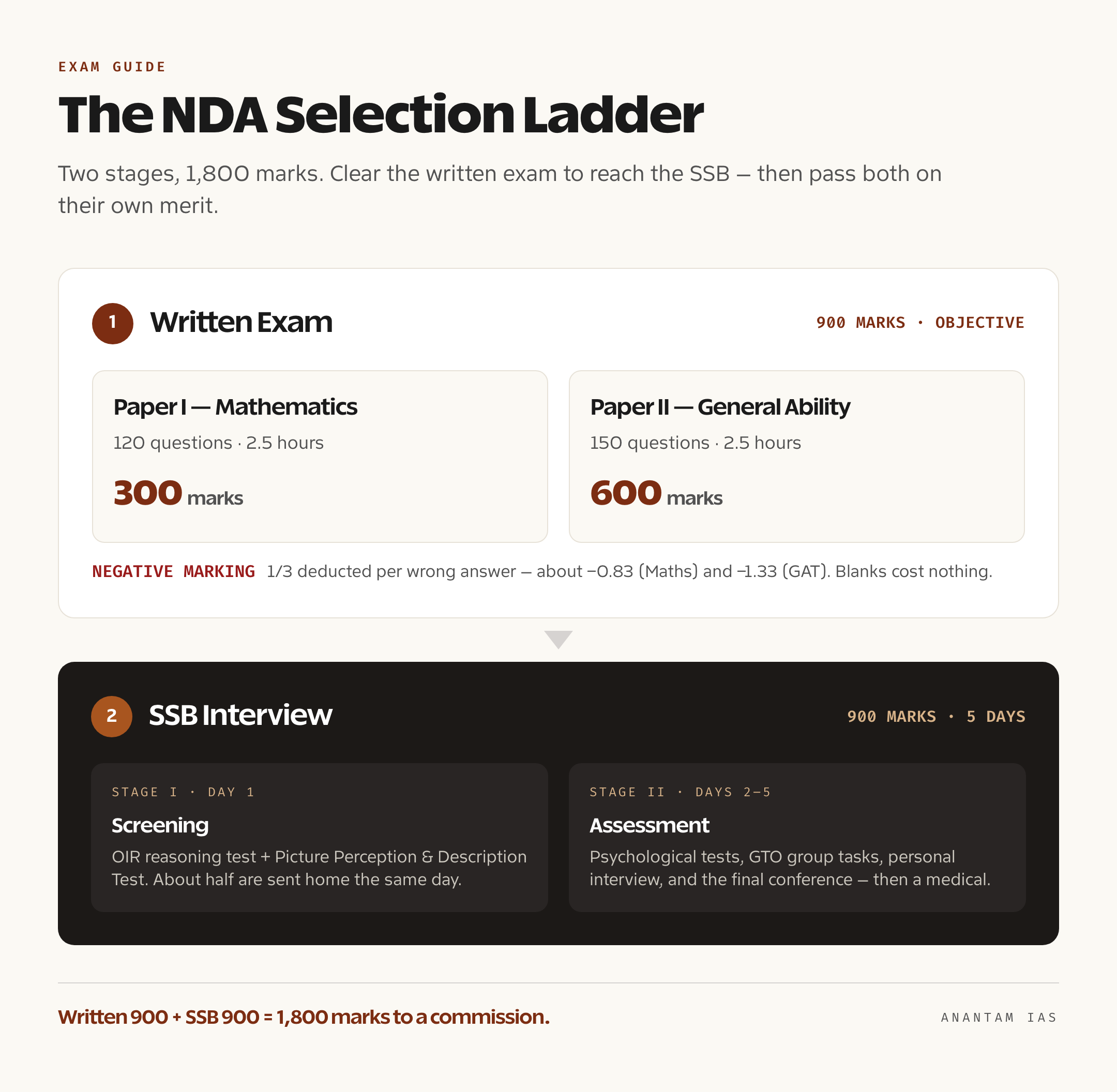
The NDA selection runs in two clearly separated stages: a written exam worth 900 marks, and an SSB interview worth another 900 marks — a grand total of 1,800 marks. You must clear the written exam to be called for the SSB, and you have to pass both independently. Strong marks in one cannot rescue a fail in the other.
Written Exam
The written test is fully objective and has two papers, both written on the same day.
| Paper | Subject | Questions | Marks | Duration |
|---|---|---|---|---|
| Paper I | Mathematics | 120 | 300 | 2.5 hours |
| Paper II | General Ability Test (GAT) | 150 | 600 | 2.5 hours |
| Total | 270 | 900 |
Mathematics carries 2.5 marks per correct answer; the GAT carries 4 marks per correct answer. Negative marking is one-third of the marks allotted — so a wrong answer costs about 0.83 marks in Mathematics and about 1.33 marks in the GAT. Blank answers are not penalised, which makes intelligent question-skipping a real skill in this exam.
The General Ability Test splits into Part A (English, 200 marks) and Part B (General Knowledge, 400 marks). Part B is a wide net across Physics, Chemistry, General Science, History, Geography, and Current Events — the breadth here is what catches most candidates off guard, since it asks for a working command of subjects most students drop after class 10.
SSB Interview
Clear the written cut-off and you’re called to a Services Selection Board for a five-day personality and intelligence assessment worth 900 marks. It runs in two stages.
- Stage I (screening, Day 1): an Officer Intelligence Rating (OIR) test of verbal and non-verbal reasoning, plus a Picture Perception and Description Test (PPDT). Roughly half the candidates are screened out the same day and sent home.
- Stage II (Days 2-5): psychological tests (Thematic Apperception, Word Association, Situation Reaction, Self-Description), Group Testing Officer (GTO) tasks like the group discussion, group planning exercise, progressive group task and command task, a personal interview, and a final conference where the board collectively decides who to recommend.
Recommended candidates then go through a medical examination at a military hospital. The SSB is famously about officer-like qualities — initiative, courage, group influence, reasoning under pressure — not bookish knowledge, which is why a written topper with no personality grounding can still fail here.
NDA Eligibility
The NDA has the strictest eligibility window of any major UPSC exam, because it’s built around school-leavers.
- Nationality: an Indian citizen, or a subject of Nepal or Bhutan, or a Tibetan refugee who came to India before 1962 to settle permanently, or a person of Indian origin migrating from specified countries with intent to settle permanently. (Candidates other than citizens of India and Nepal need an eligibility certificate from the Government of India.)
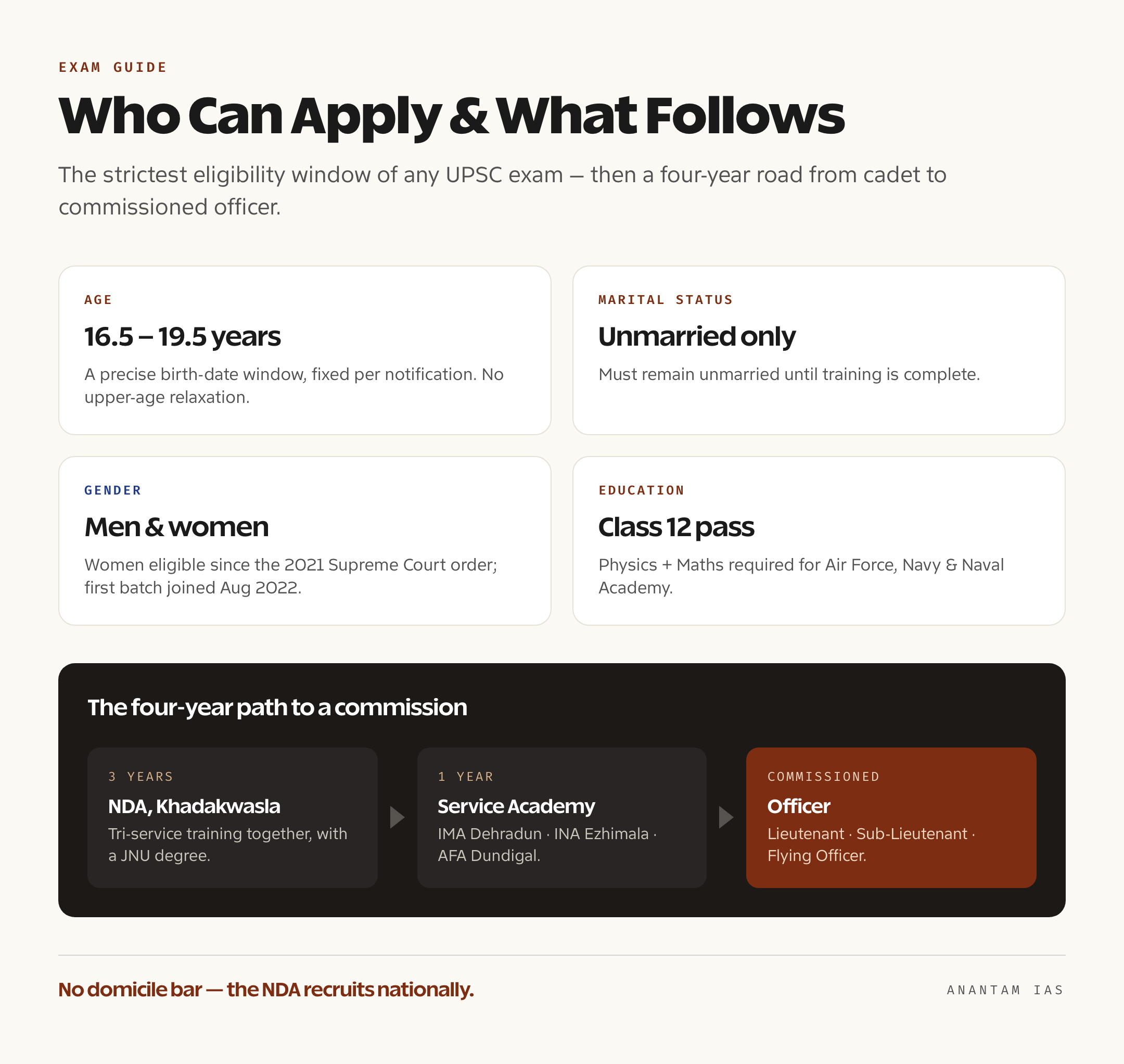
- Age: roughly 16.5 to 19.5 years, defined by a birth-date window that the UPSC fixes afresh for each NDA I and NDA II notification. There is no upper-age relaxation — miss the window and that wing is closed to you.
- Marital status: only unmarried candidates are eligible, and candidates must not marry until they complete their training.
- Gender: both men and women can apply. Women became eligible following the Supreme Court’s interim order of 18 August 2021, and the first cohort wrote the exam in the NDA II 2021 cycle.
- Education: for the Army wing, a pass in class 12 (or appearing) of the 10+2 pattern from a recognised board. For the Air Force, Navy, and the Naval Academy (10+2 Cadet Entry), you must have studied Physics and Mathematics at class 12 — without these two subjects those wings are simply not open to you.
- Physical and medical standards: candidates must meet the laid-down height, weight, vision, and overall fitness standards. Medical disqualification at the SSB stage is common, so the physical bar is as real as the written one.
Unlike a state PSC such as MPPSC, there’s no domicile requirement — the NDA recruits nationally, and there are no attempt limits beyond what the narrow age window naturally allows.
NDA Syllabus
The written syllabus maps closely to the NCERT and 10+2 curriculum, which is why disciplined board-exam study doubles as NDA preparation.
Mathematics Syllabus
Paper I covers the full class 11-12 mathematics scope: Algebra (sets, complex numbers, quadratic equations, permutations and combinations, binomial theorem), Matrices and Determinants, Trigonometry, Analytical Geometry of two and three dimensions, Differential Calculus, Integral Calculus and Differential Equations, Vector Algebra, and Statistics and Probability. Speed and accuracy matter as much as concept clarity — 120 questions in 150 minutes leaves little time to second-guess.
General Ability Test Syllabus
Part A (English, 200 marks) tests grammar, usage, vocabulary, sentence ordering, and comprehension — straightforward content that rewards consistent reading.
Part B (General Knowledge, 400 marks) is the harder half and spreads across:
- Physics — motion, work and energy, heat, light, sound, electricity, magnetism, and everyday applications.
- Chemistry — physical and chemical changes, elements and compounds, acids and bases, common reactions.
- General Science — basic biology, the human body, food and nutrition, and broad scientific awareness.
- History and Freedom Movement — Indian history with emphasis on the national movement, plus the Constitution and administration.
- Geography — physical, Indian, and world geography, including climate, resources, and regions.
- Current Events — national and international affairs, sports, and notable developments.
There’s no optional subject and no descriptive writing in the NDA — every mark is objective, which makes elimination and time management the real craft of this paper.
NDA Preparation Strategy
The NDA rewards early, steady preparation far more than a last-minute sprint, because the syllabus rides on subjects you’re already studying for your boards.
Build the Mathematics Foundation First
Mathematics is 300 marks and the most scoring section for anyone with a clear class 11-12 base. Work through NCERT thoroughly, then move to topic-wise practice and previous-year papers. Target accuracy before speed, then drill timed sets so 120 questions in 150 minutes stops feeling rushed.
Cover the GAT in Layers
Don’t try to “complete” general knowledge in one pass. Lock down English with daily reading and grammar practice, keep your class 9-12 science fresh, and treat history, geography, and polity as NCERT-driven revision rather than fresh learning. The breadth is the challenge, so consistency beats intensity here.
Treat Current Affairs as a Daily Habit
A few months of steady newspaper or monthly-compendium reading covers the Current Events portion. Note national affairs, defence developments, important appointments, and major sports results — and revise them, because recall under exam pressure is what’s actually tested.
Mine the Previous-Year Papers
NDA question patterns repeat in shape and difficulty. Solving five to ten years of past papers tells you exactly which topics carry weight, trains your negative-marking instincts, and builds the question-selection discipline that separates a clear pass from a near-miss.
Prepare for the SSB in Parallel
The SSB cannot be crammed in the gap between the written result and the interview. Start building communication, general awareness, basic physical fitness, and self-awareness early. Practise narrating stories from pictures, holding a group discussion, and answering honest questions about yourself — the board rewards a consistent, genuine personality, not a rehearsed one.
Don’t Neglect Fitness and Medicals
Daily running, basic strength work, eyesight care, and dental health all matter, because a medical rejection wastes a hard-won SSB recommendation. Treat fitness as part of your study timetable, not an afterthought.
Training, Career and Commissioning
A selected cadet spends three years at the National Defence Academy in Khadakwasla, training across six terms alongside future officers of all three services and earning a degree from Jawaharlal Nehru University. After NDA, cadets move to their service-specific academy for a final year — the Indian Military Academy at Dehradun for the Army, the Indian Naval Academy at Ezhimala for the Navy, and the Air Force Academy at Dundigal, Hyderabad, for the Air Force.
On completion, cadets are commissioned as officers — a Lieutenant in the Army, a Sub-Lieutenant in the Navy, or a Flying Officer in the Air Force — with a permanent commission, the associated pay, allowances, and the full career arc up to the senior-most ranks. This is a structurally different proposition from a desk-based civil service: it’s a leadership career in the field from day one.
The pathway is no longer men-only. The first batch of women cadets joined the NDA in August 2022, and 17 of them graduated at the 148th Course Passing Out Parade in May 2025 before heading to the IMA, INA, and AFA for their final year — the first women to come up through the tri-service academy route. For a school-leaver weighing the NDA against later entries like the CDS exam or graduate routes, the NDA’s advantage is simple: it gets you into uniform years earlier.
Frequently Asked Questions
Is the NDA exam open to women now?
Yes. Following the Supreme Court’s interim order of 18 August 2021, women became eligible, and the first cohort wrote the exam in the NDA II 2021 cycle. The first batch of women cadets joined the NDA in August 2022 and graduated in May 2025, so the route is now fully established for unmarried women within the age window.
What is the age limit for the NDA exam?
The window is roughly 16.5 to 19.5 years, fixed by a precise birth-date range that the UPSC publishes separately for each NDA I and NDA II notification. There is no upper-age relaxation, so candidates must apply within this narrow band — usually while still in or just out of class 12.
Do I need Physics and Maths for the NDA?
For the Army wing, a class-12 pass from a recognised board is enough. But for the Air Force, the Navy, and the Naval Academy (10+2 Cadet Entry), you must have studied Physics and Mathematics in class 12 — without both subjects, only the Army wing remains open to you.
How is the NDA exam scored, and is there negative marking?
The written exam is 900 marks — Mathematics (300) plus the General Ability Test (600) — and the SSB interview adds another 900, for a grand total of 1,800. There is negative marking of one-third in both papers, so a wrong answer costs about 0.83 marks in Mathematics and about 1.33 marks in the GAT, while blank answers carry no penalty.
Tell Google you want more of this.
Add Anantam IAS as a preferred sourceOne tap, and this site shows up more often in your own Top Stories, AI Overviews and AI Mode. Remove it any time.