NEET 2026 Paper Leak: Why India’s Exam Governance Crisis Demands Structural Reform
The NEET 2026 paper leak has triggered the largest single-test crisis in India’s centralized examination history. With 22.79 lakh aspirants writing the National Eligibility cum Entrance Test on May 4, 2026, confirmation of leaked question papers circulating on encrypted channels before the exam window closed forced the Union government to order a nationwide retest. The fallout reaches far beyond an inconvenienced cohort. It questions whether the National Testing Agency, created in 2017 to professionalize high-stakes testing, can deliver examinations that the country trusts.
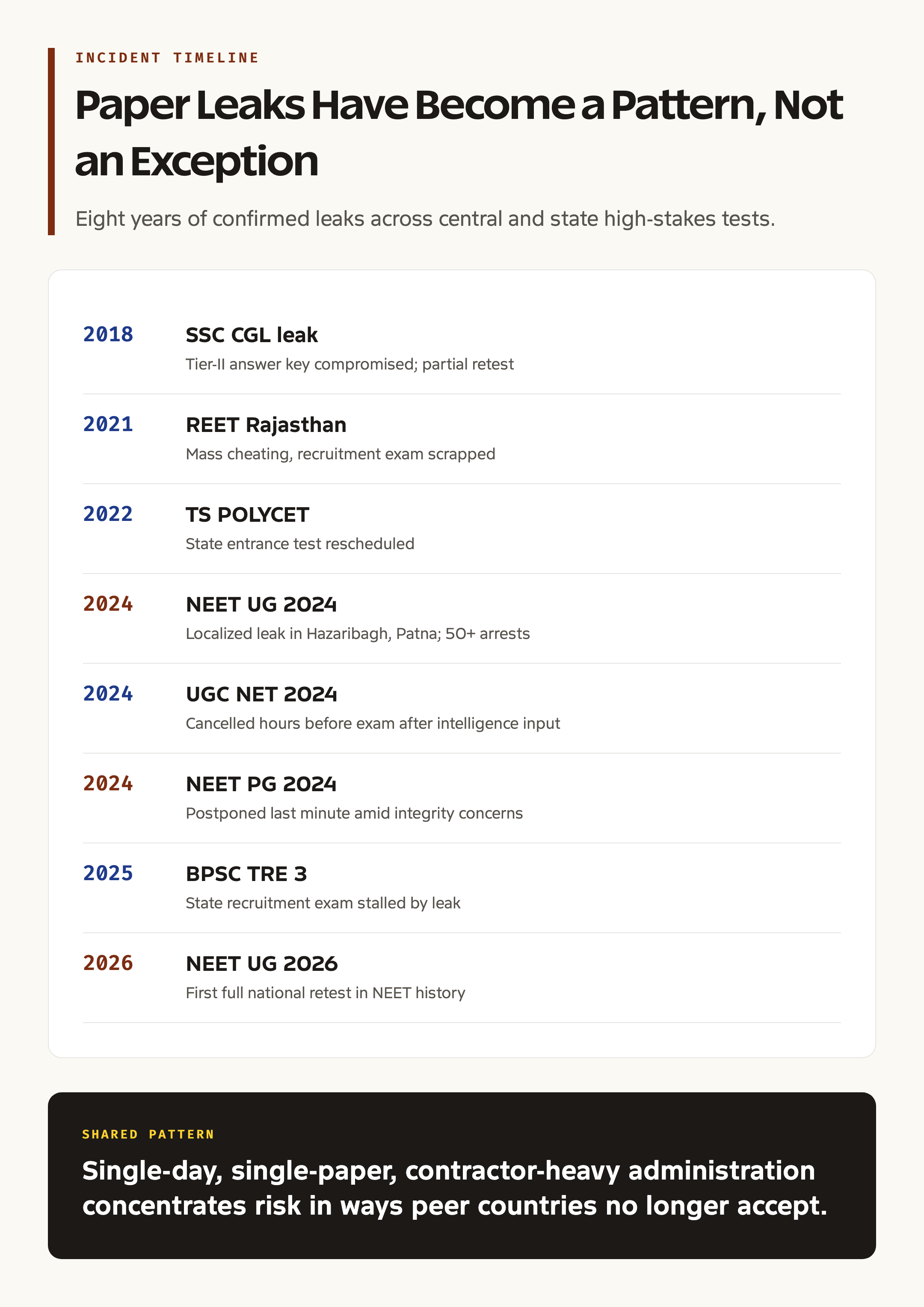
This is the second major NEET crisis in two years and the fourth NTA-conducted exam disrupted by integrity failures since 2024. The Public Examinations (Prevention of Unfair Means) Act, 2024, passed precisely to deter such leaks, has been tested in real conditions for the first time at this scale. Early arrests in Bihar, Gujarat, and Rajasthan have already produced charge sheets, but the deeper question stays open: are leak rings outpacing the law, or is the law’s enforcement architecture not yet in place?
For UPSC aspirants, the NEET 2026 paper leak sits at the intersection of governance, education policy, federalism, and criminal justice. It maps onto GS Paper 2 themes around regulatory bodies, GS Paper 3 themes around internal security and economic offenses, and the essay paper through the broader question of meritocracy and institutional decay.
Quick Facts
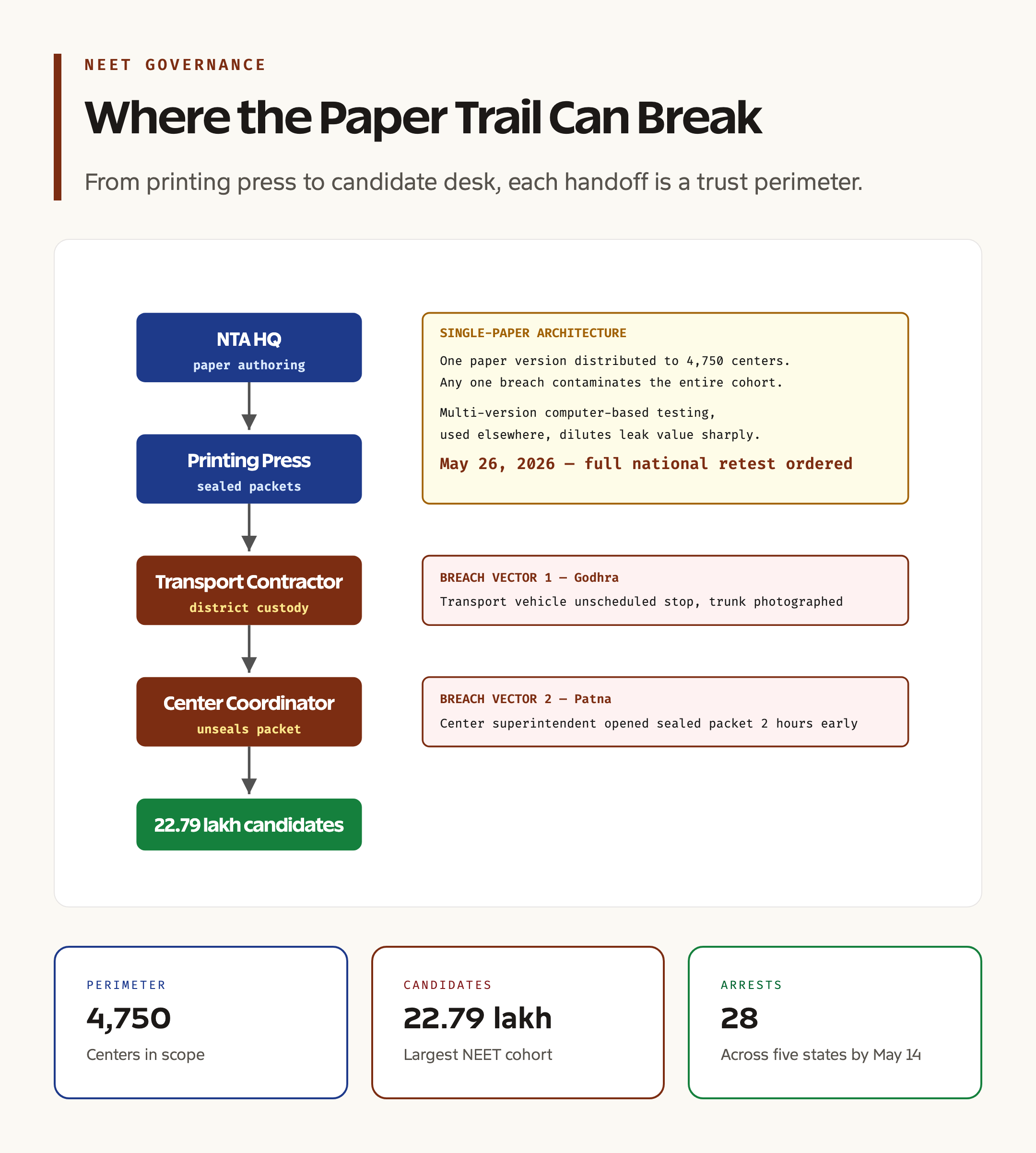
- Exam date: May 4, 2026, single-day pen-and-paper test conducted by NTA
- Candidates registered: 22.79 lakh, the largest cohort in NEET’s history
- Trigger: Leaked papers surfaced on Telegram and WhatsApp groups roughly 90 minutes before the test
- Centers affected: Initial probe identified breaches at centers in Patna, Godhra, Rajkot, Jamnagar, and Hazaribagh
- Retest ordered: May 26, 2026, across 4,750 centers
- Arrests: 28 individuals across five states, including center coordinators and a printing press contractor
- Legal route: First major test of the Public Examinations (Prevention of Unfair Means) Act, 2024
- Past precedent: NEET UG 2024 controversy, NEET PG 2024 last-minute postponement, UGC NET 2024 cancellation
What Just Happened
NTA conducted NEET UG 2026 across 557 cities and 14 international centers on May 4. Within hours of the exam ending, screenshots matching the actual question paper began circulating on social media. The Central Bureau of Investigation, called in by the Ministry of Education on May 6, traced the earliest known image to a Telegram channel timestamped 1:30 PM local time, before the 2:00 PM exam concluded in several centers.
Forensic analysis confirmed the leaked paper was identical to the version distributed at specific centers in Bihar and Gujarat. Investigators traced the breach to two separate vectors. In Patna, a center superintendent allegedly opened a sealed paper packet roughly two hours before schedule. In Godhra, a transport contractor’s vehicle made an unscheduled stop, during which the paper trunk was photographed.
By May 10, the Education Ministry confirmed that the integrity of the test had been compromised at a scale that could not be remedied through localized retesting or score normalization. A nationwide retest was announced on May 12, with the new exam scheduled for May 26. NTA committed to publishing a forensic audit report and overhauling its question paper distribution protocol before the retest.
The Supreme Court took suo motu cognizance on May 14, observing that repeated leaks have eroded the constitutional promise of equal opportunity under Article 16 and the right to fair process under Article 14. A three-judge bench is now monitoring the CBI probe and has asked the Centre to file a status report by May 28.
Background and Historical Context
NEET became the single national medical entrance examination in 2016 after the Supreme Court upheld its constitutionality, replacing more than 90 separate state and institutional tests. The shift sat inside a broader move toward standardized testing that critics have long debated alongside other reforms shaping school education and skill development and vocational education in India. The rationale was uniform standards, reduced student burden, and an end to the multiple-exam fee racket. NTA took over conduct of NEET, JEE, UGC NET, and other tests in 2017 with the same logic applied to administration: a single professional agency replacing fragmented arrangements run by CBSE, UGC, and others.
The promise was a clean institutional separation between curriculum bodies and examination conduct. In practice, NTA inherited the same printing presses, the same transport contractors, and the same district-level networks that had administered exams for decades. The architecture became more centralized, but the perimeter of trust did not shrink.
Paper leaks in Indian public examinations are not new. The Bihar Public Service Commission leaks of the 1990s, the Vyapam scandal in Madhya Pradesh during 2013, the SSC CGL leak of 2018, and a string of state recruitment leaks through the 2010s established a pattern. What has changed is the speed at which leaked content propagates. Encrypted messaging and crypto-based payments have turned what was once a regional cottage industry into an organized national operation.
NEET UG 2024 was the first major NTA-era warning. Confirmed paper distribution to a cohort of students in Hazaribagh and Patna led to an investigation that produced more than 50 arrests but did not result in a retest, with the Supreme Court accepting NTA’s argument that the breach was localized. Critics warned then that the agency had set a low bar for what counted as a compromise. The 2026 incident has effectively raised that bar.
Key Provisions of the Public Examinations Act, 2024
The Public Examinations (Prevention of Unfair Means) Act, 2024, was Parliament’s direct response to mounting leak scandals. It criminalizes a wide range of acts that previously fell into legal gray zones.
The Act covers all examinations conducted by central public examination authorities, including UPSC, SSC, RRB, IBPS, and NTA. State-level recruitment tests remain outside its scope unless states adopt parallel legislation, which only a handful have done so far.
Core offenses include leaking question papers, impersonation, tampering with answer sheets, and using unauthorized communication devices. The Act treats offenses as cognizable, non-bailable, and non-compoundable. Punishments include imprisonment up to ten years and fines up to one crore rupees for service providers who breach contracts.
The Act introduces a category of organized crime for paper leak syndicates, with enhanced punishment up to ten years rigorous imprisonment and minimum fines of one crore rupees. Property of convicted persons can be attached and recovered against examination costs.
A High-Level National Technical Committee on Public Examinations was constituted to develop secure digital infrastructure, advise on protocols, and audit examination conduct. The committee’s recommendations are advisory, which has drawn criticism from those who want a statutory regulator.
Why It Matters
The NEET 2026 paper leak matters because India runs the most consequential examination economy in the world. More than two crore young people sit centralized tests each year for college admission, government jobs, and professional licenses. The credibility of these tests determines whether merit functions as a viable social contract or hardens into cynicism.
For 22.79 lakh families, the May 26 retest means a renewed test cycle. For students who borrowed against next year’s coaching fees, who relocated for the exam, or who timed their last year of school around a single day, the cost compounds. The mental health implications are well documented: Kota and Sikar coaching centers have reported a spike in distress calls to helplines since May 12.
The federalism dimension is sharp. Health and education sit on the Concurrent List, but medical education governance is dominated by central bodies, from the National Medical Commission to NTA. The debate echoes wider concerns around the internationalisation of higher education in India and the new education policy 2020, both of which presume credible centralized assessment. State governments, especially Tamil Nadu, have argued that the central test fails to account for regional curricular variation and rural disadvantage. The 2026 leak strengthens demands from Tamil Nadu, Kerala, and West Bengal to permit state-level alternatives.
The international perception matters too. India’s higher education system markets itself globally as a meritocratic pipeline. Persistent leaks at the entry point undermine the brand and complicate recognition of Indian degrees abroad. Several European medical accreditation bodies have already requested clarification from the Indian government.
Detailed Analysis of NTA’s Structural Weaknesses
NTA’s governance model concentrates responsibility without matching authority. The agency procures printing services, transport, biometric verification, and center supervision through a layered network of contractors and subcontractors. Auditing of these vendors is thin, and the agency lacks an in-house security cadre comparable to the Reserve Bank’s currency division or UPSC’s confidential cell.
Question paper security follows what the High-Level Committee on the Conduct of Public Examinations led by K Radhakrishnan in 2024 called a “trust-based perimeter.” Once papers leave the printing facility, custody depends on local center coordinators, who are typically school principals or college administrators with no security training and modest accountability. The 2026 leak’s Patna vector involved exactly such a coordinator.
Single-day, single-paper administration creates the worst possible target for leak syndicates. With one paper version distributed across 4,750 centers, any single breach contaminates the entire cohort. Agencies in other jurisdictions, including the College Board for the SAT in the United States, have moved to multi-version and computer-adaptive testing precisely to dilute leak value.
NTA’s recourse to retests has emerged as a default rather than a last resort. Retests are expensive, logistically punishing, and politically costly. They also do not solve the underlying problem. Each retest reinforces the lesson that breach detection happens after the fact, which is exactly when prevention has already failed.
Comparative Lens: How Other Countries Handle High-Stakes Tests
The Chinese Gaokao, taken by roughly 12 to 13 million students annually, runs over two to three days with multiple paper versions, strict same-day distribution, and criminal penalties of up to seven years imprisonment for organized cheating. China has reported high-profile leaks too, but the multi-paper architecture limits the scale of contamination.
The American SAT and ACT moved to digital, computer-adaptive formats between 2023 and 2024 across most centers. Each test taker sees a partly unique question pool drawn from a large bank, which substantially reduces the value of any leaked content. The College Board reports cheating incidents but no nationwide retests in the past decade.
South Korea’s Suneung, taken by roughly half a million students, runs on a single day but with paramilitary-grade security including police escorts for paper transport, sealed centers, and a moratorium on flights and stock market openings during listening sections. Korea has not had a confirmed nationwide leak in over twenty years.
The United Kingdom’s A Levels operate through multiple awarding bodies, each running its own examinations, which distributes risk. When breaches occur, they affect a fraction of the cohort rather than the entire annual intake. This decentralized approach is the inverse of India’s current model.
Challenges and Limitations
Implementing the Public Examinations Act, 2024, requires investigative capacity that does not yet exist at scale. The CBI’s specialized exam fraud cell remains small, and state police forces, where most operational policing happens, are not deputed under the central law. Coordination gaps have delayed previous probes.
Digital infrastructure for computer-based testing across 4,000-plus centers and 22 lakh candidates is a multi-thousand-crore commitment. India’s current computer-based testing capacity, used for tests like the JEE Main and CAT, handles a maximum of 12 to 15 lakh candidates spread over several days. Scaling to NEET-class volumes would require massive expansion of test centers, broadband, and proctoring.
Coaching industry pushback is real. Pen-and-paper testing is familiar territory for the Kota-Sikar-Hyderabad coaching ecosystem. A shift to multi-version digital testing would disrupt mock-test economics and could face quiet resistance from a politically influential industry.
Data privacy concerns arise around biometric attendance, AI proctoring, and behavior analytics. The Digital Personal Data Protection Act, 2023, has yet to issue final rules, and exam-grade data collection sits in regulatory limbo.
Prelims Pointers
- NEET UG is conducted by NTA under the National Medical Commission framework for admission to MBBS, BDS, AYUSH, and allied medical courses
- NTA was constituted in 2017 as a registered society under the Department of Higher Education, Ministry of Education
- The Public Examinations (Prevention of Unfair Means) Act, 2024, received presidential assent on February 12, 2024
- The High-Level Committee on the Conduct of Public Examinations was chaired by former ISRO chairman K Radhakrishnan
- NEET became mandatory nationally for medical admissions following the Supreme Court’s 2016 judgment
- Article 14 (equality before law) and Article 21 (right to life and personal liberty) have been cited in PILs related to exam integrity
- The Right to Education Act covers school education up to Class 8 and does not extend to higher education entrance examinations
Mains Questions
- “Centralized examinations promised uniformity but delivered fragility.” Examine this proposition in the context of the NEET 2026 paper leak. Suggest a federal architecture for high-stakes testing in India. (GS Paper 2, 15 marks)
- The Public Examinations (Prevention of Unfair Means) Act, 2024, marks a shift from administrative to criminal regulation of examination integrity. Critically analyze whether criminalization alone can deter organized paper leak networks. (GS Paper 3, 15 marks)
- Discuss the implications of repeated NTA examination failures for the right to equality and the principle of meritocracy in Indian higher education. Suggest reforms to NTA’s governance, technology, and accountability framework. (GS Paper 2, 10 marks)
- Evaluate India’s preparedness to transition from pen-and-paper to computer-based adaptive testing for high-volume national examinations. Identify infrastructure, equity, and security challenges and propose a phased roadmap. (GS Paper 3, 10 marks)
Way Forward
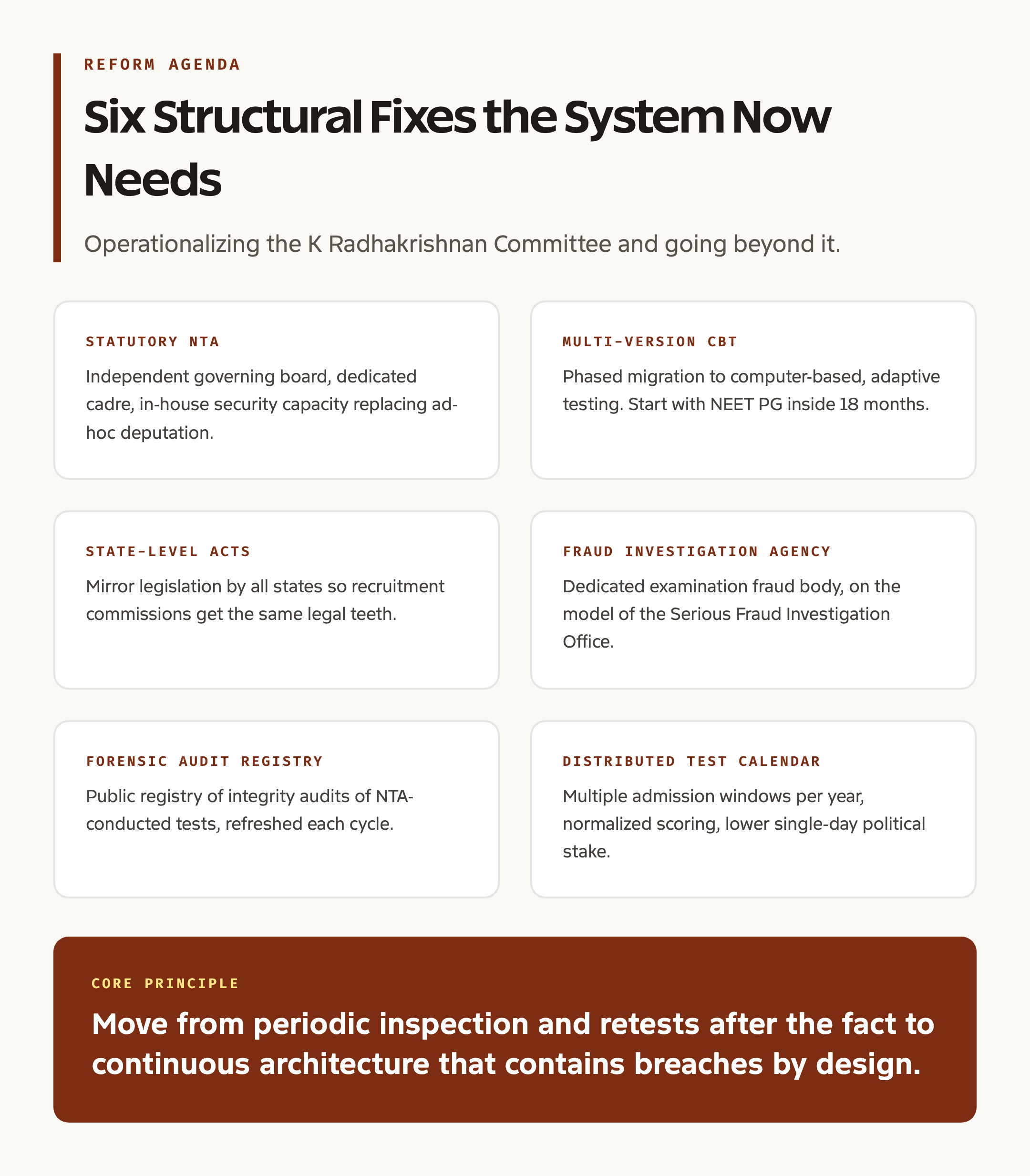
Reforming NTA is the immediate priority. The agency needs statutory backing, an independent governing board with academic and security representation, and a dedicated cadre rather than ad-hoc deputation. The K Radhakrishnan Committee’s 2024 recommendations on a permanent governance review should be operationalized, not shelved.
Phased migration to multi-version, computer-based, adaptive testing should begin within twelve to eighteen months for NEET PG, where candidate numbers are smaller. NEET UG can follow over three to five years as infrastructure expands. Question bank development must be funded centrally and audited externally.
State-level legislation mirroring the Public Examinations Act is essential. Without state laws, recruitment exams conducted by state public service commissions remain vulnerable. A model law drafted by the Ministry of Home Affairs and circulated to states would accelerate adoption.
Investigative capacity must expand. A specialized examination fraud agency, on the model of the Serious Fraud Investigation Office for corporate fraud, would consolidate skills currently spread across CBI, state police, and NTA. The case parallels arguments for stronger institutional design in other regulatory domains, including the role of parliamentary committees in oversight. Funding should flow from a small statutory levy on exam fees.
Finally, the testing economy itself needs a hard look. Single high-stakes admission tests concentrate risk and student stress. A multi-test, year-round model with credit transfer and standardized normalization would distribute the load and reduce the political cost of any single breach.
Frequently Asked Questions
What is the NEET 2026 paper leak and how was it confirmed?
The NEET 2026 paper leak refers to the confirmed circulation of actual NEET UG question papers on encrypted messaging platforms before and during the May 4, 2026 exam window. The CBI confirmed the breach through forensic matching of leaked images with the official paper version distributed at specific centers in Bihar and Gujarat.
Why was a nationwide retest ordered instead of a localized one?
The Education Ministry concluded that the leak’s contamination extended beyond identifiable centers and could not be contained through localized retesting or score normalization without violating the principle of equal opportunity. The Supreme Court accepted this assessment on May 14.
What is the Public Examinations (Prevention of Unfair Means) Act, 2024?
It is a central law that criminalizes paper leaks, impersonation, and other unfair means in examinations conducted by central public examination authorities. Offenses are cognizable, non-bailable, and non-compoundable, with imprisonment up to ten years and fines up to one crore rupees.
How is NEET 2026 different from the NEET 2024 controversy?
NEET 2024 involved a confirmed but localized leak that did not produce a nationwide retest, with the Supreme Court accepting NTA’s argument that the breach was geographically contained. NEET 2026 has produced the first full national retest in the test’s history, signaling a stricter judicial and administrative posture.
What is the role of the National Testing Agency?
NTA is an autonomous society under the Ministry of Education that conducts large-scale entrance examinations including NEET, JEE Main, UGC NET, and CUET. It was set up in 2017 to professionalize examination conduct, though it relies on a contractor network for printing, transport, and center supervision.
Will the NEET 2026 retest affect the medical admission timeline?
NTA has indicated that results from the May 26 retest will be released within four to six weeks, which pushes counseling by roughly six to eight weeks. State counseling rounds and All India quota allocations are being recalibrated accordingly.
What reforms has the K Radhakrishnan Committee recommended?
The 2024 committee chaired by former ISRO chairman K Radhakrishnan recommended phased adoption of computer-based testing, multi-stage examinations where feasible, secure digital question bank infrastructure, strengthened center auditing, and an independent grievance mechanism for candidates.
How does India’s exam security compare with other countries?
China and South Korea use single-day high-stakes tests but with multi-version papers and paramilitary-grade security. The United States and United Kingdom rely on digital adaptive or multi-board testing that limits leak value. India’s single-version, single-day, paper-based model concentrates risk in a way that few peer countries still tolerate.
Can affected candidates challenge the retest legally?
Yes. Candidates can file writ petitions under Article 32 or 226 challenging the retest on grounds of arbitrariness or denial of opportunity, though courts have historically deferred to NTA on operational decisions. The Supreme Court’s ongoing supervisory role in 2026 makes individual challenges less likely to succeed.
What is the way forward for NTA after the 2026 crisis?
NTA needs statutory backing, a permanent professional cadre, in-house security capacity, phased migration to multi-version computer-based testing, and an independent audit mechanism. State-level Public Examinations Acts and a dedicated examination fraud investigation agency would round out the reform package.