A Parliamentary Committee is a body of MPs that does what the full Parliament cannot — examine bills clause by clause, scrutinise budgets line by line, and hold the executive accountable continuously, away from the political theatre of the floor. Sir Ivor Jennings described committees as "the eyes and ears of Parliament." In Indian polity, Parliamentary Committees have been called the "mini-Parliaments" that allow detailed, less partisan, expert-driven legislative work.
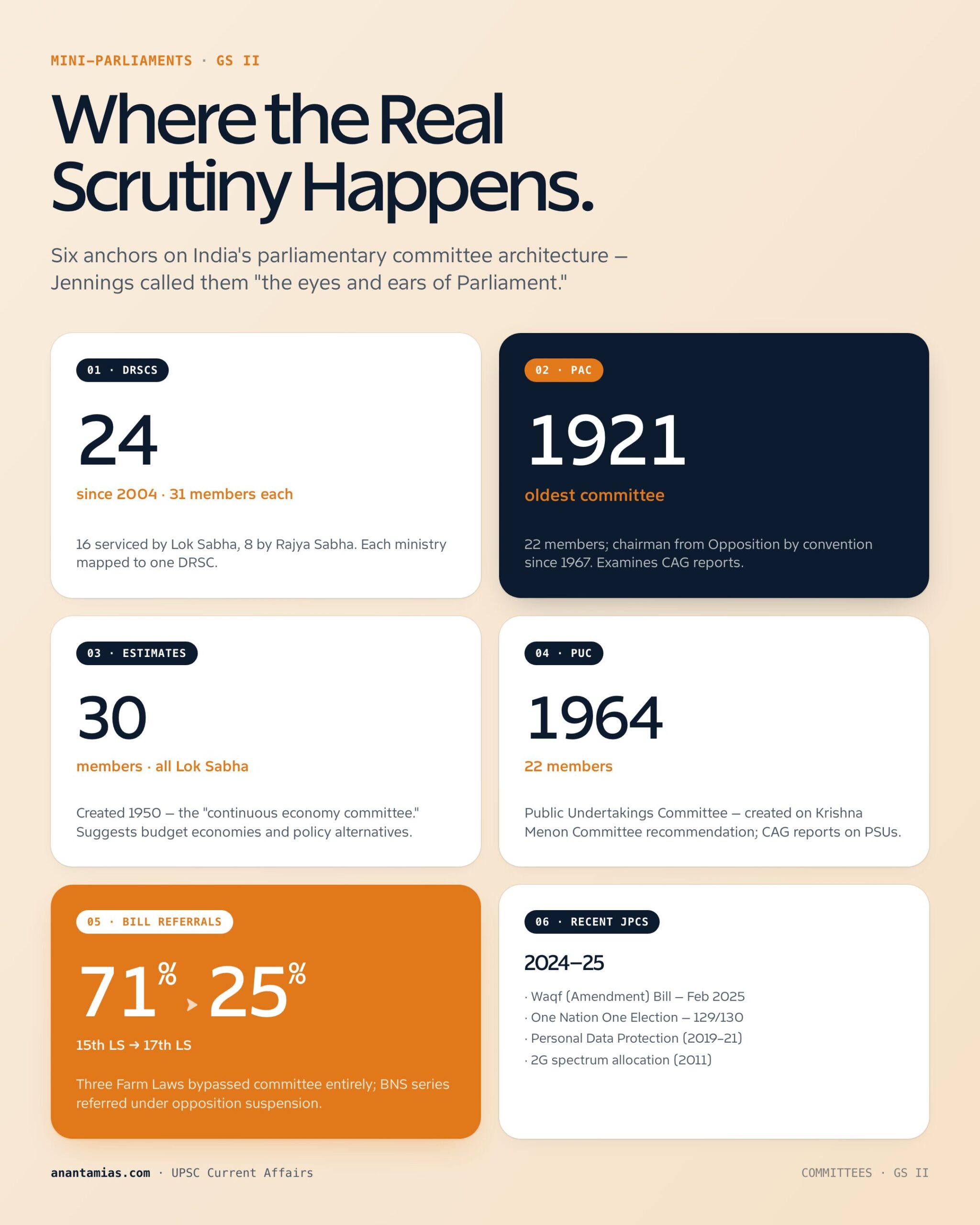
The Indian system traces its committee architecture to the Government of India Act, 1919. The Public Accounts Committee (PAC) dates back to 1921 — older than the Republic itself. The system was significantly expanded with the Departmentally Related Standing Committees (DRSCs) introduced in 1993, restructured in 2004 with 24 committees (16 serviced by Lok Sabha, 8 by Rajya Sabha).
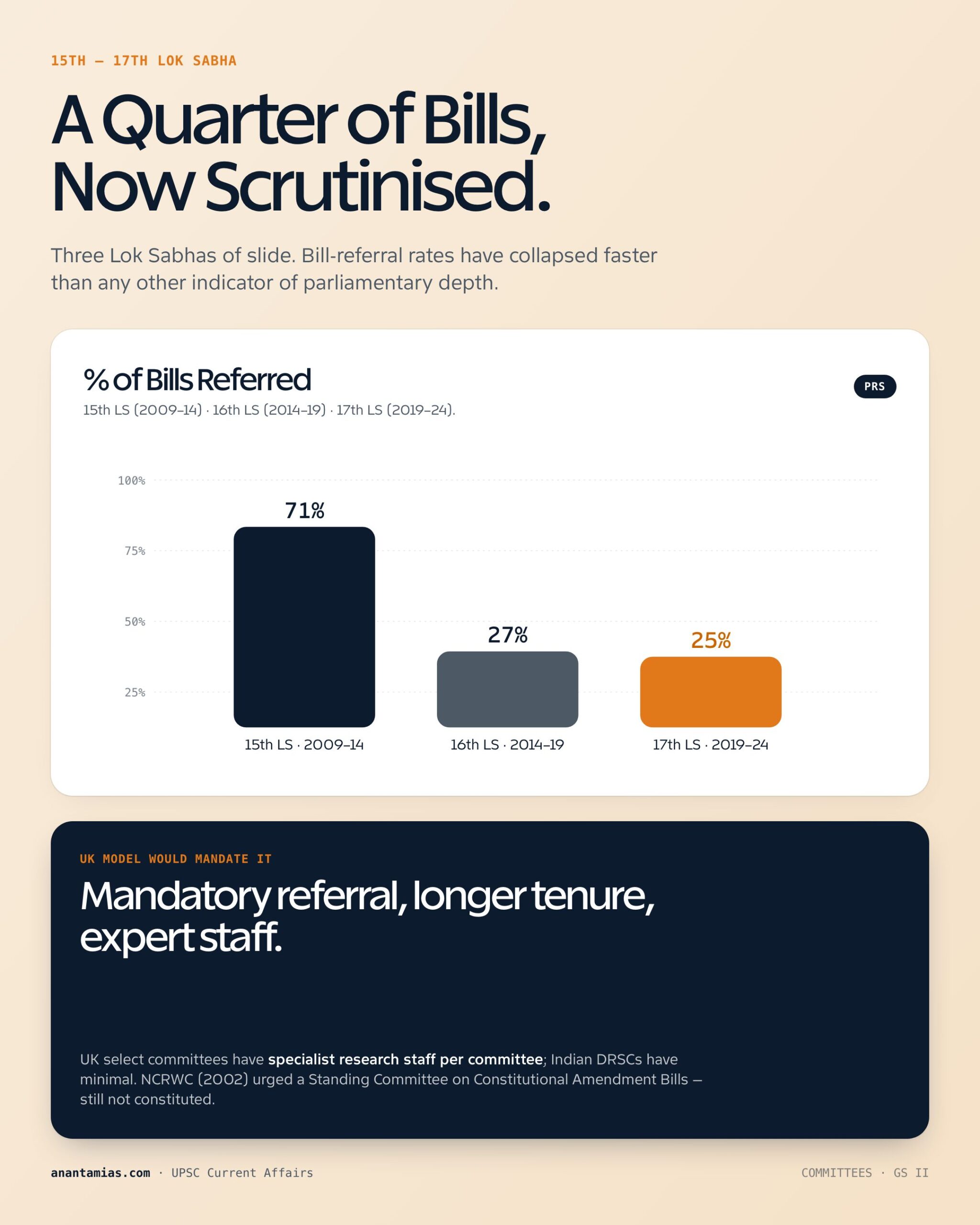
Yet the same data points that explain declining Parliament productivity also explain declining committee strength: bill referrals dropped from 71% (15th LS) to 25% (17th LS). The 18th Lok Sabha (2024-29) is showing modest revival, but the structural problems — yearly membership, lack of expert staff, low attendance — persist. This guide covers types, functions, key committees, recent reports, and the reform agenda.
Why parliamentary committees are needed
The full House cannot scrutinise every bill, every demand for grant, every CAG report. Parliament typically sits 55-75 days a year in India; it must legislate, debate, and hold executive to account in that time. Committees offer the workaround:
- Detailed scrutiny of bills that would otherwise pass with minimum debate.
- Consensus-building across party lines — committees work less along party lines than the floor.
- Stakeholder engagement — public, experts, industry, civil society can depose.
- Continuity — committees function throughout the year, not just during sessions.
- Accountability mechanism — financial committees scrutinise expenditure long after the budget is passed.
- Reduce executive dominance — counterweight to the cabinet's control over the floor.
Constitutional and procedural basis
- Article 105 — privileges and immunities for MPs apply to committee work.
- Articles 118 and 208 — each House makes its rules for procedure, including committees.
- Rules of Procedure and Conduct of Business in Lok Sabha — Rules 253-286 govern committees.
- Rule 73 of LS Rules — bills can be referred to a Select Committee or Joint Committee.
Types of parliamentary committees
| Type | Examples | Tenure |
|---|---|---|
| Standing Committees | DRSCs, PAC, Estimates, PUC, Business Advisory, Privileges, Ethics, Rules, Library | Permanent, reconstituted yearly |
| Ad-hoc Committees | Select Committee on a Bill, Joint Parliamentary Committee, Committee on Specific Issue | Dissolved once report submitted |
| Financial Committees | PAC, Estimates Committee, Public Undertakings Committee | Permanent (PAC and PUC since 1921 and 1964) |
| Departmentally Related Standing Committees (DRSCs) | 24 committees (since 2004) | Yearly |
| Joint Parliamentary Committees (JPCs) | Bofors (1987), 2G (2011), JPC on Personal Data Protection (2019-21), Waqf Bill JPC (2024-25) | Ad-hoc, can be reconstituted |
Departmentally Related Standing Committees (DRSCs)
Introduced in 1993 by Speaker Shivraj Patil; restructured in 2004 to 24 committees.
- 16 serviced by Lok Sabha; 8 by Rajya Sabha.
- Each committee has 31 members — 21 from Lok Sabha + 10 from Rajya Sabha.
- Term: one year.
- Each ministry is allocated to a DRSC.
Functions of DRSCs:
- Examination of Demands for Grants.
- Examination of bills referred by the Speaker/Chairman.
- Consideration of annual reports of ministries.
- Examination of policy documents.
DRSCs do not:
- Take up matters of day-to-day administration.
- Examine matters under consideration of any other Parliamentary Committee.
The three financial committees
Public Accounts Committee (PAC)
- Established 1921 under the Government of India Act, 1919; oldest parliamentary committee.
- 22 members — 15 Lok Sabha + 7 Rajya Sabha.
- Tenure: 1 year.
- Chairman from Lok Sabha; convention since 1967 — appointed from the Opposition.
- Examines CAG audit reports on expenditure of central government and PSUs.
- Cannot examine policy questions; only questions of audit.
- Ministers cannot be members.
Estimates Committee
- Created 1950 — direct successor to the Standing Finance Committee (1937).
- 30 members, all from Lok Sabha; no Rajya Sabha members.
- Chairman from Lok Sabha, always from ruling side.
- Called the "continuous economy committee".
- Examines budget estimates to suggest economy in expenditure.
- Suggests alternative policies for efficiency.
Public Undertakings Committee (PUC)
- Created 1964 on Krishna Menon Committee recommendation.
- 22 members — 15 Lok Sabha + 7 Rajya Sabha.
- Examines CAG reports on PSUs and reports on autonomy and efficiency.
- Cannot examine policy or day-to-day administration of PSUs.
Key non-financial committees
- Business Advisory Committee — schedules House business.
- Committee on Privileges — examines breach of privilege.
- Ethics Committee — examines conduct of MPs (e.g., Mahua Moitra cash-for-query, October 2023).
- General Purposes Committee — chaired by Speaker, advises on matters not falling under any other committee.
- Rules Committee — amendments to Rules of Procedure.
- Committee on Government Assurances — tracks promises made by ministers on the floor.
- Committee on Subordinate Legislation — scrutinises rules made under delegated legislation.
- Committee on Petitions — examines public petitions.
- Library Committee, House Committee, Committee on Absence of Members.
Joint Parliamentary Committees (JPCs)
Constituted on a specific subject; members drawn from both Houses; chaired typically by a senior MP. Recent significant JPCs:
| JPC | Year | Mandate |
|---|---|---|
| Bofors | 1987 | Defence procurement scandal |
| Securities scam (Harshad Mehta) | 1992 | Stock market scam |
| Stock market scam (Ketan Parekh) | 2001 | Stock market manipulation |
| 2G spectrum allocation | 2011 | Telecom licence allocation |
| Personal Data Protection Bill | 2019-21 | Data protection framework |
| Waqf (Amendment) Bill | 2024-25 | Reform of Waqf Boards |
| One Nation One Election Bill | 2024 | Constitutional Amendment Bills 129 and 130 |
Why India's committee system is weak
The data tell the story:
- Bills referred to committees — 71% (15th LS, 2009-14) → 27% (16th LS, 2014-19) → 25% (17th LS, 2019-24).
- Three Farm Laws (2020) — passed without committee scrutiny.
- Bharatiya Nyaya Sanhita, BNSS, BSA (2023) — referred to Standing Committee on Home Affairs; many opposition MPs absent during deliberation.
- Low attendance — average 30-40% in DRSCs.
- Yearly membership — does not allow for specialisation.
- Lack of training — new MPs join committees with no orientation.
- Lack of expert research support — UK has dedicated specialist staff per committee; India has minimal.
- No formal binding power — committee recommendations are advisory.
Should committee proceedings be open to the public?
Arguments for openness:
- Enhances accountability.
- Educates the public on policy debates.
- Prevents back-room deals.
- Aligns with US/UK practice.
Arguments against:
- Free and frank debate requires confidentiality.
- Sensitive issues (defence, intelligence, foreign policy) require closed-door deliberation.
- Risk of grandstanding for media.
Middle path: Selectively open hearings (UK Select Committee model) where stakeholders depose publicly, while internal deliberations remain private.
Major recent committee reports (2024-26)
- Standing Committee on Home Affairs — Bharatiya Nyaya Sanhita series (2023); recommendations on community service, mob lynching, marital rape exception.
- Standing Committee on Personnel, Public Grievances, Law and Justice — Election Process Reform (2023, Sushil Modi); examined common electoral roll, Aadhaar linking, age of contesting elections.
- Standing Committee on Finance — Cryptocurrency and Digital Assets framework (2024).
- Joint Committee on Waqf (Amendment) Bill (2024) — submitted report February 2025.
- JPC on One Nation One Election Bill (2024-26) — examining constitutional amendment.
- PAC report on PMLA enforcement (2024) — questioned ED conviction rate.
- Standing Committee on External Affairs — India-Maldives relations and IMEC corridor (2024).
Issues with committee reports
- Reports often not tabled in time for debate during the same session.
- No statutory requirement for the government to act on committee recommendations.
- Action Taken Report (ATR) often vague.
- Bills passed before committee report is even tabled (in some cases).
Reform agenda — way forward
| Reform | Detail |
|---|---|
| UK model bill referral | Mandate that all non-money bills be referred to Standing Committees |
| Sector-specific research staff | Each DRSC should have 5-6 sector experts |
| Tenure extension | DRSC tenure to 2-3 years for specialisation |
| Statutory committee on Constitutional Amendment Bills | NCRWC (2002) recommendation |
| Statutory committee on National Economy | NCRWC recommendation |
| Compulsory laying of ATR within 6 months | Statutory deadline |
| Live broadcast of select hearings | Selective transparency |
| Statutory minimum attendance | At least 50% for quorum |
| Independent Parliamentary Budget Office | Like US CBO; provides non-partisan analysis |
NCRWC recommendations (2002)
- Constitute Standing Committees on Constitutional Amendment Bills.
- Constitute Standing Committee on National Economy.
- Mandate reference of all bills (except money bills) to committees.
- Strengthen committee secretariat.
Mains-style answer hook
"Parliamentary Committees are the institutional answer to the central problem of modern legislatures: too much business, too little time, too thin debate. Indian DRSCs, PAC, Estimates and PUC, when they work, produce some of the most considered policy work in the Republic — the Personal Data Protection JPC, the Home Affairs Committee on the new criminal codes, the PAC on PMLA. But the data on declining bill referrals, low attendance, and absent expert staff suggest the system needs structural revival: mandatory referral, longer tenures, sector-specialist staff, and time-bound action taken reports. The committees, not the floor, are where Parliament's accountability function is now exercised — and where reform must concentrate."
Prelims pointers
- PAC — established 1921; 22 members (15 LS + 7 RS); chairman from Opposition (convention since 1967).
- Estimates Committee — 1950; 30 members, all Lok Sabha.
- Public Undertakings Committee — 1964; 22 members (15 LS + 7 RS).
- DRSCs — introduced 1993; 24 committees (16 LS + 8 RS); 31 members each.
- Bills referred — declined from 71% (15th LS) to 25% (17th LS).
- Sushil Modi Committee report on Election Process (2023) — common electoral roll, age of contesting.
- Article 105 — privileges; Articles 118, 208 — procedure.
FAQ
Who can be a member of a parliamentary committee?
Any sitting MP; ministers cannot be members of financial committees (PAC, Estimates, PUC).
Are committee proceedings public?
By default, no. Reports are tabled in the House and become public; deliberations remain confidential.
Can a committee compel a witness?
Yes — committees have the power to summon any person, papers, or records under Article 105 privileges.
Related: Parliament, Standing Committee Report Summary, Anti-Defection Law, CAG of India.
Tell Google you want more of this.
Add Anantam IAS as a preferred sourceOne tap, and this site shows up more often in your own Top Stories, AI Overviews and AI Mode. Remove it any time.