Next Generation Reforms in Bureaucracy
Why in News?
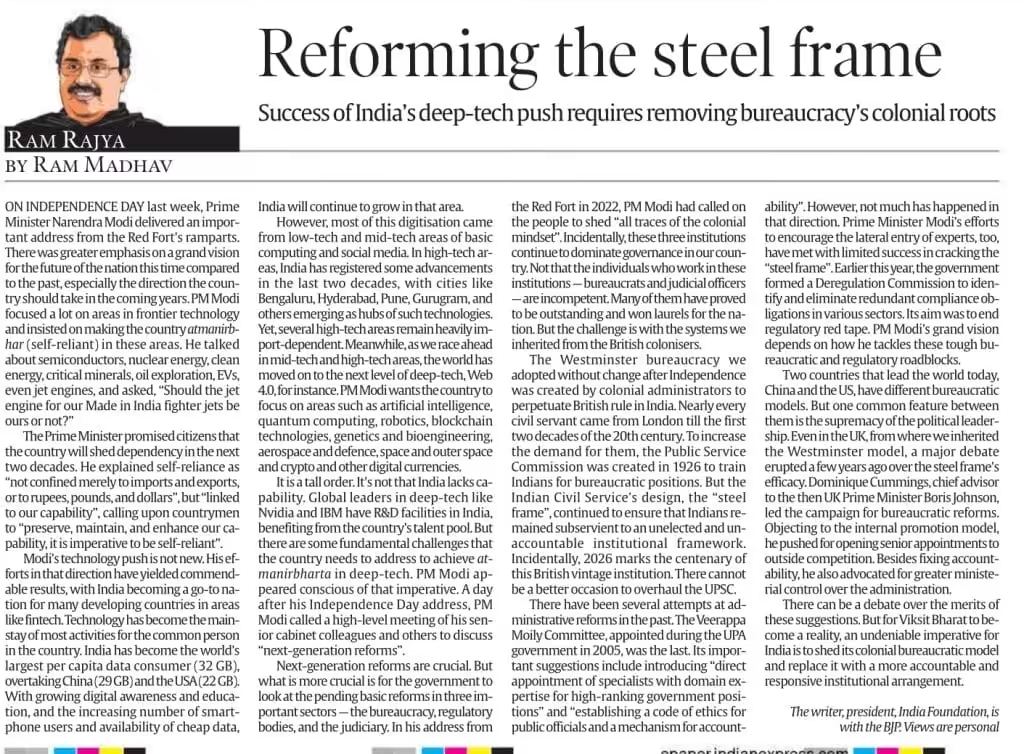
PM Modi has proposed next generation reforms for development of India in his Independence Day speech. The author has put a case for next generation reforms for Bureaucracy also.
UPSC Relevance :
GS 2, Role of Civil Services in a Democracy.
Mains PYQ :
2017 – Initially Civil Services in India were designed to achieve the goals of neutrality and effectiveness, which seems to be lacking in the present context. Do you agree with the view that drastic reforms are required in Civil Services? Comment.
2020 – “Institutional quality is a crucial driver of economic performance”. In this context suggest reforms in Civil Service for strengthening democracy.
Characteristic of Indian Bureaucracy
Hierarchical Structure – The bureaucracy follows a rigid, top-down chain of command. Authority and decision-making power flow from the top echelons, such as the Indian Administrative Service (IAS), down to the lower-level functionaries. This structure is meant to ensure clear lines of accountability and control.
Rule-Bound Operations or Formalism – The system operates on a complex framework of rules, regulations, and standardized procedures. These written codes are intended to ensure impartiality and consistency in decision-making.
Merit-Based Recruitment – Entry into the elite civil services is based on a competitive, merit-based examination (UPSC Civil Services Exam, SSC and State PSC Exams).
Permanence – Once appointed, civil servants have a secure tenure until retirement, which provides stability and political neutrality. This job security, however, can sometimes lead to a lack of accountability for poor performance. Article 311, strengthens this job security.
Generalist Approach – Historically, Indian bureaucrats have been generalists, meaning they are trained to handle a variety of administrative roles across different departments (e.g., an IAS officer may serve in health, education, and finance ministries throughout their career).
Political Neutrality – Bureaucrats are expected to remain impartial and implement government policies irrespective of the ruling party.
All-India Services – Allows Parliament to create one or more All-India Services (e.g., IAS, IPS) common to both the Union and States, further centralising bureaucracy’s structure.
Reports and Data on Indian Bureaucracy
- World Competitiveness Ranking (WCR) 2025 by Institute for Management Development
- India ranks 41st out of 69 countries, slipping two spots from 39th in 2024. In government and business efficiency, India remains unchanged with ranks 45th and 25th, respectively.
- Transparency International Corruption Perceptions Index (CPI) for 2024
- India’s rank was 96 out of 180 countries, with a score of 38 out of 100.
Recent Reforms
Lateral Entry
Lateral recruitment, at the levels of Joint Secretary, Director and Deputy Secretary in Government of India, has been undertaken since 2018 to appoint persons for specific assignments, keeping in view their specialized knowledge and expertise in the domain area.
- By July 2024, 63 appointments had been made through lateral entry out of which 35 appointments had been from the private sector.
- As of 2023 only 33% of Joint Secretaries were IAS at the central level, a significant change from near-total dominance a decade ago.
Performance-Based Governance
The government is shifting away from a seniority-based promotion system. There is an increasing focus on accountability through performance-measured assessments.
- Mission Karmayogi (launched 2020) – A systemic shift toward “role-based” and citizen-centric service, focusing on enhanced training, e-governance, and digitized processes. Initiatives like SPARROW (for performance appraisal) and CPGRAMS (for grievance redressal) are modernizing service delivery.
Digitisation
- Increased Efficiency and Reduced Paperwork – Digital platforms have replaced manual, paper-heavy processes. For example, the e-Office initiative digitizes file movement within government ministries, drastically reducing the reliance on physical files and speeding up decision-making. Similarly, the e-Courts project has helped reduce case backlogs and delays. The Gatishakti portal has streamlined functioning of multiple ministries and departments.
- Enhanced Transparency and Accountability – Online portals and digital systems create an audit trail, reducing opportunities for corruption and increasing public trust. Platforms like the e-Procurement system (Government e-Marketplace or GeM) ensure transparency in public tenders. The Right to Information (RTI) online portal also makes it easier for citizens to file and track requests, holding officials accountable.
- Citizen-Centric Service Delivery – E-governance has brought government services closer to citizens, making them more accessible and convenient. Instead of visiting multiple government offices, citizens can now access a wide range of services from a single platform, like the UMANG (Unified Mobile Application for New-age Governance) app, which integrates over 1,600 services from central and state departments.
- To bridge the digital divide, especially in rural areas, the government has set up Common Service Centres (CSCs). These are physical access points for delivering essential public services and information. Over 5.31 lakh CSCs are functional across the country.
- CPGRAMS (Centralized Public Grievance Redress and Monitoring System) – Latest data from the Department of Administrative Reforms and Public Grievances (DARPG) shows significant progress in grievance redressal. As of July 2025, 4.44 lakh grievances have been redressed at the central level, and 2.35 lakh at the state level.
- Improved Targeting of Welfare Schemes – The use of digital identity and payment systems with JAM trinity has revolutionized the delivery of subsidies and welfare benefits. It has helped eliminate “ghost beneficiaries” and reduce leakages in the system.
Need of Next Generation Reforms
1. Political Interference and Erosion of Neutrality
Frequent Transfers – A common tactic used by political executives to exert control is the frequent transfer of officers. An honest and independent officer who refuses to comply with an illegal or inappropriate order may be transferred out of their post. This not only disrupts the continuity of administration but also creates a culture of fear and sycophancy.
- Studies by the Centre for Policy Research have shown that the average tenure of an IAS officer in a single post is barely 16 months, far below the recommended norm of 3 years. Such short tenures prevent officers from undertaking long-term projects and holding a proper stake in their assigned work.
Post-Retirement Appointments – The lure of lucrative post-retirement positions, such as governorships or appointments to various commissions, can influence the behavior of senior bureaucrats while they are in service. This can lead to a “collusive corruption” where a bureaucrat makes decisions favorable to their political masters in exchange for future rewards.
Mental Health & Work Stress – Bureaucrats face high-pressure environments due to political interference and stress due to long working hours and public scrutiny.
2. Lack of Specialization and efficiency
Mismatched Roles – An officer with a background in history or literature might be appointed to head a technical ministry like the Ministry of Petroleum or the Ministry of Health. This lack of domain expertise often leads to a reliance on external consultants or a superficial understanding of complex policy matters, resulting in poor decision-making.
Slow Lateral Entry – To address this, the government has introduced the Lateral Entry Scheme to bring in domain experts from the private sector and academia. While the intent is sound, its implementation has been slow, and it has faced legal and political challenges. As of 2023, only a few dozen such appointments have been made, which is a very small number compared to the scale of the bureaucracy.
Poor performance appraisal system – A key challenge remains, with only an estimated 3% of bureaucrats facing performance reviews based on Key Performance Indicators (KPIs). Seniority based promotion remains the norm.
3. The “File Culture” and Institutional inertia
Even with the implementation of e-office, many departments still operate with physical files and outdated procedures. The fear of making a mistake or facing an inquiry often makes bureaucrats risk-averse, leading to a “noting-and-passing-the-buck” mentality where files are passed from one desk to another for approvals, resulting in significant delays.
4. Issues with digitisation
Digital Illiteracy – A significant portion of the population, especially in rural areas, lacks the digital literacy to access and use online government services. This makes them dependent on middlemen or Common Service Centres (CSCs), which can sometimes recreate the same issues of corruption and exploitation that e-governance was designed to eliminate.
Cybersecurity Threats – As more government services and citizen data are moved online, the risk of cyberattacks, data breaches, and misuse of personal information increases. Ensuring robust cybersecurity and data privacy is a major challenge for the government, which often relies on outdated infrastructure and lacks skilled cybersecurity professionals.
Deep Tech– The bureaucracy has integrated technology in rudimentary form until now and remains largely unequipped to leverage the opportunities and deal with the challenges associated with deep technologies like AI and Big Data due to lack of appropriate capacity building and training.
5. Colonial hangover – highlighted by the author
The Westminster bureaucracy we adopted without change after Independence was created by colonial administrators to perpetuate British rule in India. Nearly every civil servant came from London till the first two decades of the 20th century. To increase the demand for them, the Public Service Commission was created in 1926 to train Indians for bureaucratic positions.
But the Indian Civil Service’s design, the “steel frame“, continued to ensure that Indians re-mained subservient to an unelected and un-accountable institutional framework. As, 2026 marks the centenary of this British vintage institution, there cannot be a better occasion to overhaul the UPSC.
6. New Gen Reforms for New Age Challenges
In this globalized and interconnected world, complex challenges related to Climate Change, migration, economic uncertainties, pandemic await solutions that can be given only by a well equipped and modernised bureaucracy.
Suggested Reforms
1. Specialization and Lateral Entry
Traditionally, the Indian Administrative Service (IAS) has followed a generalist approach, with officers handling a wide range of departments regardless of their expertise. Reforms propose greater specialization to improve policy implementation.
- The Surjit Bhalla Committee and NITI Aayog have strongly advocated for lateral entry to induct professionals from the private sector and academia into key government roles.
- The Veerappa Moily Committee, appointed during the UPA government in 2005, was the last. Its impor-tant suggestions include introducing “direct appointment of specialists with domain ex-pertise for high-ranking government positions”
2. Performance-Based Accountability
Instead of promotions based solely on seniority, officers must be evaluated based on their performance and outcomes in a comprehensive manner.
- The Second Administrative Reforms Commission (ARC) recommended replacing the Annual Confidential Reports (ACRs) with a Multi-Stakeholder Feedback system. This would involve feedback from superiors, peers, and subordinates, and even from the public in some cases.
3. Ethical Governance – Cancelling the Babu culture
The focus is on instilling a strong code of ethics and moving from a “provider” to a “partner” role with citizens. Focus should be on using power to serve public interest.
- The Second ARC’s report on “Ethics in Governance” recommended a code of ethics for civil servants. It also advocated for strengthening the Centralized Public Grievance Redress and Monitoring System (CPGRAMS) and making the Right to Information (RTI) Act more effective.
- The Veerappa Moily Committee also suggested for “establishing a code of ethics for public officials and a mechanism for accountability”
4. Technological Integration and embracing Deep Tech
Digitization is seen not just as a tool for efficiency but as a fundamental reform to dismantle red tape and improve service delivery. There must be technological training and capacity building for civil servants with periodic assessments.
- The NITI Aayog has consistently pushed for the use of emerging technologies like AI, blockchain, and data analytics to enhance administrative processes.
5. Rationalization of Services
There’s a proposal to streamline the complex structure of the civil services. NITI Aayog’s report on “Strategy for New India @ 75” proposed rationalizing the over 60 existing civil services into a few, more integrated services.
6. Decentralisation & Local Governance Empowerment
Strengthen the panchayat and municipal governance structure to reduce over-reliance on central authority. Provide financial autonomy and decision-making power to local governing bodies.
7. Aligning the recruitment processes
The merit based recruitment must test the skills and capability in problem solving, management and Technology.
Case Studies – highlighted by Indian School of Public Policy
UK’s Agile Public Administration Model
- Cross-sector collaboration: Civil servants work closely with experts from academia, business, and think tanks.
- Continuous training: Programmes like the Civil Service Fast Stream ensure skill upgradation and leadership development.
- Policy flexibility: A focus on adaptive policymaking rather than rigid rule-following.
Singapore’s Adaptive Bureaucracy – Singapore’s civil service is one of the most efficient in the world.
- Meritocracy: The Public Service Commission (PSC) ensures that only the best candidates are selected through rigorous assessment.
- Technology-Driven Governance: AI-powered services, automation, and e-governance platforms ensure smooth service delivery.
- Flexible Policies: Bureaucratic structures are regularly reviewed to stay relevant to economic and social changes.
Scandinavian Model – Transparency & Decentralisation
- Highly decentralised administration: Local governments have significant autonomy in decision-making.
- Transparent governance: Open access to government documents and strong anti-corruption laws.
- Participatory governance: Their citizens actively engage in policymaking through public consultations.