NIPCR ICMR: National Institute for Pre-Clinical Research Explained
Every approved drug, every licensed vaccine, every implantable medical device passes through a stage that almost nobody outside the industry talks about: pre-clinical research. It’s the long, expensive, deeply unglamorous phase where a candidate molecule moves from a promising lab finding to something that’s safe enough to put into the first human volunteer. India has had pre-clinical capacity for decades, scattered across CSIR labs, academic institutions, ICMR centers, and private CROs. What it hasn’t had is a single, dedicated, GLP-grade national hub. The newly announced NIPCR ICMR institute is meant to fix that gap.
The National Institute for Pre-Clinical Research, or NIPCR, has been positioned by the Indian Council of Medical Research (ICMR) as a consolidated facility for pharmacological, toxicological, and biomedical product validation. The reasoning is simple. India runs the world’s largest generic drug industry and the world’s largest vaccine manufacturing base, but a meaningful share of pre-clinical work for original Indian innovation has historically been outsourced abroad or fragmented across small, under-resourced labs. NIPCR is about closing that loop.
For UPSC aspirants, the NIPCR story sits at the intersection of health policy, science and technology, industrial policy, and regulatory architecture. It’s also a clean example of how a single institutional decision can re-shape an entire pipeline.
Quick Facts at a Glance
- Full name: National Institute for Pre-Clinical Research
- Parent body: Indian Council of Medical Research (ICMR), Department of Health Research, Ministry of Health and Family Welfare
- Mandate: Pre-clinical validation of drugs, vaccines, biologics, medical devices, and diagnostics
- Standards: Compliance with Good Laboratory Practice (GLP) and OECD principles
- Why it matters: Reduces dependence on foreign CROs, shortens drug development timelines, supports Atmanirbhar Bharat in healthcare
- Strategic context: Builds on India’s COVID-19 vaccine experience, post-pandemic health resilience push, and the broader National Health Research Policy
- Related ecosystem: NIV Pune, NIE Chennai, NIN Hyderabad, NIRRH Mumbai, ICMR-NCDC Delhi, and over 25 other ICMR institutes
Why in News: A Long-Overdue Institutional Move
ICMR formally announced the NIPCR upgrade in late April 2026, framing it as a flagship initiative to consolidate India’s pre-clinical capacity. The move comes against a specific backdrop. India’s biotech and pharma industry has been pushing for years for better domestic GLP-compliant facilities. The COVID-19 pandemic exposed how dependent the country was on foreign capability for novel platform validation, even as Indian manufacturing scaled to deliver billions of doses. And the recent push under National Biotechnology Development Strategy and the BioE3 (Biotechnology for Economy, Environment, and Employment) policy has made domestic translational infrastructure a stated priority.
NIPCR isn’t being built from scratch in the literal sense. ICMR has indicated that the institute will absorb and upgrade existing pre-clinical wings (including legacy facilities at NIN Hyderabad and other centers), bring them under unified governance, and add capacity. The announcement language has emphasized “validation,” meaning third-party, regulator-grade testing that pharmaceutical and biotech companies can rely on for IND (Investigational New Drug) submissions to the Central Drugs Standard Control Organisation (CDSCO).
Background and Historical Context
ICMR is the apex body for biomedical research in India, tracing its lineage to the Indian Research Fund Association founded in 1911. After Independence it was reconstituted as the Indian Council of Medical Research in 1949. Today it operates through more than 25 permanent institutes and centers, plus a dense network of collaborative programs with universities, AIIMS, and state medical colleges.
India’s drug discovery and development arc has changed significantly since the 1970s patent regime allowed process patents only, fueling the generic industry. After the 2005 amendment that introduced product patents, the industry slowly began investing in original research. Companies like Biocon, Dr. Reddy’s, Sun Pharma, Bharat Biotech, and Serum Institute have built genuine R&D capability, but the pre-clinical bottleneck remained.
A pre-clinical study isn’t a single test. It’s a battery: pharmacokinetics, pharmacodynamics, acute toxicity, sub-chronic and chronic toxicity, genotoxicity, carcinogenicity, reproductive toxicity, immunotoxicity, biodistribution for biologics, and specialized animal models for efficacy. Doing all of this to OECD GLP standards requires expensive infrastructure, including barrier-grade animal facilities, qualified veterinarians and pathologists, validated analytical labs, and a quality assurance unit independent from the testing teams.
For most Indian innovators, especially small biotech startups, getting comprehensive GLP pre-clinical work done domestically has been hard. Many have either gone to global CROs in the US, Europe, China, or Singapore, or worked piecemeal across multiple Indian labs and stitched the dossier together. NIPCR is meant to make a one-stop, GLP-grade, regulator-trusted alternative.
If you’re tracking the broader Indian biotech policy frame, our piece on the national biotechnology development strategy provides essential context.
How It Works: The Pre-Clinical Stage Explained
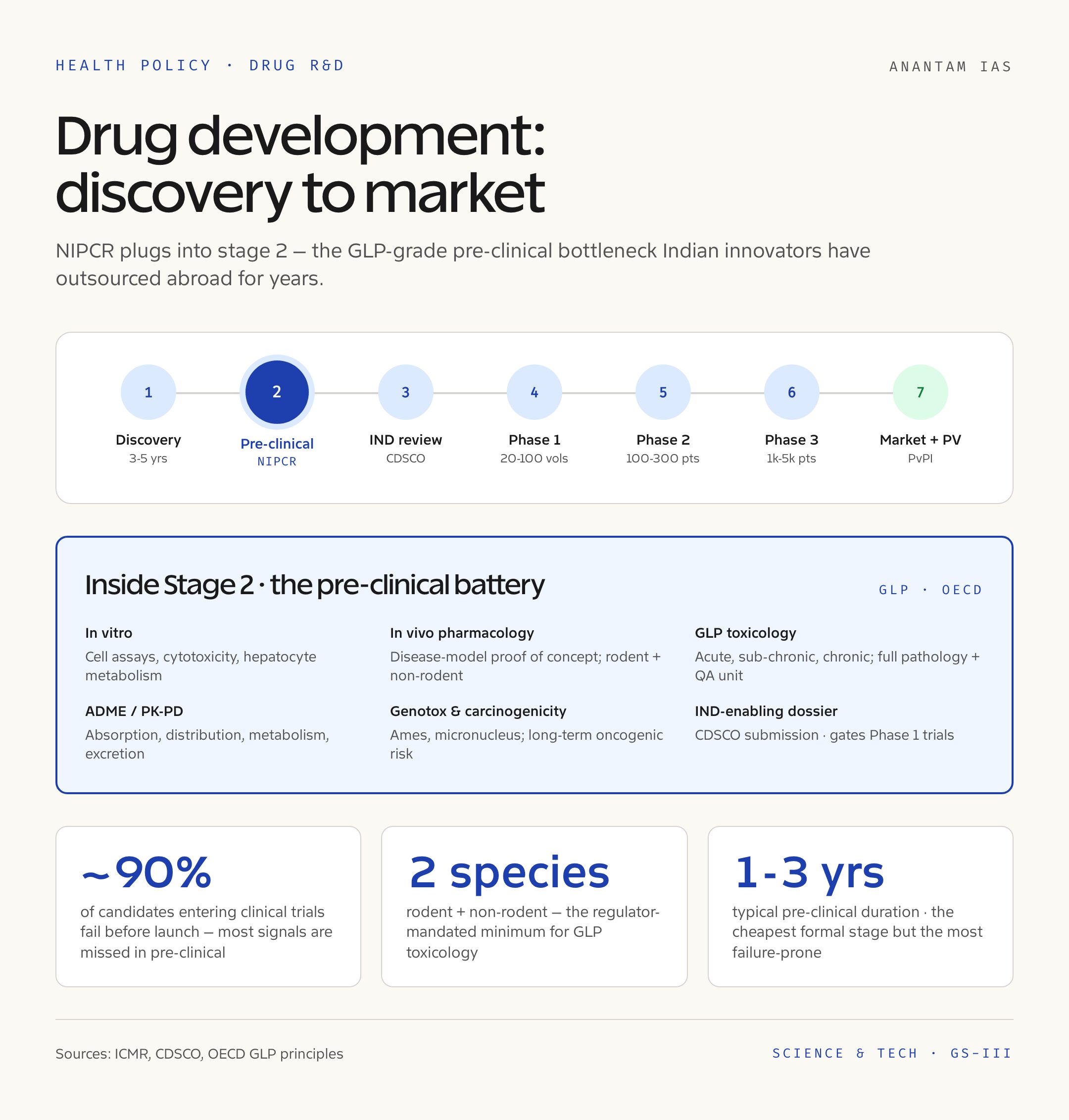
Drug development is often summarized as discovery, pre-clinical, clinical, regulatory, and post-market. Pre-clinical sits between two worlds, after a candidate has shown lab promise and before any human gets a dose.
Step 1: Lead identification and optimization. Out of thousands of compounds screened, a handful become “leads,” molecules that hit the target with reasonable potency and selectivity. Lead optimization tweaks structure to improve drug-like properties.
Step 2: In vitro testing. Cell-based assays for efficacy, cytotoxicity, off-target effects, and metabolic profiling using human liver microsomes and hepatocytes.
Step 3: In vivo pharmacology. Animal models for proof of concept. Disease-relevant models, like mice with induced diabetes, primates with simulated immune responses, are used to confirm efficacy.
Step 4: GLP toxicology. This is the regulator-facing core of pre-clinical work. Two species typically (rodent and non-rodent), multiple dose levels, full pathology, blood and urine analysis, and detailed reporting. Genotoxicity (Ames test, micronucleus assay) and chronic toxicity studies follow.
Step 5: ADME and PK/PD. Absorption, distribution, metabolism, excretion. Pharmacokinetic and pharmacodynamic modeling to predict human dosing.
Step 6: Special studies. Reproductive toxicity, juvenile toxicity for pediatric drugs, abuse liability for CNS drugs, immunogenicity for biologics.
Step 7: IND-enabling package. All data is compiled into a regulatory-grade dossier submitted to CDSCO (in India) or FDA, EMA, etc. Approval here permits Phase 1 human trials.
NIPCR is being designed to handle every step from in vitro screening through IND-enabling toxicology, all under one quality umbrella.
Why It Matters: Five Reasons NIPCR Is Strategic
One, it shortens timelines. Fragmented pre-clinical work across labs adds months to years. A consolidated facility with parallel-tracking capability can compress that.
Two, it reduces foreign dependence. Sending dossiers abroad for GLP studies costs hard currency, exposes IP, and creates strategic vulnerability during pandemics or geopolitical crises.
Three, it supports startup and academic translation. Most Indian biotech startups can’t build their own GLP facilities. NIPCR can serve as the public infrastructure they need to move from publication to product.
Four, it strengthens regulatory credibility. When CDSCO trusts the data coming from a domestic institute, the IND review is faster and cleaner. Eventually, FDA and EMA recognition of Indian GLP facilities matters too.
Five, it builds workforce capacity. Toxicologists, pharmacologists, lab animal veterinarians, and quality assurance specialists are scarce skill categories in India. A flagship institute trains hundreds of them and seeds the broader ecosystem.
Detailed Analysis
Where NIPCR Fits in the ICMR Ecosystem
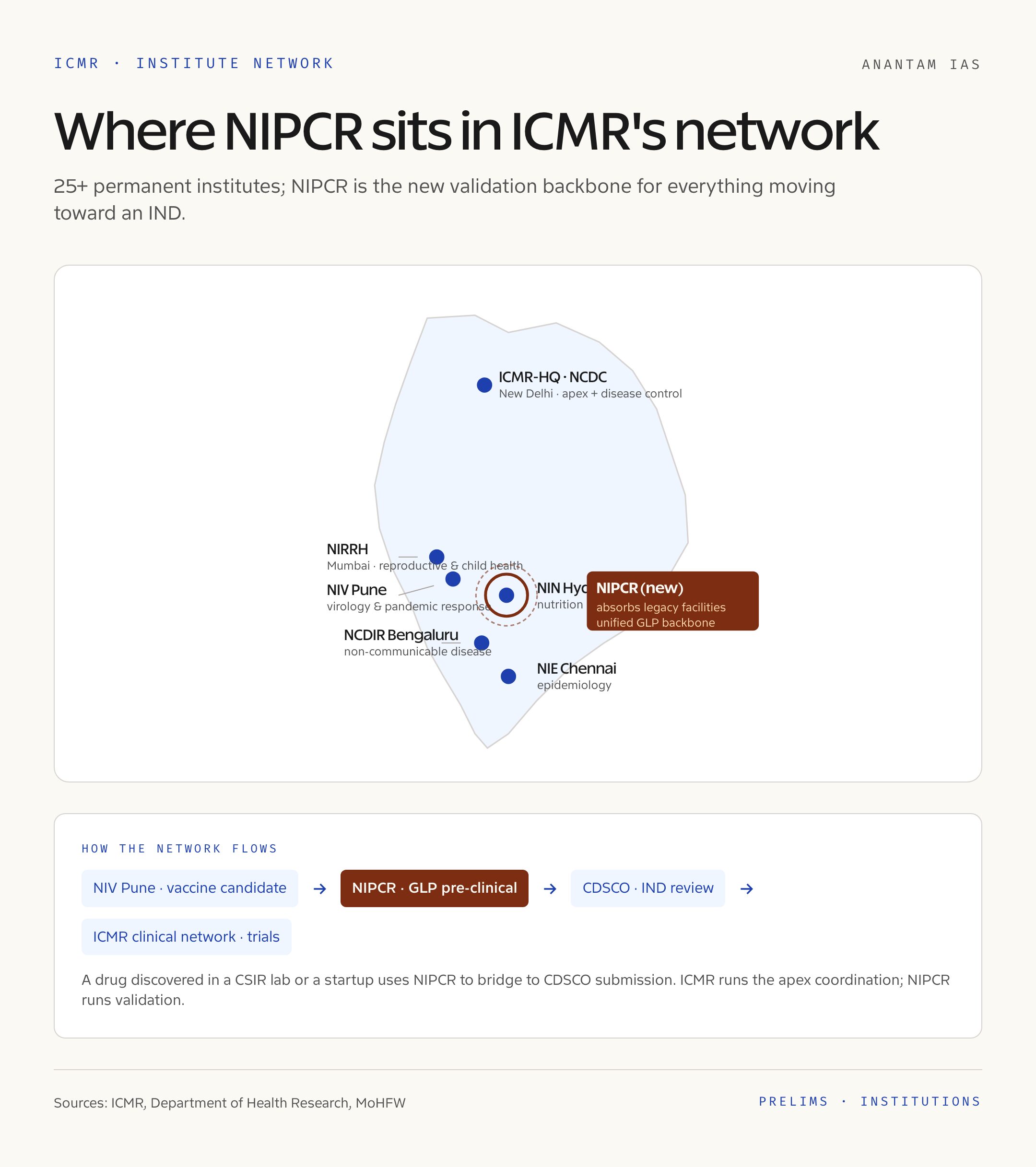
ICMR runs a thematic network. NIV Pune handles virology and pandemic response, NIE Chennai handles epidemiology, NIN Hyderabad handles nutrition, NIRRH Mumbai handles reproductive and child health, NCDIR Bengaluru handles non-communicable disease research, and so on. NIPCR plugs into this network as the validation backbone. A vaccine candidate developed at NIV can move through NIPCR for pre-clinical, then back into the clinical network. A drug discovered in a CSIR lab or a startup can use NIPCR to bridge to CDSCO submission.
GLP and Regulatory Architecture
Good Laboratory Practice is a quality system that governs how non-clinical safety studies are planned, conducted, recorded, archived, and reported. It’s enforced in India by the National GLP Compliance Monitoring Authority under the Department of Science and Technology. Globally, OECD GLP principles are the reference standard, and OECD member acceptance of test data (MAD) means a study run in an OECD-compliant facility can be accepted across multiple countries.
NIPCR’s value depends on it achieving and maintaining OECD GLP certification, with mutual recognition. That’s not automatic. It takes audits, infrastructure, and consistent quality processes over years.
Comparison With Global Pre-Clinical Hubs
Globally, pre-clinical capacity is a mix of public institutes and large commercial CROs. The US has the National Toxicology Program at NIEHS, plus commercial giants like Charles River, Labcorp Drug Development, and Inotiv. The UK has NIBSC (National Institute for Biological Standards and Control). China built up its CRO ecosystem aggressively, with WuXi AppTec dominating globally. India’s commercial pre-clinical CROs (Syngene, Aragen, Sai Life Sciences) are competitive but private. NIPCR adds a public anchor that India hasn’t had at scale.
For background on India’s broader R&D infrastructure push, our coverage of graphene research illustrates how dedicated material-specific labs accelerate translation.
Comparative Perspective
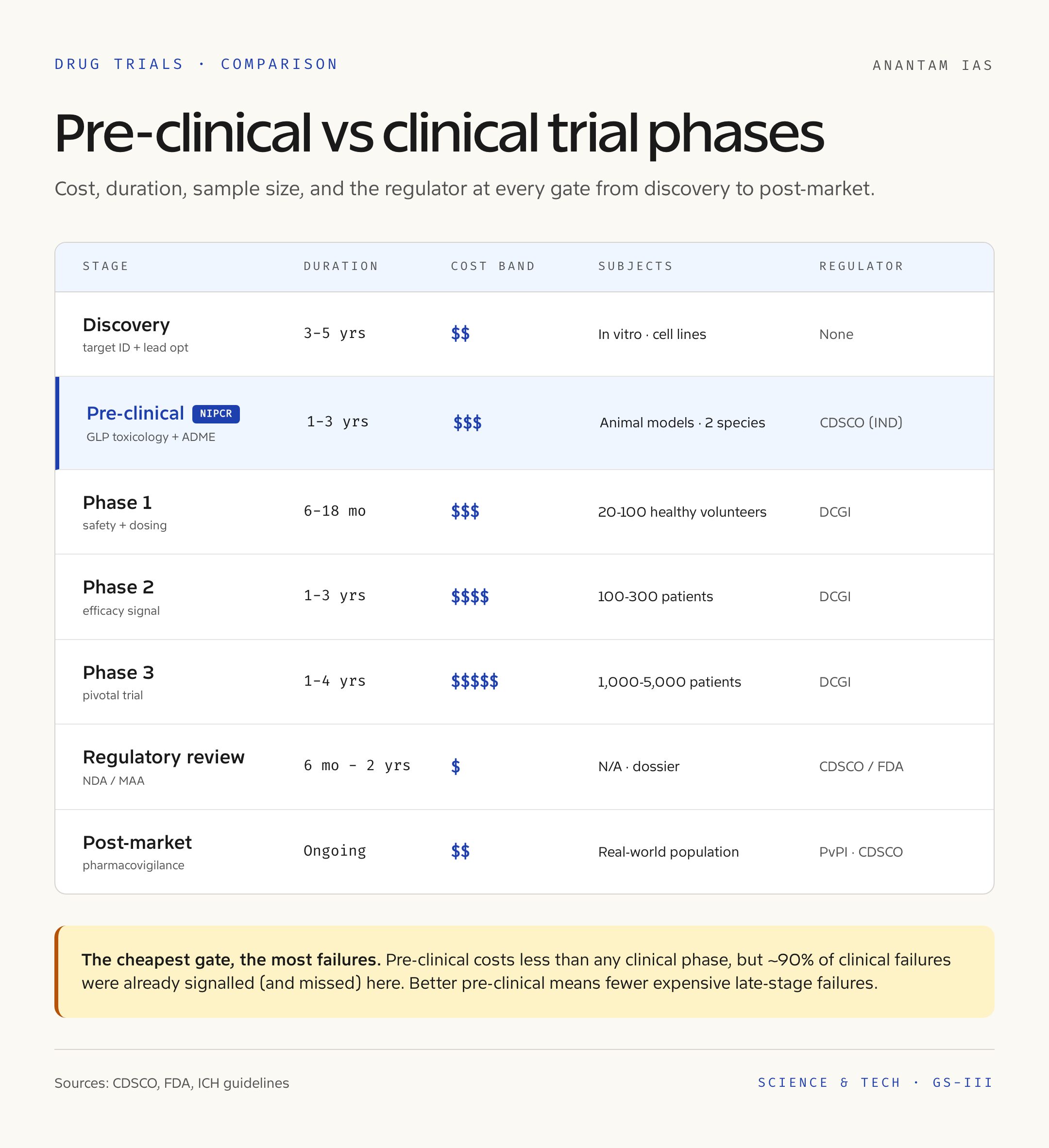
| Stage | Duration | Cost (rough) | Subjects | Regulator |
|---|---|---|---|---|
| Discovery | 3-5 years | $$ | None (in vitro) | None |
| Pre-clinical | 1-3 years | $$$ | Animal models | CDSCO (IND review) |
| Phase 1 trial | 6-18 months | $$$ | 20-100 healthy volunteers | DCGI |
| Phase 2 trial | 1-3 years | $$$$ | 100-300 patients | DCGI |
| Phase 3 trial | 1-4 years | $$$$$ | 1,000-5,000 patients | DCGI |
| Regulatory review | 0.5-2 years | $ | N/A | CDSCO/FDA |
| Post-market | Ongoing | $$ | Real-world | PvPI, CDSCO |
Pre-clinical is the cheapest formal stage but also the most failure-prone. Roughly 90% of candidates that enter clinical trials fail before launch, and most of those failures are signaled, but missed, in pre-clinical data. Better pre-clinical means fewer expensive late-stage failures.
Challenges and Critiques
NIPCR is a good idea, and that doesn’t make it automatically successful.
Animal facility capacity. GLP toxicology runs on barrier-grade animal facilities. India has a chronic shortage of trained lab animal technicians and veterinarians. Without that workforce, infrastructure alone doesn’t deliver studies.
Ethics and 3Rs. Reduce, refine, replace. Modern pre-clinical science is moving toward organoids, organ-on-chip, in silico models, and humanized cell systems. NIPCR needs to integrate these from day one, not bolt them on later.
Bureaucratic governance. ICMR institutes vary widely in operational efficiency. NIPCR will need autonomous, mission-mode governance to compete with private CROs on turnaround time.
IP and confidentiality. Pre-clinical data is sensitive. Companies will only use NIPCR if confidentiality is bulletproof. That’s a process and culture problem as much as a legal one.
Funding sustainability. GLP facilities are expensive to maintain. A one-time capital grant doesn’t run a facility for 30 years. NIPCR needs a hybrid model with public mandate and competitive service revenue.
Regulatory upgrading. CDSCO itself needs continuous capacity building. A great pre-clinical institute is wasted if the regulator can’t review submissions efficiently.
UPSC Prelims Pointers
- ICMR (Indian Council of Medical Research) is headquartered in New Delhi and is the apex body for biomedical research in India
- ICMR functions under the Department of Health Research, Ministry of Health and Family Welfare
- Good Laboratory Practice (GLP) is a quality system for non-clinical safety studies, with OECD principles as the global reference
- The National GLP Compliance Monitoring Authority is under the Department of Science and Technology
- CDSCO (Central Drugs Standard Control Organisation) is India’s national regulatory authority for drugs and medical devices
- The Drugs Controller General of India (DCGI) heads CDSCO
- Major ICMR institutes include NIV Pune (virology), NIE Chennai (epidemiology), NIN Hyderabad (nutrition), NIRRH Mumbai (reproductive health)
- Pre-clinical research typically uses two species (rodent and non-rodent) for toxicology
- The 3Rs in animal research are Replace, Reduce, Refine
Mains Practice Questions
- GS Paper III: Discuss the strategic significance of the National Institute for Pre-Clinical Research (NIPCR) for India’s pharmaceutical and biotechnology ecosystem. How does it fit into the Atmanirbhar Bharat vision in healthcare? (250 words)
- GS Paper III: “India is the pharmacy of the world but lags in original drug discovery.” Examine the structural reasons for this gap and the role of institutions like NIPCR in bridging it. (250 words)
- GS Paper II: Evaluate the regulatory architecture for drug approval in India. What reforms can strengthen CDSCO’s capacity to handle innovative therapies? (150 words)
- GS Paper III: Discuss the ethical considerations in pre-clinical animal research. How can India balance the needs of biomedical innovation with the principles of the 3Rs? (250 words)
Way Forward
NIPCR’s success will turn on a few things that are within India’s ability to control. Mission-mode governance with a competent CEO-equivalent and operational autonomy. Early OECD GLP certification with mutual recognition pathway. Integration of new approach methodologies (NAMs) like organoids and in silico models from inception, not as afterthoughts. A transparent fee schedule that startups and academics can actually afford. Tight coordination with CDSCO so that NIPCR data flows smoothly into the IND review system. And aggressive workforce development, including dedicated training programs for toxicologists, pathologists, and lab animal scientists.
If those pieces come together, NIPCR could become to pre-clinical what NIV Pune has been to virology, an anchor institution that quietly underwrites a much larger industry. If they don’t, it becomes another building with a name plate. The institutional quality of the next five years will decide which it is.
Frequently Asked Questions
What is NIPCR ICMR?
The National Institute for Pre-Clinical Research is a flagship facility under the Indian Council of Medical Research dedicated to validating drugs, vaccines, biologics, and medical devices before they enter human trials.
Why is pre-clinical research important?
Pre-clinical studies establish safety, dosing, and efficacy in laboratory and animal models before any human is exposed. This stage is required by every drug regulator before clinical trials can begin.
How does NIPCR support Indian pharma and biotech?
By providing GLP-compliant, regulator-trusted pre-clinical capacity domestically, NIPCR reduces the need to outsource studies abroad, shortens timelines, and lowers costs for Indian innovators.
What is GLP and why does it matter?
Good Laboratory Practice is a quality system for non-clinical safety studies, governing planning, conduct, recording, and reporting. GLP-compliant data is required by drug regulators worldwide.
How is NIPCR different from existing ICMR institutes?
Other ICMR institutes focus on disease areas like virology or nutrition. NIPCR is dedicated specifically to pre-clinical validation across therapeutic areas and product types.
Who regulates drugs and clinical trials in India?
The Central Drugs Standard Control Organisation (CDSCO), headed by the Drugs Controller General of India, is the national regulator. State drug control authorities handle manufacturing licenses and quality oversight.
What are the 3Rs in pre-clinical research?
The 3Rs are Replace (alternatives to animal testing), Reduce (use fewer animals), and Refine (minimize suffering). They guide ethical animal research globally.
How does NIPCR fit India’s healthcare self-reliance goal?
NIPCR strengthens the domestic R&D pipeline, reduces foreign dependence for critical validation, and aligns with Atmanirbhar Bharat priorities in pharmaceuticals, vaccines, and medical devices.