The National Biotechnology Development Strategy (NBDS) is the umbrella policy framework that guides India's biotechnology sector — from drug discovery and vaccines to GM crops, industrial enzymes, biofuels, and the rapidly emerging fields of synthetic biology and bioeconomy. The current strategy, NBDS 2021-25, set the goal of making India a USD 150 billion bio-economy by 2025, positioning the country as a global hub for biotech research, innovation and industrial growth. It is implemented by the Department of Biotechnology (DBT) under the Ministry of Science and Technology, with the autonomous Biotechnology Industry Research Assistance Council (BIRAC) as its industry-facing arm.
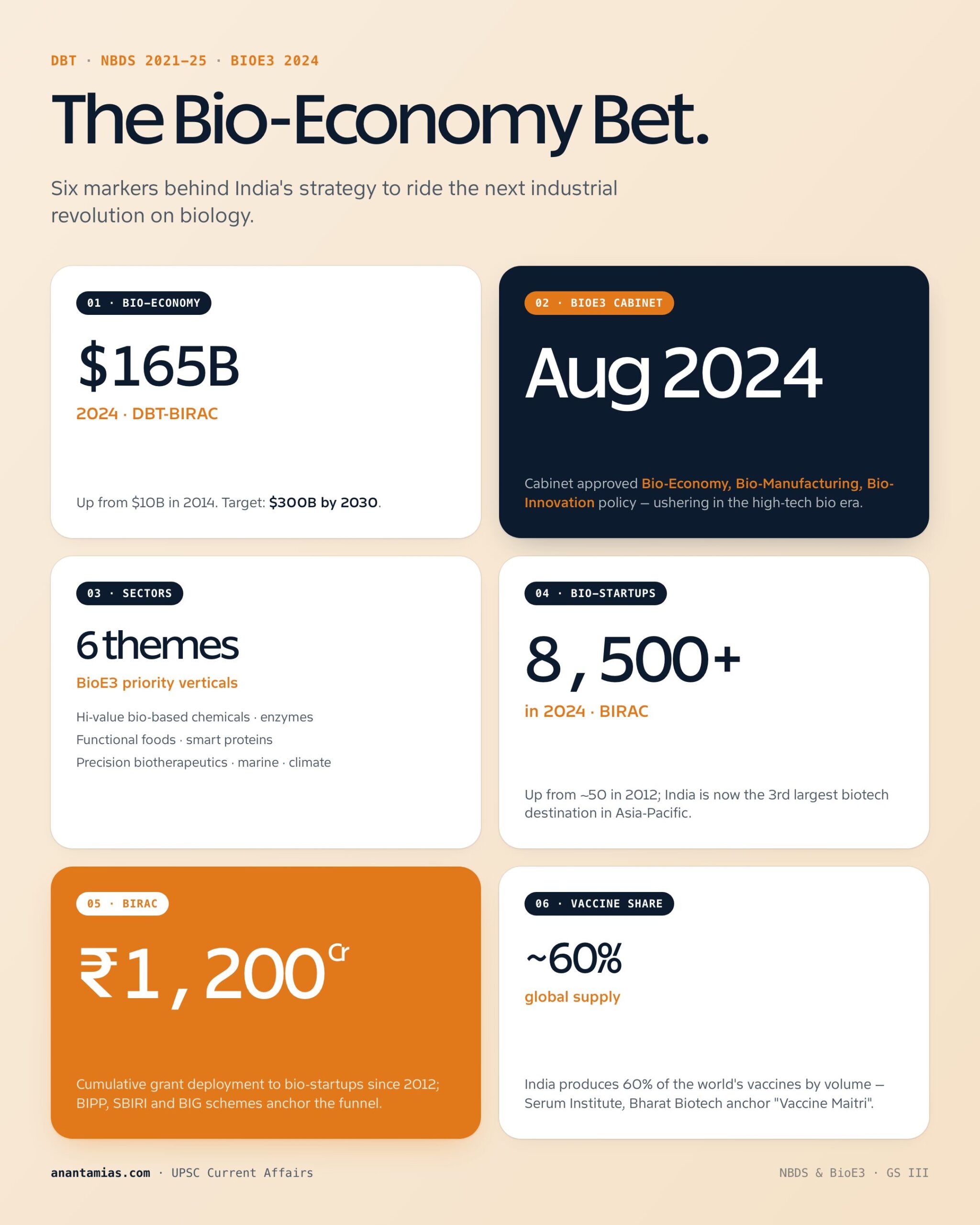
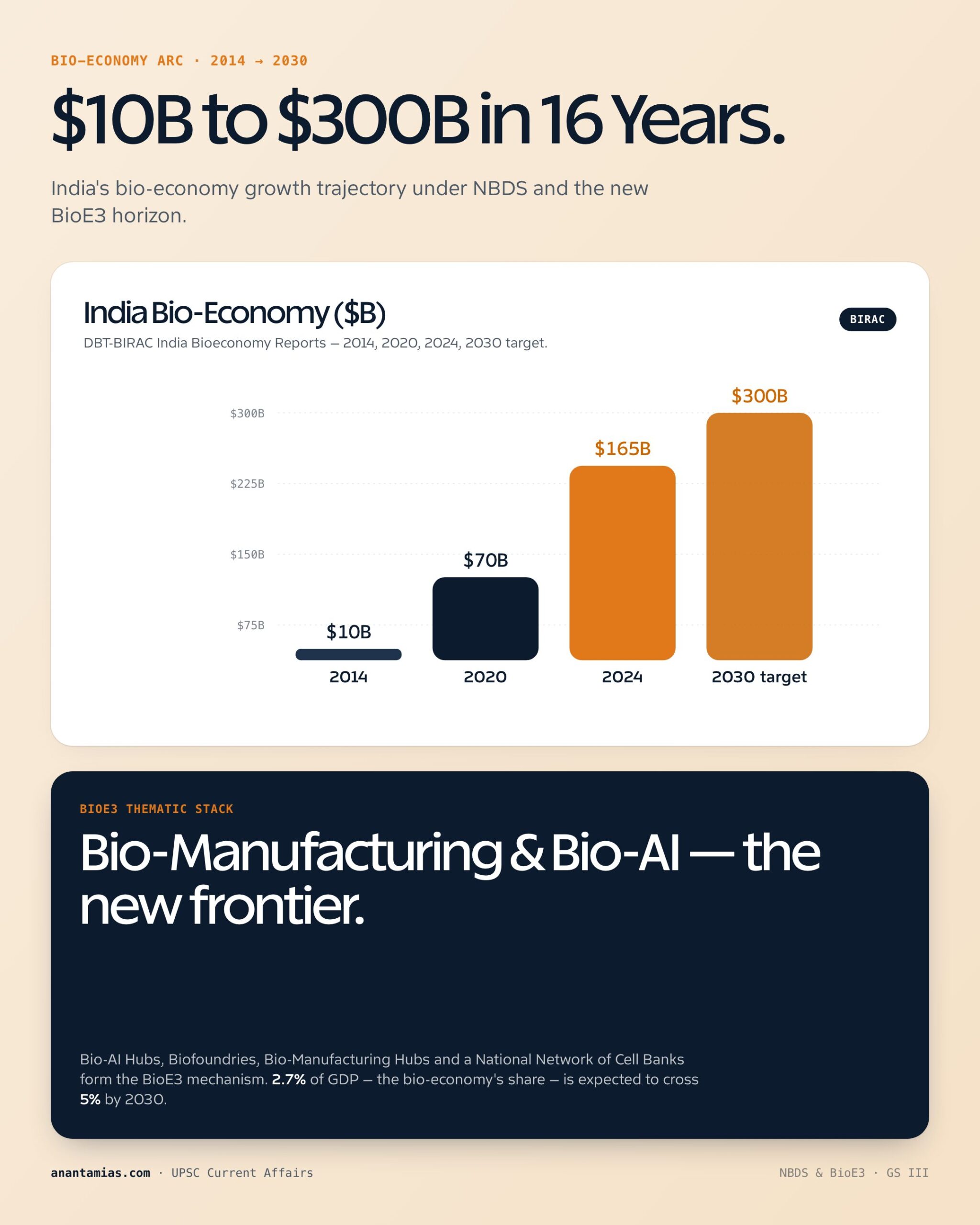
In August 2024, the Cabinet approved the next-generation framework — the BioE3 Policy (Biotechnology for Economy, Environment and Employment) — operationalising the NBDS vision and pushing India's biotech ambitions into a USD 300 billion bio-economy by 2030.
For UPSC, this is a flagship GS III — Science & Technology, Economy and Environment topic, with strong overflow into GS II — Health and Governance.
What is biotechnology — the underlying science
The Convention on Biological Diversity (CBD) defines biotechnology as "any technological application that uses biological systems, living organisms, or derivatives thereof, to make or modify products or processes for specific use." In practice, it spans:
- Red biotechnology — health and pharmaceuticals (vaccines, biologics, gene therapy, diagnostics).
- Green biotechnology — agriculture (GM crops, tissue culture, biofertilisers, biopesticides).
- White biotechnology — industrial (enzymes, bio-plastics, fermentation-based chemicals, biofuels).
- Blue biotechnology — marine and aquatic (algal biofuels, marine pharmaceuticals).
- Yellow biotechnology — food (functional foods, probiotics, brewing).
- Grey biotechnology — environmental (bioremediation, biosensors).
Modern biotech rests on three breakthroughs: recombinant DNA technology (Boyer–Cohen, 1973), PCR amplification (Mullis, 1983) and most recently CRISPR-Cas9 gene editing (Charpentier–Doudna, Nobel 2020).
NBDS 2021-25 — vision and focus areas
Vision
A USD 150 billion bio-economy by 2025; India among the top 5 global bio-manufacturing hubs; biotechnology mainstreamed across health, agriculture, environment, energy and industry.
Key strategies
- Building capacities — invest in human capital and state-of-the-art infrastructure across academia, government labs and start-ups.
- UNaTI Biotech Missions — large national missions aligned with priorities (vaccines, agri-biotech, marine biotech, cancer genomics, antimicrobial resistance).
- Atmanirbhar Bharat — promote self-reliance in affordable, accessible biotech products.
- Strategic partnerships — bilateral and multilateral collaboration for tech transfer.
- Future preparedness — strong knowledge base for emerging challenges (pandemics, climate change).
- Taking science to society — empower the rural sector through biotech (seeds, biofertilisers, livestock health).
- Global benchmarking — measure India's biotech performance against world leaders.
Focus areas
| Pillar | Examples |
|---|---|
| Healthcare | Vaccines, diagnostics, biosimilars, gene/cell therapy |
| Agriculture | Hybrid seeds, GM crops, biofertilisers, biopesticides, tissue culture |
| Environment | Bioremediation, biofuels, waste-to-energy, carbon capture |
| Industrial biotechnology | Enzymes, bio-based chemicals, bioplastics, fermentation |
| Marine and aquatic biotech | Algal biofuels, marine drugs, seaweed value chain |
| Bio-energy | Ethanol blending, advanced biofuels, biogas (SATAT) |
India's biotech ecosystem — strengths
India is already a serious biotech player. Some headline numbers:
- Bio-economy size crossed USD 137 billion in 2023 and is on track to USD 150 billion by 2025 (DBT, India BioEconomy Report 2024).
- Over 9,500 biotech start-ups, up from ~50 in 2014, supported in part by BIRAC's BIG, SBIRI, SPARSH and other schemes.
- 3rd-largest biotech destination in Asia-Pacific by number of companies.
- World's largest vaccine producer — about 60% of global vaccine doses by volume; Serum Institute, Bharat Biotech, Biological E.
- Major biosimilars exporter — Biocon, Dr Reddy's, Reliance Life Sciences.
- Rich biodiversity — 4 of the 36 global biodiversity hotspots; vast genetic reservoirs for drug discovery.
- Cost-effective clinical trials and manufacturing — strong pharma backbone.
- Genomics capacity — IndiGen and Genome India projects sequencing tens of thousands of Indian genomes.
- Skilled workforce — large pool of biotech and bioinformatics graduates from 200+ universities.
Governance and institutional architecture
| Body | Role |
|---|---|
| Department of Biotechnology (DBT) | Nodal agency for NBDS implementation |
| BIRAC | Funds biotech start-ups and industry R&D |
| Genetic Engineering Appraisal Committee (GEAC) | Approves GM crops, GM organisms |
| Review Committee on Genetic Manipulation (RCGM) | Permits research with GMOs |
| CDSCO | Regulates biologics, vaccines, gene therapy products |
| National Biodiversity Authority (NBA) | Implements Biological Diversity Act |
| DBT-Autonomous Institutes | NIBMG, RGCB, ILS, NCCS, ICGEB, NIPGR, etc. |
Major missions under NBDS
- National Biopharma Mission (Innovate in India, i3) — World Bank-supported; vaccines, biosimilars, medical devices.
- National Mission on Quantum Technologies and Applications — biotech intersections (single-molecule sensing, computational biology).
- Mission COVID Suraksha — accelerated indigenous COVID-19 vaccines (COVAXIN, ZyCoV-D, Corbevax, iNCOVACC).
- Mission Anti-Microbial Resistance — One Health surveillance.
- Mission Aroma and Phytopharmaceutical Mission — value addition to medicinal plants.
- Genome India Project — sequencing 10,000 Indian genomes (Phase 1 completed 2024).
- One Health Mission (2023) — integrated human-animal-environment surveillance.
BioE3 Policy 2024 — the next chapter
Approved by the Union Cabinet on 24 August 2024, the BioE3 Policy (Biotechnology for Economy, Environment, Employment) operationalises the NBDS vision with sharp focus on bio-manufacturing.
BioE3 thematic sectors
| Sector | Examples |
|---|---|
| High-value bio-based chemicals, biopolymers and enzymes | Bio-plastics, specialty enzymes |
| Smart proteins and functional foods | Plant-based meat, precision fermentation |
| Precision biotherapeutics | Cell and gene therapies, mRNA |
| Climate-resilient agriculture | Drought-tolerant crops, microbial inoculants |
| Carbon capture and utilisation | Algae bioreactors, microbial CO2 fixation |
| Marine and space biotechnology | Astrobiology, marine drug discovery |
BioE3 mechanisms
- Bio-AI hubs and bio-foundries for synthetic biology design-build-test-learn.
- National Bio-Manufacturing Mission with biomanufacturing parks and shared infrastructure.
- Skill development in synthetic biology, genome engineering, bioinformatics.
- Regulatory streamlining for next-generation products.
- Goal — USD 300 billion bio-economy by 2030; 35 lakh new jobs.
Challenges
| Challenge | Detail |
|---|---|
| Regulatory complexity | Multiple agencies (DBT, GEAC, CDSCO, MoEFCC) cause delays |
| GM crop hesitancy | Bt brinjal moratorium (2010); GM mustard caught in litigation |
| Translation gap | Strong publication output but weak lab-to-product pipeline |
| IP landscape | Indian filings still small share of global biotech patents |
| Public funding intensity | India spends ~0.65% of GDP on R&D vs 2-3% in advanced economies |
| Biosafety and ethics | Gene editing, gain-of-function, dual-use concerns |
| Skill mismatch | Industry needs hands-on lab skills, not just degrees |
| Bio-piracy | Genetic resources misappropriated abroad (turmeric, neem, basmati cases) |
Recent developments (2024-26)
- BioE3 Policy approved August 2024 — anchor framework for bio-manufacturing.
- National Bio-Manufacturing Mission launched in 2024 with bio-foundries planned at multiple locations.
- iNCOVACC nasal vaccine rolled out commercially under Bharat Biotech.
- CRISPR-Cas9 sickle cell therapy GeneMission announced by DBT in 2024 to develop indigenous gene therapy.
- Genome India Phase 1 completed sequencing 10,000 healthy Indians (results released January 2024).
- Anusandhan National Research Foundation (ANRF) operational from 2024 with Rs 50,000 crore corpus, partly funding biotech.
- PRIP Scheme (Promotion of Research and Innovation in Pharma MedTech) — Rs 5,000 crore outlay; biologics and gene therapy among focus areas.
- One Health Mission 2024 — ICMR, ICAR, DBT, MoHFW joint AMR and zoonotic surveillance.
- GM mustard cleared by GEAC; matter pending in Supreme Court.
- HtBt cotton (Bt cotton with herbicide-tolerance) debate intensified with farmers planting unauthorised seeds.
- Cell and Gene Therapy Centre of Excellence at IIT Bombay-Tata Memorial.
- India-EU Trade and Technology Council identified biomanufacturing as priority.
- WHO Pandemic Treaty negotiations — India's seat as a major vaccine producer.
Way forward
- Operationalise BioE3 — establish bio-foundries and biomanufacturing parks within FY 2025-27.
- Single-window biotech regulator — merge GEAC, RCGM and CDSCO biologics functions; predictable timelines.
- GM policy clarity — science-based, transparent, public-trust-building approval pathway.
- R&D intensity — raise public R&D spending towards 1% of GDP; expand ANRF biotech grants.
- Industry-academia bridges — translational research centres co-located with bio-foundries.
- Bio-piracy protection — strengthen Traditional Knowledge Digital Library (TKDL); operationalise the Nagoya Protocol commitments.
- Skill ecosystem — wet-lab + dry-lab training for synthetic biology and bioinformatics.
- One Health institutionalisation — integrate AMR and zoonotic surveillance with state health systems.
- Climate-aligned biotech — algae, microbial protein, carbon capture as flagship missions.
- Equity — affordable biologics, gene therapies under Ayushman Bharat package.
Mains hook
"From a vaccine factory to a bio-manufacturing power, India's biotechnology trajectory will be defined less by policy intent and more by translational capacity." Examine in the context of NBDS 2021-25 and the BioE3 Policy 2024. (GS III, 250 words, 15 marks)
Prelims pointers
- NBDS 2021-25 — vision of USD 150 billion bio-economy by 2025; nodal: DBT.
- BioE3 Policy — Biotechnology for Economy, Environment, Employment; approved August 2024.
- BIRAC — autonomous body under DBT; finances biotech start-ups.
- GEAC — clears GM crops; under MoEFCC.
- Major DBT institutes — NIBMG, RGCB, ILS, NCCS, NIPGR, ICGEB.
- Bharat Biotech — COVAXIN, iNCOVACC; Serum Institute — Covishield, Cervavac.
- Genome India Project — 10,000 Indian genomes sequenced; Phase 1 results 2024.
- CRISPR-Cas9 — Nobel 2020 to Emmanuelle Charpentier and Jennifer Doudna.
- One Health Mission (2023) — ICMR, ICAR, DBT, MoHFW collaboration.
- National Biopharma Mission — World Bank-supported programme for vaccines and biosimilars.
How NBDS links to other national missions
A common UPSC pitfall is treating NBDS as an island. It is not. India's biotech ambitions intersect with at least eight other flagship policies and missions:
| Linked initiative | Intersection |
|---|---|
| National Health Policy 2017 | Vaccine self-reliance, biosimilars under Ayushman Bharat |
| National Education Policy 2020 | Multidisciplinary biotech curricula in HEIs |
| National Mission on Quantum Technologies | Quantum-biology, single-molecule diagnostics |
| National Critical Minerals Mission 2024 | Inputs for bio-manufacturing infrastructure |
| PRIP Scheme | Pharma-MedTech innovation overlapping biologics |
| One Health Mission 2023 | Zoonotic and AMR research |
| National Mission on Sustainable Agriculture | GM and gene-edited climate-resilient varieties |
| Bharat Net + Digital Health Stack | Genomic and clinical data infrastructure |
| Anusandhan National Research Foundation (ANRF) | Funds biotech basic and translational research |
Reading NBDS through these linkages turns it from policy document into systems map.
For UPSC, the National Biotechnology Development Strategy is a textbook example of how a 21st-century state harnesses the life sciences as a pillar of growth. Aspirants who can connect NBDS to BioE3, climate goals, vaccine diplomacy and pandemic preparedness — and to the larger ecosystem of India's science and innovation policies — will treat biotech as the systems policy that it actually is, not as a list of acronyms.
Tell Google you want more of this.
Add Anantam IAS as a preferred sourceOne tap, and this site shows up more often in your own Top Stories, AI Overviews and AI Mode. Remove it any time.