Operation Southern Readiness: Training for Non-Traditional Maritime Threats
Why in News?
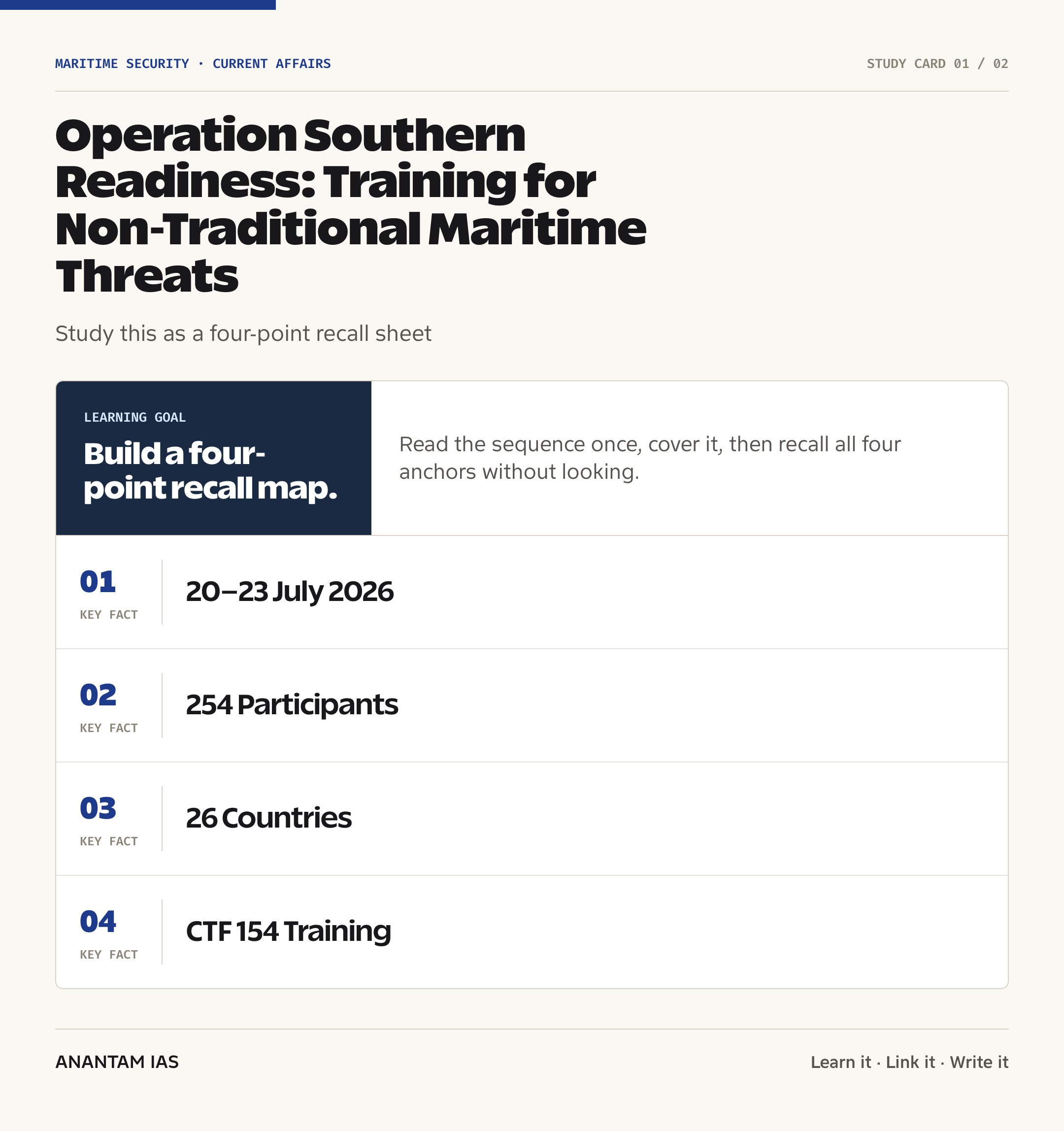
Operation Southern Readiness 26-2, a four-day multinational maritime security training engagement, began at the Southern Naval Command, Kochi, on 20 July 2026. The event runs until 23 July under the aegis of the Indian Navy-led Combined Task Force 154, in partnership with the Combined Maritime Forces.
The Hindu reported that the opening brought together 254 participants from 26 countries, supported by 74 facilitators, representatives of four international organisations and subject experts. This is the first edition of Operation Southern Readiness held in India, with training centred on practical responses to non-traditional maritime threats.
- The Indian Navy is hosting the engagement at its principal training command in Kochi.
- The schedule combines classroom instruction, simulator training and practical exposure from 20 to 23 July 2026.
- The opening-day programme included a UN Office on Drugs and Crime session on threats in the Red Sea and western Indian Ocean.
- Planned modules cover maritime law, domain awareness, counter-narcotics, force protection and asymmetric threats.
- Participants also train in boarding, damage control, firefighting, survival at sea and maritime communications.
- The engagement builds common procedures and professional familiarity; it doesn’t create a treaty-based defence obligation.
The development matters in the context of:
- Shipping routes carry legal commerce and can also be exploited by pirates, traffickers and other illicit non-state actors.
- Many maritime incidents cross jurisdictions, so detection, evidence handling, rescue and prosecution require cross-border coordination.
- Training ashore lets states strengthen skills and common procedures even when they cannot contribute a warship or aircraft.
- India’s command of CTF 154 expands its capacity-building role without converting a flexible partnership into a military alliance.
UPSC Relevance
Prelims Relevance
- Operation Southern Readiness 26-2 was hosted at the Southern Naval Command in Kochi from 20 to 23 July 2026.
- CTF 154, established in May 2023, is the Combined Maritime Forces task force dedicated to maritime security training.
- The Indian Navy assumed its first command of CTF 154 in February 2026 under Commodore Milind M. Mokashi.
- CMF has five task forces: CTF 150, 151, 152, 153 and 154, with different geographic or functional roles.
- Maritime Domain Awareness means an effective understanding of activities that could affect maritime security, safety, economy or environment.
- The International Ship and Port Facility Security Code is made mandatory through Chapter XI-2 of the SOLAS Convention.
- The Global Maritime Distress and Safety System is part of SOLAS and supports alerting, communication and rescue coordination.
- CMF describes itself as a coalition of the willing; its members aren’t bound by a fixed political or military mandate.
- UNODC’s Global Maritime Crime Programme supports maritime law enforcement, legal capacity and regional cooperation.
Mains Relevance
GS Paper 3
- Non-traditional security challenges such as piracy, narcotics trafficking, irregular migration and attacks by non-state actors.
- Role of Maritime Domain Awareness, information sharing, interdiction skills and resilient communications in coastal and maritime security.
- Capacity building for lawful boarding, evidence preservation, search and rescue, damage control and disaster response.
GS Paper 2
- India’s use of flexible maritime partnerships for capacity building and regional public goods.
- Balancing practical cooperation with strategic autonomy, international law and the varied interests of partner states.
- The distinction between an operational partnership and a treaty-based military alliance.
Essay
- Security at sea depends as much on shared skills and trust as on platforms and firepower.
- The ocean is a connected space where local instability can generate transnational risks.
- Strategic autonomy can coexist with issue-based, rules-based cooperation.
Background and Context
Operation Southern Readiness and CTF 154
The engagement belongs to a training architecture designed to improve readiness without requiring every partner to deploy major naval assets.
- Operation Southern Readiness is one of the multinational training formats conducted by CTF 154, alongside activities such as Compass Rose and Maritime Security Enhancement Training.
- The Ministry of Defence confirmed that the Kochi edition is conducted by the Southern Naval Command under the Indian Navy-led CTF 154 and in partnership with CMF.
- Established in May 2023, CTF 154 concentrates on capacity building rather than maintaining a permanently assigned combat force for a single theatre.
- Its five enduring training pillars are maritime awareness, law of the sea, maritime interdiction, maritime rescue and assistance, and leadership development.
- India assumed command of the task force on 11 February 2026 at the CMF headquarters in Manama, Bahrain, for the first time.
- Ashore-based courses widen participation because personnel can join professional training even when their country cannot spare a ship, aircraft or large detachment.
- The Kochi venue gives participants access to the Indian Navy’s simulators, instructional facilities and onboard practical exposure.
What Counts as a Non-Traditional Maritime Threat?
The term covers security risks that don’t fit a conventional state-versus-state naval conflict but can still disrupt lives, trade and sovereignty.
- Piracy and armed robbery at sea threaten crews, cargo and navigation, while incidents may occur across territorial seas and the high seas under different legal rules.
- Narcotics, arms and human trafficking use maritime routes, small craft, commercial vessels and weakly monitored coastlines to move illicit goods or people.
- Irregular migration combines humanitarian duties with identification, rescue, trafficking investigation and lawful disembarkation challenges.
- Asymmetric threats may involve small boats, drones, improvised devices, sabotage or attacks on shipping and port infrastructure by non-state actors.
- Marine accidents, extreme weather and humanitarian crises demand search and rescue, damage control, firefighting and coordination across agencies.
- Cyber incidents, spoofed identity data and interference with navigation can reduce trust in the maritime information picture even without a visible attack.
- Illegal, unreported and unregulated fishing can overlap with broader maritime crime, but enforcement must respect jurisdiction, flag-state rights and applicable treaties.
Training Design: From Information to Action
The programme connects legal knowledge and shared information with the physical skills needed to manage an incident safely.
- Maritime Domain Awareness brings together vessel identity, position, behaviour, cargo, weather and intelligence so authorities can detect anomalies and prioritise responses.
- Information sharing is useful only when partners apply common terminology, protect sensitive data and establish trusted points of contact before an emergency.
- Boarding procedures require safe approach, authority to board, crew control, search discipline, documentation and proportionate use of force.
- Counter-narcotics training must link interception with chain of custody, evidence preservation and prosecution; a seizure without legally usable evidence is an incomplete outcome.
- Damage-control and firefighting simulators allow repeated practice under pressure without exposing trainees or an operational ship to avoidable risk.
- Maritime communications training complements the distress, urgency and safety communication framework used to coordinate assistance at sea.
- Training on uncrewed systems and asymmetric threats helps personnel examine both their operational value and vulnerability in crowded maritime environments.
Legal and Institutional Framework
Interoperability isn’t permission to act anywhere; maritime cooperation remains bounded by jurisdiction, consent and international law.
- The UN Convention on the Law of the Sea allocates rights and duties across internal waters, territorial seas, exclusive economic zones and the high seas.
- On the high seas, flag-state jurisdiction is the general rule, while limited exceptions and treaty-based powers apply to specific conduct such as piracy.
- The SUA Convention creates a framework for suppressing unlawful acts against the safety of maritime navigation and for cooperation over covered offences.
- SOLAS Chapter XI-2 and the ISPS Code establish preventive security requirements for covered ships and port facilities engaged in international trade.
- The SOLAS radiocommunications framework incorporates GMDSS, while the 1979 SAR Convention promotes coordinated rescue regardless of where distress occurs.
- The developing governance of areas beyond national jurisdiction can be revised through the UNCLOS and BBNJ framework, but it isn’t a general law-enforcement mandate.
- UNODC helps states connect operational training with domestic criminal law, prosecution and judicial cooperation, reducing the gap between interdiction and conviction.
Why the Kochi Edition Matters for India
Hosting the first Indian edition turns India’s command role into a practical contribution to regional maritime capacity.
- The Southern Naval Command is the Indian Navy’s training command, making Kochi a logical site for simulator-led instruction and professional exchanges.
- Leading CTF 154 allows India to shape a training agenda around lawful, interoperable and request-based capacity building rather than only platform deployment.
- Participants can learn from India’s experience in navigation, communications, ship handling, damage control and operating across the Indian Ocean Region.
- The event supports India’s role as a provider of regional public goods, including training, humanitarian assistance, search and rescue and secure sea lanes.
- Professional networks built during courses can shorten coordination time during a later incident, especially where several navies, coast guards and civilian agencies are involved.
- The focus overlaps with other regional efforts against maritime crime, including BIMSTEC security cooperation, but the institutions have distinct memberships and mandates.
- For India, the durable gain lies in standard-setting influence, trust and usable procedures, not in treating one training event as proof of strategic alignment.
Interoperability Without Alliance Overreach
The exercise should be read as functional cooperation against shared risks, not as a new collective-defence commitment. Training capacity can improve without prior agreement on every specific regional political or strategic dispute.
- CMF describes itself as a coalition of the willing whose national contributions vary with capability, availability and sovereign choice.
- Its members aren’t bound by a fixed political or military mandate; participation may range from liaison staff to ships, aircraft or associated support.
- Interoperability here means the ability to communicate, understand procedures and work safely together when states separately choose to cooperate.
- It doesn’t automatically imply common threat perceptions, a mutual-defence clause, permanent basing rights or consent for operations in another state’s waters.
- The presence of 26 participating countries at Kochi also shouldn’t be confused with the total membership of CMF or with a list of states making identical commitments.
- Training against non-state threats can remain politically inclusive because piracy, trafficking, distress and disaster response create shared operational problems.
- India can preserve strategic autonomy by favouring transparent mandates, international law, case-specific consent and capacity building over bloc politics.
Operational Gaps to Watch
A training event creates readiness only when lessons survive beyond the classroom and remain lawful under real operational pressure.
- Partners may use different languages, equipment, rules of engagement and legal thresholds, so a shared drill doesn’t erase institutional differences.
- Information sharing faces concerns about classification, data protection, source exposure and the unequal ability to maintain surveillance systems.
- Smaller states may need sustained maintenance, refresher courses and instructor development rather than a one-time transfer of advanced procedures.
- Boarding and interdiction can fail in court if personnel don’t preserve evidence, document authority or coordinate early with prosecutors and flag states.
- Uncrewed systems and digital tools introduce dependence on resilient communications, cyber protection and procedures for misidentification or spoofing.
- Success should be assessed through improved response time, safer boarding, valid prosecutions and stronger rescue coordination, not only participant counts.
- Regular after-action reviews can turn diverse national experience into updated curricula while respecting sovereign operational limits.
Way Forward
Build a Repeatable Training Cycle
- Convert lessons from Kochi into standard operating procedure modules, refresher courses and train-the-trainer packages for partner institutions.
- Use scenario-based exercises that connect detection, decision, boarding, rescue, evidence handling and post-incident review in one chain.
Join Operations with Law
- Include maritime lawyers, coast guards, customs officers, investigators and prosecutors so an operational success can become a legally sustainable case.
- Practise jurisdiction checks, flag-state contact, treatment of rescued persons and chain-of-custody protocols before deployment.
Make Information Sharing Trustworthy
- Agree on minimum data fields, contact points, classification rules and verification steps for a common maritime picture.
- Pair advanced sensors with basic reporting networks so capacity gaps don’t exclude smaller partners from situational awareness.
Protect Strategic Autonomy
- Keep participation transparent, request-based and consistent with international law and national consent.
- Measure cooperation by public-security outcomes rather than alliance symbolism or the number of platforms displayed.
Conclusion
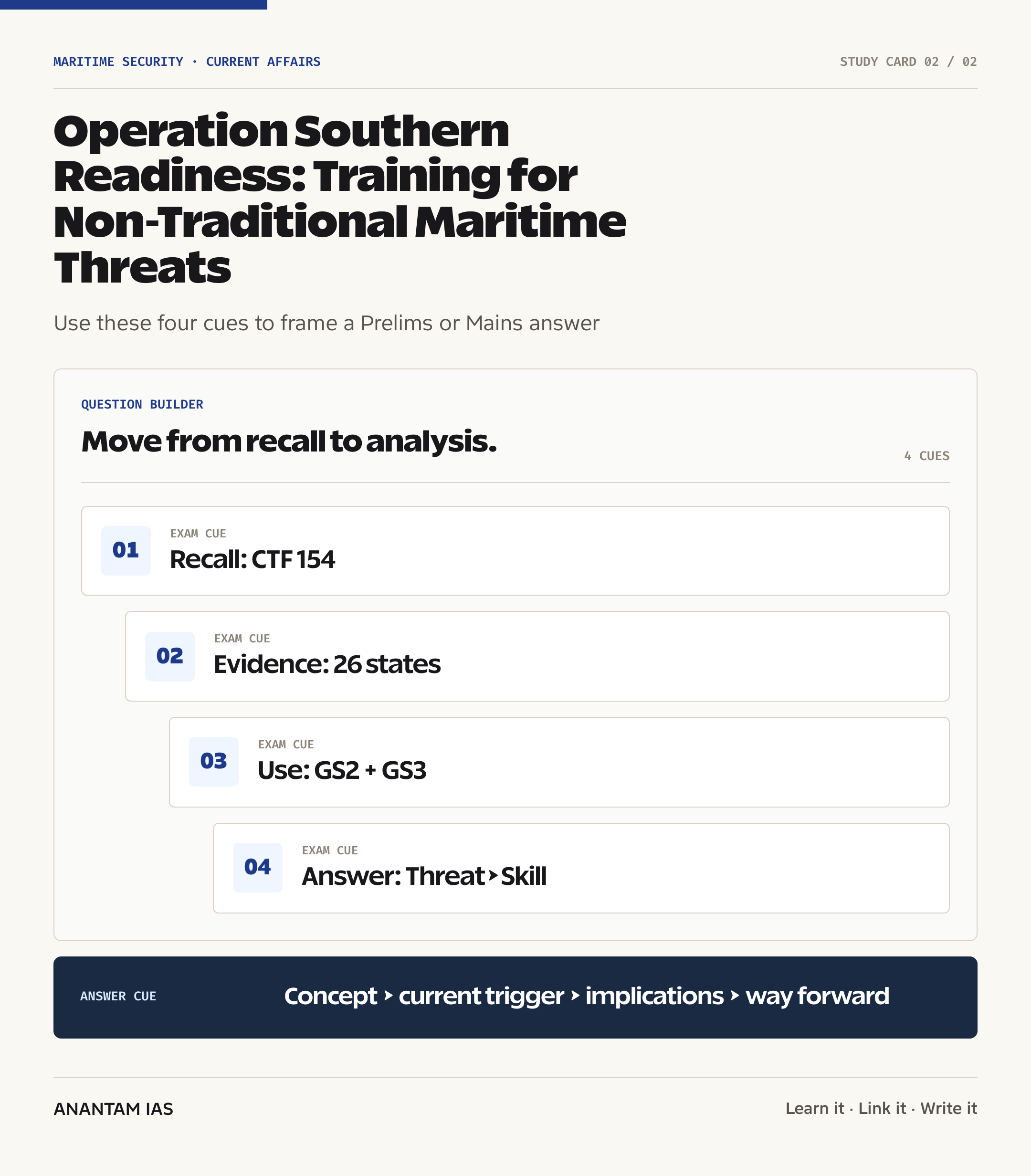
Operation Southern Readiness 26-2 shows why maritime security is a systems problem. Surveillance may detect a suspicious vessel, but a lawful response still requires communications, trained boarding teams, rescue capability, evidence handling and coordination across national agencies.
For India, hosting the engagement at Southern Naval Command converts leadership of CTF 154 into a concrete capacity-building role. The strongest interpretation is practical: India is helping partners prepare for shared non-state and humanitarian risks while expanding professional trust.
That value shouldn’t be inflated into an alliance claim. CMF’s flexible structure leaves contributions to sovereign choice. The durable test is whether common training produces faster, safer and legally sound cooperation when a real incident occurs.
UPSC Practice Questions
Prelims MCQ 1
With reference to Operation Southern Readiness 26-2, consider the following statements:
- It was hosted at the Southern Naval Command in Kochi.
- It was conducted under CTF 154, the Combined Maritime Forces task force dedicated to training.
- Participation in CMF creates a fixed collective-defence obligation for every member.
How many of the above statements are correct?
(a) Only one (b) Only two (c) All three (d) None
Answer: (b) Only two
Explanation:
Statements 1 and 2 are correct. CMF is a flexible coalition of the willing; its members aren’t bound by a fixed political or military mandate.
Prelims MCQ 2
Which one of the following best describes Combined Task Force 154?
(a) A treaty body for settling maritime boundaries (b) A CMF task force for multinational maritime security training (c) A UN peacekeeping fleet permanently based in Kochi (d) An Indian coastal police unit for port security
Answer: (b) A CMF task force for multinational maritime security training
Explanation:
CTF 154 is CMF’s dedicated training task force. Its core areas include maritime awareness, law, interdiction, rescue and assistance, and leadership development.
UPSC Mains Questions
- Non-traditional maritime threats blur the boundary between security, law enforcement and humanitarian response. Using Operation Southern Readiness 26-2 as context, analyse how domain awareness, legal interoperability, interdiction training and rescue capacity can improve cooperative security in the Indian Ocean Region. (15 marks, 250 words)
- India’s leadership of CTF 154 expands its regional capacity-building role but doesn’t create a military alliance. Discuss the strategic benefits of flexible maritime partnerships and the safeguards needed to preserve sovereign choice, strategic autonomy and compliance with international law. (15 marks, 250 words)
Sources: PIB, Ministry of Defence and The Hindu.
Frequently Asked Questions
What is Operation Southern Readiness 26-2?
It is a four-day multinational maritime security training engagement held at the Southern Naval Command in Kochi from 20 to 23 July 2026. Conducted under the Indian Navy-led CTF 154 with CMF, it combines classroom, simulator and practical training for shared maritime security challenges.
Who participated in the Kochi exercise?
The opening brought together 254 participants from 26 countries, supported by 74 facilitators, representatives of four international organisations and subject experts. The reports don’t identify every participating country, so the figure shouldn’t be treated as a confirmed country-by-country roster or as the total CMF membership.
What is Combined Task Force 154?
CTF 154 is the Combined Maritime Forces task force dedicated to multinational maritime security training and capacity building. Established in May 2023, it works across maritime awareness, law of the sea, interdiction, rescue and assistance, and leadership development. The Indian Navy assumed command in February 2026.
Which skills were covered in training?
The programme covers maritime law, domain awareness, information sharing, counter-narcotics, force protection, asymmetric threats and uncrewed systems. Practical modules include boarding, ship handling, navigation, maritime communications, survival at sea, damage control and firefighting, supported by simulators and onboard exposure.
Does CMF membership mean a military alliance?
No. CMF calls itself a coalition of the willing, and its members aren’t bound by a fixed political or military mandate. Contributions vary by national decision and availability. Interoperability in this setting means the ability to communicate and work together when states choose to cooperate, not automatic collective defence.
Why do non-traditional maritime threats need cooperation?
Piracy, trafficking, irregular migration, maritime accidents and attacks by non-state actors can cross jurisdictions and affect several countries. A sound response may require shared information, rescue coordination, lawful boarding, evidence preservation and prosecution support. No single navy or agency controls every link in that chain.