Payments Regulatory Board: Reshaping Oversight of India’s Digital Payments
Why in News?
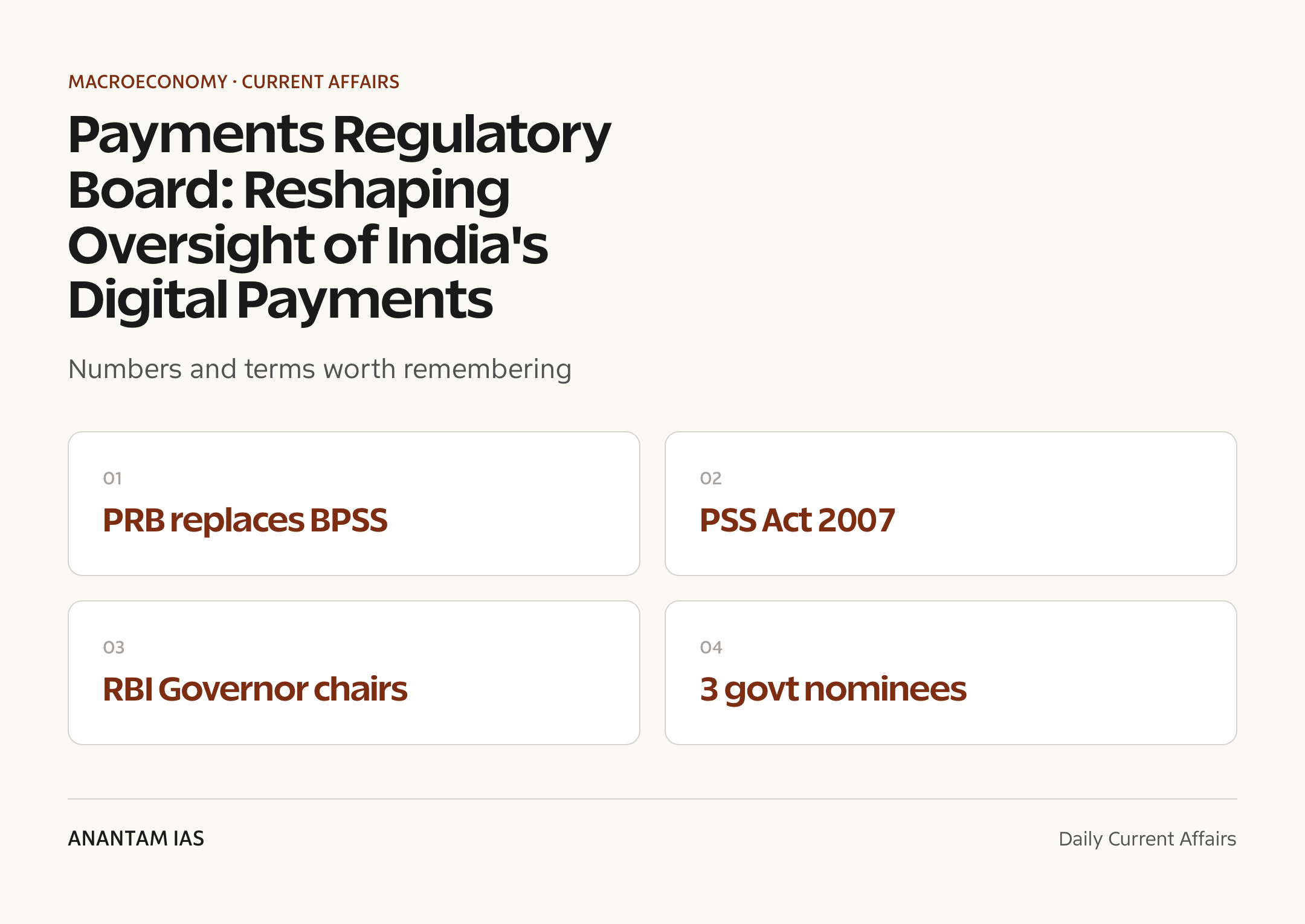
The Reserve Bank of India (RBI) notified the constitution of the Payments Regulatory Board (PRB), a new statutory body that replaces the older Board for Regulation and Supervision of Payment and Settlement Systems (BPSS) as the apex authority for regulating and supervising payment systems in India.
The PRB takes over the powers exercised under the Payment and Settlement Systems Act, 2007, and will set policy for systems such as UPI, cards, prepaid instruments, and large-value settlement rails like RTGS and NEFT.
- The PRB is chaired by the RBI Governor, with the Deputy Governor in charge of payments as the vice-chair.
- Its membership includes three nominees of the Central Government, alongside RBI members and experts.
- It supersedes the BPSS, which was a sub-committee of the RBI’s Central Board with no government nominees.
- The board’s mandate covers authorisation, oversight and standard-setting for all payment and settlement systems.
The development matters in the context of:
- Sets up a recurring tension between regulatory independence and government representation in financial-sector bodies.
- Comes as India’s UPI volumes cross record monthly transactions, making payments oversight systemically important.
- Reflects a broader shift in how the Finance Ministry and the RBI share institutional authority over the digital-payments stack.
UPSC Relevance
Prelims Relevance
- Payment and Settlement Systems Act, 2007 — the parent statute for payments regulation in India.
- Payments Regulatory Board (PRB) — replaces the BPSS; chaired by the RBI Governor.
- Board for Regulation and Supervision of Payment and Settlement Systems (BPSS) — the earlier RBI sub-committee.
- Reserve Bank of India as the designated authority for payment systems under the Act.
- National Payments Corporation of India (NPCI) — operates UPI, RuPay, IMPS and NACH.
- Unified Payments Interface (UPI), RTGS, NEFT and Prepaid Payment Instruments (PPIs) as regulated payment systems.
- Composition: RBI Governor, Deputy Governor, RBI nominees and three Central Government nominees.
- Distinction between a statutory regulator and an internal RBI committee.
Mains Relevance
GS Paper 3
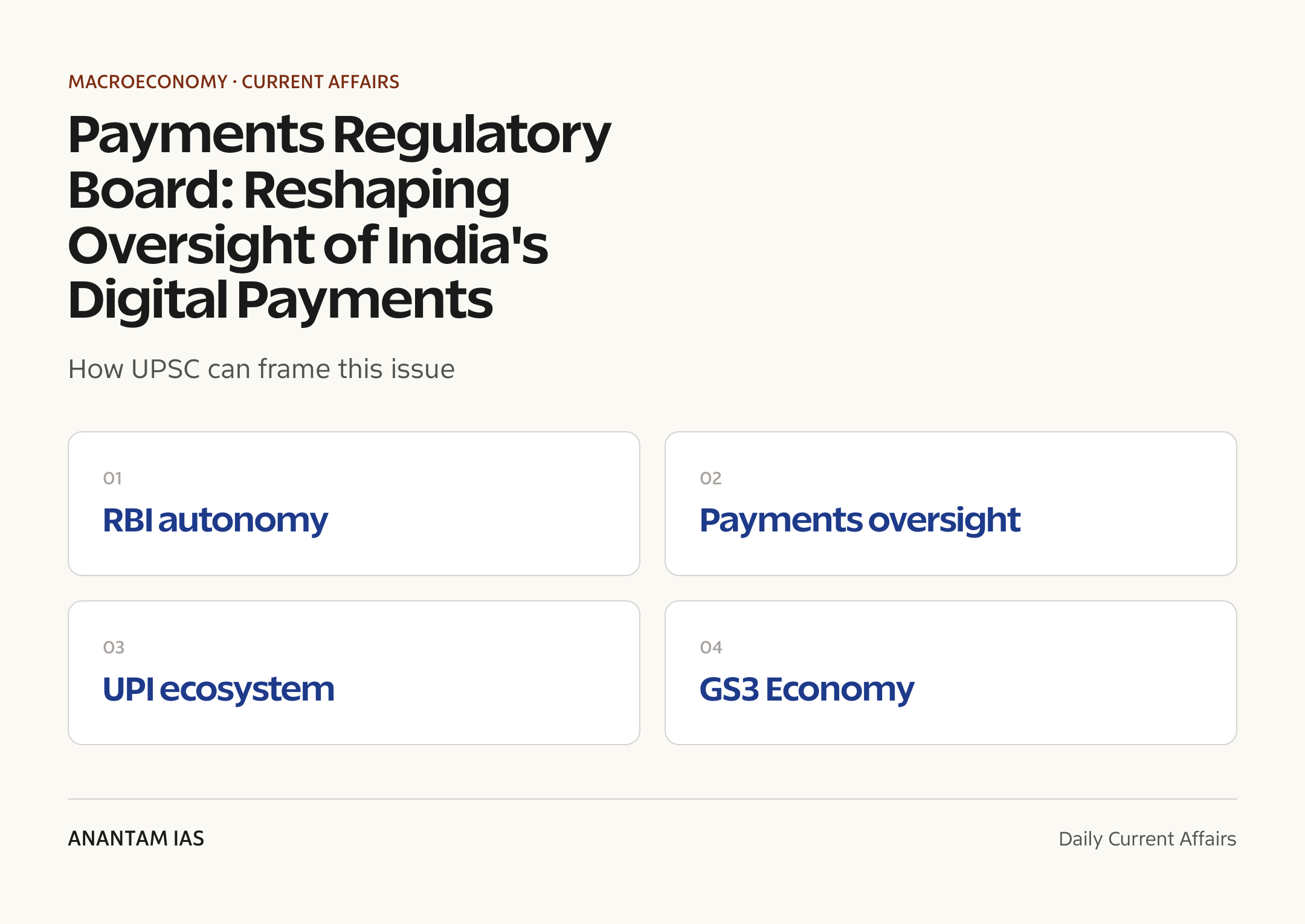
- Role of the RBI in regulating India’s payment and settlement systems and the implications of the PRB for financial stability.
- How the digital-payments ecosystem (UPI, cards, PPIs) shapes financial inclusion and the formalisation of the economy.
GS Paper 2
- Debates on regulatory autonomy versus government representation in independent financial-sector bodies.
Essay
- Independence of regulators in a developmental state — balancing accountability with autonomy.
- Technology and trust — governing India’s digital public infrastructure.
Background and Context
Why payments needed a dedicated regulator
Payment systems sit at the core of financial stability, and India built a statutory base for their oversight nearly two decades ago.
- The Payment and Settlement Systems Act, 2007 designated the RBI as the authority to regulate and supervise payment systems and to authorise their operation.
- Under the Act, the RBI set up the BPSS in 2005 as a sub-committee of its Central Board to discharge these powers.
- A ‘payment system’ under the Act covers any system enabling payment between a payer and a beneficiary — cards, UPI, money transfers, clearing and settlement.
- As volumes scaled, the case grew for a more formal, statutorily defined board rather than an internal committee.
From BPSS to the Payments Regulatory Board
The PRB is a statutory upgrade of the body that previously governed payments inside the RBI.
- The BPSS had only RBI members and reported within the central bank’s governance structure.
- The PRB is constituted as the apex decision-making body for payments policy, replacing the BPSS entirely.
- Chair: the RBI Governor; vice-chair: the Deputy Governor overseeing the payments portfolio.
- Members: RBI officials and experts plus three nominees of the Central Government, a structural change from the BPSS.
What the PRB regulates
The board’s remit spans the full payments stack, from retail rails to systemically important settlement systems.
- UPI — the interoperable real-time retail rail operated by NPCI, now India’s dominant payment mode.
- Card networks and Prepaid Payment Instruments (PPIs) such as wallets.
- Large-value and bulk systems: RTGS (real-time gross settlement) and NEFT.
- Standard-setting, authorisation of operators, and oversight of risk, security and interoperability.
The autonomy-versus-representation debate
The inclusion of government nominees has reopened a long-running question about how independent India’s financial regulators should be.
- Supporters of regulatory autonomy argue payments policy benefits from insulation from short-term political and fiscal pressures.
- The presence of government nominees on the board is read by critics as a dilution of the RBI’s operational independence.
- Earlier drafts proposing an independent payments regulator separate from the RBI were debated and then dropped in favour of an RBI-anchored board.
- The episode echoes wider questions about independent regulatory bodies, where central banks usually retain primacy over payment-system oversight.
Why the stakes are high now
Payments are no longer a back-office function; they are critical digital public infrastructure.
- UPI processes billions of transactions a month, making any oversight gap a systemic concern.
- Outages, fraud and data-security incidents in payment rails carry economy-wide spillovers.
- A clear regulatory anchor matters for cross-border payment linkages and for fintech innovation.
- Strong oversight underpins public trust in cashless transactions and continued financial inclusion.
Way Forward
Safeguard regulatory independence
- Codify clear decision rules so the RBI retains primacy over technical and prudential payments matters.
- Keep the role of government nominees advisory on policy direction rather than operational supervision.
Strengthen oversight capacity
- Invest in monitoring of fraud, outages and cyber-risk across UPI, cards and PPIs.
- Ensure transparent, consultative standard-setting with operators such as NPCI and banks.
Build accountability by publishing the board’s decisions and review processes, so that autonomy is paired with transparency rather than opacity.
Conclusion
The Payments Regulatory Board formalises and elevates the governance of a payments system that now touches almost every Indian transaction. By replacing the BPSS with a statutory board, it signals that digital payments are systemically important and deserve a dedicated apex authority.
The unresolved question is institutional design. Keeping the RBI at the centre while admitting government nominees will test whether India can combine democratic accountability with the regulatory independence that financial stability requires.
UPSC Practice Questions
Prelims MCQ 1
With reference to the Payments Regulatory Board (PRB), consider the following statements:
- It is constituted under the Payment and Settlement Systems Act, 2007.
- It replaces the Board for Regulation and Supervision of Payment and Settlement Systems (BPSS).
- It is chaired by the Union Finance Minister.
How many of the above statements are correct?
(a) Only one (b) Only two (c) All three (d) None
Answer: (b) Only two
Explanation:
Statements 1 and 2 are correct: the PRB derives from the Payment and Settlement Systems Act, 2007, and replaces the BPSS. Statement 3 is wrong — the PRB is chaired by the RBI Governor, not the Finance Minister.
Prelims MCQ 2
Which of the following payment systems falls within the regulatory remit of the RBI’s payments board?
(a) Unified Payments Interface (UPI) only (b) RTGS and NEFT only (c) Prepaid Payment Instruments (PPIs) only (d) UPI, cards, PPIs and RTGS/NEFT
Answer: (d) UPI, cards, PPIs and RTGS/NEFT
Explanation:
The board’s mandate spans the full payments stack — UPI, card networks, prepaid instruments and large-value settlement systems such as RTGS and NEFT.
UPSC Mains Questions
- The Payments Regulatory Board replaces the BPSS as the apex authority for India’s payment systems. Examine its significance for financial stability and the digital-payments ecosystem. (250 words)
- Government representation on financial-sector boards is often defended as democratic accountability and criticised as a threat to regulatory autonomy. Critically discuss with reference to the Payments Regulatory Board. (250 words)
- India’s digital public infrastructure, led by UPI, has transformed payments. Discuss the regulatory challenges this scale creates and how a dedicated payments board can address them. (150 words)
Sources: Reserve Bank of India and The Hindu.
Frequently Asked Questions
What is the Payments Regulatory Board?
The Payments Regulatory Board (PRB) is a statutory body constituted by the Reserve Bank of India to regulate and supervise payment and settlement systems in India. It replaces the older Board for Regulation and Supervision of Payment and Settlement Systems (BPSS) and sets policy for systems such as UPI, cards and prepaid instruments.
Which body did the PRB replace?
The PRB replaces the Board for Regulation and Supervision of Payment and Settlement Systems (BPSS), which was a sub-committee of the RBI’s Central Board. Unlike the BPSS, the PRB is constituted as a formal statutory board and includes Central Government nominees alongside RBI members.
Under which law is the PRB constituted?
The PRB exercises powers under the Payment and Settlement Systems Act, 2007. This Act designates the Reserve Bank of India as the authority to regulate, supervise and authorise payment systems operating in the country, providing the statutory basis for the board’s functions.
Who chairs the Payments Regulatory Board?
The Payments Regulatory Board is chaired by the RBI Governor, with the Deputy Governor in charge of payments acting as vice-chair. Its membership combines RBI officials and experts with three nominees of the Central Government, which is the change driving the autonomy debate.
Why is the PRB linked to a debate on RBI autonomy?
The inclusion of Central Government nominees on the board has revived concerns about regulatory independence. Critics argue it could dilute the RBI’s operational autonomy over payments, while supporters frame it as democratic accountability over a systemically important public infrastructure.
What payment systems does the PRB oversee?
The board oversees the full payments stack, including the Unified Payments Interface (UPI), card networks, Prepaid Payment Instruments such as wallets, and large-value settlement systems like RTGS and NEFT. Its work covers authorisation, standard-setting, security and risk oversight.