PMFME Scheme Crosses 2 Lakh Credit-Linked Micro Food Enterprises
Why in News?
The Union Minister for Food Processing Industries, Chirag Paswan, presided over a special event in New Delhi on 11 July 2026 to mark a landmark under the Pradhan Mantri Formalisation of Micro Food Processing Enterprises (PMFME) Scheme — loan sanctions to more than two lakh micro food processing enterprises. PIB confirmed the milestone in a release from the Ministry of Food Processing Industries (MoFPI).
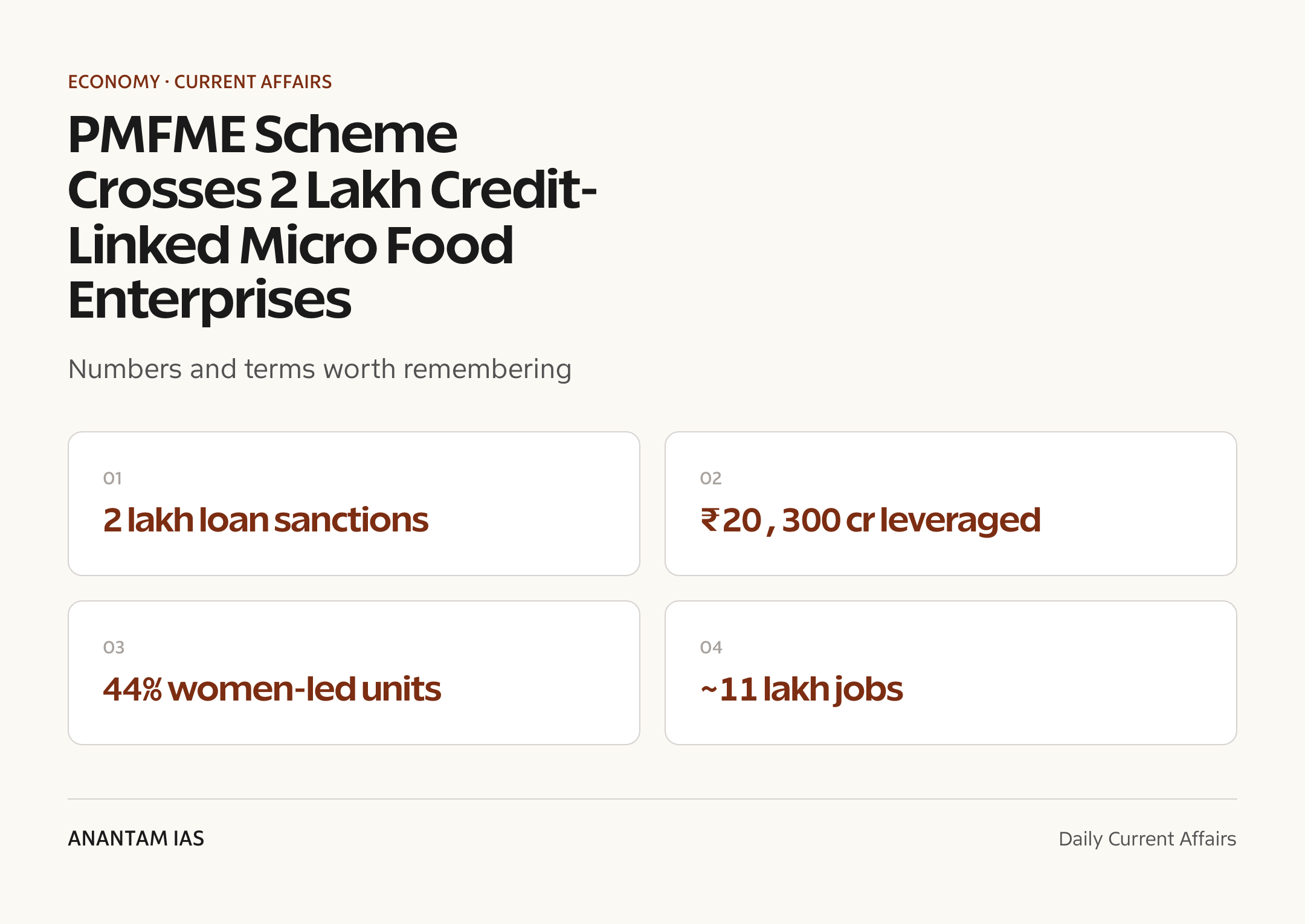
In crossing 2 lakh loan sanctions, the scheme has leveraged project investments of over Rs 20,300 crore. Nearly 90% of beneficiaries are first-generation entrepreneurs and 44% are women, and the scheme has generated close to 11 lakh direct and indirect jobs — making this the strongest formalisation story yet in India’s micro food processing sector.
- Over 2 lakh credit-linked micro food processing enterprises sanctioned loans — the scheme’s original target of assisting 2 lakh units now reached.
- Project investments of over Rs 20,300 crore leveraged through credit-linked support.
- Nearly 90% first-generation entrepreneurs; 44% women beneficiaries.
- Over 75,000 enterprises entered the formal economy through Udyam Aadhaar, Udyam Assist, FSSAI and GST registrations.
- Close to 11 lakh direct and indirect employment opportunities generated.
- The 2-lakhth beneficiary, Inderjeet Singh from Ranchi, Jharkhand, was felicitated at the event; leading states include Bihar, Maharashtra, Uttar Pradesh, Tamil Nadu and Madhya Pradesh.
The development matters in the context of:
- The milestone matters because India’s micro food processing sector is overwhelmingly informal — the NSSO 73rd Round estimated about 25 lakh unregistered food processing enterprises, roughly two-thirds of them rural and mostly family-run.
- PMFME is the government’s flagship instrument to pull these units into the formal net — combining credit, subsidy, training, branding and market linkage in one package, so the 2-lakh mark is a direct measure of formalisation progress.
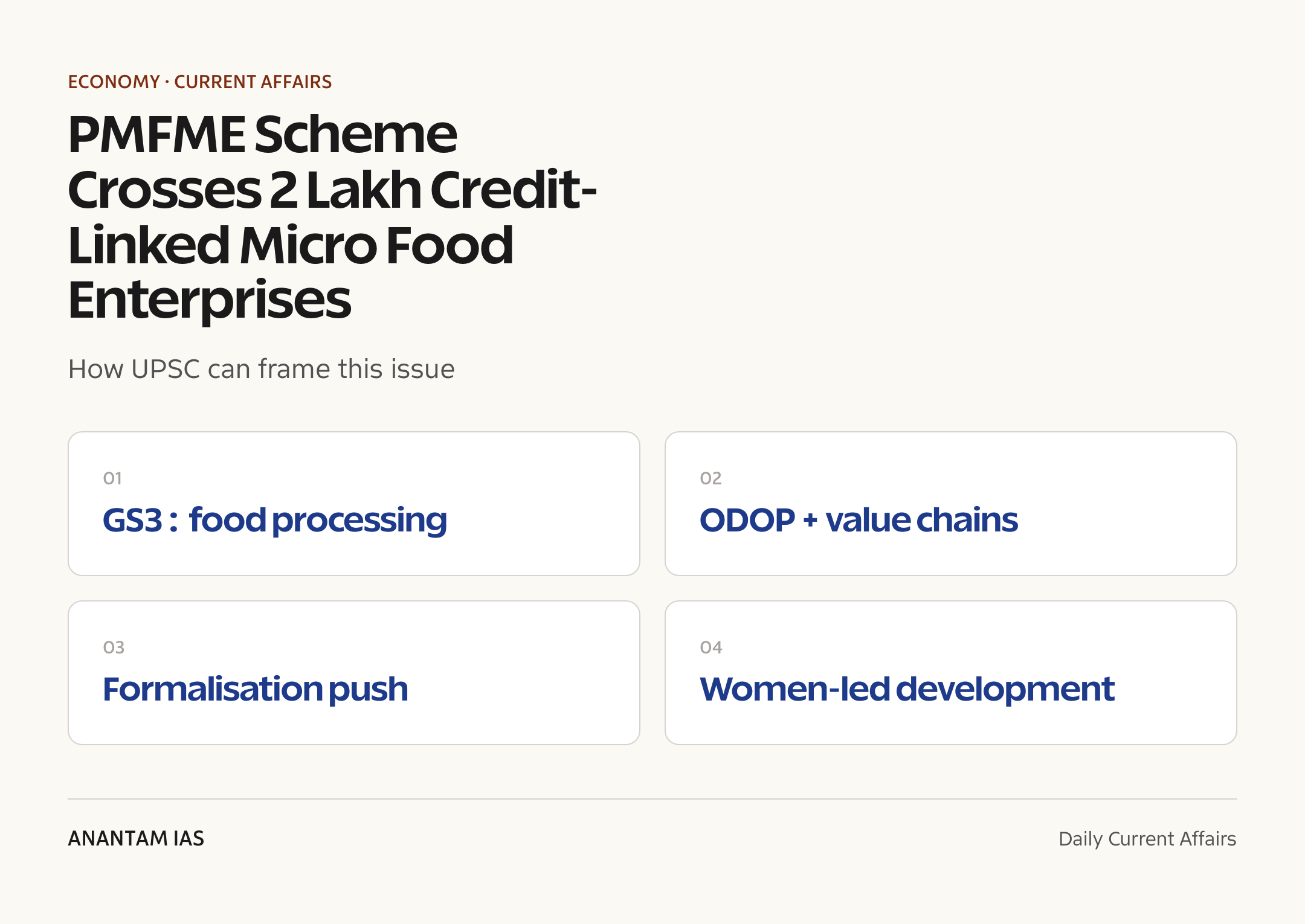
- With 44% women beneficiaries and seed capital routed through Self-Help Groups, the scheme doubles as a case study for women-led development — a recurring Mains and Essay theme.
UPSC Relevance
Prelims Relevance
- PMFME Scheme — launched 29 June 2020 under the Aatmanirbhar Bharat Abhiyan; implemented by the Ministry of Food Processing Industries.
- It is a Centrally Sponsored Scheme with an outlay of Rs 10,000 crore, originally for 2020-21 to 2024-25 and extended to 2025-26.
- Funding pattern: 60:40 Centre:State; 90:10 for North-Eastern and Himalayan states; 100% Centre for UTs without legislature.
- Core benefit: credit-linked capital subsidy at 35% of eligible project cost, capped at Rs 10 lakh per unit.
- Seed capital of Rs 40,000 per SHG member engaged in food processing, for working capital and small tools.
- One District One Product (ODOP) approach — district-specific product focus; scheme supports 40 common brands covering nearly 200 products (makhana, millets, spices, GI-tagged products).
- 80 Common Incubation Centres approved across 27 States/UTs; 32 commissioned so far.
- Seed capital has reached over 4.18 lakh SHG members; more than 1.76 lakh beneficiaries trained, 77% of them women.
- District Resource Persons (DRPs) — the scheme’s grassroots handholding cadre for applications, DPRs and registrations.
Mains Relevance
GS Paper 3
- Food processing as the bridge between agriculture and industry — how PMFME-style micro-enterprise support reduces post-harvest losses, adds value locally and raises farm incomes.
- Formalisation of the informal economy — evaluate credit-linked subsidy plus Udyam/FSSAI/GST registration as a formalisation pathway against demonetisation-era compliance-led approaches.
- MSME credit gap — what the 2 lakh sanctions (of ~25 lakh informal units) say about last-mile credit delivery, bank risk appetite and the role of handholding cadres like DRPs.
- ODOP and cluster development — district-level product specialisation, common branding and shared infrastructure as answers to the scale problem of micro units.
GS Paper 2
- Cooperative federalism in scheme delivery — Centrally Sponsored Scheme design, state nodal agencies and the wide inter-state variation in performance (Bihar, Maharashtra, UP leading).
- Women’s empowerment through SHGs — seed capital via SRLM-linked Self-Help Groups as a governance model for reaching women entrepreneurs.
Essay
- Formalisation is not paperwork but empowerment — the informal worker’s route to credit, markets and dignity.
- Women-led development as the engine of Viksit Bharat: from beneficiaries to builders.
- Small enterprises, big transformation — why India’s growth story must be written in its districts.
Background and Context
What is the PMFME Scheme?
PMFME is the Centre’s first scheme aimed squarely at the smallest, mostly unregistered food processing units.
- Launched on 29 June 2020 by the Ministry of Food Processing Industries as part of the Aatmanirbhar Bharat Abhiyan package.
- A Centrally Sponsored Scheme with a total outlay of Rs 10,000 crore, originally over 2020-21 to 2024-25 and extended to 2025-26.
- Cost-sharing: 60:40 between Centre and states, 90:10 for North-Eastern and Himalayan states, 60:40 with UTs having legislatures, and 100% central funding for other UTs.
- Its stated target was to assist 2 lakh micro food processing units with credit-linked subsidy — the target the 11 July milestone formally crosses.
- The design rests on the Aatmanirbhar Bharat logic: build local enterprise capacity rather than substitute it.
What Beneficiaries Actually Get
The scheme bundles subsidy, seed money, shared infrastructure and marketing support into one pipeline.
- Credit-linked capital subsidy of 35% of the eligible project cost, with a ceiling of Rs 10 lakh per unit, for individual micro enterprises upgrading or setting up.
- Seed capital of Rs 40,000 per SHG member engaged in food processing — for working capital and small tools, routed through State Rural Livelihood Missions.
- Groups — FPOs, SHGs and producer cooperatives — get 35% credit-linked grant support for capital investment and common infrastructure along the value chain.
- Support for branding and marketing (up to 50% grant) when groups build common brands and packaging.
- Capacity building: training through state-level technical institutions, plus District Resource Persons (DRPs) who handhold applicants through DPRs, bank loans and FSSAI/Udyam registrations.
- Full component details are on the ministry’s scheme portal, pmfme.mofpi.gov.in.
One District One Product: The Organising Idea
PMFME channels support through a district-level product focus instead of scattering money thinly.
- Under ODOP, each district identifies a signature food product — based on raw material availability and existing clusters — and scheme infrastructure converges around it.
- PIB highlighted support for 40 common brands covering nearly 200 products, building local value chains around makhana, millets, spices and GI-tagged products.
- ODOP lets micro units share what they can’t individually afford — common processing facilities, incubation centres, branding and quality certification.
- The approach links naturally to Farmer Producer Organisations, which aggregate the same district-level produce on the supply side.
The Milestone in Numbers
The 11 July data set is exam-ready — every figure below is from the ministry’s release.
- Over 2 lakh micro food processing enterprises sanctioned credit-linked loans.
- Project investments of over Rs 20,300 crore leveraged.
- Nearly 90% of beneficiaries are first-generation entrepreneurs; 44% are women.
- Nearly 11 lakh direct and indirect employment opportunities generated.
- Over 75,000 enterprises formalised through Udyam Aadhaar, Udyam Assist, FSSAI and GST registrations.
- Seed capital support to more than 4.18 lakh SHG members; over 1.76 lakh beneficiaries trained, 77% women.
- 80 Common Incubation Centres approved across 27 States/UTs; 32 commissioned.
- Best-performing states named by the minister: Bihar, Maharashtra, Uttar Pradesh, Tamil Nadu, Madhya Pradesh.
Why Formalisation of Micro Food Processing Matters
The sector PMFME targets is huge, employment-rich and almost entirely off the books.
- The NSSO 73rd Round estimated about 25 lakh unregistered food processing enterprises — roughly two-thirds in rural areas and around 80% family-based.
- Informality locks these units out of institutional credit, forces reliance on moneylenders, and keeps them below FSSAI hygiene and packaging standards — capping both safety and market reach.
- Registration under Udyam, FSSAI and GST unlocks priority-sector bank lending, government procurement, e-commerce onboarding and formal supply contracts.
- Formalisation here has an outsized welfare payoff because micro food processing absorbs women, rural workers and first-generation entrepreneurs — exactly the groups formal MSME credit historically missed, as covered in our note on the MSME sector in India.
- The SHG seed-capital route builds on the DAY-NRLM architecture — the same federated women’s collectives profiled in our NRLM SHG guide.
The Bigger Food Processing Picture
PMFME sits at the micro end of a larger policy stack for the sector.
- Food processing is the classic agriculture-industry bridge: it cuts post-harvest losses, stabilises farm-gate prices and creates non-farm rural jobs.
- The macro instruments — PM Kisan SAMPADA Yojana (infrastructure: mega food parks, cold chains) and the PLI Scheme for Food Processing (large players, global brands) — address scale; PMFME addresses the base of the pyramid.
- Together they map the full value chain: farm aggregation (FPOs) → micro processing (PMFME) → infrastructure (SAMPADA) → export-scale manufacturing (PLI).
- Sector fundamentals, data and challenges are in our full note on the food processing sector in India.
Way Forward
Deepen Credit and Close the Coverage Gap
- Two lakh sanctioned units against ~25 lakh informal enterprises means coverage is still under a tenth — the next phase needs simpler documentation, faster bank turnaround and wider DRP presence in low-performing states.
- Nudge banks with better credit-guarantee layering so first-generation borrowers without collateral histories aren’t screened out.
Convert Formalisation into Market Access
- Commission the remaining Common Incubation Centres quickly and tie ODOP brands to e-commerce, ONDC and public procurement so registration translates into revenue.
- Use the new nationwide multimedia awareness campaign announced at the event to push FSSAI compliance and quality certification, not just enrolment.
A durable exit path matters as the scheme window closes: states should institutionalise the DRP cadre and incubation network within their own industries or rural livelihoods departments, so handholding doesn’t end with the scheme’s outlay.
Conclusion
Crossing 2 lakh credit-linked enterprises is more than a scheme statistic — it’s evidence that India’s smallest food businesses respond quickly when credit, subsidy and handholding arrive as one package. The profile of the beneficiaries — 90% first-generation, 44% women — shows the gains are going to entrants, not incumbents.
The unfinished agenda is scale and sustainability: most of the ~25 lakh informal units remain outside the net, and the incubation-and-branding infrastructure is only partly built. For UPSC, PMFME is now the standard illustration for formalisation, women-led development and the agriculture-industry linkage — with a fresh, citable data set attached.
UPSC Practice Questions
Prelims MCQ 1
With reference to the Pradhan Mantri Formalisation of Micro Food Processing Enterprises (PMFME) Scheme, consider the following statements:
- It is a Centrally Sponsored Scheme implemented by the Ministry of Food Processing Industries.
- It provides a credit-linked capital subsidy of 35% of the eligible project cost, subject to a maximum of Rs 10 lakh per unit.
- Seed capital under the scheme is provided only to Farmer Producer Organisations.
How many of the above statements are correct?
(a) Only one (b) Only two (c) All three (d) None
Answer: (b) Only two
Explanation:
Statements 1 and 2 are correct: PMFME is a Centrally Sponsored Scheme of MoFPI (launched June 2020, Rs 10,000 crore outlay) with a 35% credit-linked subsidy capped at Rs 10 lakh. Statement 3 is wrong — seed capital of Rs 40,000 per member goes to Self-Help Group members engaged in food processing, not to FPOs.
Prelims MCQ 2
The ‘One District One Product (ODOP)’ approach, under which districts build value chains around products such as makhana, millets and GI-tagged foods, is a design feature of which scheme?
(a) PM Kisan SAMPADA Yojana (b) PM Formalisation of Micro Food Processing Enterprises (PMFME) Scheme (c) PLI Scheme for Food Processing Industry (d) Mission for Integrated Development of Horticulture
Answer: (b) PM Formalisation of Micro Food Processing Enterprises (PMFME) Scheme
Explanation:
ODOP is the organising framework of PMFME: each district identifies a signature food product and the scheme’s infrastructure, branding and incubation support converge on it. PMFME currently supports 40 common brands covering nearly 200 products.
UPSC Mains Questions
- The PMFME Scheme’s crossing of two lakh credit-linked enterprises shows that formalisation of micro enterprises works best as a bundled offer of credit, subsidy and handholding rather than a compliance mandate. Critically examine with reference to India’s micro food processing sector.
- Food processing is the most direct bridge between India’s farms and its factories. Discuss how the One District One Product approach under PMFME strengthens this bridge, and identify the constraints that still limit micro food enterprises from scaling up.
- Nearly 44% of PMFME beneficiaries are women and seed capital flows through Self-Help Groups. Evaluate the SHG route as an instrument for women-led enterprise development in India.
Source: PIB, Ministry of Food Processing Industries.
Frequently Asked Questions
What is the PMFME Scheme?
The Pradhan Mantri Formalisation of Micro Food Processing Enterprises Scheme, launched on 29 June 2020 under Aatmanirbhar Bharat, is a Centrally Sponsored Scheme of the Ministry of Food Processing Industries. With a Rs 10,000 crore outlay, it gives micro food processing units credit-linked subsidy, training, branding support and help with formal registration.
What milestone did PMFME cross in July 2026?
On 11 July 2026, the ministry celebrated loan sanctions crossing two lakh micro food processing enterprises — the scheme’s original target. The credit-linked support has leveraged over Rs 20,300 crore in project investment and generated close to 11 lakh direct and indirect jobs across the country.
How much subsidy does PMFME give?
Individual micro enterprises get a credit-linked capital subsidy of 35% of the eligible project cost, capped at Rs 10 lakh per unit. Self-Help Group members engaged in food processing get seed capital of Rs 40,000 each, while FPOs, SHGs and cooperatives get 35% grant support for common infrastructure.
What is the One District One Product approach?
Under ODOP, every district identifies one signature food product — based on local raw materials and existing clusters — and PMFME’s infrastructure, incubation, branding and marketing support converge around it. The scheme currently backs 40 common brands covering nearly 200 products, including makhana, millets, spices and GI-tagged foods.
Why is formalisation of food processing units important?
The NSSO 73rd Round counted about 25 lakh unregistered food processing enterprises, mostly rural and family-run. Informality cuts them off from bank credit, FSSAI certification and organised markets. Registration under Udyam, FSSAI and GST unlocks institutional loans, e-commerce access, government procurement and safer, better-priced products.
Which states lead in PMFME implementation?
At the July 2026 milestone event, the Union Minister named Bihar, Maharashtra, Uttar Pradesh, Tamil Nadu and Madhya Pradesh as the leading states. The two-lakhth beneficiary, Inderjeet Singh of Ranchi, Jharkhand, was felicitated and handed his sanction letter at the New Delhi event.