Micro, Small and Medium Enterprises (MSMEs) are the backbone of Indian employment, exports, and entrepreneurship. The sector employs around 25 crore people (second only to agriculture), contributes about 30% of GDP, nearly 45% of manufacturing output, and close to 45% of India's exports. Yet MSMEs face persistent challenges — formalisation gaps, credit shortage, weak technology, slow dispute resolution, and delayed payments. For UPSC, MSMEs are a recurring GS-III topic covering growth, employment, industrial policy, and financial inclusion.
MSMEs at a Glance
| Indicator | Value |
|---|---|
| Registered MSMEs on Udyam portal (2024) | Over 5.4 crore |
| Employment supported | ~25 crore |
| Share of GDP | ~30% |
| Share of manufacturing | ~45% |
| Share of exports | ~45% |
| Micro enterprises share of total MSMEs | ~99% |
Updated context: As of 2024, over 5.4 crore MSMEs had registered on the Udyam Registration portal, with Udyam Assist Platform onboarding informal micro-enterprises at scale.
Revised MSME Definition (July 2020)
The Aatmanirbhar Bharat Abhiyaan introduced a new composite definition of MSMEs combining investment in plant & machinery and annual turnover:
| Classification | Investment limit | Turnover limit |
|---|---|---|
| Micro | ≤ Rs 1 crore | ≤ Rs 5 crore |
| Small | ≤ Rs 10 crore | ≤ Rs 50 crore |
| Medium | ≤ Rs 50 crore | ≤ Rs 250 crore |
Key changes from the old MSMED Act 2006 definition:
- Higher investment limits to reflect price inflation since 2006.
- Turnover criterion added, reducing incentive to under-invest.
- Same thresholds for manufacturing and services, removing the old artificial distinction.
Updated context: Budget 2025-26 announced a further upward revision of MSME thresholds to further support enterprise growth — specifics notified in accompanying notifications.
Why the Old Definition Failed
The pre-2020 definition created perverse incentives:
- Old limits (Rs 25 lakh micro, Rs 5 crore small, Rs 10 crore medium) were set in 2006 and didn't adjust for inflation.
- MSMEs kept books informal and deliberately under-reported investment to stay eligible.
- Firms with potential to scale feared losing MSME benefits — tax concessions, collateral-free loans, priority sector lending. So they stayed small on paper.
The Economic Survey 2018-19 flagged this as the "dwarf firm problem" — firms older than 10 years yet still employing fewer than 100 people dominated manufacturing. These dwarfs made up over half of manufacturing firms by count but only about 14% of manufacturing employment.
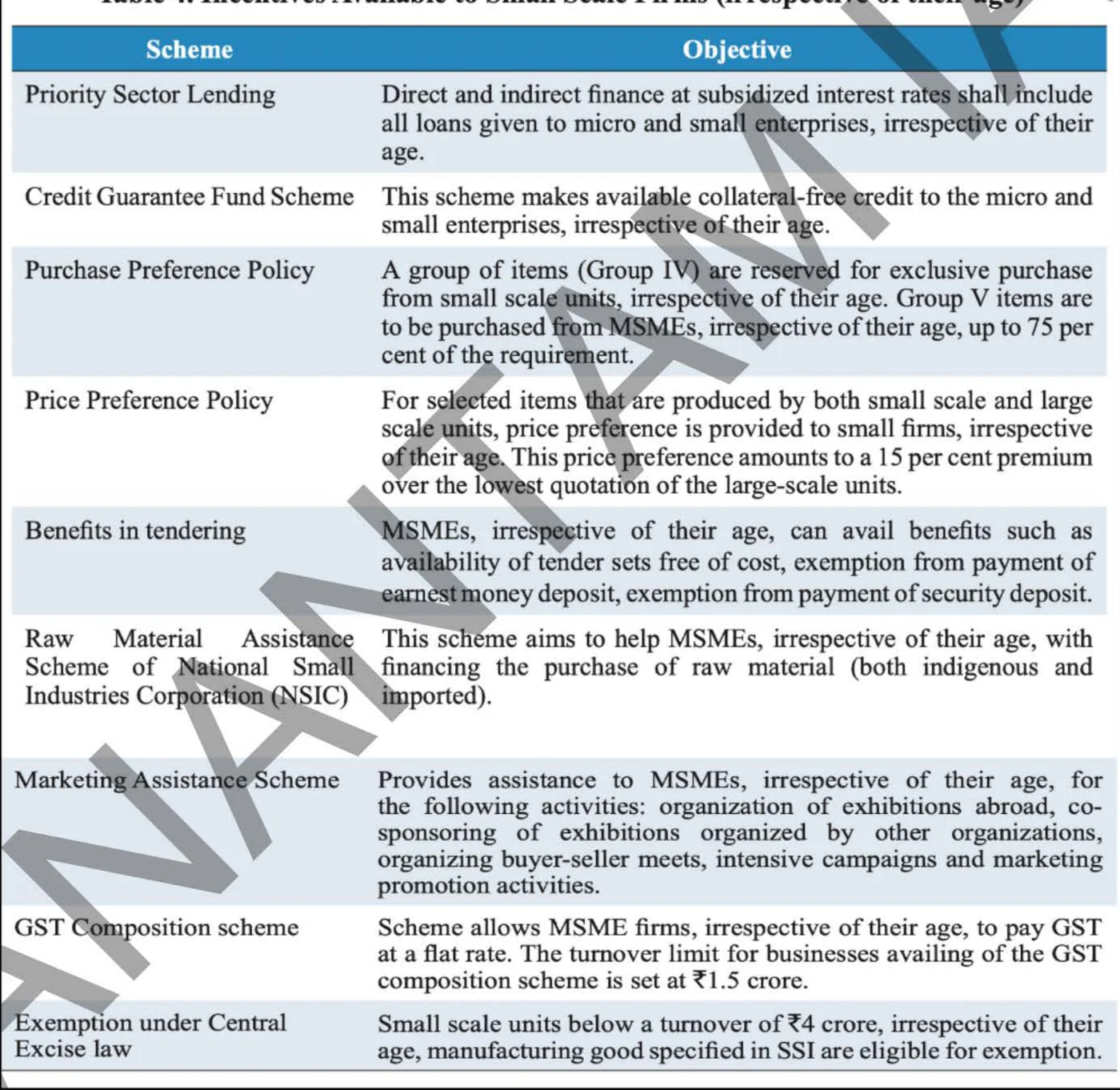
Government Initiatives for MSMEs
Credit Support
- Mudra Yojana (PMMY) — loans up to Rs 10 lakh (raised to Rs 20 lakh in Budget 2024-25 for Tarun+).
- Credit Guarantee Fund Trust for Micro and Small Enterprises (CGTMSE) — collateral-free loans up to Rs 5 crore (raised from Rs 2 crore to Rs 5 crore in 2022-23).
- Prime Minister's Employment Generation Programme (PMEGP) — Rs 50 lakh project limit for manufacturing, Rs 20 lakh for services (post-Budget 2023).
- Stand-up India — Rs 10 lakh-Rs 1 crore loans to SC/ST and women entrepreneurs.
- Emergency Credit Line Guarantee Scheme (ECLGS) — COVID-era liquidity scheme; restructured and eventually closed in 2023.
- TReDS (Trade Receivables Discounting System) — invoice discounting platform that helps MSMEs get paid against receivables from large buyers.
Technology and Quality
- ZED (Zero Defect Zero Effect) Certification — incentivises quality and environmental sustainability.
- Lean Manufacturing Competitiveness Scheme and Credit Linked Capital Subsidy Scheme (CLCSS) for technology upgradation.
- Design Clinics — industrial design support.
- National Manufacturing Competitiveness Programme (NMCP).
Market Access
- GeM Portal — Government e-Marketplace; MSMEs can supply to ministries and PSUs.
- Public Procurement Policy — 25% of government purchases from MSMEs (within that, 4% from SC/ST and 3% from women-owned MSEs).
- Open Network for Digital Commerce (ONDC) — open protocol for e-commerce that reduces MSME dependence on platform monopolies.
- Towns of Export Excellence and district-level export hubs.
Payment Discipline
- MSME SAMADHAAN portal — track and escalate delayed payments.
- MSE Facilitation Councils (MSEFCs) — dispute resolution.
- Section 43B(h) of Income Tax Act (2024-25) — mandates disallowance of expense deduction if payment to micro and small enterprises is delayed beyond 45 days.
Branding and Cluster Development
- Cluster Development Programme.
- Sfurti — revival of traditional industries (khadi, coir, handloom).
U.K. Sinha Committee Recommendations (2019)
The RBI-constituted U.K. Sinha Committee on MSME Development proposed extensive reforms:
Institutional Architecture
- National Council for MSMEs at apex level under PM chairmanship.
- State-level Councils for MSMEs to coordinate development initiatives.
- Non-profit SPV to support crowd-sourced investments in MSME ecosystem.
Ease of Doing Business
- PAN as Unique Enterprise Identifier (UEI) — replace multiple registrations (Udyog Aadhaar, GSTN, NSIC).
- Enterprise Development Centres (EDCs) within District Industries Centres for hand-holding.
- Expedite District-level industrial policy.
Delayed Payments
- Dedicated monitoring authority under Development Commissioner, MSME.
- More MSE Facilitation Councils — most states have only one per state.
GeM and Procurement
- Mandatory MSE procurement through GeM portal for PSUs up to the 25% target.
- Expand GeM into a full-fledged marketplace for MSMEs to source raw materials too.
Access to Finance
- Non-collateralised loan limit under Mudra raised to Rs 20 lakh (up from Rs 10 lakh).
- Banks specialising in MSME lending may be allowed to waive agricultural PSL if they meet 50% (universal banks) or 80% (small finance banks) MSME lending target.
- Loan Service Providers (LSPs) as borrower-side agents offering individualised advice.
- Fund of Funds to back VC/PE investments in MSME ecosystem.
- PSB Loans in 59 Minutes portal extended to new entrepreneurs (who lack GSTIN, IT returns history).
- Dedicated insurance coverage for MSME employees on PMSBY/PMJJBY lines.
Clusters and Distressed Assets
- Cluster collaborations with R&D institutions and universities.
- Distressed Asset Fund for clusters hit by external shocks (e.g., plastics ban, dumping).
Economic Survey 2018-19: "Infant" vs "Dwarf" Firms
The Survey distinguished:
- Infant firms — young, growing, employment-creating.
- Dwarf firms — old, stagnant, employment-light.
Recommendations:
- Sunset clause — MSME benefits should last only 5-7 years after formation.
- Re-orient Priority Sector Lending toward start-ups and infants.
- Target labour-intensive sectors (textiles, leather, apparel).
- Deregulate labour laws — Rajasthan's reforms are cited as a positive example.
Ongoing Challenges
Formalisation and Udyam Registration
Despite 5+ crore Udyam registrations, many small and micro units remain outside. The Udyam Assist Platform (UAP), launched in January 2023 via TReDS/banking relationships, brings informal micros into the formal system.
Credit Gap
MSME credit gap is estimated at Rs 20-25 lakh crore by various reports (IFC, SBI). Only a fraction of working-capital needs are met by banks; many MSMEs still rely on informal credit.
Late Payment Problem
Over Rs 10 lakh crore is estimated as outstanding dues from large corporates and governments. Section 43B(h) (effective from FY 2023-24) was designed to accelerate payments.
Technology Adoption
Small MSMEs are slow adopters of ERP, digital marketing, and Industry 4.0. The ONDC and Digital India push is starting to close this gap but unevenly.
Global Competitiveness
MSMEs face Chinese import competition, quality standards gaps, and limited R&D spend.
Latest developments (2024-26)
- Budget 2024-25 — credit guarantee for MSMEs in manufacturing up to Rs 100 crore introduced; Mudra Tarun limit raised to Rs 20 lakh; new MSME credit assessment model to replace asset-based lending with cash-flow-based lending; Self-financing guarantee fund of Rs 100 crore for MSMEs.
- Budget 2025-26 — further revision of MSME classification thresholds (upward); Credit Guarantee scheme enhanced with higher coverage for manufacturing MSMEs; enhanced credit cards with Rs 5 lakh limit for registered MSMEs on Udyam in Tier-2 cities; investment and turnover limits for MSMEs to be liberalised further.
- Section 43B(h) — operational from FY 2023-24; significantly improving payment discipline to micro and small enterprises.
- ONDC — crossed 9 million transactions/month by mid-2024, with MSMEs as core sellers across mobility, grocery, and fashion.
- Udyam Registration — over 5.4 crore MSMEs registered by 2024; Udyam Assist bringing in informal units.
- GeM — transactions crossed Rs 4 lakh crore annually by FY24; MSME sellers dominate the supply base.
- Priority Sector Lending — adjusted to give higher weight to micro loans (unit cost up to Rs 25 lakh) in 2024 review.
- PLI schemes — indirect boost to MSME supply chains in electronics, pharmaceuticals, textiles, and food processing.
- MSME Champions scheme — integrated three erstwhile schemes (NMCP Lean, Design, Digital MSME) for one-stop competitiveness support.
UPSC Relevance
GS-III Mapping
- Effects of liberalisation on the economy, changes in industrial policy — MSME as key employment and innovation sector.
- Inclusive growth — MSMEs drive rural non-farm employment.
- Mobilisation of resources — MSME credit and capital.
- Employment — labour-intensive sectors.
Prelims Pointers
- New MSME definition (2020): Micro (Rs 1 cr investment, Rs 5 cr turnover), Small (Rs 10 cr / Rs 50 cr), Medium (Rs 50 cr / Rs 250 cr).
- CGTMSE limit raised to Rs 5 crore.
- Section 43B(h) — 45-day payment rule for micro and small.
- U.K. Sinha Committee (2019) — RBI-constituted MSME reform committee.
- Economic Survey 2018-19 — dwarf firms framework.
- MSME SAMADHAAN — delayed payments portal; MSME-SAMBANDH — procurement portal.
Mains Angles
- "MSMEs are the engines of Indian manufacturing but are stuck in structural traps. Analyse with reference to the U.K. Sinha Committee." (GS-III)
- "Evaluate the new MSME definition and its effectiveness in incentivising growth."
- "Discuss the role of ONDC, GeM, and TReDS in transforming the MSME ecosystem."
- "Economic Survey 2018-19 argued that policy should support infant firms, not dwarf firms. Critically examine."
MSMEs will decide whether India can convert its demographic dividend into sustained manufacturing growth. The 2020 definition, CGTMSE enhancement, ONDC, and Section 43B(h) together mark the most significant reform wave in decades — but full formalisation, higher-value clustering, and technology diffusion are still works in progress. For UPSC, pair the U.K. Sinha recommendations with Budget 2025-26 numbers to build comprehensive answers.
Tell Google you want more of this.
Add Anantam IAS as a preferred sourceOne tap, and this site shows up more often in your own Top Stories, AI Overviews and AI Mode. Remove it any time.