Project Cheetah at a New Phase: Population Past 50 and Gandhi Sagar as the Second Home
Why in News?
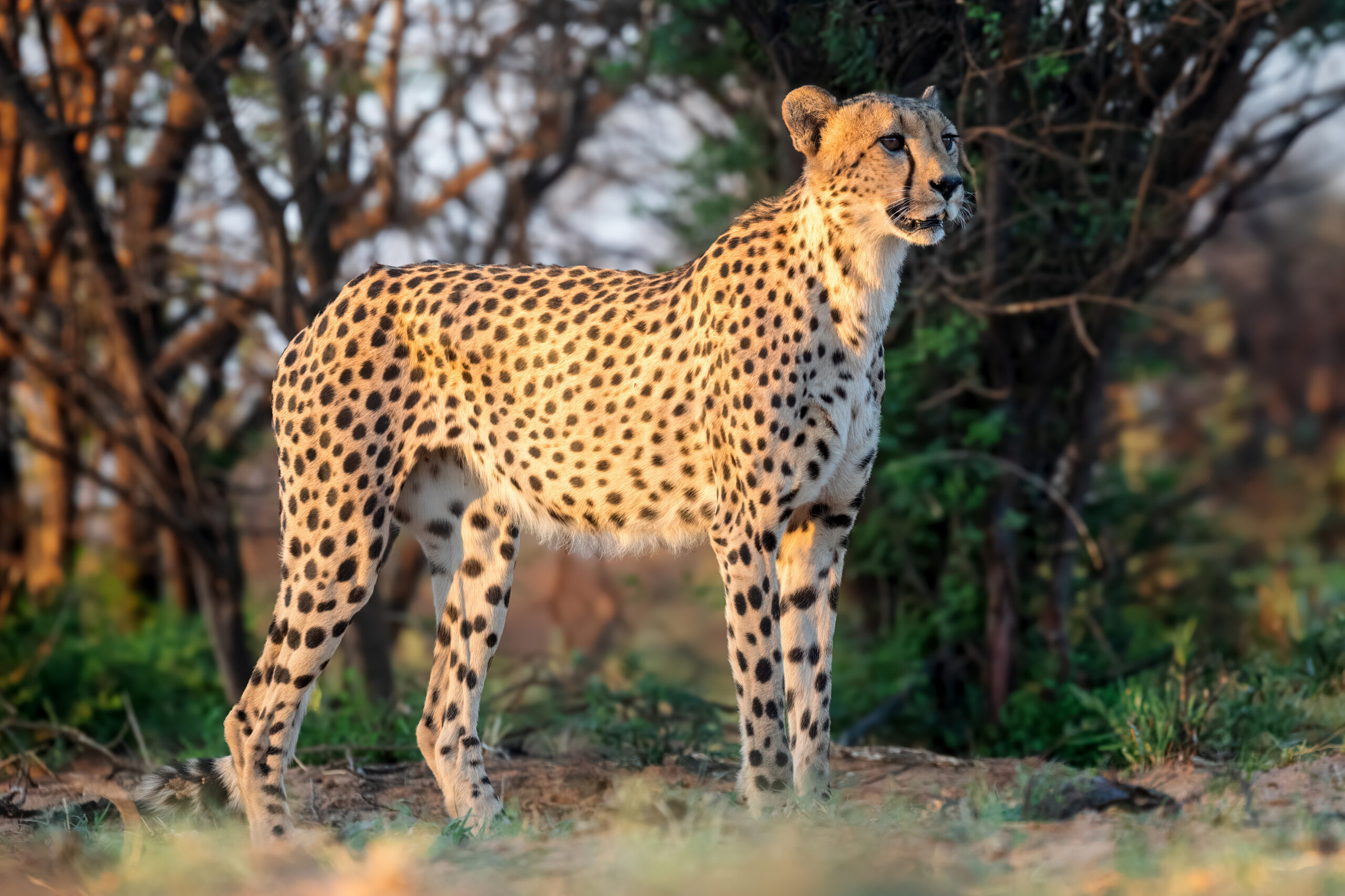
Project Cheetah, India’s flagship intercontinental species-reintroduction programme, has entered a new phase. The total cheetah count in the country has crossed 50 individuals — a mix of imported Namibian and South African adults plus a growing cohort of India-born cubs — and the programme has formally moved beyond its single founding site at Kuno National Park.
The decisive shift is the activation of Gandhi Sagar Wildlife Sanctuary in Madhya Pradesh as a second home for cheetahs. With the first animals shifted there in April 2025 and a contiguous Kuno-Gandhi Sagar-Mukundra corridor being planned across Madhya Pradesh and Rajasthan, the programme is now pivoting from a single-site experiment toward a managed metapopulation spread over a larger landscape.
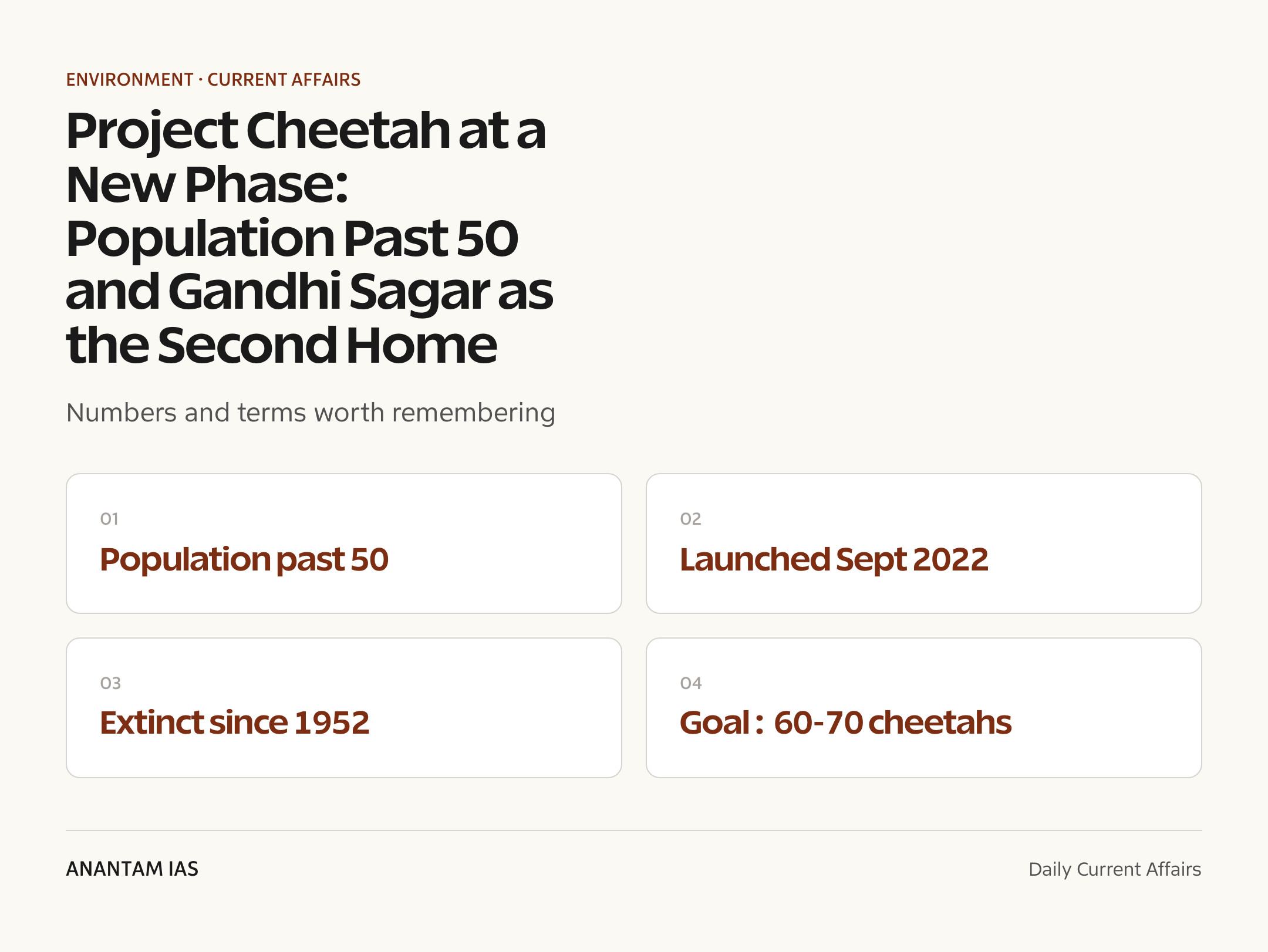
- India’s cheetah population has crossed the 50-individual threshold, combining Namibian and South African founders with India-born cubs.
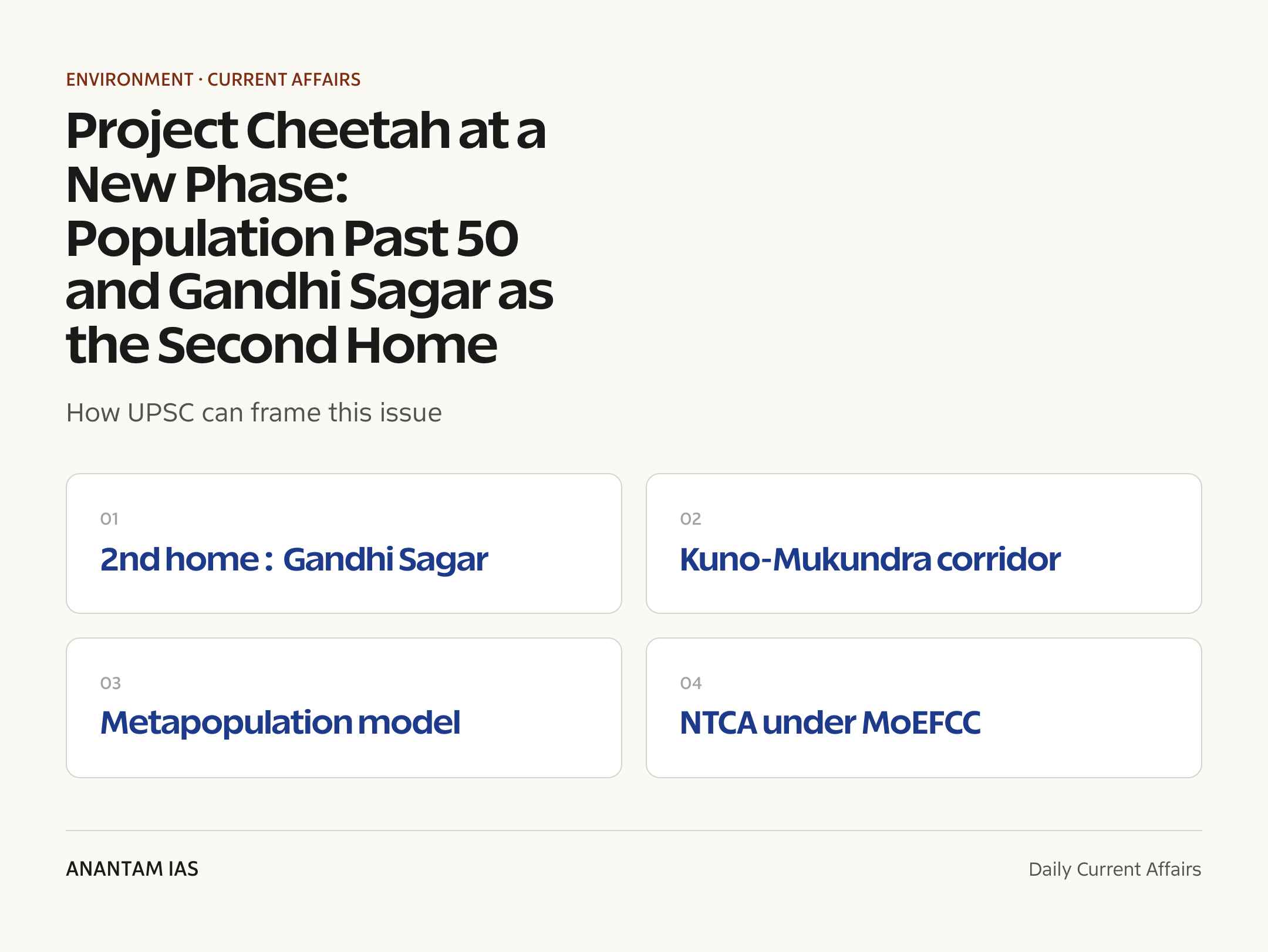
- Gandhi Sagar Wildlife Sanctuary (Mandsaur-Neemuch districts, Madhya Pradesh) is now the programme’s second home after Kuno National Park.
- The first cheetahs were translocated to Gandhi Sagar in April 2025, ending the single-site phase of the project.
- Authorities are developing a Kuno-Gandhi Sagar-Mukundra conservation landscape spanning Madhya Pradesh and Rajasthan.
- The long-term design follows the metapopulation model, in which several linked sub-populations are managed as one viable whole.
The development matters in the context of:
- Project Cheetah was launched in September 2022 as the world’s first intercontinental translocation of a large carnivore.
- The cheetah was declared extinct in India in 1952, making this a true reintroduction rather than a population top-up.
- The programme is implemented by the National Tiger Conservation Authority (NTCA) under the Ministry of Environment, Forest and Climate Change.
UPSC Relevance
Prelims Relevance
- Project Cheetah began in September 2022; 8 cheetahs from Namibia were released at Kuno on 17 September 2022 and 12 from South Africa on 18 February 2023.
- Kuno National Park lies in Sheopur district, Madhya Pradesh, on the Kuno river, a tributary of the Chambal.
- Gandhi Sagar Wildlife Sanctuary straddles the Mandsaur and Neemuch districts of north-western Madhya Pradesh, bordering Rajasthan, and is bisected by the Chambal river.
- The cheetah was officially declared extinct in India in 1952; the last individuals were recorded in present-day Chhattisgarh.
- Project Cheetah is implemented by the NTCA under the Ministry of Environment, Forest and Climate Change (MoEFCC).
- The Kuno-Gandhi Sagar landscape is an interstate complex of roughly 17,000 sq km across Madhya Pradesh and Rajasthan, mostly within the Chambal basin.
- Connectivity to Rajasthan’s Mukundra Hills Tiger Reserve and conservation reserves in Kota and Baran is central to the corridor plan.
- The cheetah (Acinonyx jubatus) is the world’s fastest land animal and an inhabitant of open grassland and savannah ecosystems.
- A planned cheetah metapopulation of 60-70 individuals across the Kuno-Gandhi Sagar landscape is the stated long-term goal.
- Cheetahs at Kuno that crossed into Rajasthan were described by the NTCA as displaying natural territorial dispersal rather than straying.
Mains Relevance
GS Paper 3
- Project Cheetah as a case study in species reintroduction, intercontinental translocation, and the scientific risks of restoring a locally extinct large carnivore.
- The shift from a single site to a metapopulation across linked habitats illustrates landscape-level conservation and the value of ecological corridors.
- Establishing Gandhi Sagar as a second home raises questions of prey-base preparation, habitat carrying capacity, and disease/genetic risk that the syllabus treats under conservation of biodiversity.
Essay
- Restoring a species erased from the land seven decades ago tests whether human ambition can repair what human action destroyed.
- A second home for the cheetah is a reminder that conservation succeeds not at single points but across connected landscapes.
Background and Context
The new phase: population past 50 and a second site
The headline development is twofold — a numerical milestone and a spatial one.
- The total cheetah count in India has crossed 50, drawing on imported Namibian and South African adults together with India-born cubs.
- Several cubs born on Indian soil have survived past the vulnerable early months, a marker the project treats as proof of breeding success in a reintroduced founder stock.
- The first births of Namibian cheetah cubs in India after roughly seven decades, noted by Drishti IAS, signalled that the species could reproduce in Indian conditions.
- Crucially, the programme is no longer confined to one park — the activation of a second home marks its transition from pilot to landscape-scale effort.
Gandhi Sagar Wildlife Sanctuary as the second home
Gandhi Sagar was chosen to spread risk and expand the programme’s footprint.
- The sanctuary lies in the Mandsaur and Neemuch districts of north-western Madhya Pradesh, on the boundary with Rajasthan, and is bisected by the Chambal river.
- It sits within dry deciduous forest and open grassland terrain broadly suited to cheetahs, which hunt by sight and speed across open ground.
- The first cheetahs were shifted to Gandhi Sagar in April 2025, opening the second site after extensive prey-base and enclosure preparation.
- A dedicated NTCA action plan for cheetah introduction at Gandhi Sagar (2024) framed the sanctuary as the natural next step after Kuno.
- Establishing a second population guards against a single catastrophic event — disease, drought or flood — wiping out the entire founder stock at one location.
The Kuno-Gandhi Sagar-Mukundra corridor
The two sites are meant to function as parts of one connected landscape, not as isolated islands.
- Authorities envisage a contiguous cheetah conservation landscape linking Kuno and Gandhi Sagar across Madhya Pradesh and Rajasthan.
- The landscape, largely within the Chambal basin, is estimated at around 17,000 sq km, with the majority in Madhya Pradesh and the remainder in Rajasthan.
- Connectivity runs through territorial forest divisions of Kota, Baran, Jhalawar and Chittorgarh and links to Rajasthan’s Mukundra Hills Tiger Reserve.
- The NTCA has described cheetahs crossing from Kuno into Rajasthan as showing natural territorial behaviour, underlining why a planned corridor matters.
- The stated long-term target is a metapopulation of 60-70 cheetahs across this Kuno-Gandhi Sagar landscape.
Project Cheetah: a brief recap
The current phase builds on a programme launched only a few years ago.
- Project Cheetah was launched in September 2022 and is billed as the world’s first intercontinental translocation of a large carnivore.
- On 17 September 2022, 8 cheetahs from Namibia were released at Kuno; on 18 February 2023, 12 from South Africa followed.
- The cheetah was declared extinct in India in 1952, so the effort is a reintroduction of a species absent for over seven decades.
- The programme is run by the NTCA under the MoEFCC, with the Wildlife Institute of India and African partners providing technical support.
- Anantam IAS has covered the founding site separately in its note on Kuno National Park and the new site in its note on the Gandhi Sagar Wildlife Sanctuary.
Why a metapopulation approach
The science of small-population persistence drives the design.
- IUCN reintroduction guidance favours managing a species across several linked sub-populations rather than a single isolated one.
- A metapopulation allows managers to move individuals between sites to maintain genetic diversity and replace local losses.
- Population viability analyses cited for the project suggest a higher chance of long-term persistence when numbers exceed 50 individuals or when smaller groups are managed as a connected whole.
- Spreading animals across Kuno, Gandhi Sagar and the wider landscape reduces dependence on the carrying capacity of any one park.
Challenges that persist
The new phase does not erase the programme’s known stress points.
- Prey density and habitat readiness at each new site must be built up before cheetahs can range freely and hunt unaided.
- Cheetah mortality — from infections, injuries and inter-cheetah conflict — has dogged the project and demands close veterinary monitoring.
- Long periods in fenced enclosures raise debate over whether the animals are truly free-ranging or intensively managed.
- Dispersal into human-use areas around the parks creates potential for human-wildlife conflict that the corridor plan must manage.
- Some ecologists question whether African cheetahs are an ecological match for India’s historically present Asiatic cheetah and savannah-type habitats.
Significance for India
Beyond the cheetah itself, the project carries wider weight.
- Success would make India the first country to host a self-sustaining intercontinentally reintroduced big-cat-class predator.
- Restoring an apex predator can help revive grassland and savannah ecology, habitats often neglected in a forest-focused conservation system.
- The corridor model offers a template for landscape-level conservation that prioritises connectivity over isolated protected areas.
- The programme strengthens India’s standing in global biodiversity diplomacy through cooperation with Namibia, South Africa and other range states.
Way Forward
The immediate priority is to consolidate Gandhi Sagar as a functioning second home — building prey density, monitoring the translocated animals, and steadily moving from enclosures toward free-ranging conditions. Genetic management across sites should begin early so that the emerging population avoids the inbreeding traps that shrink small founder stocks.
Over the longer run, the corridor linking Kuno, Gandhi Sagar and Mukundra needs legal and ecological protection so that natural dispersal is an asset rather than a conflict trigger. Transparent reporting of births, deaths and ranging behaviour, alongside community engagement in fringe villages, will determine whether the metapopulation goal of 60-70 cheetahs is realistic.
Conclusion
Crossing the 50-cheetah mark and opening Gandhi Sagar as a second home together mark the most substantive checkpoint for Project Cheetah since its 2022 launch. The programme has moved from a high-profile single-site experiment toward the harder, slower work of building a connected, self-sustaining population across a real landscape.
Whether that landscape becomes a durable cheetah range or remains a managed showcase will hinge on prey bases, corridor protection and honest accounting of losses. For now, the milestone confirms that reintroducing a species lost in 1952 is biologically possible — and that the next chapter is about ecology and connectivity, not just arrivals.
UPSC Practice Questions
Prelims MCQ 1
With reference to Project Cheetah, consider the following statements: 1. The first batch of cheetahs introduced under the project came from Namibia. 2. The project is implemented by the National Tiger Conservation Authority under the Ministry of Environment, Forest and Climate Change. 3. The cheetah was declared extinct in India in 1952. Which of the statements given above are correct?
1 and 2 only 2 and 3 only 1 and 3 only 1, 2 and 3
Answer: 1, 2 and 3
Explanation:
All three are correct. Eight Namibian cheetahs were released at Kuno in September 2022; the NTCA under the MoEFCC implements the project; and the cheetah was declared extinct in India in 1952.
Prelims MCQ 2
Gandhi Sagar Wildlife Sanctuary, recently designated a second home for cheetahs, is located in which state and is associated with which river?
Rajasthan; Banas river Madhya Pradesh; Chambal river Gujarat; Sabarmati river Maharashtra; Tapi river
Answer: Madhya Pradesh; Chambal river
Explanation:
Gandhi Sagar Wildlife Sanctuary lies in the Mandsaur and Neemuch districts of north-western Madhya Pradesh, bordering Rajasthan, and is bisected by the Chambal river.
UPSC Mains Questions
- Project Cheetah has entered a new phase with the opening of Gandhi Sagar as a second home and a population crossing 50. Examine the ecological rationale for a metapopulation approach to cheetah reintroduction in India. (250 words)
- Discuss the challenges of reintroducing a locally extinct large carnivore, using Project Cheetah as a case study. How can a landscape-level corridor strategy address these challenges? (250 words)
- “Restoring grassland predators is as important as protecting forests.” Critically analyse this statement in the context of Project Cheetah and India’s neglect of savannah ecosystems. (150 words)
Sources: Drishti IAS and National Tiger Conservation Authority (NTCA).
Frequently Asked Questions
Why is Gandhi Sagar Wildlife Sanctuary in the news?
It has been activated as the second home for cheetahs under Project Cheetah after Kuno National Park, with the first animals translocated there in April 2025.
Where is Gandhi Sagar Wildlife Sanctuary located?
It lies in the Mandsaur and Neemuch districts of north-western Madhya Pradesh, on the border with Rajasthan, and is bisected by the Chambal river.
How many cheetahs are there in India now?
The total count has crossed 50 individuals, combining the imported Namibian and South African founders with cubs born in India; exact figures are revised periodically by the NTCA.
What is the Kuno-Gandhi Sagar-Mukundra corridor?
It is a planned contiguous conservation landscape linking Kuno and Gandhi Sagar with Rajasthan’s Mukundra Hills Tiger Reserve, allowing cheetahs to be managed as a single connected metapopulation.
When was Project Cheetah launched and by whom?
It was launched in September 2022 and is implemented by the National Tiger Conservation Authority under the Ministry of Environment, Forest and Climate Change.
Why is a metapopulation approach used for cheetahs?
Managing several linked sub-populations across sites helps maintain genetic diversity, replace local losses, and improve the long-term survival odds of a small reintroduced population.