
Gandhi Sagar Wildlife Sanctuary is a protected area located in the Mandsaur and Neemuch districts of Madhya Pradesh, spread over approximately 368.62 sq km along the banks of the Chambal River and the Gandhi Sagar Reservoir. It has gained major attention in recent years as the second site in India for cheetah reintroduction under Project Cheetah, after Kuno National Park. For UPSC aspirants, Gandhi Sagar Wildlife Sanctuary is a crucial topic cutting across GS Paper I (Geography), GS Paper III (Environment & Ecology), and current affairs involving wildlife conservation, species reintroduction, and the Chambal ecosystem. Understanding its location, biodiversity, and policy significance is essential for both Prelims and Mains.
Where Is Gandhi Sagar Wildlife Sanctuary Located?
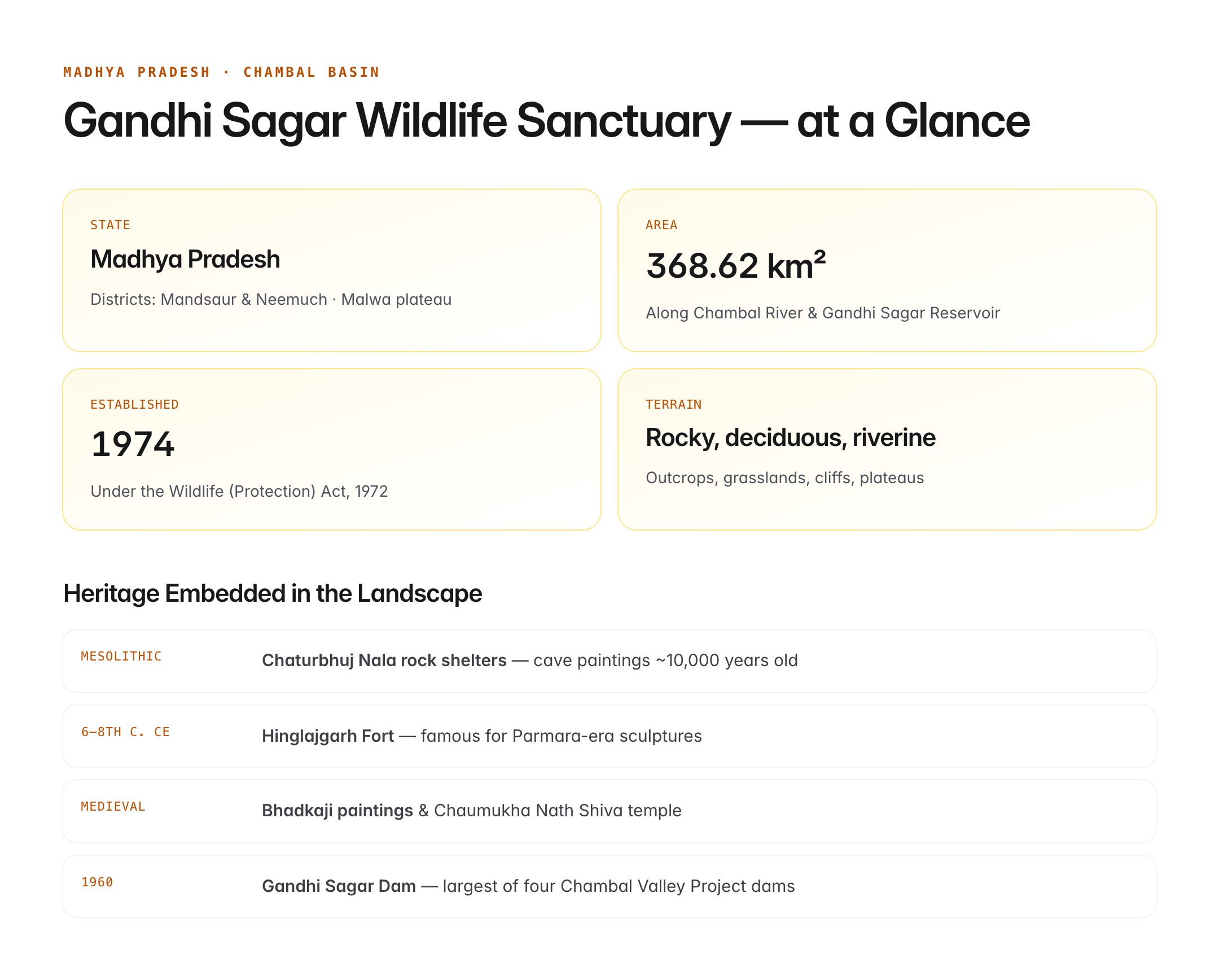
- State: Madhya Pradesh
- Districts: Mandsaur and Neemuch (Malwa plateau region)
- River: Along the Chambal River
- Reservoir: Gandhi Sagar Dam (largest of the four Chambal dams)
- Area: ~368.62 sq km
- Established: 1974 under the Wildlife (Protection) Act, 1972
- Terrain: Rocky outcrops, dry deciduous forests, riverine grasslands, cliffs, and plateaus
The sanctuary lies adjacent to the Rajasthan border, and across it, Bhainsrodgarh Wildlife Sanctuary and Rawatbhata forests form a continuous habitat corridor.
Historical and Cultural Significance
Gandhi Sagar is not just an ecological zone — it is a cultural and historical landscape:
- Chaturbhuj Nala rock shelters — ancient rock paintings dating to the Mesolithic era (~10,000 years old).
- Bhadkaji rock paintings and Chaumukha Nath Temple — medieval heritage.
- Hinglajgarh Fort — 6th–8th century fort, famous for Parmara-era sculptures.
- Chaumukh Nath — an ancient Shiva temple.
- Gandhi Sagar Dam — built on the Chambal under the Chambal Valley Project (constructed in 1960).
This blend of prehistoric, medieval, and modern heritage gives the sanctuary added conservation value.
Flora and Fauna
Flora
- Dry deciduous forests, dominated by:
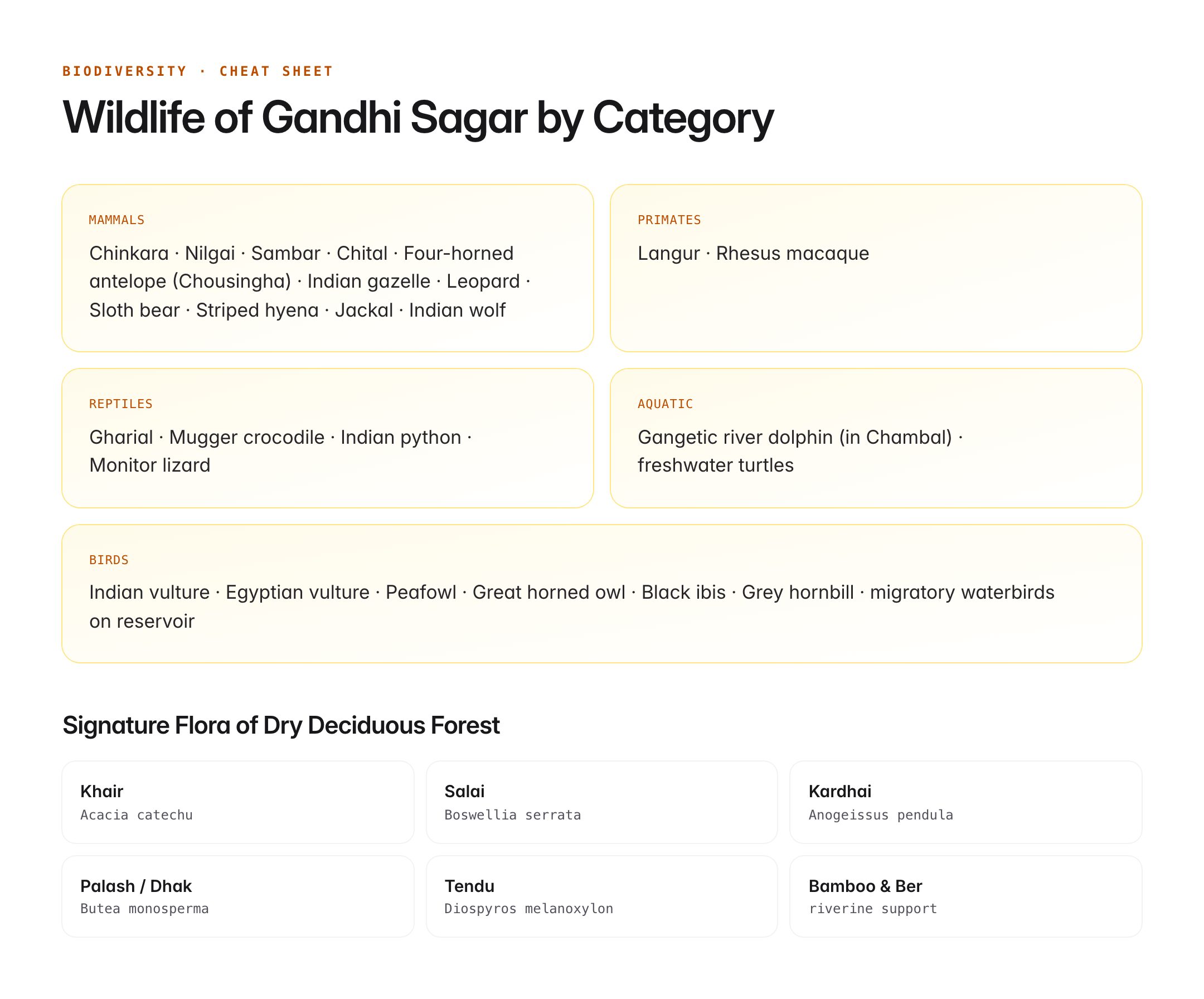
- Khair (Acacia catechu)
- Salai (Boswellia serrata)
- Kardhai (Anogeissus pendula)
- Dhak/Palash (Butea monosperma)
- Tendu, Bamboo, Ber
- Grasslands along the Chambal ravines.
Fauna
| Category | Key Species |
|---|---|
| Mammals | Chinkara, Nilgai, Sambar, Chital, Four-horned antelope (Chousingha), Indian gazelle, Leopard, Sloth bear, Striped hyena, Jackal, Indian wolf |
| Primates | Langur, Rhesus macaque |
| Reptiles | Gharial, Mugger crocodile, Indian python, Monitor lizard |
| Aquatic | Freshwater Gangetic dolphin (in Chambal), Turtles |
| Birds | Indian vulture, Egyptian vulture, Peafowl, Great horned owl, Black ibis, Grey hornbill |
The Chambal ecosystem supports the National Chambal Gharial Sanctuary (nearby tri-state sanctuary of MP, UP, Rajasthan) which harbors gharials, mugger crocodiles, and river dolphins.
Gandhi Sagar and Project Cheetah
Background
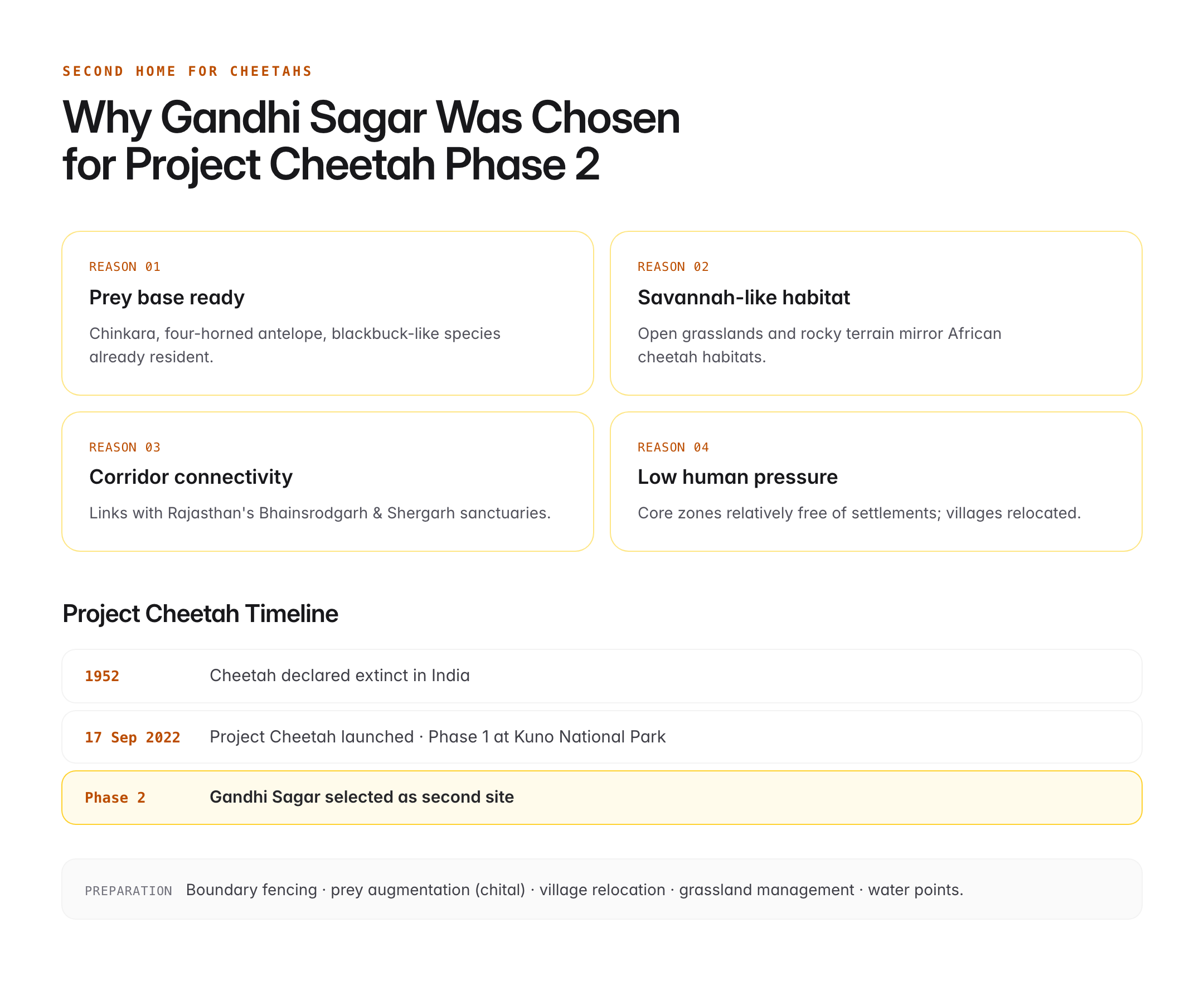
- Project Cheetah launched by the Government of India on 17 September 2022 — the world's first intercontinental translocation of a large carnivore.
- Phase 1: Cheetahs from Namibia and South Africa translocated to Kuno National Park (MP).
- Phase 2: Gandhi Sagar Wildlife Sanctuary identified as the second home for African cheetahs.
Why Gandhi Sagar?
- Prey base: Chinkara, blackbuck-like species, four-horned antelope.
- Open grasslands and rocky terrain — similar to African savannah.
- Connectivity with Rajasthan's Bhainsrodgarh Sanctuary and Shergarh Sanctuary, creating a larger cheetah landscape.
- Low human pressure in core zones.
- Capacity: Estimated to support a founder population of cheetahs after habitat preparation.
Preparations Undertaken
- Boundary fencing of core area.
- Prey augmentation — introduction of chital and other ungulates.
- Relocation of villages from core areas.
- Upgrade of habitat — grassland management, water points.
- Arrival of cheetahs into Gandhi Sagar began as part of the phased rollout of Project Cheetah.
Ecological Significance
- Protects the Chambal River ecosystem, home to gharial (Critically Endangered) and Ganges river dolphin.
- Forms part of a regional conservation corridor connecting Madhya Pradesh and Rajasthan.
- Habitat for the rare Indian wolf and threatened vultures.
- Supports migratory waterbirds on Gandhi Sagar reservoir.
- Acts as an in-situ conservation laboratory for reintroducing the cheetah — India's extinct large carnivore (declared extinct in India in 1952).
Threats
- Sand mining along Chambal.
- Poaching of antelopes and reptiles.
- Ravine degradation and soil erosion.
- Human-wildlife conflict at fringe villages.
- Invasive species like Prosopis juliflora.
- Reservoir fluctuations affecting riparian habitats.
Conservation Framework
- Governed under the Wildlife (Protection) Act, 1972.
- Managed by MP Forest Department in coordination with:
- NTCA (National Tiger Conservation Authority) — advisory role for Project Cheetah.
- Wildlife Institute of India (WII) — scientific monitoring.
- MoEFCC — policy oversight.
- Part of Cheetah Task Force recommendations.
Comparative Context
| Protected Area | State | Significance |
|---|---|---|
| Kuno National Park | MP | First Project Cheetah site |
| Gandhi Sagar WLS | MP | Second Project Cheetah site |
| Shahgarh Landscape | Rajasthan | Proposed as cheetah habitat |
| Nauradehi WLS | MP | Earlier proposed for cheetahs |
| National Chambal Sanctuary | MP/UP/Raj | Gharial and dolphin habitat |
UPSC Relevance
- Prelims focus: Location (Madhya Pradesh; Mandsaur–Neemuch districts), Chambal River, Gandhi Sagar Dam, year of establishment (1974), Project Cheetah (2022), second cheetah home after Kuno, rock paintings, Hinglajgarh Fort, Wildlife Protection Act, 1972.
- Mains GS-III angle: Biodiversity conservation; species reintroduction and its scientific and ethical dimensions; ecological corridors; Chambal river conservation; Project Cheetah evaluation.
- Sample PYQ angle: "Discuss the rationale and challenges of intercontinental species translocation with reference to Project Cheetah and the role of Gandhi Sagar Wildlife Sanctuary as its second home." — bring in habitat suitability, corridor planning, IUCN reintroduction guidelines, and community involvement.
Tell Google you want more of this.
Add Anantam IAS as a preferred sourceOne tap, and this site shows up more often in your own Top Stories, AI Overviews and AI Mode. Remove it any time.