Quantum-AI Peptide Design: What the Cancer Vaccine Study Proved
Why in News?
A DTU-led research consortium reported a hybrid quantum-classical pipeline that used a real photonic processor with a generative AI model to design short peptides predicted to bind human leukocyte antigen molecules. The work appeared as a bioRxiv preprint on July 10, 2026 and was discussed by The Indian Express.
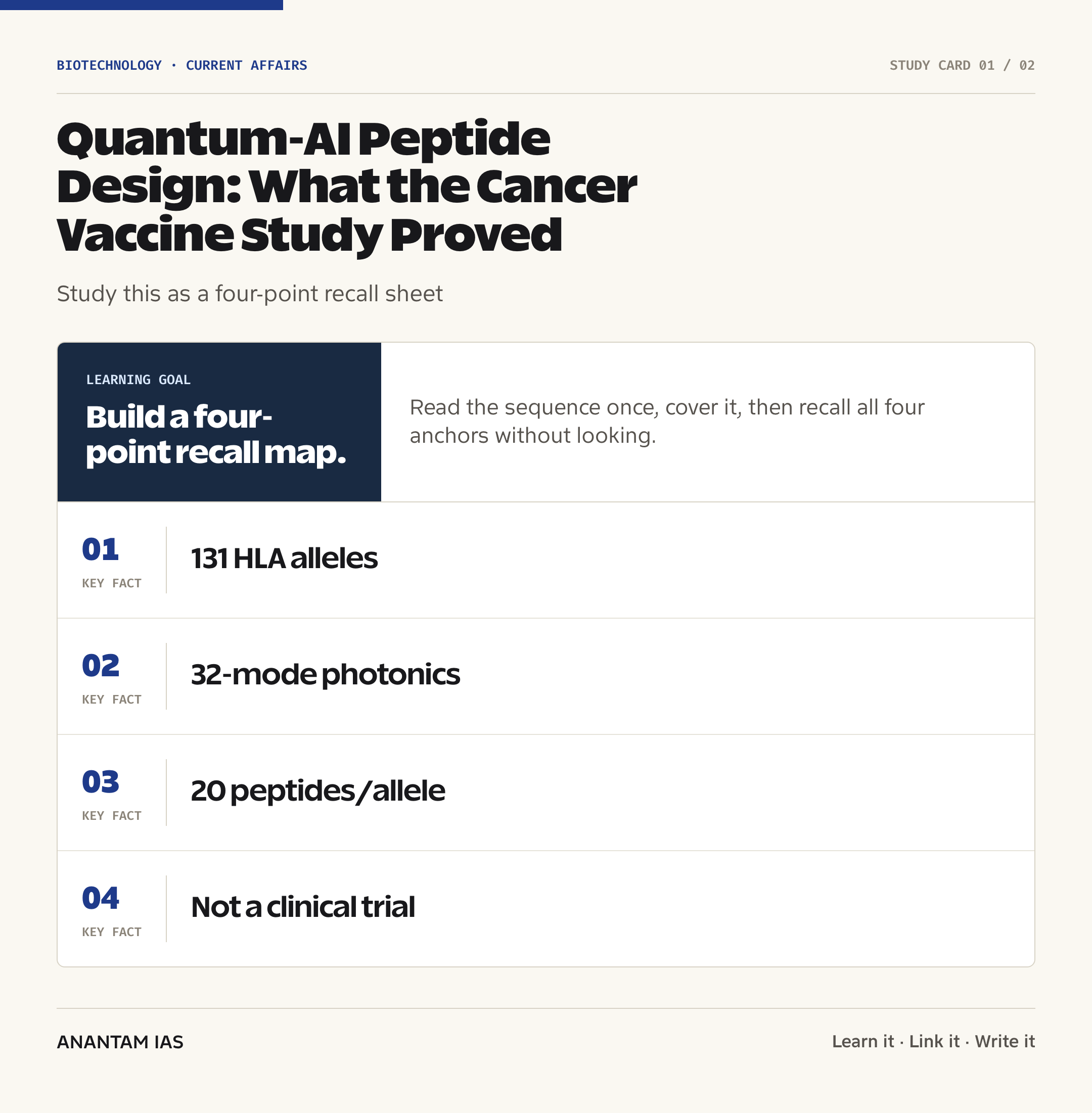
The result is an early proof of concept, not a clinically tested cancer vaccine. Researchers demonstrated computational generation and laboratory stabilisation of peptide–MHC complexes; they did not show tumor targeting, T-cell activation, protection in animals, safety in humans or improved patient outcomes.
- The model combined a conditional generative adversarial network with latent samples from a 32-mode photonic quantum processor.
- Researchers evaluated generated nine-amino-acid peptides across 131 HLA alleles, including five alleles absent from the training dataset.
- For three understudied alleles, the team synthesised the 20 highest-ranked peptides per allele and tested peptide–MHC stability by ELISA.
- Quantum-prior models produced more predicted strong binders than simple Gaussian and Bernoulli baselines, with gains concentrated in data-sparse alleles.
- The authors explicitly stated that the system size remained classically simulable and that their results did not demonstrate quantum advantage.
The development matters in the context of:
- The finding matters in the context of personalised medicine, where an individual’s HLA type affects which peptide fragments can be presented to T cells.
- It also highlights the difference between candidate discovery and a medical product: MHC binding is necessary for many peptide vaccines, but it is not sufficient for immunogenicity or clinical benefit.
- For India, the study connects biotechnology with the National Quantum Mission, while showing why public investment must pair frontier computing with wet-lab validation, representative biological data and health regulation.
UPSC Relevance
Prelims Relevance
- Major histocompatibility complex class I molecules display intracellular peptide fragments on most nucleated cells for surveillance by CD8+ T cells.
- Human leukocyte antigen is the human form of the MHC system; HLA genes are highly polymorphic, so binding preferences vary between alleles.
- A peptide is a short chain of amino acids; the experiment restricted its training set to nine-amino-acid peptides, a common MHC-I ligand length.
- A generative adversarial network contains a generator that proposes samples and a discriminator that distinguishes generated samples from training data.
- The model’s latent prior is the input probability distribution from which the generator begins its search; the study compared quantum-derived priors with Gaussian and Bernoulli priors.
- Gaussian boson sampling uses squeezed light, optical interference and photon-number detection to sample a correlated probability distribution.
- In silico means computer-based evaluation; in vitro refers to experiments performed outside a living organism under laboratory conditions.
- A peptide–MHC stability ELISA can test whether a peptide stabilises an MHC complex, but it does not establish T-cell recognition or therapeutic efficacy.
- A neoantigen is a tumor-specific antigen arising from mutations; this study generated HLA-binding peptides without building a patient-specific tumor vaccine.
- A preprint is a research manuscript shared before formal peer review; its conclusions require independent scrutiny and replication.
Mains Relevance
GS Paper 3
- Convergence of quantum computing, artificial intelligence and biotechnology in therapeutic-candidate discovery.
- Role of India’s National Quantum Mission in building research capacity, hardware access, skills and translational partnerships.
- Need to distinguish a computational benchmark from clinical evidence when evaluating emerging technologies.
GS Paper 2
- Public-health implications of personalised medicine, including affordability, informed consent, privacy and equitable access.
- Regulatory need for staged evidence across laboratory studies, preclinical models and human trials before medical claims are made.
GS Paper 4
- Ethics of communicating early biomedical research without hype, especially when patients may mistake candidate design for an available treatment.
- Fair representation of diverse HLA profiles in datasets to reduce population bias in precision health tools.
Essay
- Frontier technologies create public value when computational novelty is matched by biological proof and responsible communication.
- Precision medicine can widen health equity only if its data, validation and access models include underrepresented populations.
Background and Context
How T Cells Read Peptide Signals
The immune relevance begins with antigen presentation, not with the quantum computer.
- Cells break proteins into short peptide fragments, load some onto MHC-I molecules and display them for inspection by CD8+ T cells.
- In humans, MHC molecules are encoded by highly variable HLA genes; each allele has preferences for amino acids at particular anchor positions.
- For a therapeutic cancer vaccine, a useful peptide should ideally originate from a tumor-specific or tumor-associated antigen, bind the patient’s HLA, be naturally processed and presented, activate suitable T cells, avoid harmful cross-reactivity and produce clinical benefit.
- The current study addressed mainly one gate in that chain: whether generated peptides can form stable complexes with selected MHC-I molecules.
How the Hybrid Pipeline Worked
The experiment altered the starting distribution of an otherwise classical generative model.
- The training set contained 105,970 experimentally validated peptide–HLA ligand pairs, representing about 77,000 unique nine-amino-acid sequences across 126 MHC-I molecules.
- A conditional GAN learned to generate peptide sequences for a specified HLA label; its architecture and training objective were held constant across comparisons.
- Classical baselines used factorised Gaussian and Bernoulli input distributions. Quantum conditions used distributions from simulated boson sampling and from a physical photonic processor.
- The real device was a 32-mode photonic system hosted at the United Kingdom’s National Quantum Computing Centre. It used optical interference and photon-number detection to produce correlated samples.
- The quantum hardware did not simulate immune biology or calculate a finished vaccine. It supplied a structured latent prior that seeded the classical generator’s search.
What the Computational Results Showed
The reported gain was real within the chosen benchmark but modest on average and dependent on the comparison.
- The team generated 1,000 peptide sequences per target allele across 131 HLA alleles and used NetMHCpan 4.2 to predict binding.
- A peptide was labelled a predicted strong binder at an eluted-ligand percentile rank of 0.5%, and each model configuration was trained with 30 random seeds.
- A quantum-derived prior outperformed the Gaussian prior on 63% of alleles; the real-hardware condition showed an estimated gain of 6.3 strong binders per 1,000 attempts.
- The simulated quantum prior showed an estimated gain of 10.6 additional strong binders per 1,000 over the Gaussian baseline.
- Benefits were concentrated among alleles for which classical baselines performed poorly or moderately, supporting the hypothesis that structured priors may help explore data-sparse sequence spaces.
- Quantum-prior models increased diversity mainly at non-anchor positions while preserving recognised HLA anchor patterns, suggesting broader exploration rather than random loss of specificity.
What the Laboratory Test Added
Wet-lab testing strengthened the binding claim but did not move the work to animal or clinical evidence.
- Researchers selected HLA-A*68:01, HLA-B*37:01 and HLA-A*31:01, three underrepresented alleles for which the quantum-prior model had shown gains.
- They synthesised the 20 top-ranked peptides for each allele from the physical quantum-prior configuration and included three predicted non-binders per allele as negative controls.
- A UV-mediated exchange assay replaced a light-cleavable peptide, after which a sandwich ELISA measured whether each candidate stabilised the peptide–MHC complex.
- All tested predicted binders for HLA-A*31:01 and HLA-A*68:01 crossed the positivity threshold; HLA-B*37:01 produced many binders but also several failures.
- The best quantum-generated and classical-generated sets had similar mean ELISA signals, although the strongest binder for each tested allele came from the quantum-prior model.
- The observations don’t establish immune-cell activation, tumor killing, safety, dose, delivery, durability or survival benefit.
Why This Is Not Yet a Cancer Vaccine
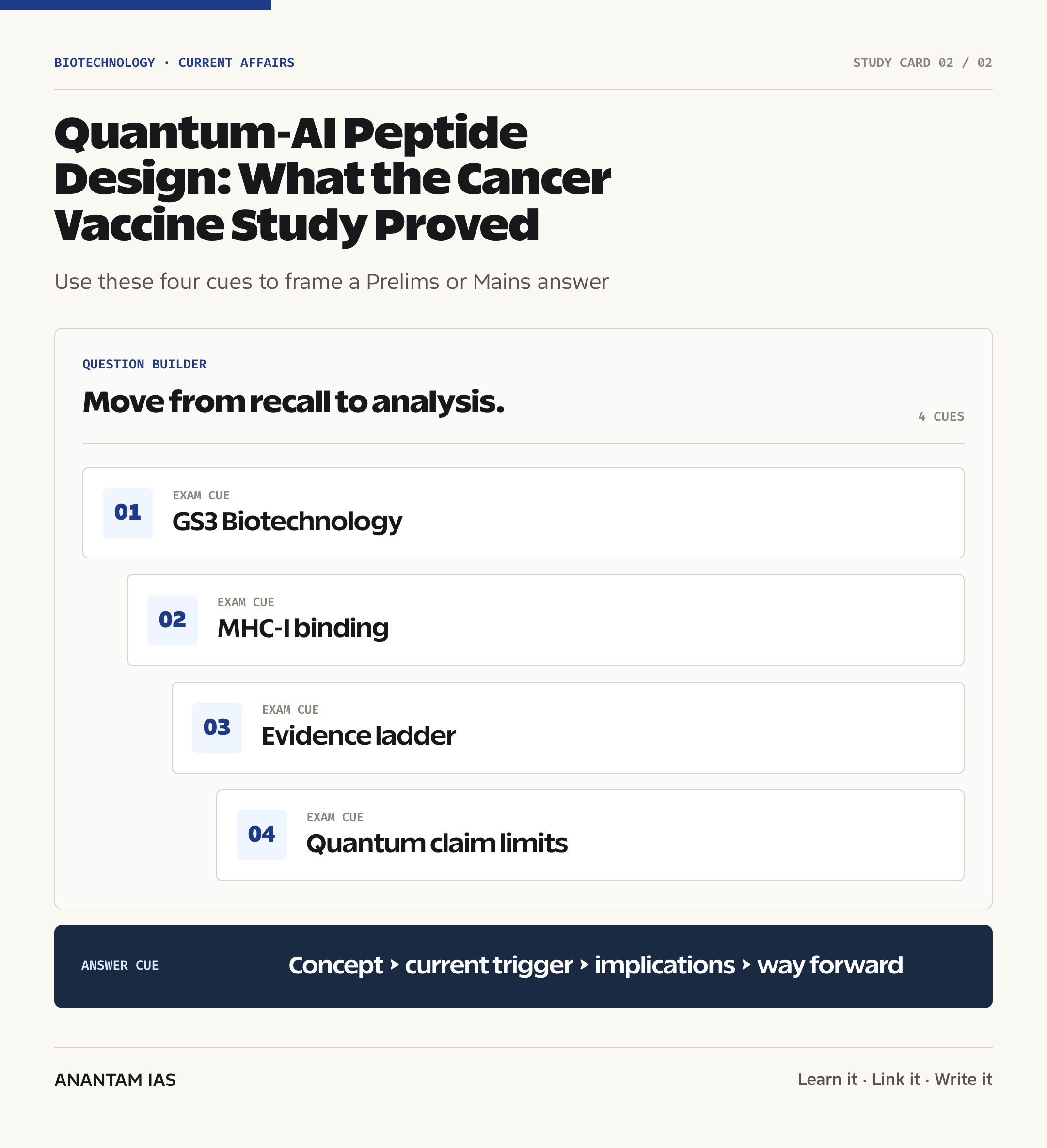
The evidence ladder prevents a promising design method from being mistaken for a therapy.
- The researchers did not begin with a patient’s tumor mutations and did not show that generated sequences were tumor-specific neoantigens.
- MHC binding is necessary for many peptide-vaccine strategies, but immunogenicity also depends on antigen processing, natural presentation, T-cell receptor availability, immune context and immune escape.
- No experiment tested T-cell activation, cytokine response, selective killing of cancer cells, tumor control in animals or outcomes in human clinical trials.
- The manuscript was a preprint, so peer review, independent replication and broader experimental comparison remained pending.
- The authors said their 32-dimensional distributions were classically simulable. The experiment demonstrated a useful quantum-derived input, not quantum computational advantage.
- A safe description is: a hybrid platform generated laboratory-confirmed HLA-binding peptide candidates that may inform future immunotherapy research.
Equity, Governance and India's Policy Opportunity
The most important policy question is whether frontier models work for diverse populations and reach patients responsibly.
- HLA allele frequencies differ across populations, while immunopeptidomics datasets often overrepresent groups with stronger research infrastructure. This can produce data inequity in prediction quality.
- A model that improves candidate yield for underrepresented alleles could support inclusion, but only after validation using representative Indian HLA data and transparent performance reporting.
- India can link the National Quantum Mission with genomics, immunology, bioinformatics and clinical-research networks instead of treating quantum hardware as an isolated computing project.
- Publicly funded platforms should require auditable datasets, reproducible benchmarks, disclosure of competing interests, privacy protection and clear labels for preclinical evidence.
- Personalised products may be expensive and logistically demanding. Policy must consider manufacturing, diagnostics and access so that personalised medicine does not become limited to a small group.
Way Forward
Climb the Biological Evidence Ladder
- Test whether candidates are naturally processed and presented on tumor cells through immunopeptidomics, not binding assays alone.
- Measure T-cell recognition, specificity, cross-reactivity and tumor-cell killing before moving to animal studies and phased clinical trials.
- Integrate antigen origin and tumor expression with HLA binding so the model designs medically relevant candidates.
Benchmark the Quantum Contribution
- Compare quantum priors against richer classical priors, modern generative architectures and matched computing budgets using preregistered metrics.
- Release non-proprietary code and sampling details where possible, invite replication and report runtime, cost and scaling before claiming quantum advantage.
Build Representative and Ethical Datasets
- Expand allele-resolved datasets with informed consent and strong privacy safeguards, especially for populations underrepresented in existing HLA resources.
- Communicate the stage of evidence in plain language so patients aren’t misled by labels such as cancer vaccine breakthrough.
Create an Indian Translational Testbed
- Connect quantum mission hubs with DBT, ICMR, hospitals, biofoundries and clinical-trial networks for joint computational and wet-lab validation.
- Support shared photonic hardware, immunoinformatics skills and milestone-based funding tied to reproducible biological progress.
Conclusion
The study offers a careful proof that a quantum-derived latent prior can change how a classical generative model searches peptide space and can yield candidates that stabilise selected HLA complexes in vitro. Its strongest contribution is methodological: it connects real photonic hardware with an end-to-end biological design-and-test loop.
But the distance from HLA binding to a safe, effective cancer vaccine remains large. The credible next step is not a clinical promise; it is deeper immunological validation, stronger classical benchmarking, representative datasets and transparent evidence. That distinction is central to responsible frontier-technology policy.
UPSC Practice Questions
Prelims MCQ 1
With reference to peptide presentation and the hybrid quantum-AI study, consider the following statements:
- MHC class I molecules commonly present intracellular peptide fragments to CD8+ T cells.
- Human leukocyte antigen alleles can differ in their peptide-binding preferences.
- A stable peptide–MHC complex by itself proves that the peptide will produce clinical protection against cancer.
How many of the above statements are correct?
(a) Only one (b) Only two (c) All three (d) None
Answer: (b) Only two
Explanation:
Statements 1 and 2 are correct. MHC-I presentation is part of CD8+ T-cell surveillance, and HLA polymorphism creates allele-specific binding preferences. Statement 3 is incorrect because binding does not by itself prove immunogenicity, tumor killing, safety or clinical efficacy.
Prelims MCQ 2
What was the most accurate role of the photonic quantum processor in the reported pipeline?
(a) It diagnosed cancer directly from patient scans (b) It simulated complete human immune responses (c) It supplied a structured latent distribution to a classical generative model (d) It conducted a randomised clinical trial
Answer: (c) It supplied a structured latent distribution to a classical generative model
Explanation:
The photonic processor generated correlated samples used as the GAN’s latent prior. The generator, prediction model and laboratory validation performed the other stages; there was no diagnosis, whole-immune-system simulation or clinical trial.
UPSC Mains Questions
- The convergence of quantum computing, artificial intelligence and biotechnology can accelerate candidate discovery, but it can also blur the line between computational promise and medical proof. Discuss the opportunities, evidence requirements and regulatory safeguards for India’s emerging health-technology ecosystem.
- Personalised immunotherapy depends on diverse biological datasets as much as advanced algorithms. Examine how unequal HLA-data coverage can affect health equity, and suggest institutional measures for representative research, privacy protection, transparent benchmarking and affordable access.
- A laboratory demonstration may be scientifically valuable without constituting a deployable therapy or quantum advantage. Using the quantum-AI peptide-design study as context, explain how policymakers should evaluate claims, fund translational research and communicate uncertainty.
Sources: bioRxiv preprint by a DTU-led research consortium and The Indian Express Explained.
Frequently Asked Questions
Did quantum AI create a cancer vaccine?
No. The study generated short peptides designed to bind selected HLA molecules and confirmed peptide–MHC stability in a laboratory assay. It did not create a patient-ready vaccine, use tumor-specific patient data, activate T cells, treat animals or enrol humans. Cancer-vaccine development is a possible future application, not a demonstrated clinical outcome.
What did the quantum computer actually do?
A 32-mode photonic processor produced correlated samples through Gaussian boson sampling. Those samples served as the latent starting distribution for a classical generative adversarial network. The quantum device did not model the whole immune system or test a drug; it influenced how the AI explored possible peptide sequences.
Why are HLA-binding peptides important?
HLA molecules display peptide fragments to T cells. A peptide that binds the right HLA allele may become visible to immune surveillance, making HLA binding an important early filter in peptide-vaccine and T-cell-therapy research. But natural processing, presentation, T-cell recognition, safety and therapeutic effect must still be established.
Did the study prove quantum advantage?
No. The authors explicitly said the tested system size remained classically simulable and the average improvement over simple classical priors was modest. The narrower result is that a structured distribution sampled from real quantum hardware acted as a useful input bias. Stronger classical baselines, scale tests, runtime and cost comparisons remain necessary.
What evidence came from the laboratory?
For three understudied HLA alleles, researchers synthesised the 20 highest-ranked quantum-prior peptides per allele and measured peptide–MHC stability by ELISA. Many candidates stabilised the complexes, with all tested predicted binders succeeding for two alleles. The assay confirmed binding-related stability, not T-cell activation or anti-cancer efficacy.
Why do underrepresented HLA alleles matter?
HLA alleles vary across populations, and prediction systems learn best where experimental data are abundant. Poor coverage can make models less reliable for some groups. Better candidate generation for data-sparse alleles is promising, but equity requires representative datasets, allele-wise audits, consent, privacy protection and independent biological validation.