For most of medicine’s history, a doctor reaching for a prescription pad has been making an educated bet. The drug and the dose printed on the label were worked out for an “average patient” — a statistical fiction assembled from clinical trials — and you were handed the version that helped the most people in those trials. It works often enough. But it also fails quietly and routinely: the same standard dose of a blood-thinner can do nothing in one person and cause a dangerous bleed in another, and the painkiller that settles your neighbour’s migraine may leave yours untouched. Personalised medicine — used almost interchangeably with the term precision medicine — is the deliberate move away from that one-size-fits-all model. It tailors prevention, diagnosis and treatment to an individual’s own genes, environment and lifestyle, so that the right patient gets the right drug at the right dose at the right time.
This is no longer a futurist’s slide. India now has a homegrown cancer cell therapy that re-engineers a patient’s own immune cells, a completed national project that has sequenced 10,000 Indian genomes, and a growing body of evidence that Indians metabolise common drugs differently from the European populations on whom most genetic research was done. For a UPSC aspirant, personalised medicine sits at the live intersection of biotechnology, public health, data privacy and equity — a GS Paper 3 science-and-technology topic that also pulls in ethics and the politics of who gets cutting-edge care. The trick is to explain the core science cleanly and then weigh the promise against the very real problems of cost, privacy and the “missing diversity” in the world’s genomic databases.
What Personalised Medicine Actually Means
Start with the shift in thinking, because the technology only makes sense once you grasp it. Classical medicine treats a disease — say, “breast cancer” or “depression” — as a single thing and gives every patient broadly the same first-line drug. Personalised medicine treats the patient, on the understanding that two people with the same diagnosis may have biologically different diseases that respond to different drugs. The United States National Institutes of Health, which launched its Precision Medicine Initiative in 2015 to push the field forward, defines the approach plainly: it uses information about a person’s genes, environment and lifestyle to guide medical decisions, replacing the average-patient model with one tuned to the individual.
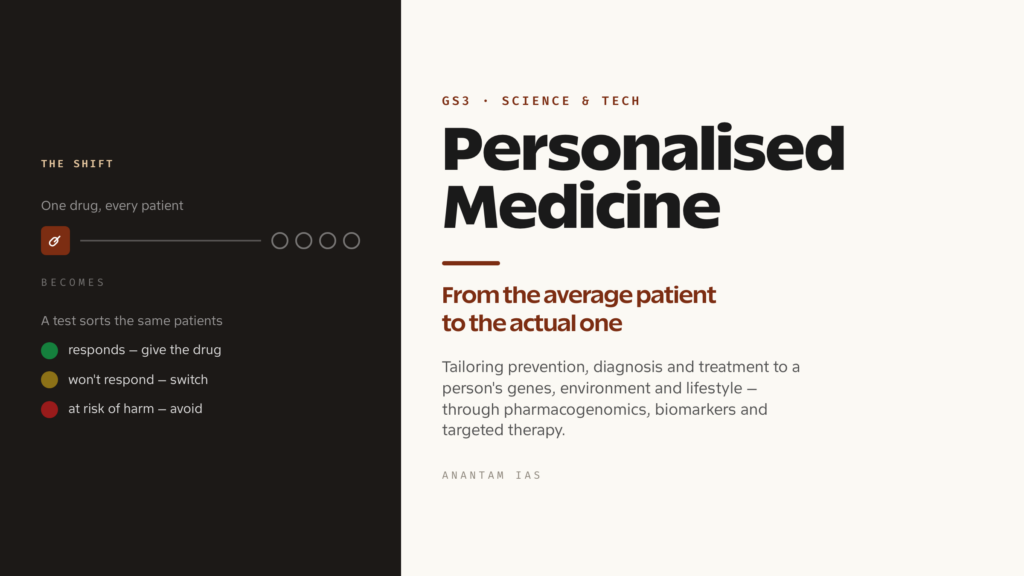
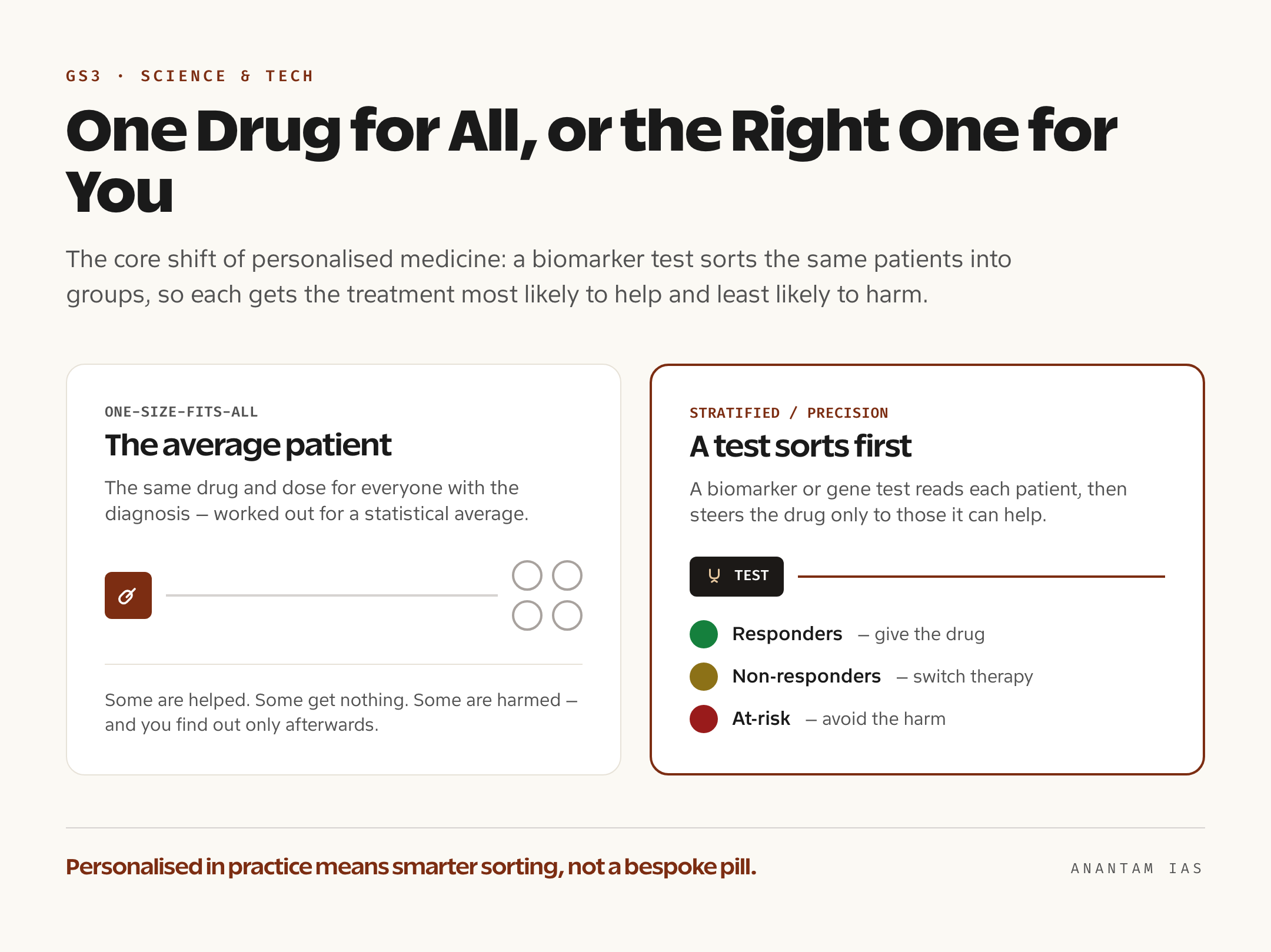
The bridge concept is stratified medicine, and it is the single most exam-useful idea here. Rather than promising a unique drug designed for you alone — which is rare and expensive — personalised medicine usually works by sorting patients into smaller, biologically similar groups, or strata, and matching each group to the therapy most likely to work for it. A test identifies who will respond to a drug, who will not, and who is at risk of serious harm from it, and treatment is steered accordingly. So the realistic face of “personalised” medicine is not a bespoke pill; it is a smarter act of sorting, driven by a biological marker rather than a one-rule-for-all guideline.
What makes this possible now is a stack of enabling technologies that simply did not exist a generation ago. The cost of sequencing a human genome has collapsed from roughly three billion dollars for the first one, completed in 2003, to a few hundred dollars today — a fall steeper than anything in computing. Cheap sequencing produces oceans of data, and big-data analytics and artificial intelligence are what turn that raw genetic code into patterns a clinician can act on, by spotting which variants track with which drug responses or disease risks. And large biobanks — organised collections of biological samples linked to health and lifestyle records, such as the UK Biobank or the NIH’s All of Us programme, which aims to enrol at least a million volunteers — supply the population-scale evidence that connects a gene to an outcome. Sequencing reads the book; AI finds the meaning; biobanks tell you whether the pattern holds across many people. If you want the longer story of how we learned to read the genome at all, our explainer on genome sequencing covers the underlying technology and India’s IndiGen effort.
The Toolkit: Pharmacogenomics, Biomarkers and Targeted Therapies
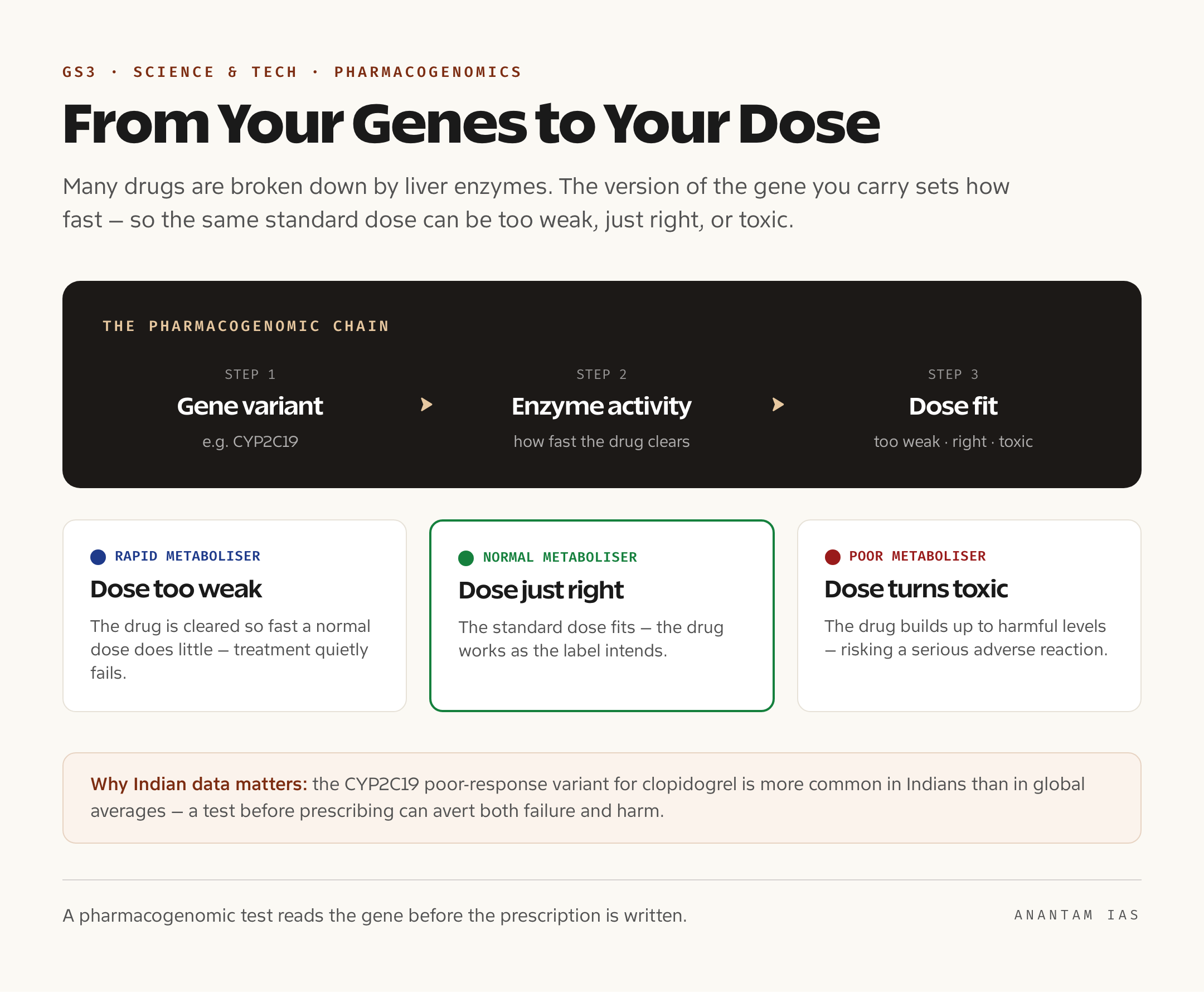
This is where the abstract idea turns into named, examinable tools. The first and most mature is pharmacogenomics — the study of how a person’s genes affect their response to drugs. Many medicines are broken down in the liver by a family of enzymes, and the genes that code for those enzymes vary from person to person. Depending on which version of a gene you carry, you may be a “poor metaboliser” who clears a drug too slowly, so a normal dose builds up to toxic levels, or a “rapid metaboliser” who clears it so fast that a normal dose does nothing. A pharmacogenomic test reads the relevant gene before prescribing, letting a doctor pick the drug or adjust the dose to fit your biology. The blood-thinners warfarin and clopidogrel, several antidepressants, and certain chemotherapy drugs are classic cases where the right genetic test can prevent either a failed treatment or a serious adverse reaction.
The second tool is the biomarker — a measurable biological signal, such as a specific protein or a mutation in a tumour, that reveals something about a disease or how it will respond to a drug. When a biomarker test is formally paired with a particular drug, so that the drug is only given to patients whose test comes back positive, that test is called a companion diagnostic. This is the engine of modern targeted cancer therapy. Instead of carpet-bombing every dividing cell with traditional chemotherapy, a targeted therapy attacks a specific molecular feature of the cancer — and the companion diagnostic identifies which patients actually carry that feature. A drug that works only against tumours with a certain mutation is wasted, or worse than wasted, on patients whose tumours lack it; the test makes sure it goes to the people it can help.
At the frontier sit the cell and gene therapies, the most literally personalised treatments of all. CAR-T therapy, the headline example, takes a patient’s own immune T-cells, genetically re-engineers them in a laboratory to recognise and attack cancer cells, and infuses them back. The product is, in effect, manufactured from and for one patient. India crossed an important threshold here: NexCAR19, developed by ImmunoACT in collaboration with IIT Bombay and Tata Memorial Centre, received approval from the Central Drugs Standard Control Organisation and was dedicated to the nation in 2024 as India’s first home-grown CAR-T therapy for certain blood cancers. Its significance is as much economic as scientific — comparable Western treatments can cost three to four crore rupees, while NexCAR19 is offered at roughly a tenth of that, the difference between a therapy for the few and one a health system can begin to reach. Gene therapies that aim to correct a faulty gene at its source push the same logic further; our piece on gene therapy traces how that approach is moving from rare inherited disorders toward the mainstream.
Why It Matters: The Promise and the Hard Problems
The promise is easy to state and genuinely large. Matching drugs to biology means better outcomes — therapies that work the first time instead of after months of trial and error — and fewer adverse reactions, which matter enormously because adverse drug reactions are a major, under-counted cause of hospital admissions and deaths worldwide. It means earlier and more precise detection, as genetic risk scores and biomarker screening flag disease before symptoms appear. And it shifts the whole emphasis of medicine toward prevention tuned to the individual, rather than treatment averaged across the crowd. For a country carrying a heavy and rising burden of cancer, diabetes and heart disease, a medicine that wastes fewer drugs and avoids more harm is not a luxury; it is a way to get more health out of every rupee spent.
But the hard problems are just as real, and a strong answer names them squarely. The first is cost and access. Sequencing has become cheap, but the therapies built on it — CAR-T, gene therapies, many targeted drugs — remain extraordinarily expensive, and a medicine that only the rich can afford widens health inequality rather than narrowing it. NexCAR19’s low price shows the gap can be attacked, yet for most precision therapies the equity question is unresolved. The second is data privacy. Your genome is the most personal data you own — it cannot be changed if leaked, and it implicates your blood relatives, who never consented. Storing millions of genomes creates a target and a temptation. India’s Digital Personal Data Protection Act of 2023 governs personal data broadly but does not single out genetic data for the special protection that its sensitivity arguably demands, a gap commentators have flagged as consumer DNA testing spreads.
The third problem is the one most likely to win marks because few candidates raise it: genetic discrimination and the missing diversity in genomic data. If insurers or employers could see your genetic risks, they might refuse you cover or a job. The United States addressed this in 2008 with the Genetic Information Nondiscrimination Act, known as GINA, which bars discrimination in health insurance and employment, though even that leaves gaps in life and disability cover; India has no dedicated equivalent, and although the Delhi High Court has held that treating genetic disposition as a ground to deny insurance is discriminatory and unconstitutional, the protection rests on judicial reasoning rather than a clear statute. Layered on top is a scientific bias with direct consequences for India: the overwhelming majority of the world’s genomic research — by recent counts, roughly 80 to 90 per cent of participants in genome-wide studies — is drawn from people of European ancestry, who are only about a sixth of humanity. A genetic risk score or drug-response rule calibrated on European genomes can be inaccurate, even misleading, when applied to an Indian patient. Precision medicine built on the wrong reference population is not precise at all.
The India Angle: Genome India, IndiGen and Why Indian Data Matters
This is the section where everything converges, and it is the one most likely to anchor a good answer. India is not a small or simple population — it is a vast collection of communities, many of them historically endogamous, carrying genetic variation found nowhere else. So drug-response rules and disease-risk models imported from the West can mislead. The evidence is already on the table. Studies of the Indian population have found that the CYP2C19 variant linked to a poor response to clopidogrel, the standard anti-clotting drug given after heart attacks and stents, is markedly more common in Indians than in global averages — meaning a substantial share of Indian cardiac patients may get little benefit from a drug their doctors assume is working. Variants in the HLA-B gene that trigger severe, sometimes fatal skin reactions to common epilepsy drugs such as carbamazepine occur at frequencies that make pre-prescription testing genuinely worthwhile in India. You cannot practise precision medicine on Indians using a European instruction manual.
That is exactly the gap the national genomics effort is built to close. The Council of Scientific and Industrial Research launched IndiGen in 2019, sequencing about a thousand Indian genomes to prove that India could build the infrastructure, ethics frameworks and analytics pipelines for population genomics at home. The Department of Biotechnology then funded the far larger Genome India Project, a consortium of around twenty institutions whose goal was to sequence 10,000 genomes spanning the country’s communities and build a reference catalogue of Indian genetic variation. That 10,000-genome milestone was reached and announced complete, with the data placed in the Indian Biological Data Centre at Faridabad so that researchers can mine it. The point of all this is not national pride; it is accuracy. A reference dataset built from Indian genomes lets scientists tell which variants are common here, which drive disease in Indian patients, and which change how Indians respond to drugs — the foundation any honest precision medicine for India must stand on.
The road ahead has a clear shape, and it is worth carrying into a conclusion. Affordability has to be designed in, not bolted on, as NexCAR19 showed by pricing an advanced therapy for an Indian, not an American, wallet. Pharmacogenomic testing for high-stakes drugs — the clopidogrels and carbamazepines where the genetic signal is strong and the harm from getting it wrong is severe — is the most immediate, most cost-effective place to start, because it can be folded into existing care without waiting for the whole edifice of personalised medicine to arrive. And the genomic data India is gathering needs both protection and openness: protected against misuse and discrimination, yet open enough to fuel discovery. Get that balance right and personalised medicine becomes a genuine tool of health equity; get it wrong and it becomes one more advantage that flows to those who already have the most.
For Your Mains Answer
This is a high-value topic for GS Paper 3, which covers developments in science and technology, biotechnology and their applications, and Indian achievements in science. It also reaches into GS Paper 2 through public health and the regulation of sensitive personal data, and into the ethics paper (GS4) through consent, genetic privacy and the fairness of who gets access to expensive therapies. Questions on biotechnology in healthcare, on the Genome India Project, or on the ethical and equity dimensions of new medical technology can all be answered with this material. The skill examiners reward is balance: explain the science precisely, then weigh promise against the problems of cost, privacy and missing diversity, and land it on India.
How to Build the Answer
Open with the shift, not the gadget — define personalised or precision medicine as the move from the “average patient” to treatment tailored to genes, environment and lifestyle, and introduce stratified medicine as how it usually works in practice. Then walk the toolkit in order: pharmacogenomics (genes and drug response), biomarkers and companion diagnostics (matching drug to patient), and cell and gene therapies such as CAR-T at the frontier. Name the enablers — cheap sequencing, AI, biobanks. Turn to significance (better outcomes, fewer adverse reactions, prevention) and then the problems (cost and equity, data privacy, genetic discrimination, the European-data bias). Close on India: why Indian-specific data matters, what IndiGen and the Genome India Project deliver, and NexCAR19 as proof affordability is possible. That arc — define, enable, apply, weigh, localise — fits almost any question on the theme.
Common Mistakes to Avoid
Don’t treat “personalised” as a unique pill designed for one person; the realistic mechanism is stratification — sorting patients into biological groups. Don’t describe targeted cancer therapy without mentioning the companion diagnostic that selects patients for it, because the test is half the point. Don’t list only the benefits; the cost, privacy and discrimination concerns are what lift an answer into the higher band. And don’t forget the missing-diversity point — most genomic data is European, which is precisely why Indian genomic projects exist; an answer that connects that bias to the Genome India Project shows real understanding.
A Compact Answer Spine
Personalised/precision medicine = tailoring prevention, diagnosis and treatment to individual genes, environment and lifestyle, replacing the “average patient” → works mainly through stratified medicine (sort patients, match therapy) → toolkit: pharmacogenomics (genes affect drug response and dosing), biomarkers + companion diagnostics (match drug to patient), cell/gene therapies like CAR-T (NexCAR19, India’s first, ~1/10th Western cost) → enablers: cheap genome sequencing, AI/big data, biobanks → promise: better outcomes, fewer adverse reactions, earlier detection → problems: cost/access, data privacy (DPDP Act gap), genetic discrimination (US has GINA, India has none), European-dominated genomic data (~80-90%) → India: IndiGen (1,000 genomes), Genome India Project (10,000 genomes, IBDC Faridabad) build the Indian reference data precision medicine needs.
Diagram or Flowchart Idea
Draw two stacked rows. The top row shows one drug arrow pointing at four identical patient icons — the one-size-fits-all model. The bottom row inserts a “biomarker test” box that splits the same four patients into three streams: responders (give the drug), non-responders (give an alternative) and at-risk (avoid it). A small side-box can show a gene variant changing a metabolising enzyme so a standard dose reads as “too weak / right / toxic.” This single contrast communicates stratified medicine at a glance and is quick to sketch.
A Balanced-Conclusion Line
A line that lands the marks: “Personalised medicine promises to replace the average patient with the actual one — but it will only be precise, and only be fair, if India builds it on Indian genomes, prices it for Indian patients, and guards the genetic data it gathers as carefully as it mines it.”
How to Use Data Without Cramming
You need only a handful of anchors, not a textbook: the field’s core definition (genes, environment, lifestyle), the genome-cost collapse (billions of dollars to a few hundred), 10,000 genomes under the Genome India Project, NexCAR19 at roughly one-tenth of Western cost, and the European-data figure (around 80-90 per cent of genomic study participants). Attribute them plainly — “the NIH’s Precision Medicine Initiative defines it as…”, “the Genome India Project’s completed cohort” — rather than scattering numbers without a source.
Frequently Asked Questions
What is the difference between personalised medicine and precision medicine?
In practice the two terms are used interchangeably, and both describe tailoring prevention, diagnosis and treatment to an individual’s genes, environment and lifestyle rather than applying a one-size-fits-all rule. Some scientists prefer “precision medicine” because “personalised” can wrongly suggest a unique drug made for each person, whereas the real mechanism is usually stratified medicine — sorting patients into biologically similar groups and matching each group to the therapy most likely to help it.
What is pharmacogenomics and why does it matter for India?
Pharmacogenomics is the study of how a person’s genes affect their response to drugs — whether they break a medicine down too fast, too slowly or normally, which decides whether a standard dose works, fails or turns toxic. It matters acutely for India because Indians carry several drug-response variants at frequencies different from European populations; for example, the CYP2C19 variant linked to poor response to the heart-attack drug clopidogrel is more common in Indians, so a genetic test before prescribing can prevent both treatment failure and harm.
What is NexCAR19 and why is it significant?
NexCAR19 is India’s first home-grown CAR-T cell therapy, developed by ImmunoACT with IIT Bombay and Tata Memorial Centre and approved by the Central Drugs Standard Control Organisation. It re-engineers a patient’s own immune T-cells to attack certain blood cancers — a highly personalised treatment built for one patient. Its significance is affordability: comparable Western therapies can cost three to four crore rupees, while NexCAR19 is offered at roughly a tenth of that, showing advanced precision therapies can be priced for an Indian health system.
Why is most genomic data a problem for precision medicine in India?
Because roughly 80 to 90 per cent of participants in the world’s genome-wide studies are of European ancestry, even though Europeans are only about a sixth of humanity. Genetic risk scores and drug-response rules calibrated on European genomes can be inaccurate when applied to Indians, who carry distinct variation. This “missing diversity” is exactly why India built IndiGen and the Genome India Project — to create an Indian reference dataset so precision medicine here is actually precise.
Practice Questions
Prelims MCQs
- With reference to personalised (precision) medicine, which statement is most accurate?
(a) It means designing a unique drug molecule for every individual patient
(b) It tailors prevention, diagnosis and treatment to a person’s genes, environment and lifestyle, often by stratifying patients into groups
(c) It refers only to organ transplantation matched by blood group
(d) It is another name for traditional one-size-fits-all treatment
Answer: (b) Precision medicine moves away from the “average patient,” and in practice usually works through stratified medicine — sorting patients into biologically similar groups and matching each to the best therapy. - The term “pharmacogenomics” in the context of personalised medicine refers to which of the following?
(a) The mass manufacture of generic drugs
(b) The study of how a person’s genes affect their response to drugs
(c) The pricing of patented medicines
(d) The use of robots to dispense medicines
Answer: (b) Pharmacogenomics studies how genetic variation — for instance in drug-metabolising enzymes — changes whether a standard dose works, fails or becomes toxic in a given person. - A “companion diagnostic,” frequently mentioned with targeted cancer therapy, is best described as:
(a) A second doctor’s opinion before surgery
(b) A test paired with a specific drug to identify which patients should receive it
(c) A nursing service that accompanies a patient
(d) A generic substitute for a branded drug
Answer: (b) A companion diagnostic is a biomarker test formally linked to a particular drug, so the drug is given only to patients whose test shows they are likely to benefit. - NexCAR19, in the news recently, is associated with which of the following?
(a) A new variety of drought-resistant rice
(b) India’s first indigenously developed CAR-T cell therapy for certain blood cancers
(c) A COVID-19 booster vaccine
(d) A satellite for health-data transmission
Answer: (b) NexCAR19, developed by ImmunoACT with IIT Bombay and Tata Memorial Centre and approved by the CDSCO, re-engineers a patient’s own T-cells to attack blood cancers, at roughly a tenth of comparable Western costs. - Consider the following statements about the Genome India Project.
1. It aimed to sequence the genomes of 10,000 Indians across the country’s communities.
2. It was funded by the Department of Biotechnology.
3. Its data is housed at the Indian Biological Data Centre. Which are correct?
(a) 1 and 2 only
(b) 2 and 3 only
(c) 1 and 3 only
(d) 1, 2 and 3
Answer: (d) The Genome India Project, funded by the Department of Biotechnology, completed sequencing of 10,000 genomes across diverse communities, with the data placed at the Indian Biological Data Centre in Faridabad.
Mains Practice Questions
- “Personalised medicine replaces the average patient with the actual one.” Explain the scientific basis of precision medicine and discuss the technologies that have made it feasible. (15 marks, 250 words)
- Discuss the role of pharmacogenomics in improving drug safety and efficacy. Why is India-specific pharmacogenomic data particularly important for the Indian population? (15 marks, 250 words)
- Examine the ethical and equity concerns raised by personalised medicine, including data privacy, genetic discrimination and unequal access. How adequately does India’s current legal framework address them? (15 marks, 250 words)
- The “missing diversity” in global genomic databases limits the benefits of precision medicine for non-European populations. In this light, evaluate the significance of the IndiGen initiative and the Genome India Project. (15 marks, 250 words)
- With NexCAR19 as a case study, analyse how India can make advanced precision therapies affordable and accessible without compromising on safety and innovation. (10 marks, 150 words)
Tell Google you want more of this.
Add Anantam IAS as a preferred sourceOne tap, and this site shows up more often in your own Top Stories, AI Overviews and AI Mode. Remove it any time.