The Responsible Nations Index: A New Lens on Global Responsibility
Why in News?
India has launched the Responsible Nations Index (RNI), a new assessment framework that ranks countries by their actual conduct as global citizens rather than by income or institutional checklists alone. The launch positions India as a norm-setter that authors its own metrics instead of only being measured by indices designed in the West.
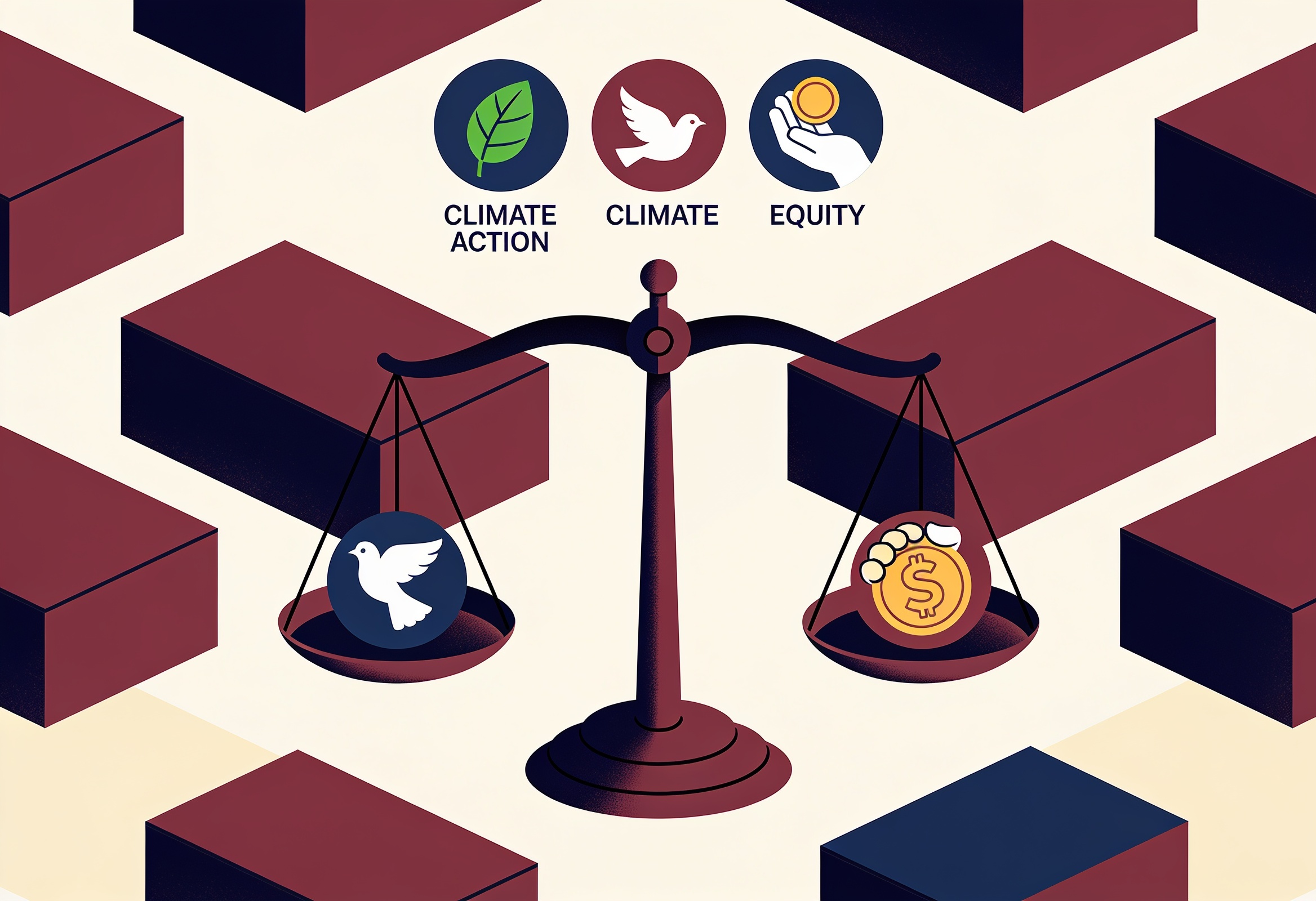
The RNI scores nations across responsibility themes such as climate action and per-capita/historical emissions, equity, contribution to peace, debt sustainability, and development cooperation — reframing ‘responsibility’ around fairness to the developing world rather than compliance with a developed-world template.
- A made-in-India index that judges nations on responsible global conduct, not just GDP or governance optics.
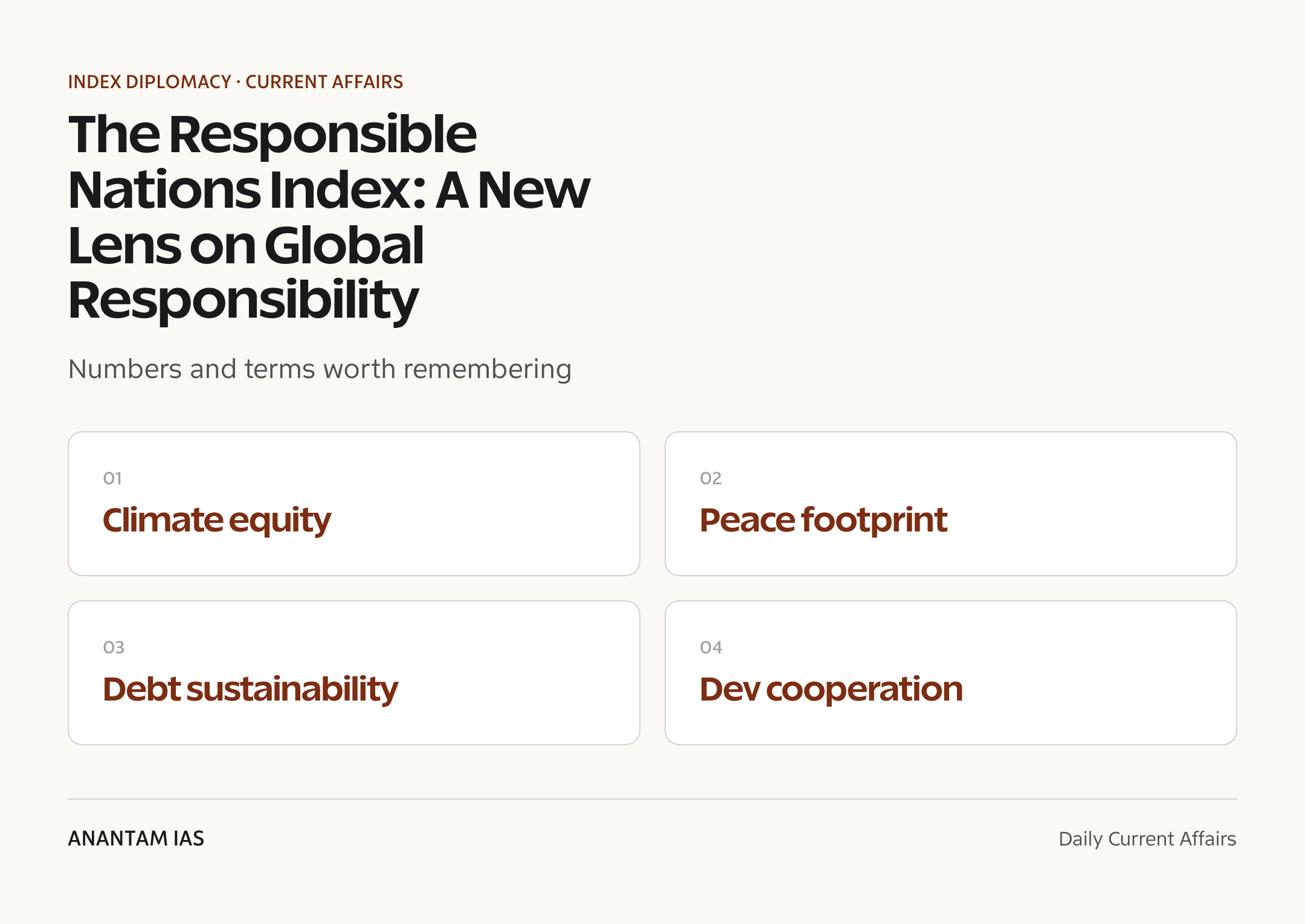
- Core pillars span climate equity, peace and conflict footprint, debt sustainability, and development cooperation.
- Emphasises per-capita and historical emissions, embedding Common But Differentiated Responsibilities (CBDR) into the scoring.
- Advances India’s pitch as the Voice of the Global South and a credible alternative knowledge producer.
- Frames a direct critique of Western-authored indices seen as opaque, ideologically loaded, or biased against developing economies.
The development matters in the context of:
- Global rankings shape credit ratings, aid flows, FDI and diplomatic leverage — so who builds the index wields real power.
- It operationalises ‘Vasudhaiva Kutumbakam’ (the world is one family), the theme India carried through its G20 presidency.
- Lands amid India’s push for reformed multilateralism and a louder developing-world seat at global high tables.
UPSC Relevance
Prelims Relevance
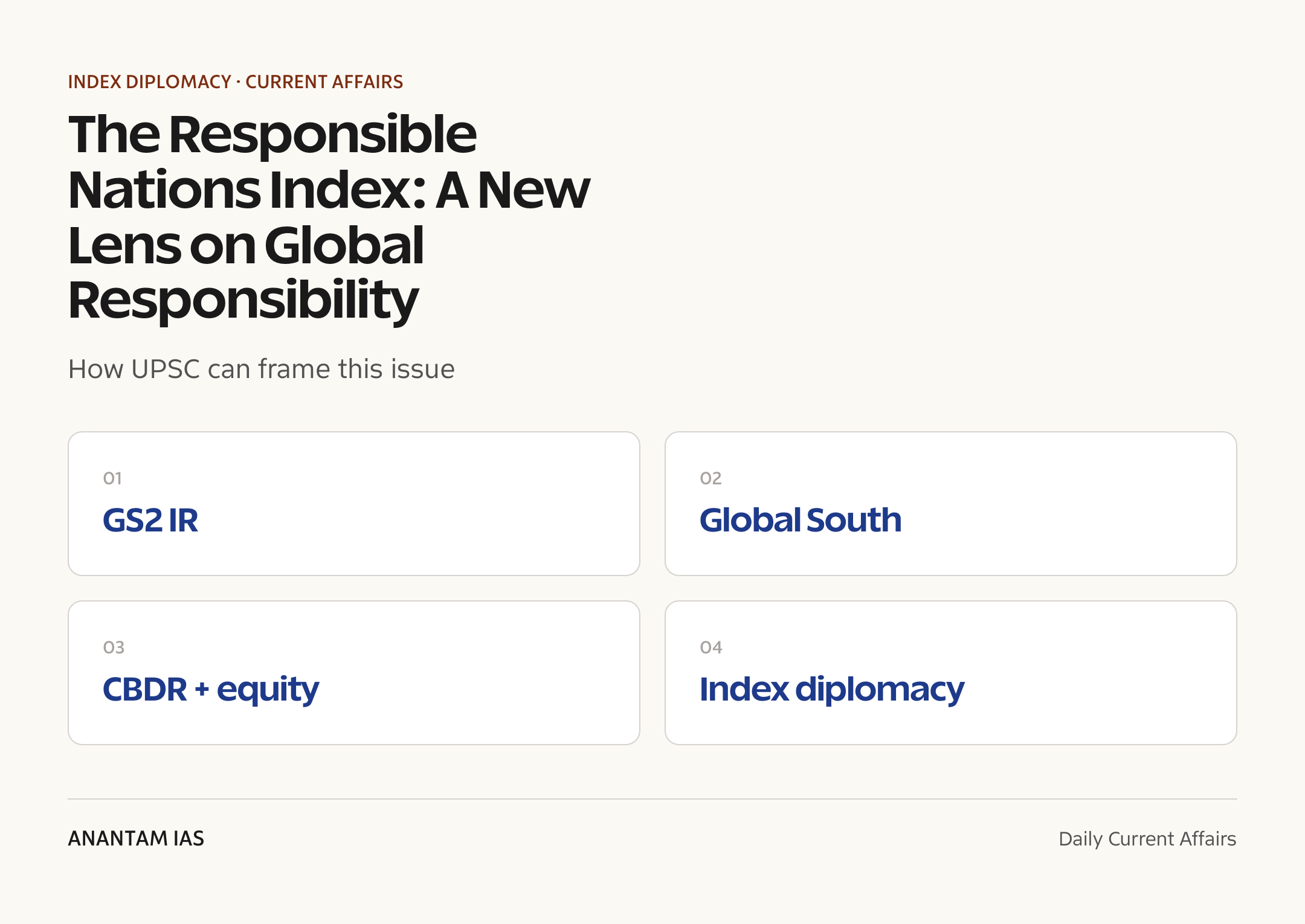
- Responsible Nations Index (RNI) — purpose, broad parameters, India-led origin.
- Common But Differentiated Responsibilities (CBDR) — principle under the UNFCCC and Paris Agreement.
- Distinction between per-capita, absolute and historical (cumulative) emissions.
- Voice of the Global South Summit — India-hosted platform for developing nations.
- Vasudhaiva Kutumbakam — its appearance as India’s G20 theme.
- Major existing indices for comparison — Human Development Index (UNDP), SDG Index, Climate Change Performance Index.
- Soft power and ‘normative power’ as instruments of foreign policy.
- Difference between a composite index and a single-indicator ranking.
Mains Relevance
GS Paper 2
- India’s evolving role in shaping global norms and its bid for reformed multilateralism and Global-South leadership.
- Indices as instruments of foreign policy and soft power — agenda-setting through metrics rather than military or economic coercion.
- Effect of bilateral, regional and global groupings and agreements involving and affecting India’s interests.
GS Paper 3
- Climate-change negotiations through the lens of equity, CBDR and historical responsibility.
- Sustainable development metrics and the politics of measuring environmental and developmental performance.
Essay
- He who controls the measure controls the meaning — on who gets to define global ‘responsibility’.
- Justice without fairness is hollow: equity in the age of climate and debt.
Background and Context
What the Responsible Nations Index sets out to measure
The RNI is a composite framework that scores nations on how responsibly they act toward the planet and toward fellow nations, not on wealth alone.
- Bundles several responsibility themes into one comparable score, in the manner of a composite index (like the HDI).
- Climate responsibility — judged through per-capita and historical emissions, so heavy historical polluters cannot hide behind recent cuts.
- Equity — fairness in trade, technology access and the distribution of global burdens.
- Peace — a nation’s contribution to or disruption of global stability and conflict.
- Debt sustainability — responsible lending and the debt distress faced by developing borrowers.
- Development cooperation — aid, capacity-building and South-South partnership rather than extraction.
Why India is building its own index
The launch reflects a deliberate shift from being only measured by others to authoring the yardstick itself.
- Most influential rankings originate in the Global North or Western think-tanks, embedding their priorities and assumptions.
- India argues several indices are opaque in methodology, subjective in their proxies, and structurally unfavourable to developing economies.
- Authoring a credible index is an act of agenda-setting — it reframes what ‘good behaviour’ on the world stage even means.
- Reinforces India’s self-image as the Voice of the Global South and a bridge between developed and developing blocs.
- Sits alongside India’s call for reformed multilateralism and a fairer global governance architecture.
Climate equity and the CBDR backbone
By weighting per-capita and historical emissions, the RNI hard-codes the equity argument India has long pressed in climate talks.
- CBDR-RC (Common But Differentiated Responsibilities and Respective Capabilities) is a founding principle of the UNFCCC and the Paris Agreement.
- It holds that all nations share the climate burden, but those with greater historical emissions and capacity must do more.
- Ranking by per-capita rather than absolute emissions reframes which countries are the bigger per-head polluters.
- Historical (cumulative) emissions capture the carbon already in the atmosphere from early industrialisers.
- This counters narratives that judge developing nations purely on their current absolute output.
Index diplomacy and soft power
The RNI is an exercise in soft power — shaping global conversation through ideas and metrics, not coercion.
- Soft power is the ability to influence others through attraction, legitimacy and agenda-setting.
- Indices act as normative tools: they reward the behaviour they choose to measure and quietly penalise the rest.
- A widely-cited index gives India a recurring platform to frame debates on climate, debt and development.
- It complements India-led platforms such as the Voice of the Global South Summit and the International Solar Alliance.
- Builds on the goodwill of India’s G20 presidency and its ‘Vasudhaiva Kutumbakam’ framing.
How it compares with existing rankings
Several global indices already rate countries on slices of development and sustainability — the RNI distinguishes itself on framing and authorship.
- Human Development Index (UNDP) — health, education and income, but silent on a nation’s external conduct.
- SDG Index — tracks progress on the Sustainable Development Goals, largely an inward scorecard.
- Climate Change Performance Index — climate policy and emissions, but built by Western civil-society bodies.
- The RNI’s novelty is the ‘responsibility to others’ lens — peace, debt, cooperation — and its Global-South authorship.
- Its credibility will hinge on transparent methodology, verifiable data, and independence from political framing.
Criticisms and credibility risks
Any new index, especially a state-launched one, must guard against the very flaws it accuses others of.
- Perceived bias — a government-backed index risks being dismissed as self-serving unless governance is arm’s-length.
- Data quality — comparable, audited cross-country data on peace and cooperation is genuinely hard to assemble.
- Indicator selection — which themes are weighted, and how, embeds value judgments that critics will probe.
- Index fatigue — the global space is crowded; uptake by other governments and bodies is not guaranteed.
- Long-term influence depends on peer-reviewed transparency, not just diplomatic launch momentum.
Way Forward
Methodological credibility
- Publish a transparent, peer-reviewed methodology with open data sources and clear weightings.
- House the index in an arm’s-length body to insulate it from accusations of political framing.
Coalition-building
- Co-develop and validate the framework with Global-South partners and multilateral institutions to widen ownership.
- Anchor it to existing India-led platforms to give it a recurring institutional home and audience.
Sustained influence will come less from the launch and more from consistent annual releases, independent scrutiny, and demonstrable use of the rankings in real climate, debt and cooperation debates.
Conclusion
The Responsible Nations Index marks a shift from India being only a subject of global rankings to becoming an author of them. By re-centring the conversation on climate equity, peace, debt and cooperation, it embeds the developing world’s fairness concerns into the very act of measurement.
Its lasting value will rest on credibility, not optics. If the RNI stays transparent, evidence-driven and genuinely independent, it can mature into a durable instrument of India’s soft power and its push for reformed, more equitable multilateralism.
UPSC Practice Questions
Prelims MCQ 1
With reference to the principle of Common But Differentiated Responsibilities (CBDR), consider the following statements:
- It is a core principle under the UNFCCC and the Paris Agreement.
- It requires all countries to undertake identical, uniform emission-reduction commitments.
- It recognises the greater responsibility of nations with higher historical emissions and capacity.
How many of the above statements are correct?
(a) Only one (b) Only two (c) All three (d) None
Answer: (b) Only two
Explanation:
Statements 1 and 3 are correct. Statement 2 is wrong — CBDR explicitly rejects identical obligations, differentiating duties by historical contribution and respective capabilities.
Prelims MCQ 2
The ‘Responsible Nations Index’, launched by India, is best described as which of the following?
(a) A credit-rating system issued by the Reserve Bank of India (b) A composite index assessing countries on responsible global conduct such as climate equity, peace, debt sustainability and development cooperation (c) A United Nations treaty binding members to emission targets (d) A ranking of Indian states on environmental performance
Answer: (b) A composite index assessing countries on responsible global conduct such as climate equity, peace, debt sustainability and development cooperation
Explanation:
The RNI is an India-launched composite index ranking nations on their conduct as global citizens — climate equity, peace, debt and cooperation — not a credit rating, a treaty, or a state-level ranking.
UPSC Mains Questions
- Indices are increasingly instruments of foreign policy rather than neutral scorecards. In this context, examine the significance of India launching its own Responsible Nations Index for its Global-South leadership. (250 words)
- Discuss how the principles of climate equity and Common But Differentiated Responsibilities shape India’s stance in global climate negotiations, and how a responsibility-based index could advance that position. (250 words)
- ‘He who frames the metric frames the debate.’ Critically analyse the opportunities and credibility risks of state-launched global indices, with reference to the Responsible Nations Index. (150 words)
Sources: Ministry of External Affairs, Government of India and The Hindu.
Frequently Asked Questions
What is the Responsible Nations Index?
It is a composite index, launched by India, that ranks countries on how responsibly they act as global citizens. Instead of measuring wealth or governance checklists alone, it scores nations on themes such as climate action, equity, contribution to peace, debt sustainability, and development cooperation toward the developing world.
Why did India launch its own index?
Most influential global rankings originate in the West and embed its priorities. India argues several are opaque or biased against developing economies. By authoring its own credible index, India sets the agenda, reframes what ‘responsible’ conduct means, and strengthens its claim to be the Voice of the Global South.
How does the index treat climate responsibility?
It weights per-capita and historical (cumulative) emissions, not just current absolute output. This reflects the Common But Differentiated Responsibilities principle under the UNFCCC and Paris Agreement, ensuring early industrialisers who put most carbon into the atmosphere are judged on that historical burden rather than recent cuts alone.
How is the RNI different from the Human Development Index?
The HDI measures a country’s internal development — health, education and income. The Responsible Nations Index instead looks outward, at a nation’s conduct toward the rest of the world: its climate footprint, peace contribution, debt practices and cooperation. Its other distinction is its Global-South authorship rather than a Western origin.
What is index diplomacy?
Index diplomacy is the use of rankings and metrics as soft-power tools. Because indices reward the behaviour they choose to measure, the body that builds a widely-cited index gains agenda-setting power over global debates. Launching the RNI lets India shape conversations on climate, debt and development without coercion.
What are the main criticisms of such an index?
A government-backed index risks being seen as self-serving unless it is arm’s-length and transparent. Comparable cross-country data on peace and cooperation is hard to assemble, indicator weighting embeds value judgments, and the crowded ranking space makes uptake uncertain. Lasting credibility depends on peer-reviewed, independent methodology.