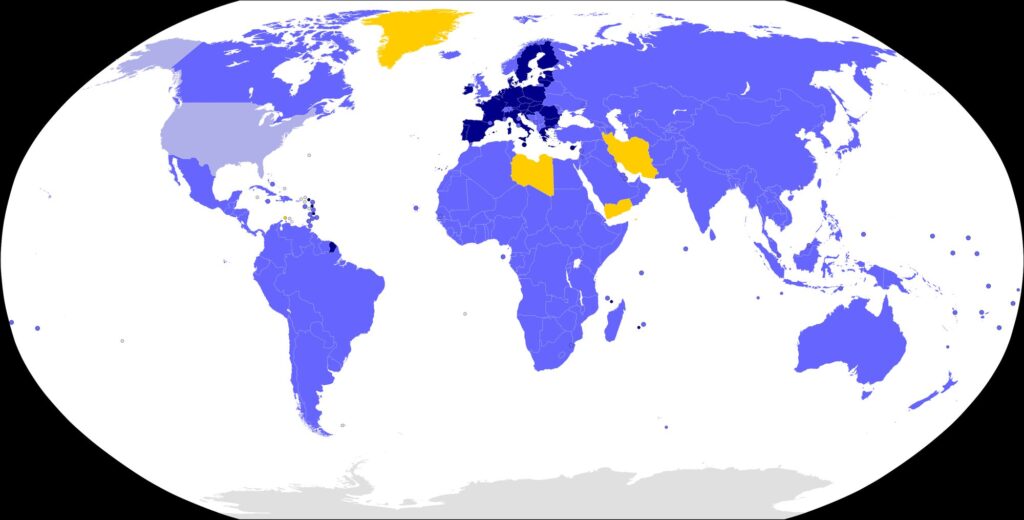
The Paris Agreement 2015 is the legally binding international treaty on climate change, adopted on 12 December 2015 at the 21st Conference of the Parties (COP21) to the United Nations Framework Convention on Climate Change in Le Bourget, Paris. It entered into force unusually fast — on 4 November 2016 — once 55 countries representing at least 55 percent of global emissions had ratified it. The Paris Agreement 2015 replaced the top-down architecture of the Kyoto Protocol with a bottom-up framework of nationally determined contributions, embedding the universal participation of 196 parties for the first time in climate diplomacy.
The headline ambition of the Paris Agreement 2015 is captured in Article 2: hold the increase in global average temperature to well below 2 °C above pre-industrial levels and pursue efforts to limit it to 1.5 °C. To achieve this, the treaty asks every party to communicate, every five years, a progressively more ambitious nationally determined contribution (NDC), supported by transparency, finance and a global stocktake.
Origin and Negotiating History
The Paris Agreement 2015 did not appear in isolation. It emerged from two decades of failed top-down attempts to extend the Kyoto Protocol, the collapse of the Copenhagen summit in 2009, and the gradual realisation that a universal, hybrid architecture — legally binding on process, nationally determined on substance — was the only politically feasible path.
The Road from Copenhagen to Paris
The Copenhagen COP15 in 2009 had failed to deliver a successor treaty to Kyoto. The Copenhagen Accord that emerged was a political document, not a legal instrument, and only 114 countries associated with it. The Durban Platform in 2011 reset the process, creating an Ad Hoc Working Group on the Durban Platform for Enhanced Action (ADP) tasked with delivering a new legal instrument by 2015.
The Lima Call for Climate Action in 2014 established the concept of intended nationally determined contributions (INDCs), inviting every country to submit its own pledge ahead of Paris. By the opening of COP21, 187 countries representing over 95 percent of global emissions had submitted INDCs — a level of upfront engagement that no previous climate negotiation had achieved.
COP21 and the Adoption Day
COP21 ran from 30 November to 12 December 2015. The French presidency, led by Laurent Fabius, opted for a transparent “indaba” style of negotiation borrowed from South African tradition. On 12 December 2015, the 32-page Paris Agreement was adopted by consensus of all 196 parties present. Fabius famously brought down the gavel after pausing to manage a last-minute United States objection over a “shall” versus “should” in the mitigation article.
Core Architecture of the Paris Agreement 2015
The Paris Agreement 2015 has 29 articles. Its hybrid design legally binds parties to procedural obligations — submitting NDCs, reporting, participating in the global stocktake — while leaving the substantive level of ambition to be nationally determined.
Article 2: The Temperature Goal
Article 2(1)(a) anchors the long-term goal: “Holding the increase in the global average temperature to well below 2 °C above pre-industrial levels and pursuing efforts to limit the temperature increase to 1.5 °C above pre-industrial levels.” The insertion of the 1.5 °C aspiration was a hard-won victory for the Alliance of Small Island States and the Climate Vulnerable Forum.
Article 2 also commits parties to increasing the ability to adapt, fostering climate resilience and low greenhouse-gas development, and making finance flows consistent with a pathway towards low-carbon and climate-resilient development.
Article 4: Nationally Determined Contributions
Article 4 obliges every party to prepare, communicate and maintain successive NDCs. Each new NDC must represent a progression beyond the previous one and reflect the party’s highest possible ambition. NDCs are communicated every five years, with the next round due by 2025 covering targets to 2035. The first round in 2015 covered targets to 2025 or 2030.
The NDCs are not legally binding in their level of ambition. The obligation is procedural — to submit, maintain and pursue domestic mitigation measures with the aim of achieving the objectives. This pragmatic design is what made universal adoption possible.
Article 6: Carbon Markets
Article 6 is the most technically complex provision. It provides three mechanisms for voluntary cooperation between parties to meet their NDCs.
- Article 6.2 allows internationally transferred mitigation outcomes (ITMOs) — bilateral or plurilateral trading between parties.
- Article 6.4 establishes a centralised crediting mechanism, sometimes called the Paris Agreement Crediting Mechanism, supervised by a UN body — the successor to the Kyoto Clean Development Mechanism.
- Article 6.8 establishes a framework for non-market approaches, including finance, technology transfer and capacity building.
The Article 6 rulebook was finalised at COP26 in Glasgow (2021) and operationalised at COP27 and COP28. India has been an active participant, particularly through carbon market arrangements with Japan, Singapore and Switzerland.
Ratchet Mechanism and Global Stocktake
The Paris Agreement 2015 contains a built-in escalator. Every five years, parties must submit a new NDC that is more ambitious than the previous one. The global stocktake under Article 14 assesses collective progress towards the long-term goals and informs the next round of NDCs.
The First Global Stocktake (2023)
The first global stocktake concluded at COP28 in Dubai in December 2023. Its 196-paragraph cover decision was the first multilateral text to call on parties to transition away from fossil fuels in energy systems, in a just, orderly and equitable manner, with a view to achieving net zero by 2050. The stocktake also confirmed that current NDCs put the world on track for 2.5–2.9 °C of warming and called for a tripling of renewable energy capacity and a doubling of energy efficiency by 2030.
Common but Differentiated Responsibilities
The Paris Agreement 2015 retains the UNFCCC principle of common but differentiated responsibilities and respective capabilities (CBDR-RC), but applies it dynamically through national circumstances rather than the static Annex I / non-Annex I split of Kyoto. Developed countries continue to lead through absolute economy-wide emission reduction targets; developing countries are encouraged to move over time towards economy-wide reductions.
Climate Finance Under the Paris Agreement
Article 9 obliges developed countries to provide financial resources to developing countries for both mitigation and adaptation. It also encourages other parties to provide such support voluntarily.
The pre-2020 pledge of USD 100 billion per year, made at Copenhagen and reaffirmed in the Paris decision, was finally met in 2022 according to the OECD. The Paris Agreement requires a new collective quantified goal (NCQG) from a floor of USD 100 billion per year to be set before 2025. COP29 in Baku in November 2024 agreed an NCQG of USD 300 billion per year by 2035 — a figure widely criticised by developing countries as inadequate against the USD 1.3 trillion estimated as needed.
India and the Paris Agreement 2015
India played a constructive role in shaping the Paris Agreement 2015, anchored in three demands: equity and CBDR, climate justice for developing countries, and finance and technology transfer.
India’s Ratification and First NDC
India ratified the Paris Agreement on 2 October 2016, on the birth anniversary of Mahatma Gandhi. Its first NDC, submitted in October 2015, contained three quantitative targets for 2030:
- Reduce the emissions intensity of GDP by 33–35 percent from 2005 levels.
- Achieve 40 percent cumulative installed power capacity from non-fossil sources.
- Create an additional carbon sink of 2.5–3 billion tonnes of CO2 equivalent through forest cover.
India’s Updated NDC (2022) and Panchamrit
At COP26 in Glasgow in November 2021, Prime Minister Narendra Modi announced India’s “Panchamrit” — five nectar elements — that were formalised in the updated NDC of August 2022:
- Reach 500 GW of non-fossil fuel installed capacity by 2030.
- Meet 50 percent of energy requirements from renewable energy by 2030.
- Reduce projected total carbon emissions by 1 billion tonnes from now to 2030.
- Reduce the carbon intensity of the economy by 45 percent (revised upward from 33–35 percent) from 2005 levels by 2030.
- Achieve net-zero emissions by 2070.
India’s third NDC, due in 2025, is being prepared and is expected to extend targets to 2035.
The United States: Withdrawal and Rejoin
The Paris Agreement 2015 has weathered two changes of US position. President Donald Trump announced US withdrawal on 1 June 2017; under Article 28, the earliest effective withdrawal date was 4 November 2020. President Joe Biden rejoined on his first day in office, 20 January 2021, and the US re-entered formally on 19 February 2021. In January 2026, the second Trump administration again submitted a notice of withdrawal, repeating the cycle and exposing the fragility of climate cooperation to domestic political shifts.
Strengths, Limits and the Emissions Gap
The Paris Agreement 2015 is widely credited with three structural achievements: universal participation, a clear long-term temperature goal, and a built-in ratchet mechanism. It is also criticised on three counts. NDC ambition has not been sufficient — UNEP’s Emissions Gap Report 2024 found that full implementation of unconditional NDCs would still put the world on a path to 2.6–2.8 °C warming. Finance flows remain below need. And the compliance mechanism under Article 15 is facilitative, not punitive — there are no sanctions for missing an NDC.
Yet by linking the IPCC AR6 Report findings to a five-yearly political process, the Paris Agreement 2015 has institutionalised climate ambition in a way no previous treaty achieved. The 2023 global stocktake and the COP 28 of UNFCCC decision on transitioning away from fossil fuels show that the ratchet can produce real movement.
Paris Agreement 2015 in the UPSC Context
For UPSC General Studies Paper III (Environment and Ecology) and Paper II (International Relations), the Paris Agreement 2015 anchors a wide range of questions. Candidates should know its relationship with the parent UNFCCC and the predecessor Kyoto Protocol, how it differs from the Montreal Protocol model of universal sectoral phaseout, and how India’s NDCs evolved from 2015 to 2022. Prelims questions have repeatedly tested Article 6, the 1.5 °C target, the global stocktake cycle and the Green Climate Fund.
Frequently Asked Questions
When was the Paris Agreement 2015 adopted and when did it enter into force?
The Paris Agreement was adopted on 12 December 2015 at COP21 in Paris. It entered into force on 4 November 2016, just 30 days after the dual threshold of 55 countries representing 55 percent of global emissions was met — the fastest entry into force of any major multilateral environmental agreement.
What is the difference between the 1.5 °C and 2 °C goals?
Article 2 of the Paris Agreement 2015 commits parties to holding warming u0022well below 2 °Cu0022 while u0022pursuing effortsu0022 to limit it to 1.5 °C. The IPCC Special Report on 1.5 °C (2018) found that limiting warming to 1.5 °C would substantially reduce climate risks compared with 2 °C, particularly for small island states and vulnerable ecosystems. The 1.5 °C goal has since become the de facto operational target.
What are nationally determined contributions (NDCs)?
NDCs are the climate action plans that every party to the Paris Agreement submits, updates and progresses every five years. Each NDC must represent a progression beyond the previous one and reflect highest possible ambition. NDCs are not legally binding on level of ambition — the obligation is procedural.
What is the global stocktake?
Under Article 14, the global stocktake assesses collective progress every five years towards the long-term goals of the Paris Agreement. The first stocktake concluded at COP28 in 2023, calling on parties to transition away from fossil fuels. The second is due in 2028.
What is Article 6 of the Paris Agreement?
Article 6 enables voluntary international cooperation in implementing NDCs. Article 6.2 allows bilateral trading of mitigation outcomes (ITMOs), Article 6.4 establishes a centralised UN-supervised crediting mechanism, and Article 6.8 covers non-market approaches. The Article 6 rulebook was finalised at COP26 (2021) and made operational at COP28 (2023).
When did India ratify the Paris Agreement?
India ratified the Paris Agreement on 2 October 2016, on the birth anniversary of Mahatma Gandhi. It was the 62nd country to do so. India submitted its updated NDC in August 2022 following the Glasgow Panchamrit announcements.
What is India’s net-zero target under the Paris Agreement?
At COP26 in November 2021, India announced a net-zero emissions target for 2070, formalised in the updated NDC of 2022. Alongside it, India committed to 500 GW of non-fossil capacity by 2030, 50 percent renewable energy share, and a 45 percent reduction in emissions intensity from 2005 levels by 2030.
Has the United States withdrawn from the Paris Agreement?
The US has had a turbulent relationship with the agreement. Donald Trump withdrew the country in 2020. Joe Biden rejoined in January 2021. The second Trump administration submitted a renewed notice of withdrawal in January 2026, with effect after a one-year notice period under Article 28.
Tell Google you want more of this.
Add Anantam IAS as a preferred sourceOne tap, and this site shows up more often in your own Top Stories, AI Overviews and AI Mode. Remove it any time.