Retail Inflation Climbs to 16-Month High: Reading the CPI Print
Why in News?
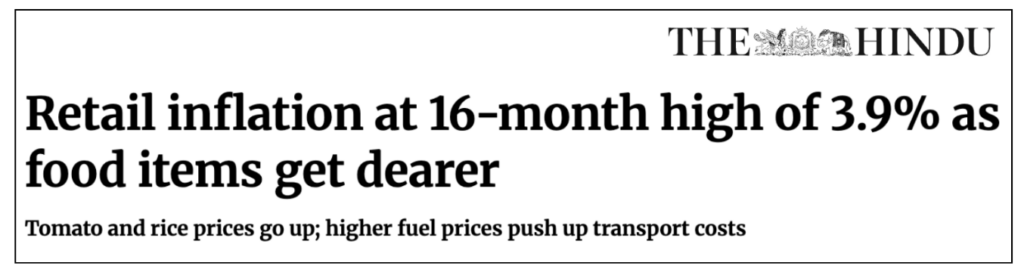
Official Consumer Price Index data released on June 12, 2026, showed India’s retail inflation rising to a 16-month high of 3.9% in May 2026, up from 3.48% in April. The Hindu reported the uptick was driven by costlier food items.
The headline number stays inside the Reserve Bank of India‘s tolerance band but reverses several months of cooling, putting the focus back on the food basket and the trajectory of the Monetary Policy Committee‘s repo rate.
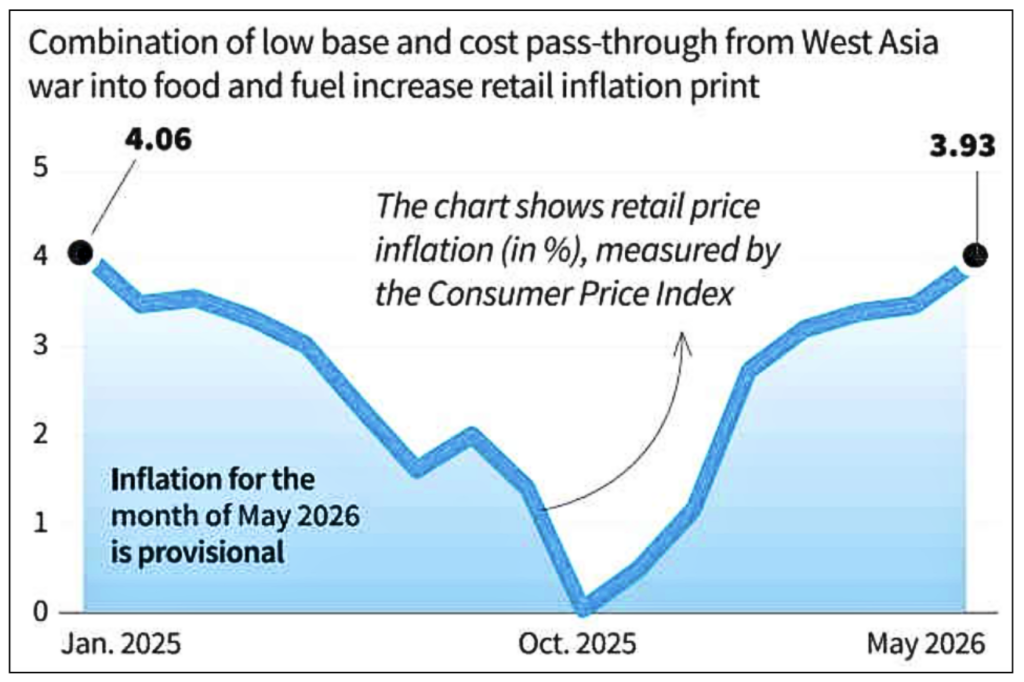
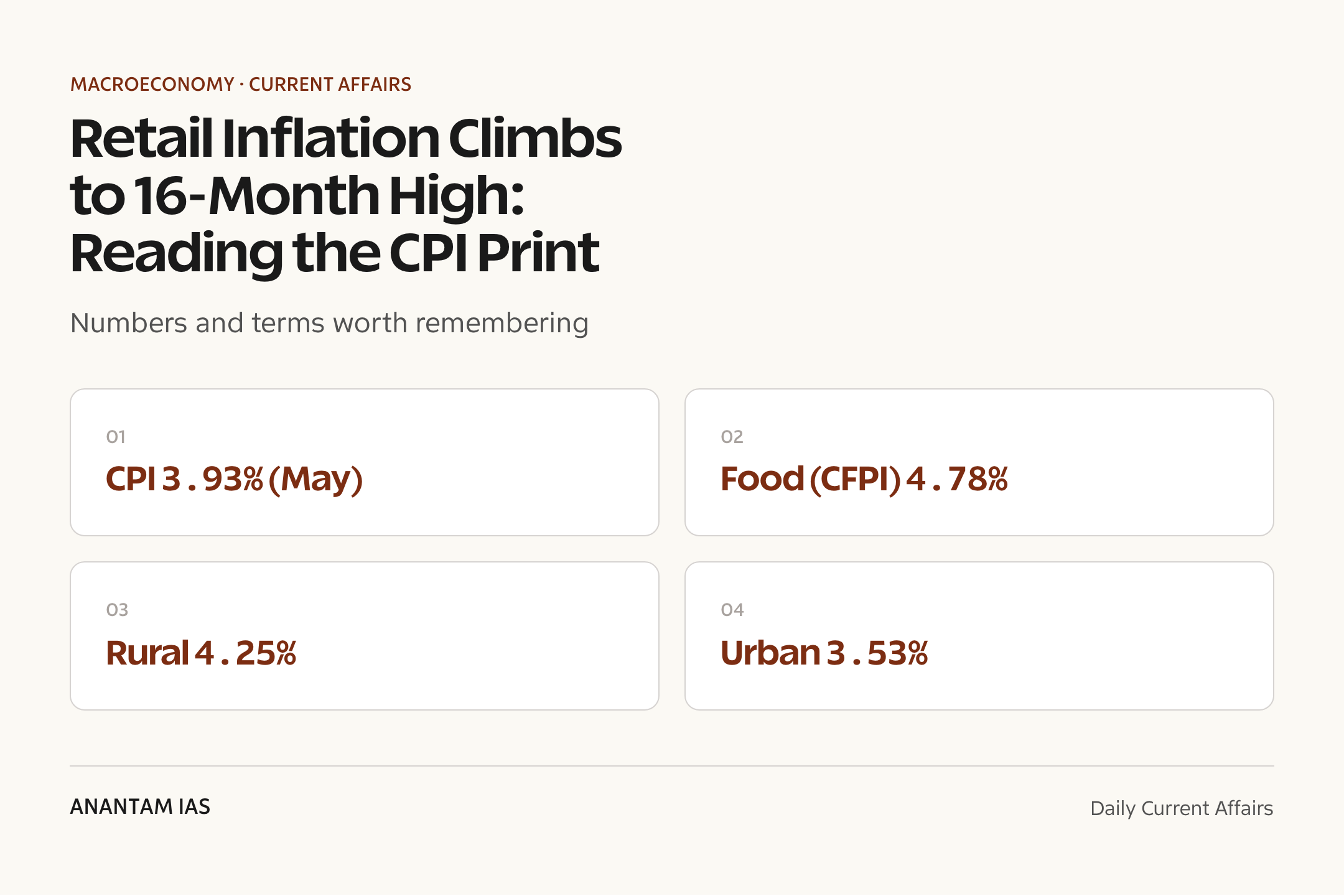
- Headline CPI inflation at 3.93% (provisional) in May 2026 versus 3.48% in April — the highest reading in roughly 16 months.
- All-India food inflation (CFPI) climbed to 4.78% from 4.20% the previous month.
- Rural inflation ran hotter at 4.25% against urban at 3.53%.
- Housing inflation stood at 2.12% year-on-year, a sub-component tracked only for the urban index.
- Data compiled and released by the National Statistical Office (NSO) under the Ministry of Statistics and Programme Implementation (MoSPI).
- Firming retail fuel prices added an estimated upward push to the headline print.
The development matters in the context of:
- Inflation is the price-stability anchor of India’s flexible inflation targeting framework, so every monthly print feeds directly into rate expectations.
- A move toward the 4% target midpoint from sub-4% readings signals the disinflation phase may be plateauing, not deepening.
UPSC Relevance
Prelims Relevance
- CPI (Combined) base year is 2012; released by NSO/MoSPI monthly.
- CFPI = Consumer Food Price Index, the food sub-index of CPI.
- Food and beverages carry the largest weight (~45.86%) in CPI-Combined.
- WPI (base 2011-12) is released by the Office of the Economic Adviser, Ministry of Commerce and Industry; it has no services and no retail margins.
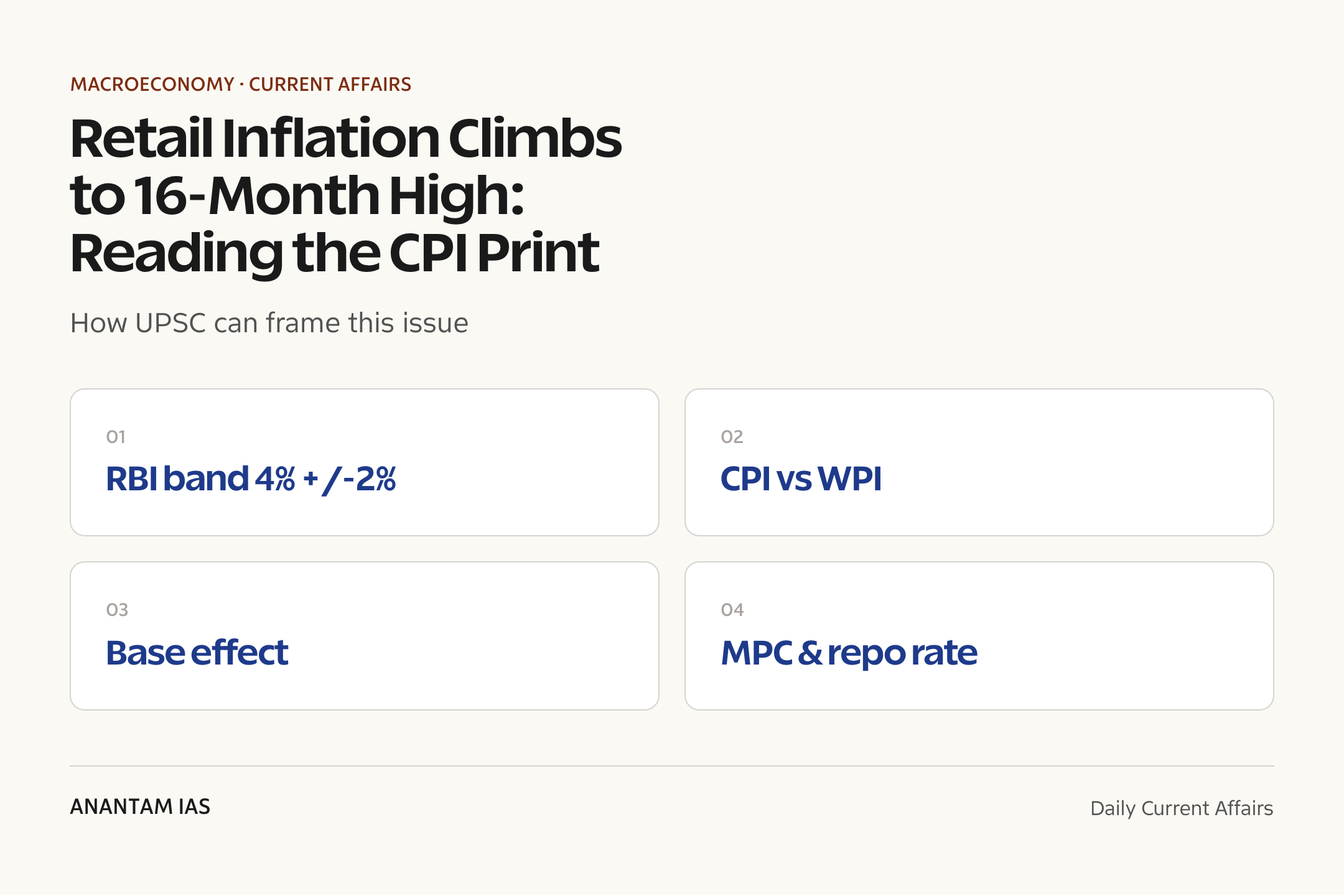
- RBI’s flexible inflation target: 4% CPI with a +/- 2% band (2%-6%).
- The Monetary Policy Committee (MPC) is a six-member body; the RBI Governor has a casting vote.
- Repo rate is the RBI’s primary policy lever for transmission to lending rates.
- Base effect: a low year-ago price level mechanically lifts the current inflation rate.
- Core inflation strips out volatile food and fuel.
- Inflation-targeting mandate flows from the amended RBI Act, 1934 (2016) via the Finance Act, 2016.
Mains Relevance
GS Paper 3
- Examine why food inflation drives India’s headline CPI more than core inflation, and the policy limits of monetary tools against supply-side food shocks.
- Evaluate the flexible inflation-targeting framework: has the 4% +/- 2% band balanced growth and price stability?
GS Paper 2
- Discuss the institutional design of the MPC and the accountability mechanism when inflation breaches the band for three consecutive quarters.
Essay
- Price stability versus growth: the perennial trade-off in a developing economy.
Background and Context
What the May 2026 print actually says
The headline number rose but stayed comfortably within the target band.
- CPI-Combined inflation at 3.93% in May, up 45 basis points from April’s 3.48%.
- The reading is the highest in about 16 months, reversing a multi-month softening trend.
- Still below the 4% target midpoint, so it does not breach the RBI’s tolerance band.
- The rise is broad-based across the food basket rather than one outlier, with fuel adding pressure.
How CPI is built and who measures it
The Consumer Price Index tracks the retail cost of a fixed consumption basket.
- Compiled by the NSO under MoSPI; the current base year is 2024. See our primer on the Consumer Price Index.
- Measures price change for a representative consumption basket of goods and services households actually buy.
- Reported separately for Rural, Urban and Combined; the Combined series is the RBI’s target metric.
- Food and beverages dominate the weight (~45.86%), which is why food swings move the headline so sharply.
- Other groups: housing (urban only), fuel and light, clothing, health, transport, education, miscellaneous.
CPI versus WPI — the two inflation gauges
Aspirants must keep the retail and wholesale measures distinct.
- CPI is retail-level, household-facing, services-inclusive, and the RBI’s policy anchor.
- WPI is wholesale, producer-facing, goods-only, with no services and no retail margins.
- WPI weights manufactured products heavily; CPI weights food heavily — so they can diverge for months, as seen when India’s wholesale inflation hit a 42-month high earlier in 2026.
- The RBI shifted to CPI as the nominal anchor after the Urjit Patel Committee (2014).
The food index and the base effect
Food prices and statistical base effects together explain most of the move.
- CFPI rose to 4.78% from 4.20%, leading the headline higher.
- Vegetables, edible oils and protein items are the usual swing factors in India’s food basket.
- A base effect — last year’s low prices — can inflate the year-on-year rate even without fresh price rises.
- Because monetary policy cannot grow more onions, food-led inflation is largely a supply-side problem.
Flexible inflation targeting and the RBI’s band
India’s monetary framework is built around a legally mandated CPI target.
- Statutory target: 4% CPI inflation with a +/- 2% tolerance band (2% to 6%).
- Mandate flows from the 2016 amendment to the RBI Act, 1934 and the Finance Act, 2016.
- The Monetary Policy Committee (MPC) — six members, three from RBI and three appointed by the Centre — votes on the policy rate.
- A breach for three consecutive quarters triggers a written report from the RBI to the government.
- The repo rate is the main transmission lever; a hardening print narrows room to cut.
Why a 16-month high matters for policy
The number reframes the rate-cut debate even while staying within the band.
- A move back toward the 4% midpoint suggests disinflation is plateauing.
- It keeps the MPC data-dependent rather than pre-committed to further easing, much like the April 2026 decision to hold the repo at 5.25%.
- Core inflation (ex food and fuel) is the cleaner read on demand-side pressure.
- Persistent food spikes can de-anchor inflation expectations, a key RBI worry.
Way Forward
Supply-side management
- Strengthen buffer stocks, cold chains and market intelligence for volatile vegetables and pulses.
- Calibrate trade levers (export curbs, duty cuts) on edible oils and key food items to smooth spikes.
Monetary calibration
- Keep the MPC data-dependent, weighing core inflation and the durability of food shocks before any rate move.
- Improve monetary transmission so repo changes pass through to lending and deposit rates.
Sustained price stability needs both arms working together: the RBI manages demand-side and expectations, while the government and states tackle the supply bottlenecks that drive India’s food-heavy basket.
Conclusion
The May 2026 print is a reminder that India’s headline inflation lives and dies by its food basket. A 16-month high that still sits below the 4% midpoint is a warning flag, not an alarm bell.
For policy, the message is patience: the MPC can stay within its band while watching whether food-led pressure is transient or sticky. For aspirants, the durable lesson is the machinery behind the number — CPI versus WPI, the food index, the base effect, and the RBI’s flexible inflation-targeting mandate.
UPSC Practice Questions
Prelims MCQ 1
With reference to the Consumer Price Index (CPI) in India, consider the following statements:
- The CPI (Combined) is released monthly by the National Statistical Office under MoSPI.
- Food and beverages carry the single largest weight in the CPI (Combined) basket.
- The CPI is the metric targeted under India’s flexible inflation-targeting framework.
How many of the above statements are correct?
(a) Only one (b) Only two (c) All three (d) None
Answer: (c) All three
Explanation:
CPI-Combined is released by the NSO (MoSPI) monthly, food and beverages have the largest weight (~45.86%), and CPI-Combined is the RBI’s targeted metric after the Urjit Patel Committee. All three are correct.
Prelims MCQ 2
Which of the following correctly distinguishes the Wholesale Price Index (WPI) from the Consumer Price Index (CPI)?
(a) WPI includes services while CPI excludes them
(b) WPI is released by the RBI while CPI is released by MoSPI
(c) WPI covers only goods at the wholesale level while CPI covers goods and services at the retail level
(d) WPI is the metric targeted by the RBI’s Monetary Policy Committee
Answer: (c) WPI covers only goods at the wholesale level while CPI covers goods and services at the retail level
Explanation:
WPI is goods-only and wholesale-level (released by the Office of the Economic Adviser, Ministry of Commerce); CPI is retail-level and includes services. The RBI targets CPI, not WPI.
UPSC Mains Questions
- Food prices repeatedly drive India’s headline retail inflation, yet the chief policy lever is monetary. Examine why food-led inflation poses a structural challenge to inflation targeting and what supply-side measures can address it.
- Critically evaluate India’s flexible inflation-targeting framework since 2016. Has the 4% +/- 2% tolerance band achieved a credible balance between price stability and growth?
Sources: The Hindu and MoSPI (NSO) CPI release.
Frequently Asked Questions
What was India’s retail inflation in May 2026?
Retail inflation measured by the Consumer Price Index rose to about 3.9% (3.93% provisional) in May 2026, up from 3.48% in April. The Hindu reported it as a 16-month high, driven mainly by costlier food items, though the reading stayed below the RBI’s 4% target midpoint.
What is the difference between CPI and WPI?
CPI tracks retail prices households pay and includes services, with food carrying the heaviest weight. WPI tracks wholesale prices of goods only, with no services and no retail margins. The RBI targets CPI, not WPI, which is why the two indices can move differently for months at a time.
What is the RBI’s inflation target band?
Under India’s flexible inflation-targeting framework, the RBI must keep CPI inflation at 4%, with a tolerance band of plus or minus 2% — so a range of 2% to 6%. The mandate flows from the 2016 amendment to the RBI Act, 1934. A reading of 3.9% is within this band.
What is the CFPI?
The Consumer Food Price Index, or CFPI, is the food sub-index of the CPI. It isolates inflation in the food basket, which dominates India’s CPI weight at roughly 45.86%. In May 2026 the CFPI rose to 4.78% from 4.20%, the main reason the headline number firmed up.
Why does food inflation matter so much for India?
Because food and beverages make up nearly half the CPI basket, swings in vegetable, oil and protein prices move the headline number sharply. Food inflation is largely a supply-side problem that monetary policy cannot fix directly, which complicates the RBI’s job of steering inflation.
What is a base effect in inflation data?
A base effect is when the year-ago price level distorts the current year-on-year inflation rate. If prices were unusually low last year, even modest current prices can show as high inflation, and vice versa. It explains part of the May 2026 uptick without implying fresh price pressure across the board.