Context:
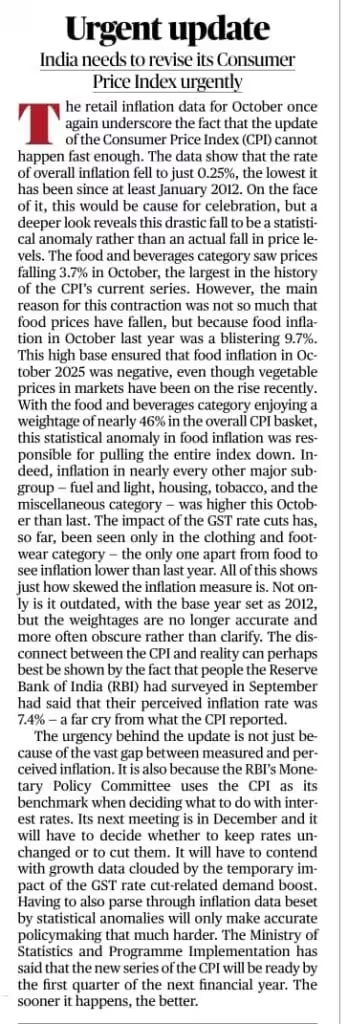
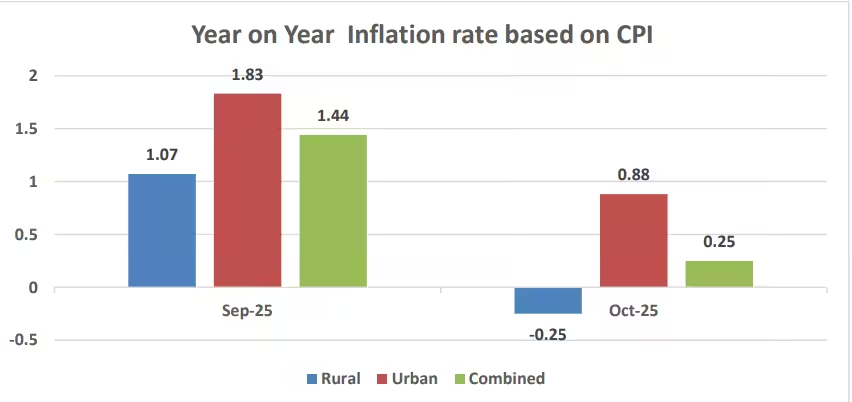
Rretail inflation (CPI) fell sharply to 0.25%, the lowest since January 2012. However, this dramatic fall is not a sign of real price decline but is the result of statistical distortions in the Consumer Price Index (CPI).
UPSC Relevance:
Economics
UPSC PYQ:
Consider the following statements: (2020)
1. The weightage of food in Consumer Price Index (CPI) is higher than that in Wholesale Price Index (WPI).
2. The WPI does not capture changes in the prices of services, which CPI does.
3. The Reserve Bank of India has now adopted WPI as its key measure of inflation and to decide on changing the key policy rates.
Which of the statements given above is/are correct?
(a) 1 and 2 only
(b) 2 only
(c) 3 only
(d) 1, 2 and 3
Price indices in India
- (i) WPI- It is compiled and released on monthly basis by the Office of Economic Adviser, Department of Industrial Policy and Promotion (DIPP), Ministry of Commerce & Industry;
- (ii) CPI (Urban, Rural and All India)- It is released by Central Statistics Office (CSO), Ministry of Statistics & Programme Implementation (MoSPI);
- (iii) CPI (Industrial Workers)- CPI (Agricultural Labour) and CPI (Rural Labour) are a set of Indices released by the Labour Bureau, Ministry of Labour. Some States also compile variants of CPI and WPI indices at the State level.
About CPI:
Consumer Price Index (CPI) measures the changes over time in the level of retail prices of goods and services that a reference population acquires, use, or pay for consumption (The population that falls within the scope of an index is termed as the reference population). In practice, a CPI measures the cost of purchasing a fixed basket of goods and services. The coverage and applicability of CPIs are generally limited to specified socio-economic groups.
Uses of CPI:
- To measure the changes over time in the general level of prices of consumption goods and
services that the reference population acquire, use or pay for consumption. - For indexation of prices in contracts for the supply of goods and services by firms.
- To provide one of the basic parameters needed for economic planning and policy
formulations by Government as well as private organizations. - To adjust the taxes, fines or fees levied by Government so as to maintain the burden upon
the people paying taxes, fines, etc. constant in real terms. - For obtaining constant-price estimates of consumption expenditure for national accounting.
- For indexation of wages and salaries in contracts of employment. This presumably avoids
the need to renegotiate the contracts when prices rise.
Selection of a base year:
(i) A normal year i.e. a year in which there are no abnormalities in the level of production, trade and in the price level and price variations,
(ii) a year for which reliable price data are available and
(iii) a year as recent as possible, and comparable with other price index series released at national and state levels
Difference b/w CPI and WPI:
| Criteria | Wholesale Price Index | Consumer Price Index (CPI) |
| Level | Measures Inflation at Wholesale level | Measures Inflation at Retail level |
| Who Calculates? | Office of Economic Advisor, Ministry of Commerce and Industry | National Statistical Office, MoSPI |
| Base year | 2011-12 | 2012 |
| Released on | 14th of Every Month | 12th of Every Month |
| Number of Items covered | 697 | 299 |
| Categories and their respective weightages | Primary Articles: (22.6%)Manufactured products (64.2%)Fuel and Power (13.2%) | Food and beverages (45.86%)Pan, Tobacco and Intoxicants (2.38%) Clothing and Footwear (6.53%)Housing (10%)Fuel and Light (6.84%): Electricity, LPG, Kerosene etc. (Does not include Petrol and Diesel)Miscellaneous- Education, Healthcare, Transportation and Communication etc. (28.32%) |
| Weightage given to Food Articles | WPI-Food Index (24%): Food articles from “Primary Articles” and “Manufactured Food Product”. | Consumer Food Price Index (CFPI): (39%): Out of 12 sub-groups contained in ‘Food and Beverages’ group, CFPI is based on ten sub-groups, excluding ‘Non-alcoholic beverages’ and ‘Prepared meals, snacks, sweets etc. (For Details, refer to Rau’s Economic Survey Video) |
| Impact of increase in Food items | Less impact on WPI as compared to CPI | Larger impact on CPI |
| Weightage of Fuel and Power | Included in separate category of Fuel and Power (13.2%) | Weightage (~8%): Included in (a) category of Fuel and light and (b) Category of Transportation and Communication (Fuel for Transportation) |
| Highest Weightage | Manufactured products (64.2%) | Food and Beverages (45.9%) |
| Services included | No | Yes |
| Indirect Taxes Included? | No | Yes |
| Targeted by RBI? | No | Yes. The RBI is required to maintain CPI rate of inflation of 4% with a deviation of 2%. |
Tell Google you want more of this.
Add Anantam IAS as a preferred sourceOne tap, and this site shows up more often in your own Top Stories, AI Overviews and AI Mode. Remove it any time.