Round-the-Clock Constitutional Courts: Emergency Access to Justice
Why in News?
On July 14, 2026, the Supreme Court of India agreed to examine a public-interest petition seeking a uniform mechanism through which people can approach constitutional courts outside regular working hours in emergencies involving life and personal liberty.
A Bench led by the Chief Justice of India issued notice to the High Courts while flagging the central design problem: an emergency window must be genuinely accessible, but it must not become a route for obtaining after-hours hearings in matters that can safely wait for the ordinary roster.
- The petition seeks a standard operating procedure for urgent hearings beyond normal court hours.
- The immediate focus is on cases such as illegal detention, imminent arrest, deportation, demolition, medical emergency or any action with irreversible consequences for life and liberty.
- The Court sought the views of the High Courts, whose administrative conditions, territorial spread and existing emergency practices differ widely.
- The Court also raised the risk of forum shopping, privileged access and routine disputes being presented as emergencies.
- The Hindu reported the development as a wider debate over whether constitutional remedies should remain reachable at all hours.
The development matters in the context of:
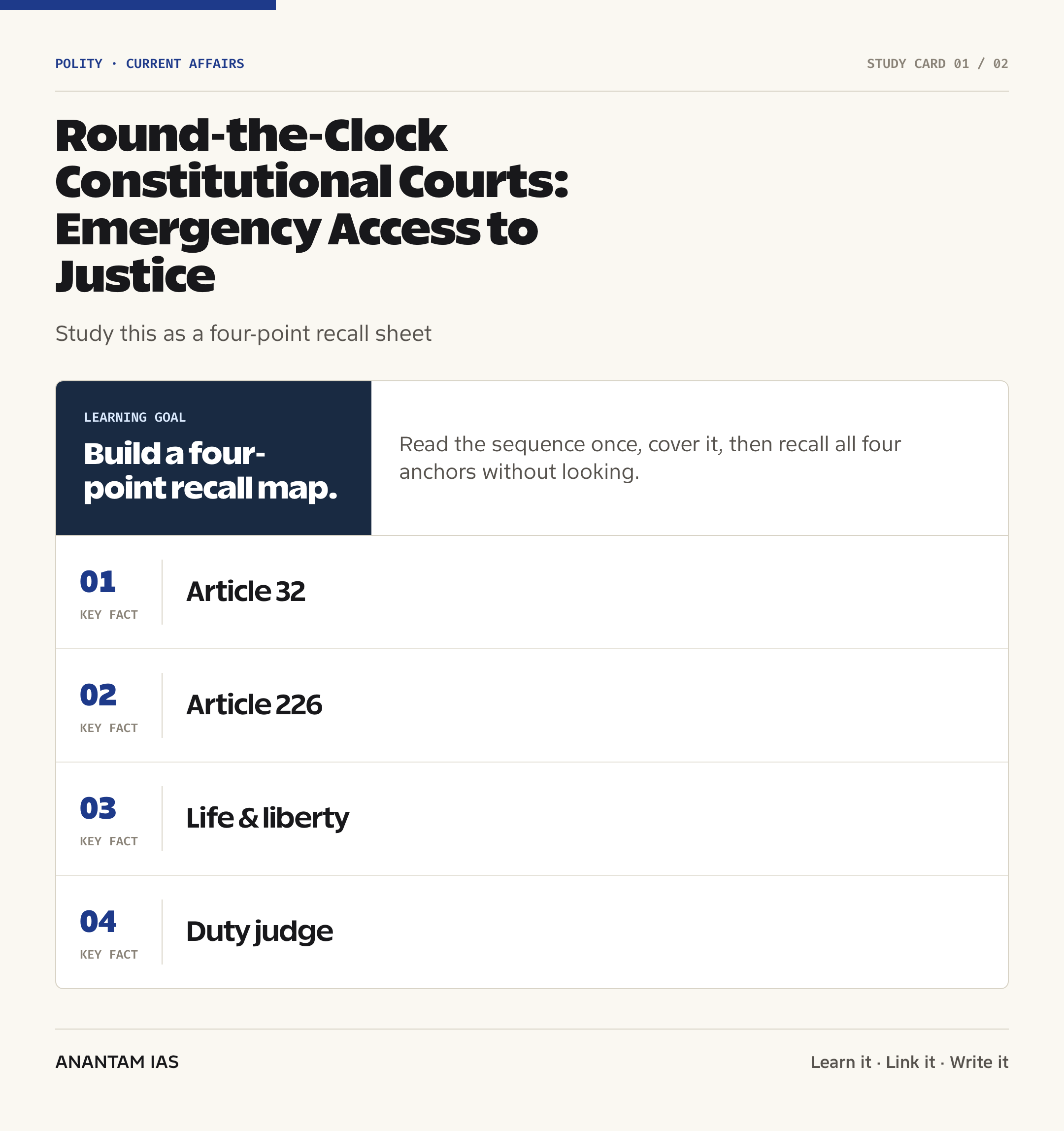
- The issue connects a guaranteed remedy under Article 32 with the practical capacity to obtain a hearing before harm becomes irreversible.
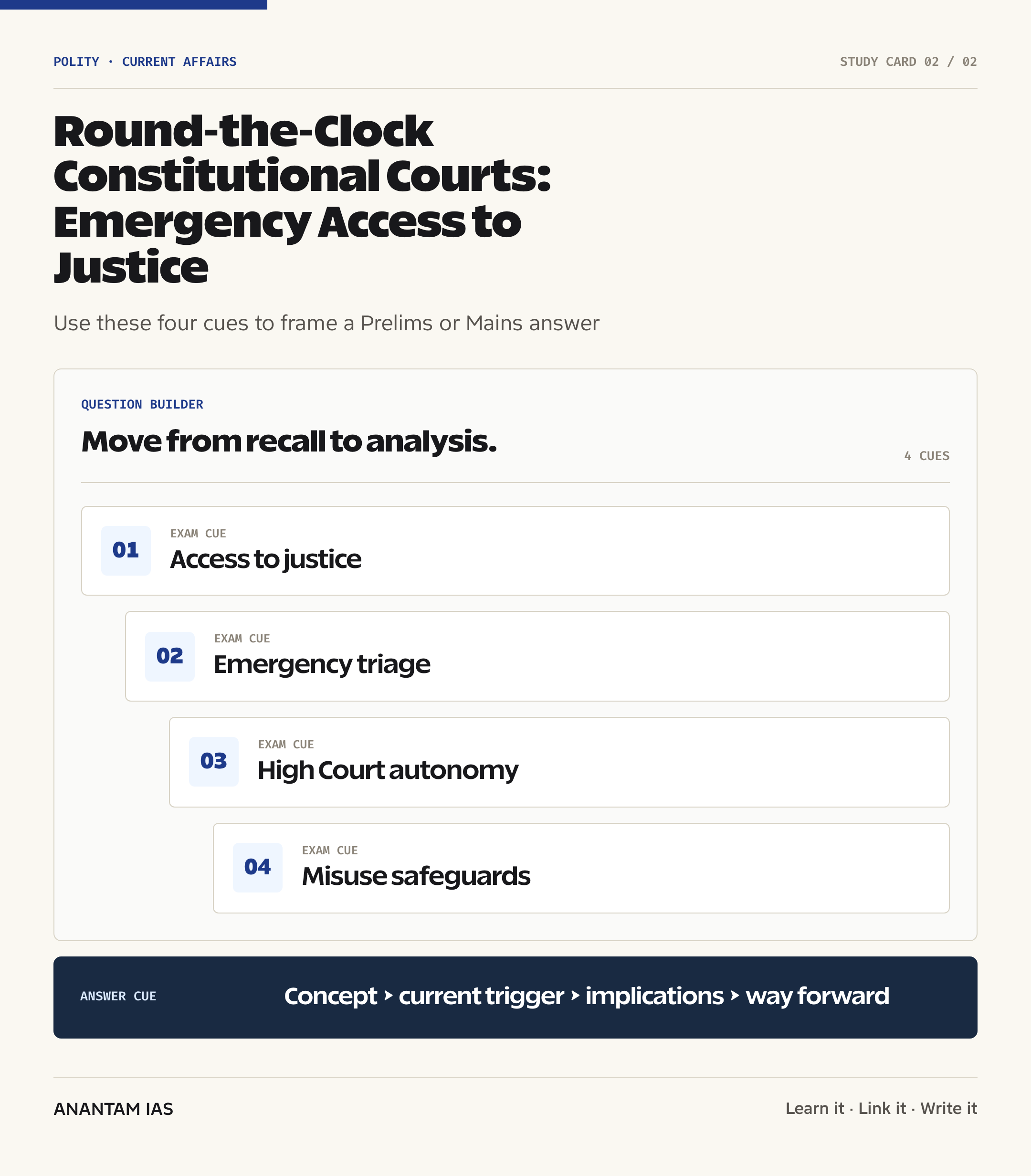
- It tests how judicial independence and High Court autonomy can coexist with minimum national standards for emergency access.
- It also distinguishes a narrow emergency service from the unrealistic idea of running every courtroom and every category of case 24×7.
UPSC Relevance
Prelims Relevance
- Article 32 guarantees the right to move the Supreme Court for enforcement of Fundamental Rights and is itself a Fundamental Right.
- Article 226 empowers High Courts to issue writs for Fundamental Rights and for “any other purpose”, making its substantive scope wider than Article 32.
- The five constitutional writs are habeas corpus, mandamus, prohibition, certiorari and quo warranto.
- A petition for habeas corpus challenges unlawful detention and may be moved by the detained person or another person acting on their behalf.
- Article 21 protects life and personal liberty except according to procedure established by law.
- Article 22 contains safeguards relating to arrest and detention, including production before a magistrate within 24 hours, excluding journey time.
- Article 39A, a Directive Principle, directs the State to secure equal justice and provide free legal aid.
- Under Article 145, the Supreme Court may frame rules regulating its practice and procedure, subject to constitutional conditions.
- High Courts are constitutional courts, not administratively subordinate units of the Supreme Court; consultation is central to a workable national framework.
Mains Relevance
GS Paper 2
- Judiciary and constitutional remedies: converting formal writ jurisdiction into timely and effective protection.
- Governance and institutional design: building transparent triage, accountability and review into an after-hours system.
- Federal judicial administration: balancing common standards with the administrative autonomy and capacities of different High Courts.
GS Paper 4
- Ethics of public institutions: fairness between influential applicants and ordinary citizens seeking the same emergency remedy.
- Competing duties: protecting liberty without normalising exceptional procedure or imposing unsustainable burdens on judges and registry staff.
Essay
- A right delayed beyond the point of irreversible harm can become a right denied.
- Technology can widen the courthouse door, but institutional fairness determines who actually enters.
- Emergency powers need narrow gates, written reasons and public accountability.
Background and Context
Constitutional basis of emergency judicial protection
The proposal is rooted in the Constitution’s promise that enforceable rights must have an effective remedy.
- Article 32 gives the Supreme Court original jurisdiction to enforce Fundamental Rights through directions, orders and writs; the Court’s official jurisdiction page lists this remedial power.
- Article 226 gives every High Court a wider writ power because it covers Fundamental Rights as well as other legal rights and public duties.
- The internal primer on Article 32 and constitutional remedies explains why a paper right is incomplete without direct access to a constitutional court.
- The companion guide to Article 226 writ jurisdiction shows why High Courts are usually the more accessible first constitutional forum.
- Judicial review is part of the Constitution’s basic structure, but the Constitution does not prescribe a single after-hours filing and hearing protocol for every court.
What counts as a legal emergency?
A credible system must define urgency by the threatened harm, not by a party’s status or the publicity around a dispute.
- A strong threshold is whether waiting until the next regular sitting would cause irreversible harm that a later order cannot adequately repair.
- Classic examples include an unlawful loss of liberty, an expiring deportation order, threatened destruction of shelter, denial of time-critical medical care or imminent execution of coercive State action.
- A commercial deadline, reputational discomfort or an avoidable filing delay should not automatically become a constitutional emergency.
- The applicant should disclose earlier proceedings, the exact relief sought, the reason regular listing is inadequate and any attempt already made before the appropriate forum.
- The registry’s first screening should be procedural; the assigned judge must retain the judicial power to decide whether urgency and interim relief are actually made out.
Existing building blocks are not a blank slate
Indian courts already use urgent mentioning, vacation benches, electronic filing and special sittings, so the debate concerns standardisation and equitable access.
- The Supreme Court’s published procedures recognise applications for early hearing, interim relief, bail, interim bail and hearing during vacation.
- During partial court working days, designated vacation benches hear matters of urgent nature rather than leaving the institution entirely closed.
- Special benches have also been constituted outside the ordinary roster when an imminent constitutional consequence requires immediate attention.
- e-filing allows documents to be lodged beyond counter hours, but a digital upload is not the same as real-time scrutiny, service and judicial hearing.
- The eCourts Phase III framework can supply secure filing, digital records, video links and interoperable data, while human decision-making must control urgency and relief.
A workable 24×7 emergency-access architecture
The practical model is a narrow on-call pathway, not continuously operating courts for the entire docket.
- Each constitutional court could maintain a rotating duty registry officer and duty judge, supported by published contact channels and escalation steps.
- A secure portal should accept a standard emergency form, identity details, case documents, requested relief and a signed declaration explaining why the matter cannot wait.
- The system should generate a time-stamped audit trail showing receipt, scrutiny, judicial allocation, hearing mode and outcome.
- Video hearings can reduce distance and speed up participation, but telephone access and physical facilitation points remain necessary for citizens facing a digital divide.
- Legal Services Authorities, police control rooms, prisons and hospitals need a verified escalation channel for people who cannot reach an advocate during the emergency.
- Any ex parte interim order should be brief, reasoned and placed before the regular roster promptly for confirmation, modification or recall.
Benefits for rights and rule of law
Timely access can stop constitutional injury before it becomes irreversible and can improve trust in justice delivery.
- For personal liberty, hours can matter: an immediate habeas corpus or interim-protection hearing may prevent unlawful custody or coercion.
- A known protocol reduces dependence on informal calls, personal networks or media attention, supporting equality before law under Article 14.
- Uniform minimum information requirements help advocates and registries prepare emergency applications without guessing at court-specific conventions.
- A transparent duty roster can make institutional response more predictable while shielding individual judges from ad hoc pressure.
- Aggregate, anonymised data on requests and outcomes can reveal which kinds of State action repeatedly create after-hours emergencies and require administrative correction.
Risks, limits and constitutional cautions
An emergency channel can itself become unequal or unmanageable unless access, triage and workload safeguards are designed together.
- Powerful litigants may try to convert influence into priority access, while unrepresented citizens may struggle to frame urgency in legally familiar language.
- Loose standards can encourage routine bail, commercial or service matters to be relabelled as urgent, producing docket distortion and forum shopping.
- Judges, court masters, registry staff, security personnel and technical teams need protected rotations; 24×7 access cannot mean permanent availability for the same workers.
- A single rigid national process could overlook differences in geography, connectivity, language and staffing across the 25 High Courts and their benches.
- Cybersecurity, confidential filings, identity verification and reliable service on the opposing party become harder during compressed timelines.
- Emergency relief is often based on incomplete records, so safeguards against suppression of facts and a rapid return to the ordinary adversarial process are essential.
UPSC distinction: access is not disposal
A 24×7 pathway addresses urgent entry into the system; it does not by itself solve judicial delay or the wider pendency problem.
- Emergency access concerns the small class of matters where the timing of first judicial intervention determines whether a right can still be protected.
- Pendency requires separate reforms in appointments, infrastructure, adjournments, case management, government litigation and alternative dispute resolution.
- The broader judicial reforms framework is needed because digital filing cannot substitute for adequate judges, courtrooms and support staff.
- A balanced Mains answer should support an emergency-access guarantee while rejecting the simplistic claim that every court and every case must function continuously.
Way Forward
Adopt a model emergency-access SOP
- The Supreme Court, High Courts and e-Committee should frame a consultative model protocol that states minimum standards but permits locally suitable implementation.
- Define urgency through illustrative categories and an irreversible-harm test, while preserving judicial discretion for exceptional facts.
Make triage transparent and reviewable
- Publish duty contacts, filing requirements, response targets and escalation steps in major regional languages and accessible formats.
- Record brief reasons for accepting or declining an after-hours hearing, with sensitive information protected and a regular-bench review available.
Build inclusion into the channel
- Connect the system with NALSA, State Legal Services Authorities, district legal aid offices and prison legal-aid clinics.
- Retain telephone and assisted physical routes alongside digital filing so poverty, disability, language or connectivity doesn’t decide access.
Protect institutional capacity
- Use rotating on-call teams, compensatory rest, secure technology and adequate registry staffing instead of adding invisible labour to the regular judicial day.
- Audit anonymised data on applications, acceptance rates, response times and later modification of emergency orders to improve the system without compromising case privacy.
Conclusion
A constitutional remedy is meaningful only if it can arrive before the threatened harm becomes irreversible. A carefully designed 24×7 emergency-access mechanism would strengthen Articles 21, 32 and 226 by making urgent protection less dependent on informal influence or the accident of court hours.
But the sound reform is a narrow, transparent and inclusive on-call system, not the continuous operation of the entire judicial docket. Clear triage, recorded reasons, legal-aid access, High Court consultation and humane staffing can reconcile liberty with institutional sustainability.
UPSC Practice Questions
Prelims MCQ 1
With reference to the writ jurisdiction of constitutional courts in India, consider the following statements:
- The right to move the Supreme Court under Article 32 for enforcement of Fundamental Rights is itself a Fundamental Right.
- A High Court under Article 226 may issue writs only for enforcement of Fundamental Rights.
- Habeas corpus is a remedy used to test the legality of detention.
How many of the above statements are correct?
(a) Only one (b) Only two (c) All three (d) None
Answer: (b) Only two
Explanation:
Statements 1 and 3 are correct. Article 226 is wider than Article 32 because High Courts may issue writs both for Fundamental Rights and for any other purpose.
Prelims MCQ 2
Which constitutional provision directs the State to secure equal justice and provide free legal aid?
(a) Article 39A (b) Article 50 (c) Article 136 (d) Article 226
Answer: (a) Article 39A
Explanation:
Article 39A is a Directive Principle requiring equal justice and free legal aid so that economic or other disabilities don’t deny opportunities for securing justice.
UPSC Mains Questions
- A constitutional remedy that cannot be reached before irreversible harm occurs may offer only formal, not effective, protection. In this context, examine the case for round-the-clock emergency access to the Supreme Court and High Courts, along with safeguards needed against misuse and unequal access.
- Digital filing can widen the courthouse door, but it cannot by itself guarantee access to justice. Discuss how an after-hours constitutional-court mechanism should combine technology, legal aid, transparent triage, judicial discretion and humane staffing while respecting the administrative autonomy of High Courts.
Sources: Supreme Court of India and The Hindu.
Frequently Asked Questions
What did the Supreme Court examine?
The Supreme Court agreed to examine a petition seeking a standard mechanism for approaching constitutional courts outside regular hours in urgent life-and-liberty cases. It issued notice to the High Courts and also highlighted the need to prevent routine disputes from being presented as emergencies.
Would all courts operate continuously?
Not necessarily. The practical proposal is a narrow on-call system involving a duty registry officer and a duty judge for exceptional cases. Regular civil, commercial and criminal dockets would continue through ordinary rosters rather than being heard continuously throughout the day and night.
Which constitutional articles are relevant?
Articles 21, 32 and 226 are central. Article 21 protects life and personal liberty. Article 32 guarantees access to the Supreme Court for enforcing Fundamental Rights, while Article 226 gives High Courts wider writ jurisdiction for Fundamental Rights and other legal purposes.
How should an emergency be identified?
The best test is whether waiting for the next regular sitting could cause irreversible harm that a later order cannot repair. Illegal detention, imminent deportation or time-critical denial of medical care may qualify; publicity, inconvenience or a self-created deadline ordinarily should not.
What is the main misuse risk?
Influential litigants could seek priority hearings, and routine matters could be labelled urgent to bypass the normal roster. Written thresholds, disclosure requirements, reasoned triage, an audit trail and prompt review by the regular bench can reduce forum shopping and unequal access.
How can poor litigants access it?
The mechanism should connect with NALSA, State Legal Services Authorities, prisons, hospitals and district legal-aid offices. It should offer regional-language instructions, accessible digital forms, telephone escalation and assisted physical filing so that money, disability or connectivity doesn’t determine emergency protection.