The Department of Justice, in partnership with the Supreme Court eCommittee, hosted the National Conference on Judicial Process Re-Engineering and Digital Transformation on April 11 and 12, 2026. The conference doubled as the formal rollout for four flagship eCourts Phase III initiatives: the eCourts Single Sign-On (SSO) Portal, Electronic Delivery of Summons through Email, eCourts and ePrison integration, and the eCourts Services Mobile App version 4.0.
Phase III is not a cosmetic upgrade. It’s a re-engineering exercise that aims to convert Indian courts from paper-driven institutions into platforms where litigants, lawyers, judges, and prison authorities exchange data over a unified digital backbone.
This explainer unpacks each initiative, places Phase III in the longer eCourts trajectory since 2007, and flags the governance questions that civil services aspirants must engage with. The eCourts Phase III rollout is one of the most significant administrative reforms of 2026 and a high-yield topic for GS-II.
Quick Facts at a Glance
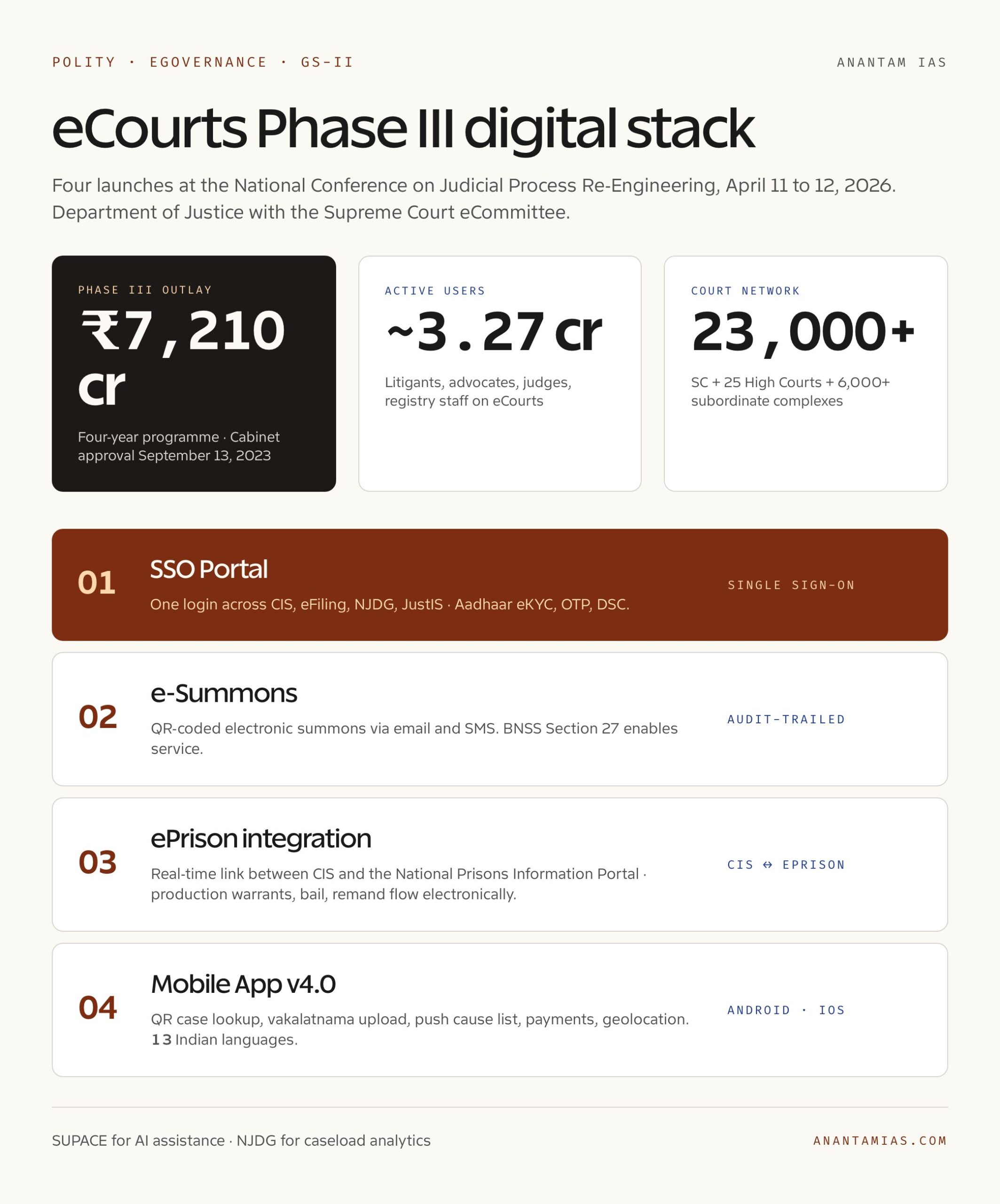
- Initiative: eCourts Phase III digital transformation
- Conference: National Conference on Judicial Process Re-Engineering and Digital Transformation
- Dates: April 11 to 12, 2026
- Hosting authorities: Department of Justice, Supreme Court eCommittee
- Phase III approval: Cabinet sanctioned in September 2023, four-year duration with Rs 7,210 crore outlay
- Launches: SSO Portal, e-Summons, ePrison integration, Mobile App v4.0
- Target users: ~3.27 crore active eCourts users (litigants, advocates, judges, registry staff)
- UPSC relevance: GS-II Polity, Governance, eGovernance
What Just Happened
The April 11 to 12 conference brought together Chief Justices of High Courts, registrars general, IT in-charges, and Department of Justice officials. The two-day agenda combined keynote addresses with hands-on technical sessions on the new tools.
Four launches were announced:
- eCourts SSO Portal lets users log in once and access all eCourts services across CIS (Case Information System), the eFiling portal, the National Judicial Data Grid (NJDG), JustIS, and other platforms.
- Electronic Delivery of Summons through Email moves a paper-heavy, time-consuming process online with full audit trails.
- eCourts and ePrison Integration connects court case data with prison management systems so production warrants, bail orders, and remand records flow without manual coordination.
- eCourts Services Mobile App v4.0 adds case search by QR code, multi-language support across 13 Indian languages, and integrated payment for court fees.
The conference also previewed AI-assisted case classification and automatic translation tools that the eCommittee is piloting under SUPACE (Supreme Court Portal for Assistance in Courts Efficiency).
Background and Historical Context
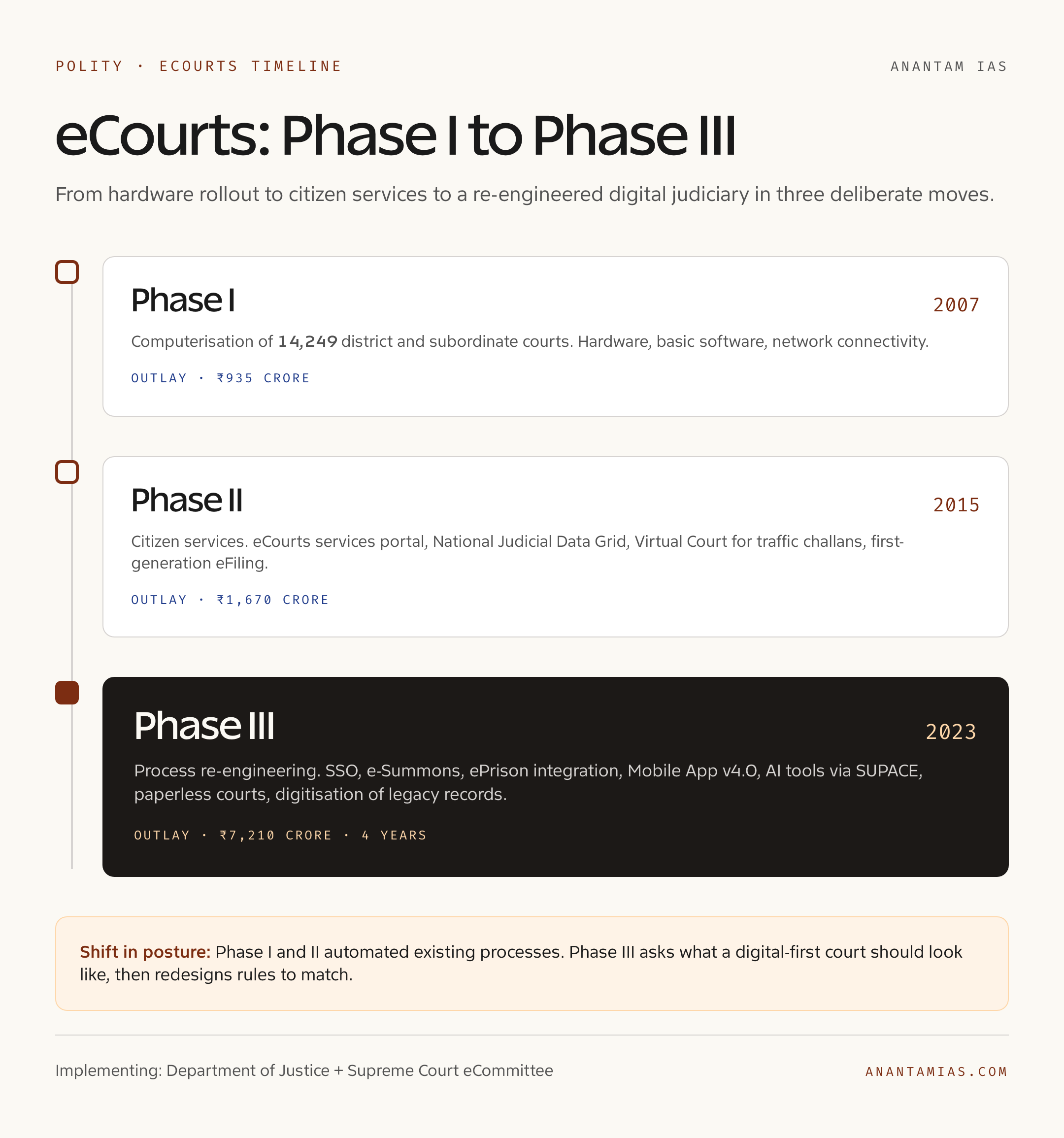
eCourts didn’t begin in 2026. It started as a Phase I rollout in 2007 with a Rs 935 crore outlay focused on computerising 14,249 district and subordinate courts. Phase I gave courts hardware, basic software, and network connectivity. By 2015, the program moved to Phase II with a Rs 1,670 crore outlay and a sharper focus on citizen services: the eCourts services portal, the National Judicial Data Grid, the Virtual Court system for traffic challans, and the first generation of eFiling.
Phase III: From Computerisation to Re-Engineering
Phase III, approved by the Cabinet on September 13, 2023, allocates Rs 7,210 crore over four years (2023 to 2027). It’s larger than the previous two phases combined. The scope shifts from “putting systems in place” to “redesigning how courts work.”
Phase III’s seven core thrust areas include digitisation of legacy records, paperless courts, modernising hardware infrastructure, expanding eSewa Kendras to all court complexes, AI-driven tools (transcription, translation, smart search), enhanced video conferencing, and exactly the kind of cross-system integration that eCourts-ePrison links represent.
Phase III is not just a judiciary project. It’s an interlock with Digital India, Aadhaar-based authentication, DigiLocker, Bharat NIRMAN broadband connectivity, and the Unified Mobile Application for New-age Governance (UMANG). Looking at the larger reform context, our piece on the SAMADHAN SAMAROH initiative shows how digital tools support parallel mediation drives.
Key Provisions and Features
The four April 2026 launches sit at the centre of Phase III’s first major deliverables window.
eCourts SSO Portal
Until April 2026, an advocate who appeared in multiple courts had to maintain separate logins for the eFiling portal, the CIS, NJDG, and various High Court-specific systems. The SSO Portal collapses these into a single authentication layer using Aadhaar-based eKYC, mobile OTP, or digital signature certificates. Once logged in, users move across services without re-authenticating. Role-based access ensures advocates see only their cases, judges see their dockets, and registry staff access their administrative tools.
Electronic Delivery of Summons through Email
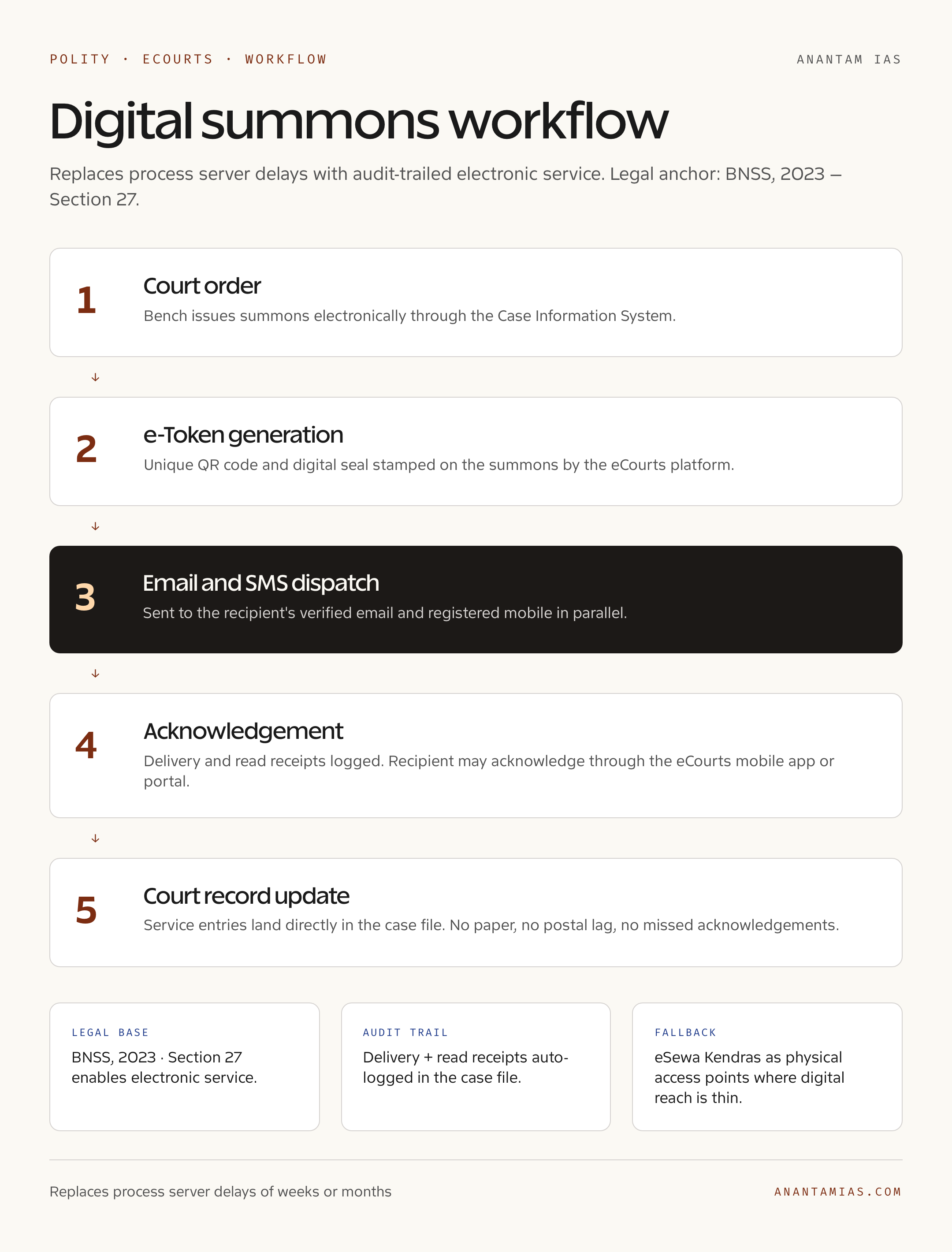
Summons delivery has been one of the slowest steps in Indian litigation. Process servers, postal delays, and refused acknowledgements added weeks or months. The new system generates an electronic summons with a unique QR code and digital seal, dispatches it through email and SMS, and records delivery and read receipts as part of the court record. Section 27 of the Bharatiya Nagarik Suraksha Sanhita, 2023, already permits electronic service, so the legal foundation is in place.
eCourts and ePrison Integration
Production warrants, remand orders, bail releases, and prisoner transfer requests have historically moved on paper between courts and prisons. Errors and delays caused remand violations and bail order non-compliance. The new integration creates a real-time data exchange between the eCourts CIS and the National Prisons Information Portal (ePrison). When a court issues a production warrant, the prison receives it electronically and acknowledges back. Bail orders trigger automatic release verification.
eCourts Services Mobile App v4.0
The earlier app gave case status. Version 4.0 adds: QR-based case lookup, vakalatnama and authority letter uploads, daily cause list with push notifications, multi-language interface in 13 languages, integrated payment gateway for court fees, and a “find a court” geolocation feature. The app is available on Android and iOS and integrates with the SSO Portal.
Why eCourts Phase III Matters
Three reasons make this a watershed moment.
The first is scale. India has more than 23,000 courts in Phase III’s scope, including the Supreme Court, 25 High Courts, and over 6,000 subordinate court complexes. Re-engineering at this scale, on this budget, with this level of institutional buy-in, hasn’t been attempted before in any common law jurisdiction.
The second is integration. Phase III breaks the silo between judiciary, prisons, police, and citizens. Once production warrants flow electronically, prison overstays drop. Once summons go by email, civil suits don’t sit unserved for months. Once SSO removes login friction, advocates spend less time on portals and more on cases.
The third is the precedent. If eCourts Phase III delivers, the model becomes a template for other Indian institutions, and even other countries. For UPSC aspirants, this is a textbook case of process re-engineering plus eGovernance plus citizen-centric service delivery.
Detailed Analysis: The Re-Engineering Idea
Process re-engineering, as a discipline, came out of management thinking in the 1990s. The core idea is that you don’t automate broken processes; you redesign them and then automate. eCourts Phase I and II largely automated existing court processes. The eFiling portal still mirrored paper filing. The CIS still mirrored the cause list register.
Phase III reverses that approach. It asks: what does a digital-first court process look like? Cases are filed once, summons delivered electronically, hearings conducted in hybrid mode where appropriate, documents indexed by AI, judgments translated into regional languages automatically, and prison authorities integrated into the case lifecycle.
This shift is non-trivial. It requires rule-making changes by High Courts, training of around 18,000 judicial officers and 80,000 court staff, and political support across central and state governments. The April 2026 launches are early proof points that the transition is moving.
Comparative Perspective: Global Benchmarks
Singapore’s iJudiciary platform, Estonia’s e-File system, and the UK’s HMCTS Reform Programme are the three benchmarks. Estonia, with its much smaller scale, runs almost entirely paperless courts. Singapore’s eLitigation system handles all civil filings electronically. The UK’s HMCTS Reform Programme has had mixed results, including criticism for cost overruns and rural digital exclusion.
India’s challenge is unique: 23 official languages in court use, vast geographic disparity in connectivity, and a Bar that varies from globally networked Tier-1 advocates to district court practitioners with limited tech exposure. eCourts Phase III’s design tries to address this through 13-language support, eSewa Kendras as physical access points, and capacity-building programs.
For a comparative anchor, the eCourts Phase III framework will likely be cited at international judicial conferences as the most ambitious Global South digital judiciary effort.
Challenges and Critiques
Four issues need watching.
Digital divide. Around 40% of Indian households still lack reliable broadband. Litigants in rural areas may be excluded from email summons or app-based services. eSewa Kendras help but don’t fully bridge the gap.
Cybersecurity. A unified SSO portal becomes a high-value target. The 2024 AIIMS ransomware incident and various state portal breaches show the risk. eCourts will need continuous security audits, zero-trust architecture, and incident response capability.
Legacy data quality. Decades of court records exist in inconsistent formats, with scanning quality issues. Digitisation alone doesn’t make these searchable or useful.
Training and adoption. Many judicial officers and lawyers, especially senior practitioners, are uncomfortable with new tools. Without sustained capacity-building, adoption stalls.
UPSC Prelims Pointers
- eCourts Phase III approved by Cabinet on September 13, 2023, with Rs 7,210 crore outlay for four years.
- Phase I (2007) outlay: Rs 935 crore. Phase II (2015) outlay: Rs 1,670 crore.
- National Conference on Judicial Process Re-Engineering and Digital Transformation: April 11 to 12, 2026.
- Four launches: SSO Portal, e-Summons, ePrison integration, Mobile App v4.0.
- The Supreme Court eCommittee is the nodal body for implementation, working with the Department of Justice.
- National Judicial Data Grid (NJDG) was launched under Phase II.
- SUPACE (Supreme Court Portal for Assistance in Courts Efficiency) is the AI-assistance platform piloted under Phase III.
- Section 27 of the Bharatiya Nagarik Suraksha Sanhita, 2023, enables electronic service of summons.
- Mobile App v4.0 supports 13 Indian languages.
- ePrison is the National Prisons Information Portal under the Ministry of Home Affairs.
Mains Practice Questions
- The eCourts Phase III initiative represents a shift from automation to process re-engineering in the Indian judiciary. Discuss the implications for access to justice and judicial efficiency. (GS-II, 15 marks)
- Examine the role of digital infrastructure in addressing judicial pendency in India. How does eCourts Phase III complement legislative reforms like the Mediation Act, 2023? (GS-II, 15 marks)
- Critically evaluate the challenges of implementing a unified digital judiciary in India given linguistic, geographic, and infrastructural diversity. (GS-II, 10 marks)
- The integration of eCourts and ePrison platforms is expected to reduce remand violations and improve bail compliance. Analyse with examples. (GS-II, 10 marks)
Way Forward and Conclusion
eCourts Phase III is one of those rare reform programs where ambition, budget, and institutional ownership align. The April 2026 launches signal that the eCommittee and Department of Justice are moving past pilots and into national rollout.
What remains is execution discipline. Three priorities matter. First, sustained digital literacy training for judicial officers, court staff, and the bar. Second, hardened cybersecurity and incident response, treating courts as critical national infrastructure. Third, bridging the rural digital divide so e-Summons and the mobile app don’t become a privilege of urban litigants.
If India gets this right, by 2027 we’ll have a judicial system where filing, service, hearing, and disposal happen on a unified digital stack. That’s not a small achievement. It’s the kind of structural reform that doesn’t make daily headlines but reshapes the citizen-state relationship for decades. Aspirants tracking this should also revisit our Indian Polity Notes for constitutional context on judicial administration.
Frequently Asked Questions
Q1: What is eCourts Phase III?
A: It’s the third phase of India’s eCourts Mission Mode Project, approved in September 2023 with Rs 7,210 crore outlay for four years. It focuses on judicial process re-engineering rather than just computerisation.
Q2: When was the eCourts Phase III conference held?
A: April 11 to 12, 2026, jointly by the Department of Justice and the Supreme Court eCommittee.
Q3: What does the eCourts SSO Portal do?
A: It provides single sign-on access to multiple eCourts services (CIS, eFiling, NJDG, JustIS) so users authenticate once and move between services without re-login.
Q4: How does electronic summons delivery work?
A: The court generates a digital summons with QR code and digital seal, sends it via email and SMS, and records delivery and read receipts as part of the case file.
Q5: What is the eCourts-ePrison integration?
A: A real-time data exchange between court CIS and the National Prisons Information Portal so production warrants, bail orders, and remand records move electronically.
Q6: Which languages does the Mobile App v4.0 support?
A: 13 Indian languages including Hindi, English, Tamil, Telugu, Kannada, Malayalam, Bengali, Marathi, Gujarati, Punjabi, Odia, Assamese, and Urdu.
Q7: Is electronic summons legally valid?
A: Yes. Section 27 of the Bharatiya Nagarik Suraksha Sanhita, 2023, recognises electronic service of summons.
Q8: Who funds eCourts Phase III?
A: It’s a Central Sector Scheme funded by the Government of India, implemented by the Department of Justice in partnership with the Supreme Court eCommittee.
Tell Google you want more of this.
Add Anantam IAS as a preferred sourceOne tap, and this site shows up more often in your own Top Stories, AI Overviews and AI Mode. Remove it any time.