SAMADHAN SAMAROH: Supreme Court’s Mediation Push and the Special Lok Adalat 2026
The Supreme Court of India rolled out SAMADHAN SAMAROH on April 21, 2026, a court-led mediation drive that culminates in a three-day Special Lok Adalat from August 21 to 23, 2026. The acronym unpacks as Supreme Court Action for Mediated Adjudication and Disputes Harmonization Across Nation. It’s the apex court’s most ambitious push yet to clear long-pending matters through structured mediation rather than adversarial trial.
The timing isn’t accidental. With over 80,000 cases pending before the Supreme Court alone and roughly 5 crore cases across all Indian courts, the bench has accepted that more judges and longer sittings won’t close the gap. SAMADHAN SAMAROH bets on something older and quieter: settlement.
This piece walks through what was launched, how it links to the Mediation Act, 2023, why Lok Adalat infrastructure matters, and where the gaps remain. If you’re prepping for UPSC GS-II, you’ll find the polity, governance, and ADR threads all converging in this one initiative.
Quick Facts at a Glance
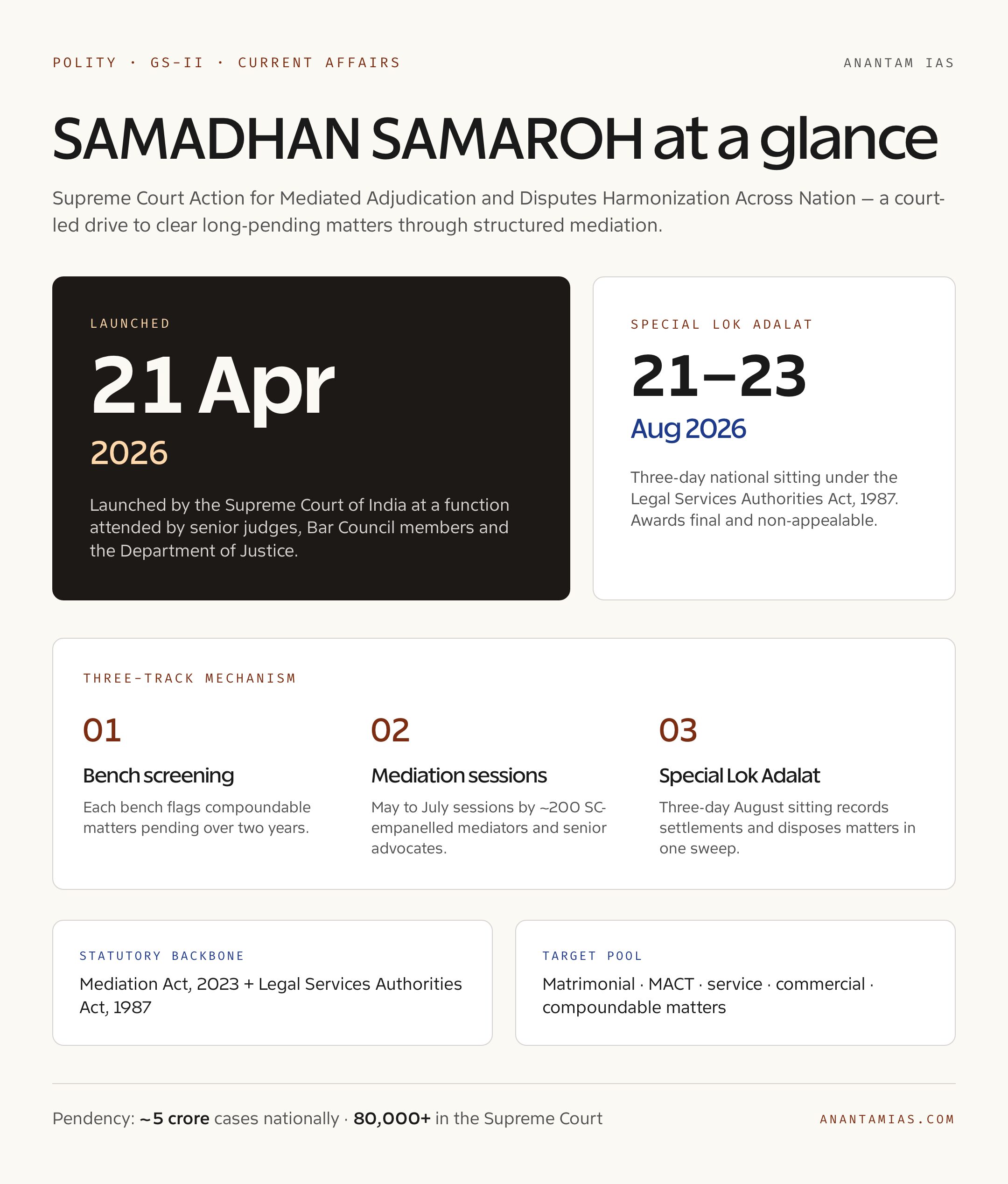
- Initiative: SAMADHAN SAMAROH (Supreme Court Action for Mediated Adjudication and Disputes Harmonization Across Nation)
- Launched: April 21, 2026
- Launching authority: Supreme Court of India
- Culmination event: Special Lok Adalat, August 21 to 23, 2026
- Statutory backbone: Mediation Act, 2023 + Legal Services Authorities Act, 1987
- Targeted matters: Compoundable, settlement-amenable cases including matrimonial, motor accident claims, service, and commercial disputes
- Thematic focus: Pre-litigation mediation, court-annexed mediation, Lok Adalat referrals
- UPSC relevance: GS-II (Polity, Governance, Judiciary)
What Just Happened
On April 21, 2026, the Chief Justice of India formally launched SAMADHAN SAMAROH at a function attended by senior judges, Bar Council members, and the Department of Justice. The launch order directed all benches to identify pending matters that are amenable to mediation and refer them to the Supreme Court Mediation Centre or appropriate Lok Adalat panels in a phased manner over four months.
The plan has three moving parts. First, sitting benches screen their dockets and flag cases. Second, mediators (drawn from the Supreme Court’s empanelled list and senior advocates trained under the Mediation and Conciliation Project Committee) hold sessions through May, June, and July. Third, the Special Lok Adalat sits from August 21 to 23, 2026, to record settlements and dispose of matters in a single sweep.
Crucially, the Court has invited High Courts to mirror the model. State-level SAMADHAN drives are expected to roll out through July, with the August Lok Adalat acting as the national flag-bearer event.
Background and Historical Context
India’s tryst with alternative dispute resolution didn’t start in 2023 or 2026. Section 89 of the Code of Civil Procedure, inserted by the 1999 amendment, already allowed courts to refer disputes to arbitration, conciliation, judicial settlement, or mediation. The Legal Services Authorities Act, 1987, gave Lok Adalats statutory recognition and made their awards equivalent to civil court decrees.
Yet for two decades, mediation lived as a courtesy. Judges referred cases when dockets allowed it. Parties showed up, sometimes settled, often didn’t. There was no umbrella statute, no national accreditation body, and no enforceable settlement mechanism for private mediation outside court.
That changed when Parliament passed the Mediation Act, 2023, which received presidential assent on September 14, 2023. The Act made pre-litigation mediation mandatory for certain categories, set up the Mediation Council of India, and gave mediated settlement agreements the status of court decrees subject to limited grounds for challenge.
SAMADHAN SAMAROH is the operational follow-through. The Mediation Act gave the law; this initiative gives the practice. For a deeper view of how constitutional design supports such judicial reforms, our note on the Basic Structure Doctrine explains the boundaries within which the judiciary can innovate.
Key Provisions and Features of SAMADHAN SAMAROH
The drive isn’t a single circular. It’s a bundle of operational steps. Here’s what the launch document covers.
Case identification protocol
Each bench prepares a list of pending matters that meet three filters: the dispute is compoundable or settlement-amenable, the parties have not previously refused mediation, and the matter has been pending for more than two years. Service matters, matrimonial appeals, motor accident claims, consumer disputes, and contractual commercial cases form the core pool.
Mediator panels
The Supreme Court Mediation Centre’s existing roster of around 200 trained mediators forms the front line. Senior advocates with mediation training, retired High Court judges, and accredited mediators under the Mediation Council of India join the pool. For complex commercial matters, sector specialists are added.
Special Lok Adalat structure
The August 21 to 23 sitting follows the Legal Services Authorities Act framework. Each Lok Adalat bench has a sitting or retired judicial officer plus a legal expert. Awards are final, binding, and not appealable. No court fee is charged, and any court fee already paid is refunded if the matter settles.
Tech-assisted mediation
The Centre is using its online mediation platform built under eCourts Phase III for parties who can’t travel. This dovetails with the broader eCourts Phase III digital push rolled out earlier this April.
Awareness and outreach
Bar associations across states are running camps. Legal Services Authorities at the state, district, and taluka level are coordinating with mediation centres. The push reaches beyond metros into district headquarters.
Why SAMADHAN SAMAROH Matters
Three structural reasons make this more than a feel-good court drive.
The pendency problem is now an institutional risk. With around 5 crore pending cases nationally, including over 80,000 in the Supreme Court, traditional adjudication can’t catch up. Average disposal time in some High Courts has crossed seven years. Justice delayed has stopped being a slogan; it’s a measurable failure rate.
Second, mediation works where adjudication can’t. Family disputes, neighbourhood quarrels, motor accident compensation, and many service matters end better with a negotiated outcome than a verdict. SAMADHAN SAMAROH targets exactly these categories.
Third, this is a judicial nudge to the bar. Indian advocates have historically been wary of mediation because it shortens billable lifecycles and eliminates appeals. A Supreme Court-led drive recalibrates that culture from the top.
Detailed Analysis: Mediation Act 2023 in Practice
The Mediation Act, 2023, is what makes SAMADHAN SAMAROH legally robust. Five features are worth noting.
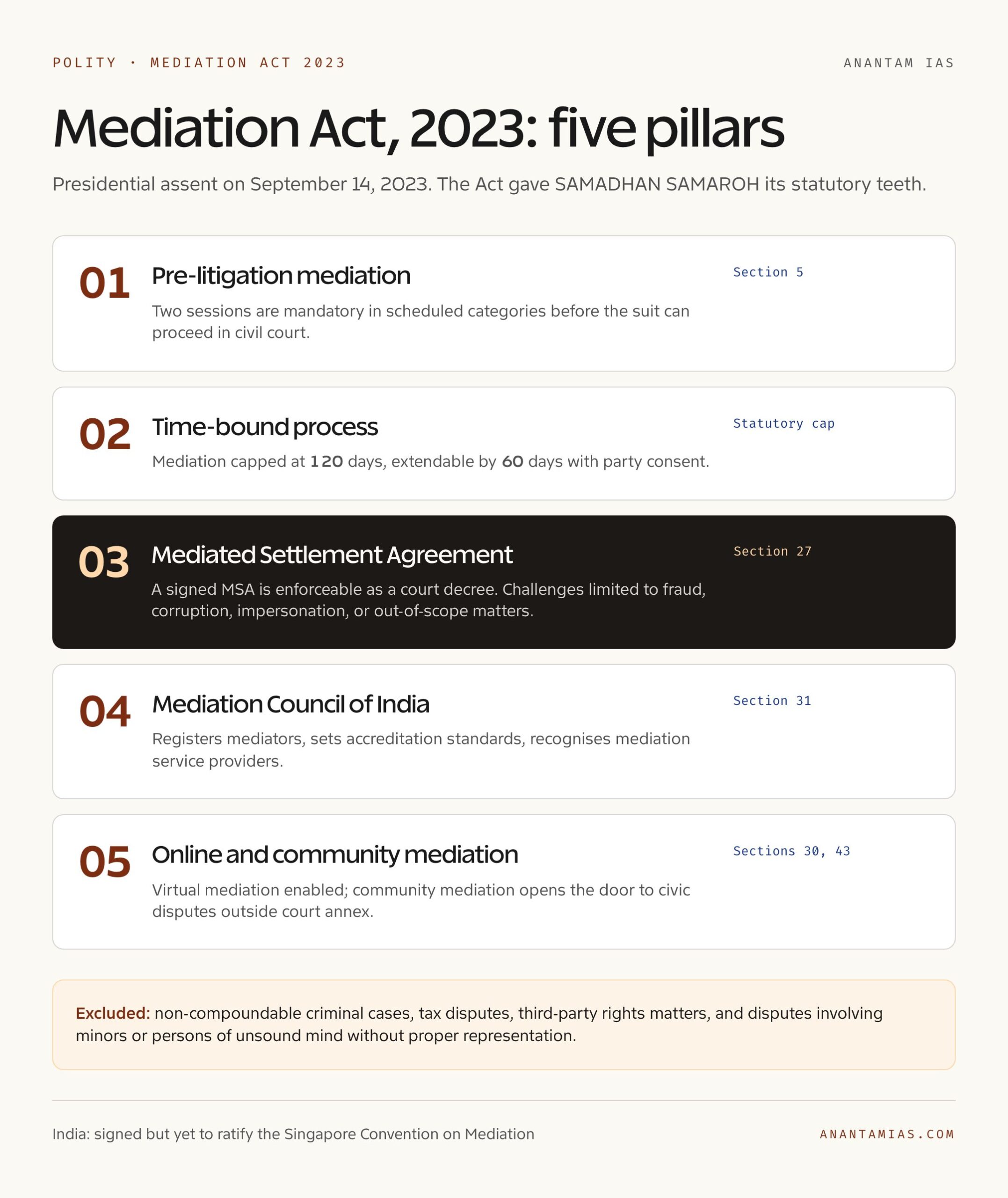
Pre-litigation mediation: Section 5 enables (and in scheduled categories, expects) parties to attempt mediation before approaching a civil court. Two sessions are mandatory before the suit can proceed.
Time-bound process: The Act caps mediation at 120 days, extendable by 60 days with party consent. This prevents mediation from becoming another delay tactic.
Mediated Settlement Agreements (MSA): A signed MSA is enforceable as a court decree under Section 27. Challenges are limited to fraud, corruption, impersonation, or matters not within the Act’s scope.
Mediation Council of India: Established under Section 31, the Council registers mediators, sets accreditation standards, and recognises mediation service providers. It’s the regulatory backbone.
Online and community mediation: Sections 30 and 43 explicitly enable virtual mediation and community mediation for civic disputes, expanding the channel beyond traditional court-annexed forms.
The Act doesn’t apply to certain matters: criminal cases (other than compoundable ones), tax disputes, third-party rights matters, and disputes involving minors or persons of unsound mind without proper representation.
Comparative Perspective: How India Stacks Up
Singapore’s mediation regime under the Singapore Mediation Act 2017 and the Singapore Convention on Mediation (2019) is often held up as the gold standard. Singapore offers cross-border enforceability of mediated settlements, which India hasn’t ratified yet.
The United States runs court-annexed mediation through every federal district. About 95% of US civil cases settle, many through structured mediation. The UK’s Civil Procedure Rules treat unreasonable refusal to mediate as a costs sanction.
India’s Mediation Act, 2023, brings the country closer to global benchmarks but stops short of two things: ratifying the Singapore Convention (which would let Indian MSAs be enforced abroad and vice versa), and making mediation mandatory across the board. SAMADHAN SAMAROH is a step toward closing the practice gap even before the policy gap closes fully.
Lok Adalat Infrastructure: The Quiet Workhorse
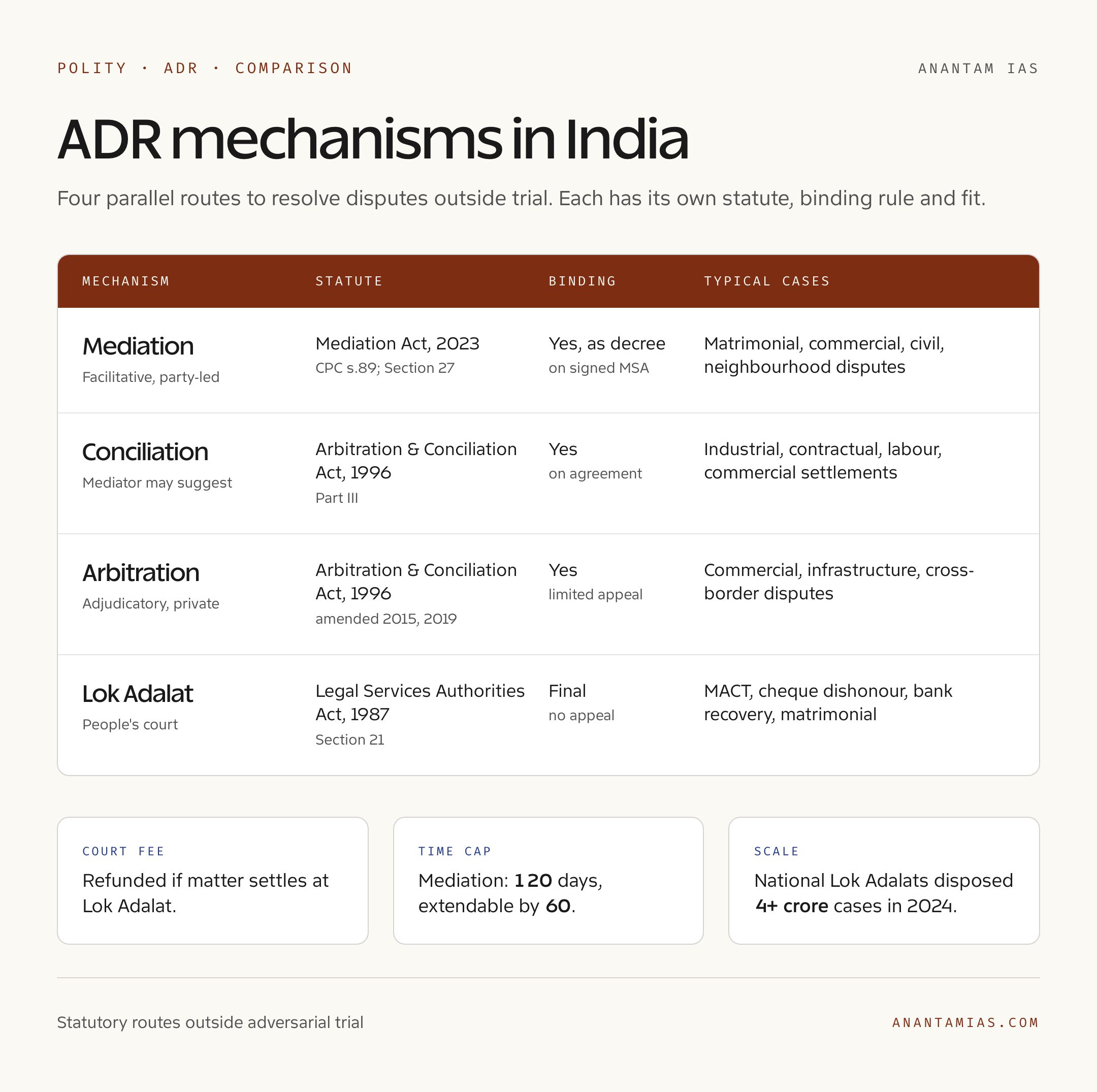
Lok Adalats have been settling cases at scale long before mediation became fashionable. The National Legal Services Authority (NALSA) and State Legal Services Authorities run National Lok Adalats four times a year. In 2024 alone, National Lok Adalats disposed of more than 4 crore cases (pre-litigation plus pending), making them arguably the most efficient dispute resolution mechanism in the country.
Lok Adalat awards are final, non-appealable, and have the force of a civil court decree under Section 21 of the Legal Services Authorities Act. There’s no court fee. Cases settled at Lok Adalats include cheque dishonour matters, bank recovery suits, motor accident claims, matrimonial disputes, and labour matters.
SAMADHAN SAMAROH plugs into this existing pipeline. The August 2026 Special Lok Adalat is essentially a curated, Supreme Court-supervised version of the regular national exercise, focused on long-pending and high-stakes matters.
Challenges and Critiques
Three concerns sit on the table.
Quality of mediator training. India has roughly 17,000 trained mediators, far short of the demand a national mediation drive will generate. The Mediation Council of India is still ramping up accreditation. Inconsistent quality undermines settlement durability.
Bar resistance. Many advocates view mediation as revenue loss. Without bar council buy-in, referrals stall at the trial court level. SAMADHAN SAMAROH partly addresses this by routing through the Supreme Court, but state-level replication will face friction.
Enforcement gaps. While the Mediation Act treats MSAs as decrees, execution proceedings still take time. If a settlement isn’t honoured, the aggrieved party returns to court for execution, partly defeating the speed promise.
Awareness deficit. Most litigants don’t know mediation is an option, and most don’t trust it. A three-day Special Lok Adalat won’t fix that. Sustained public-facing campaigns and Bar-led outreach are needed.
UPSC Prelims Pointers
- SAMADHAN SAMAROH stands for Supreme Court Action for Mediated Adjudication and Disputes Harmonization Across Nation, launched April 21, 2026.
- The Special Lok Adalat is scheduled for August 21 to 23, 2026.
- Mediation Act, 2023, received presidential assent on September 14, 2023.
- Mediation Council of India is established under Section 31 of the Mediation Act, 2023.
- Section 89 of CPC (1999 amendment) was the first statutory recognition of court-referred ADR including mediation.
- Lok Adalat awards are governed by the Legal Services Authorities Act, 1987, and are equivalent to civil court decrees under Section 21.
- NALSA was established under the Legal Services Authorities Act, 1987, and became operational in 1995.
- The Singapore Convention on Mediation (2019) deals with international enforcement of mediated settlements; India is a signatory but hasn’t ratified.
- Pre-litigation mediation under the 2023 Act is capped at 120 days, extendable by 60 days.
Mains Practice Questions
- The SAMADHAN SAMAROH initiative reflects a structural shift in India’s approach to dispute resolution. Examine its constitutional and statutory underpinnings. (GS-II, 15 marks)
- Critically evaluate the Mediation Act, 2023, in light of judicial pendency in India. To what extent can pre-litigation mediation address the case backlog? (GS-II, 15 marks)
- Lok Adalats have emerged as a parallel justice delivery system in India. Discuss their role, achievements, and limitations. (GS-II, 10 marks)
- Compare and contrast India’s mediation framework with the Singapore Convention on Mediation. What policy steps should India consider to align with global best practices? (GS-II, 15 marks)
Way Forward and Conclusion
SAMADHAN SAMAROH is a useful experiment, not a silver bullet. It tests whether a Supreme Court-led mediation drive can shift behaviour at scale. The August 2026 Lok Adalat will produce headline numbers, but the real measure is whether mediation becomes the default first stop for civil disputes by 2030.
Three actions matter going forward. India needs to ratify the Singapore Convention on Mediation to unlock cross-border enforcement. The Mediation Council of India must scale accreditation aggressively, training at least 50,000 mediators by 2028. Bar Councils need to integrate mediation into the LLB curriculum and the All India Bar Examination.
For students of governance, this is a clean case study in how legislative reform (Mediation Act, 2023), judicial leadership (SAMADHAN SAMAROH), and institutional infrastructure (Lok Adalats, NALSA) can combine to address a chronic problem. The Indian polity occasionally moves in this kind of synchronised fashion, and when it does, it’s worth studying carefully. Our Indian Polity Notes contextualises this within the broader judicial system.
Frequently Asked Questions
Q1: What does SAMADHAN SAMAROH stand for?
A: Supreme Court Action for Mediated Adjudication and Disputes Harmonization Across Nation.
Q2: When was SAMADHAN SAMAROH launched?
A: April 21, 2026, by the Supreme Court of India.
Q3: When is the Special Lok Adalat scheduled?
A: August 21 to 23, 2026.
Q4: Is the Mediation Act, 2023, applicable to criminal cases?
A: Generally no. The Act covers civil and commercial disputes. Compoundable criminal matters can be mediated under specific provisions, but the Act excludes most criminal cases.
Q5: Are mediated settlements binding?
A: Yes. Under Section 27 of the Mediation Act, 2023, a Mediated Settlement Agreement is enforceable as a court decree.
Q6: How are Lok Adalat awards different from court judgments?
A: Lok Adalat awards under the Legal Services Authorities Act, 1987, are final and not appealable but have the same enforceability as civil court decrees.
Q7: What is the time limit for mediation under the 2023 Act?
A: 120 days, extendable by 60 days with party consent.
Q8: Has India ratified the Singapore Convention on Mediation?
A: India has signed the Convention (2019) but has not ratified it as of April 2026.