Samriddh Gram wins WSIS Prize 2026: BharatNet-powered rural service delivery
Why in News?
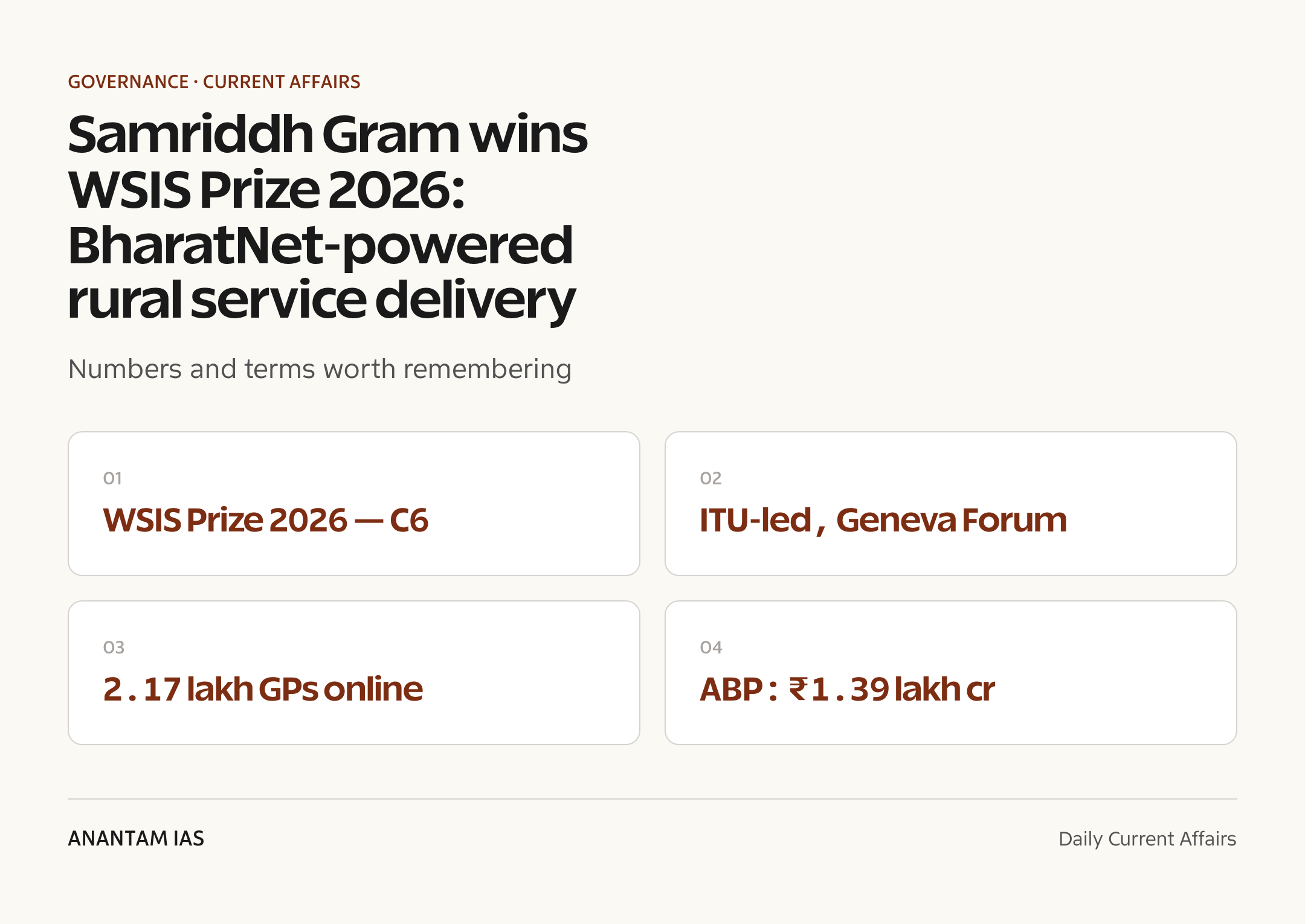
PIB confirmed on 9 July 2026 that the Department of Telecommunications (DoT) has been declared the Global Winner of the World Summit on the Information Society (WSIS) Prizes 2026 under Action Line C6 – Enabling Environment for its flagship project “Samriddh Gram: Integrated Phygital Service Delivery Model Enabled by BharatNet”. The award was presented at the WSIS Forum 2026 in Geneva.
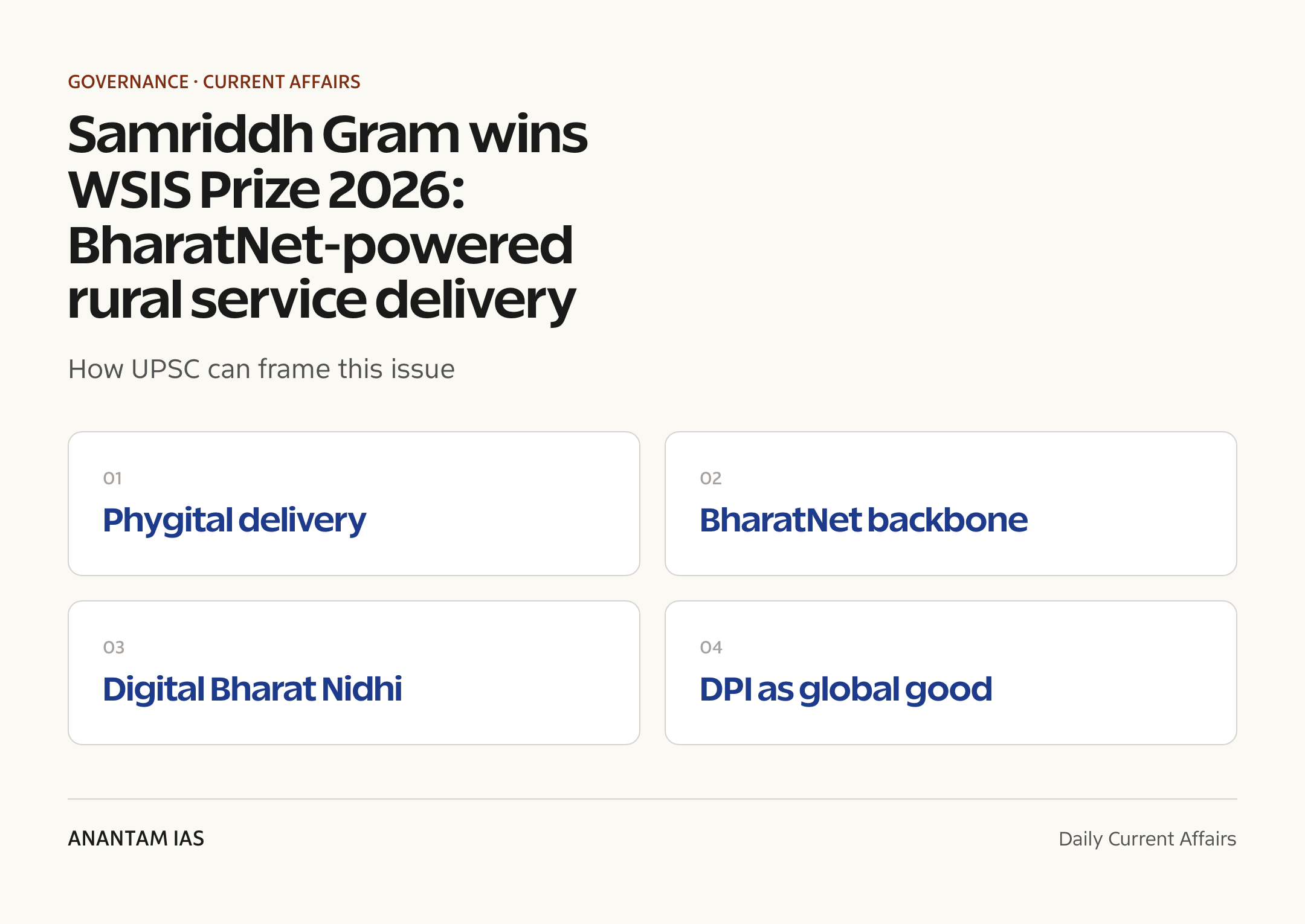
Samriddh Gram rides on the BharatNet optical-fibre backbone to run village-level Samriddhi Kendras — one-stop hubs that combine broadband connectivity with assisted, in-person (“phygital”) delivery of healthcare, education, banking, agriculture and e-governance services. The win puts India’s digital public infrastructure (DPI) story on a UN-system podium.
- The WSIS Prizes are instituted under the WSIS process led by the International Telecommunication Union (ITU), the UN’s specialised agency for telecommunications.
- Samriddh Gram won in one of 18 award categories; it cleared a multi-stage process — international screening, global online voting (over 2.2 million votes cast across nominated projects), a top-five Champion Project shortlist, and final adjudication by the WSIS Expert Committee.
- Only two projects from India made it to Champion Project status in 2026; Samriddh Gram then emerged as the category’s Global Winner.
- PIB notes that BharatNet has made more than 2.17 lakh Gram Panchayats service-ready and online — the connectivity base the model builds on.
- Union Communications Minister Jyotiraditya Scindia called the award a global recognition of India’s inclusive Digital India vision and its leadership in DPI.
The development matters in the context of:
- The award matters for GS2 because it validates a last-mile service-delivery model: connectivity alone doesn’t deliver welfare — an assisted, village-level interface does.
- It lands amid the global WSIS+20 review era, when countries are re-examining how ICT commitments made at Geneva (2003) and Tunis (2005) translate into development outcomes.
- For India, it strengthens the case for exporting DPI-based governance models — a theme India pushed during its G20 presidency.
UPSC Relevance
Prelims Relevance
- Samriddh Gram — integrated phygital (physical + digital) rural service-delivery initiative of the Department of Telecommunications, built on the BharatNet backbone.
- Samriddhi Kendras — one-stop village-level hubs delivering tele-health, smart classrooms, banking-correspondent and e-governance services with local facilitation.
- WSIS Prizes — ITU-led global awards under the World Summit on the Information Society process; Samriddh Gram won Action Line C6 – Enabling Environment in 2026.
- WSIS Forum — annual multi-stakeholder meet at Geneva; WSIS grew out of two summits — Geneva (2003) and Tunis (2005).
- BharatNet — world’s largest rural broadband project; began as the National Optical Fibre Network (NOFN) in 2011, renamed BharatNet in 2015; over 2.17 lakh Gram Panchayats service-ready.
- Amended BharatNet Programme (2023) — ₹1,39,579 crore outlay to connect all ~2.64 lakh Gram Panchayats on an IP-MPLS ring topology with a 10-year operation mandate.
- Digital Bharat Nidhi — the renamed Universal Service Obligation Fund (USOF) under the Telecommunications Act, 2023; funds BharatNet and rural connectivity.
- Bharat Net Udyami (BNU) model — local entrepreneurs deliver last-mile FTTH (fibre-to-the-home) connections; target of 1.5 crore rural FTTH connections.
- PM-WANI — public Wi-Fi framework (2020) whose hotspots feature in the Samriddh Gram service bundle alongside Health ATMs and PM Jan Aushadhi Kendras.
Mains Relevance
GS Paper 2
- E-governance and citizen-centric service delivery: how a phygital model bridges the assisted-access gap that pure digital portals leave in rural India.
- Government interventions for vulnerable sections: converging health, education, banking and skilling services at one village-level touchpoint.
- International institutions: the ITU/WSIS architecture and how global recognition shapes domestic policy legitimacy.
GS Paper 3
- Infrastructure: BharatNet’s design shift under the Amended BharatNet Programme — from linear to ring topology, and from build-out to utilisation.
- Inclusive growth: broadband as a general-purpose technology for agriculture (IoT soil testing, drone spraying), rural enterprise and e-commerce.
Essay
- Connectivity is necessary but not sufficient: technology delivers development only through the last human mile.
- India’s digital public infrastructure as a public good the Global South can adopt.
Background and Context
What exactly is Samriddh Gram?
Samriddh Gram is DoT’s integrated rural digital-transformation initiative that converts BharatNet connectivity into doorstep services.
- The core unit is the Samriddhi Kendra — a one-stop, village-level hub combining reliable telecom connectivity, digital platforms and assisted physical service delivery.
- “Phygital” is the operative design idea: a trained local facilitator sits between the citizen and the digital service, so the model works even for users with low digital literacy.
- The pilot phase began with a Samriddhi Kendra at Umri village, Guna district (Madhya Pradesh) in early 2026, as reported by DD News and PIB’s nomination release.
- The model treats connectivity as a platform: the same fibre line carries tele-medicine, smart-classroom content, banking and e-governance rather than a single-purpose application.
- Community participation and local facilitation are built into the design — the project’s stated aim is measurable socio-economic outcomes, not just network coverage.
The service bundle at a Samriddhi Kendra
PIB lists a wide convergence basket delivered under one roof.
- Health — tele-consultation, diagnostics through Health ATMs, and low-cost medicines via PM Jan Aushadhi Kendras.
- Education and skilling — smart classrooms and AR/VR-based skill development modules.
- Agriculture — IoT-based soil testing, drone-enabled fertilizer and pesticide spraying, and app-based smart irrigation.
- Finance and governance — Common Services Centre (CSC)/e-governance counters and Banking Correspondent services for financial inclusion.
- Connectivity and commerce — FTTH and PM-WANI public Wi-Fi, e-commerce support for local products, and CCTV-based village surveillance.
- India already runs digital-access channels like e-governance platforms and CSCs; Samriddh Gram’s novelty is convergence — stacking them on one BharatNet-fed hub.
WSIS and the ITU: the institution behind the prize
The award’s weight comes from the UN-system process that grants it.
- The World Summit on the Information Society (WSIS) was a two-phase UN summit — Geneva 2003 and Tunis 2005 — that set global commitments on using ICTs for development.
- The ITU leads the WSIS process; the annual WSIS Forum at Geneva brings together governments, UN agencies, industry, academia and civil society.
- WSIS work is organised into Action Lines — thematic tracks such as ICT infrastructure, capacity building and e-applications; Action Line C6 covers the Enabling Environment (policy and regulatory conditions for inclusive digital development).
- The WSIS Prizes recognise projects that harness ICTs for sustainable development across 18 categories; winners emerge from submission, screening, global online voting, a Champion shortlist and expert adjudication.
- PIB notes the project advances multiple Sustainable Development Goals — health, quality education, financial inclusion, reduced inequalities and innovation.
BharatNet: the backbone underneath
Samriddh Gram is only as strong as the fibre network it stands on.
- BharatNet began as the National Optical Fibre Network (NOFN) in October 2011 and was renamed BharatNet in 2015; it aims to connect every Gram Panchayat with high-speed broadband.
- As per PIB, more than 2.17 lakh Gram Panchayats are now service-ready and online — making BharatNet one of the world’s largest rural broadband builds (see the fuller picture in Broadband in India).
- The Union Cabinet approved the Amended BharatNet Programme (ABP) in August 2023 with an outlay of ₹1,39,579 crore, covering all ~2.64 lakh Gram Panchayats and about 3.8 lakh villages on demand.
- ABP shifts the network to a resilient ring topology under a Design-Build-Operate-Maintain (DBOM) framework with BSNL as the project-management agency, fixing the uptime problems of the old linear design.
- Funding flows from the Digital Bharat Nidhi — the Universal Service Obligation Fund (USOF) as renamed by the Telecommunications Act, 2023.
- Last-mile delivery uses Bharat Net Udyamis (BNUs) — village-level entrepreneurs who sell FTTH connections, with a target of 1.5 crore rural fibre connections.
Why this recognition matters for India's DPI story
The prize is less about a trophy and more about a governance model getting UN-system validation.
- It signals that India’s digital public infrastructure approach — open, population-scale rails plus assisted access — is a replicable template for other developing countries (background: DPI and India Stack).
- It reframes BharatNet’s success metric from kilometres of fibre laid to services actually consumed — the utilisation question that has dogged the project for a decade.
- The “Enabling Environment” category specifically rewards policy and implementation ecosystems, not gadgets — a recognition of institutional design.
- It complements India’s G20-era push to position DPI as a global public good, alongside UPI’s international expansion and the India Stack diplomacy.
The caveats an examiner will expect you to know
A balanced answer acknowledges BharatNet’s persistent execution gaps.
- Utilisation gap — a large share of BharatNet fibre has historically remained under-used (“dark fibre“), with weak uptake of connections at the Gram Panchayat level.
- Maintenance and uptime — fibre cuts and poor upkeep under the earlier linear topology kept many connected GPs effectively offline; the ABP’s ring design responds to exactly this.
- Digital divide within villages — device affordability, digital literacy and gender gaps in phone ownership limit who actually benefits from a Kendra.
- Sustainability of the phygital layer — Samriddhi Kendras need viable revenue models for local facilitators, or they risk the fate of under-used telecentres worldwide.
- Scale-up risk — a pilot that works in a few districts must survive procurement, staffing and state-coordination pressures across 2.6 lakh Gram Panchayats.
Way Forward
Convert connectivity into consumption
- Publish district-wise utilisation dashboards for BharatNet — active FTTH connections, Kendra footfall and service transactions, not just GPs connected.
- Bundle high-demand services (tele-health consultations, exam-form filling, DBT grievance redress) to give villagers a recurring reason to visit Samriddhi Kendras.
Make the phygital layer viable
- Give Bharat Net Udyamis and Kendra facilitators a clear commission-plus-service-fee revenue model, on the lines of the Banking Correspondent economics.
- Converge with existing CSCs and Panchayat Bhavans rather than duplicating physical infrastructure.
Institutionalise and export the model
- Codify Samriddh Gram’s design into a standard operating framework states can adopt, with Digital Bharat Nidhi support tied to service-level outcomes.
- Use the WSIS platform to offer the model as DPI cooperation to Global South partners, as India has done with UPI and DigiLocker stacks.
Conclusion
The WSIS Prize 2026 is a milestone with a message: the world is rewarding India not for laying fibre but for the institutional imagination layered on top of it. Samriddh Gram’s phygital design answers the hardest question in digital governance — how the last, least-connected citizen actually uses the network the state has built.
For aspirants, the topic sits at the junction of GS2 governance (service delivery, e-governance) and GS3 infrastructure (BharatNet, Digital Bharat Nidhi). Remember the pairing: BharatNet is the pipe, Samriddhi Kendras are the tap — and the WSIS jury awarded the tap.
UPSC Practice Questions
Prelims MCQ 1
With reference to the Samriddh Gram initiative, consider the following statements:
- It is an initiative of the Ministry of Rural Development implemented through Common Services Centres.
- It won the WSIS Prize 2026 under Action Line C6 (Enabling Environment) of the ITU-led WSIS process.
- Its village-level delivery hubs are called Samriddhi Kendras and use the BharatNet network.
How many of the above statements are correct?
(a) Only one (b) Only two (c) All three (d) None
Answer: (b) Only two
Explanation:
Statement 1 is incorrect — Samriddh Gram belongs to the Department of Telecommunications (Ministry of Communications), though CSC services feature in its bundle. Statements 2 and 3 are correct: DoT won the ITU-led WSIS Prize 2026 under Action Line C6, and the model delivers services through BharatNet-fed Samriddhi Kendras.
Prelims MCQ 2
The ‘Digital Bharat Nidhi’, recently in news in connection with BharatNet funding, is:
(a) a sovereign wealth fund for investing in Indian technology start-ups (b) the renamed Universal Service Obligation Fund under the Telecommunications Act, 2023 (c) a corpus created under the Digital India programme for state e-governance missions (d) a credit-guarantee fund for village-level entrepreneurs selling broadband connections
Answer: (b) the renamed Universal Service Obligation Fund under the Telecommunications Act, 2023
Explanation:
The Telecommunications Act, 2023 renamed the USOF — the levy-funded pool for rural and remote connectivity — as the Digital Bharat Nidhi. It finances BharatNet, including the ₹1,39,579-crore Amended BharatNet Programme approved in 2023.
UPSC Mains Questions
- “Connectivity becomes development only when it is converted into services.” In the light of the Samriddh Gram initiative winning the WSIS Prize 2026, examine how ‘phygital’ delivery models can close the last-mile gap in rural e-governance. (250 words)
- BharatNet has been criticised for laying fibre faster than India could use it. Discuss the design changes under the Amended BharatNet Programme, 2023 and the role of initiatives like Samriddh Gram in improving utilisation. (250 words)
- India increasingly projects its digital public infrastructure as a global public good. What does international recognition such as the WSIS Prizes add to this effort, and what are its limits? (150 words)
Source: PIB, Ministry of Communications.
Frequently Asked Questions
What is the Samriddh Gram initiative?
Samriddh Gram is a Department of Telecommunications initiative that uses the BharatNet fibre network to run village-level Samriddhi Kendras — one-stop hubs delivering healthcare, education, banking, agriculture and e-governance services through a combined physical-plus-digital (‘phygital’) model with local facilitators.
What award did Samriddh Gram win in 2026?
It was declared Global Winner of the WSIS Prizes 2026 under Action Line C6 (Enabling Environment), awarded at the WSIS Forum 2026 in Geneva under the World Summit on the Information Society process led by the International Telecommunication Union (ITU).
What are Samriddhi Kendras?
Samriddhi Kendras are one-stop village hubs under Samriddh Gram. They combine telecom connectivity with assisted service delivery — tele-consultations and Health ATMs, smart classrooms, banking-correspondent counters, CSC e-governance services, IoT-based agri tools, FTTH and PM-WANI Wi-Fi, and e-commerce support for local products.
What is BharatNet and its current status?
BharatNet, started as the National Optical Fibre Network in 2011, is the world’s largest rural broadband project. Per PIB, over 2.17 lakh Gram Panchayats are service-ready. The Amended BharatNet Programme (2023, ₹1,39,579 crore) targets all 2.64 lakh Gram Panchayats on a resilient ring topology.
What is the Digital Bharat Nidhi?
Digital Bharat Nidhi is the new name for the Universal Service Obligation Fund (USOF) under the Telecommunications Act, 2023. Collected as a levy on telecom operators, it funds connectivity in rural, remote and underserved areas — including BharatNet and last-mile fibre schemes.
Why is the WSIS Prize significant for UPSC?
It is a prelims-ready fact linking several syllabus themes: the ITU and WSIS process (international institutions), BharatNet and Digital Bharat Nidhi (infrastructure), and phygital service delivery (e-governance). It also illustrates India’s digital public infrastructure being validated as a global model.