E-Governance in India: Initiatives & UPSC Notes
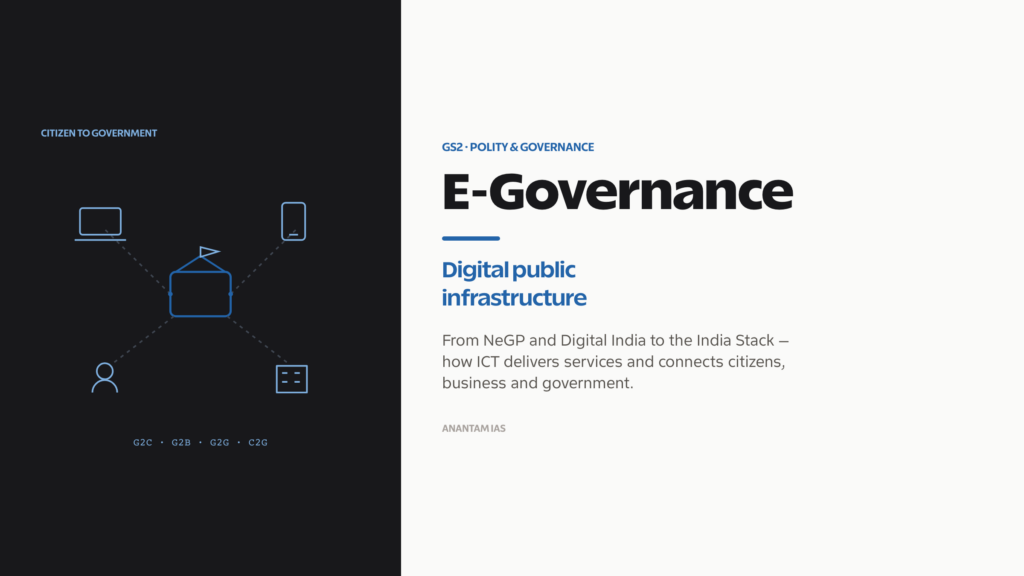
E-Governance is the application of information and communication technology (ICT) to deliver government services, exchange information, and enable citizen-government interaction through digital platforms. India’s e-governance journey has evolved from the National Informatics Centre (NIC) in 1977 to the comprehensive Digital India programme launched in 2015. It’s a key topic for UPSC GS-II (Governance) and GS-III (Technology).
Evolution of E-Governance in India
Timeline of Key Developments
| Phase | Period | Key Milestones |
|---|---|---|
| Phase 1: Computerisation | 1977–1990s | NIC established (1977); government departments computerised |
| Phase 2: Networking | 1990s–2006 | NICNET, internet connectivity, early citizen services |
| Phase 3: NeGP | 2006–2014 | National e-Governance Plan with 31 Mission Mode Projects |
| Phase 4: Digital India | 2015–present | Comprehensive digital transformation; mobile-first governance |
National e-Governance Plan (NeGP)
Launched in 2006, NeGP comprised 31 Mission Mode Projects (MMPs) covering central, state, and integrated categories. Key principles:
- “One-stop-shop” for citizen services
- Reaching the “last mile” through Common Service Centres (CSCs)
- Minimal government, maximum governance
- Building shared infrastructure (State Data Centres, State Wide Area Networks)
Digital India Programme (2015)
The Digital India programme launched on 1 July 2015 transformed e-governance from a project-based approach to a platform-based, citizen-centric model. It rests on three pillars:
- Digital Infrastructure as Core Utility: Broadband connectivity, mobile connectivity, digital identity (Aadhaar), and shareable private space (cloud)
- Governance and Services on Demand: Seamless integration of services across departments, availability of services in real-time from online and mobile platforms
- Digital Empowerment of Citizens: Universal digital literacy, digital resources in Indian languages, collaborative digital platforms
Major E-Governance Initiatives
Citizen-Facing Platforms
UMANG (Unified Mobile Application for New-Age Governance): A single mobile app providing access to over 1,200 government services from central and state agencies. Services include EPF, Aadhaar, income tax, passport, driving licence, and more.
DigiLocker: A cloud-based platform for storing, sharing, and verifying documents and certificates. Linked to Aadhaar, it provides authenticated electronic copies of government-issued documents. Over 150 crore documents have been issued.
e-District: Provides electronic delivery of high-volume, citizen-centric services at the district level — certificates (birth, death, income, domicile), social welfare schemes, and revenue court services.
GeM (Government e-Marketplace): An online procurement platform for government buyers. It promotes transparency, efficiency, and savings in public procurement. Over Rs 4 lakh crore of cumulative transactions.
Identity and Financial Inclusion
Aadhaar (UIDAI): The world’s largest biometric identity system with over 138 crore enrollments. Aadhaar enables targeted delivery of subsidies (DBT), KYC verification, and authentication for government services.
Jan Dhan-Aadhaar-Mobile (JAM) Trinity: Links bank accounts (Jan Dhan), biometric identity (Aadhaar), and mobile phones to enable direct benefit transfers — eliminating intermediaries and reducing leakage in welfare schemes.
Direct Benefit Transfer (DBT): Over Rs 30 lakh crore transferred directly to beneficiaries since inception. Covers LPG subsidy (PAHAL), MGNREGA wages, PM-KISAN payments, scholarships, and pension.
Service Delivery Platforms
| Initiative | Purpose | Key Feature |
|---|---|---|
| e-Court | Digital judiciary services | Case status, cause lists, judgments online |
| e-Hospital | Hospital management | Online OPD registration, reports, blood bank |
| e-Visa | Tourist and business visas | Online application, e-visa for 160+ countries |
| GSTN | Tax administration | Unified GST filing and compliance |
| SWAYAM | Online education | Free online courses from top institutions |
| e-NAM | Agricultural marketing | National electronic trading portal for farm produce |
| CoWIN | Vaccination management | COVID-19 vaccination scheduling and certification |
| PM Gati Shakti | Infrastructure planning | GIS-based multimodal connectivity planning |
Models of E-Governance
Interaction Models
| Model | Description | Indian Example |
|---|---|---|
| G2C (Government to Citizen) | Government delivers services to citizens | Passport Seva, income tax e-filing, DigiLocker |
| G2B (Government to Business) | Government interacts with businesses | GeM, MCA21 (company registration), GSTN |
| G2G (Government to Government) | Inter-governmental data exchange and coordination | e-Office, NIC’s messaging services, PRAGATI platform |
| C2G (Citizen to Government) | Citizens engage with government | MyGov platform, RTI online, CPGRAMS (grievances) |
The SMART Framework
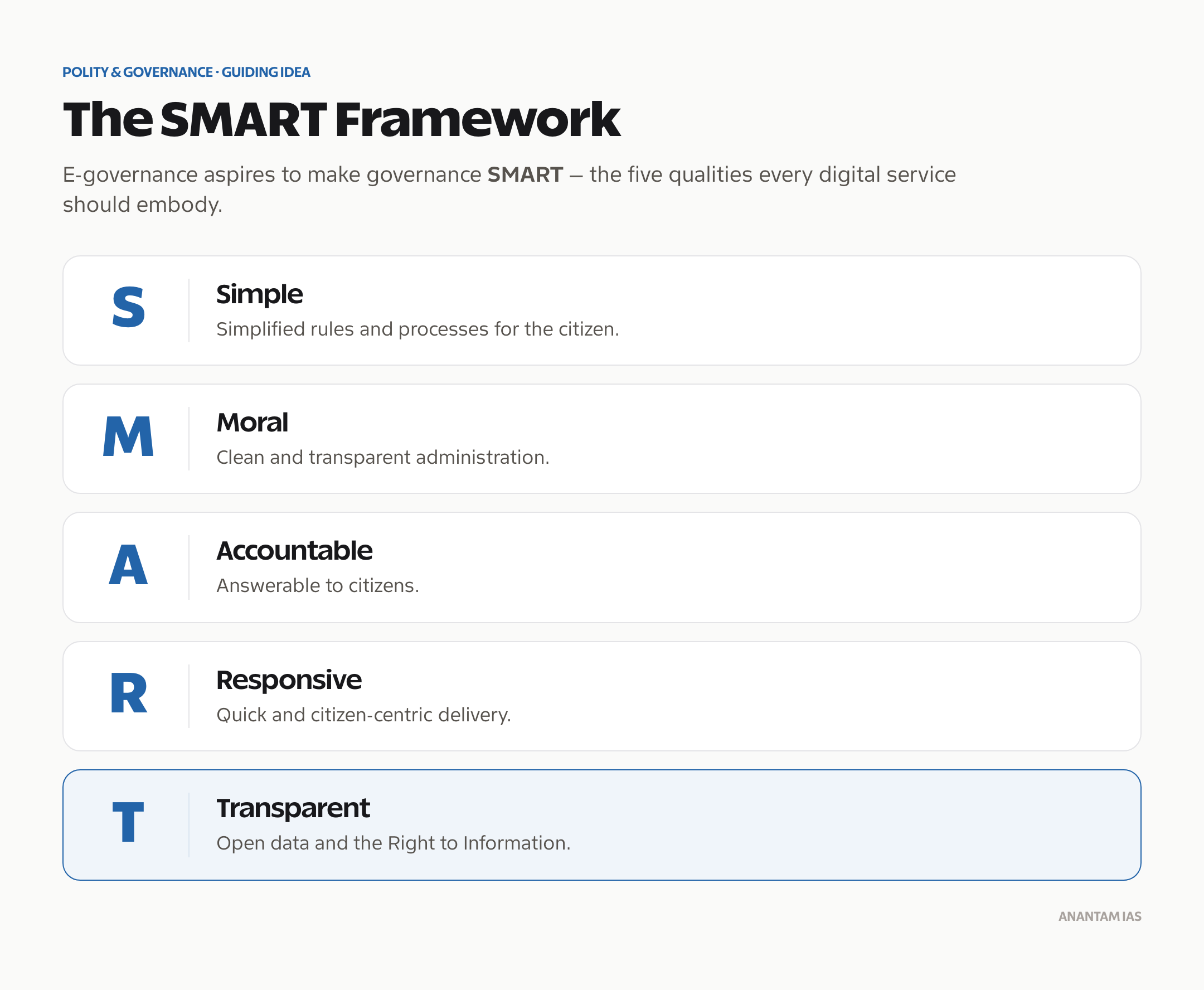
E-governance aspires to make governance:
- Simple — Simplified rules and processes
- Moral — Clean and transparent administration
- Accountable — Answerable to citizens
- Responsive — Quick and citizen-centric
- Transparent — Open data and Right to Information
India Stack: The Digital Public Infrastructure
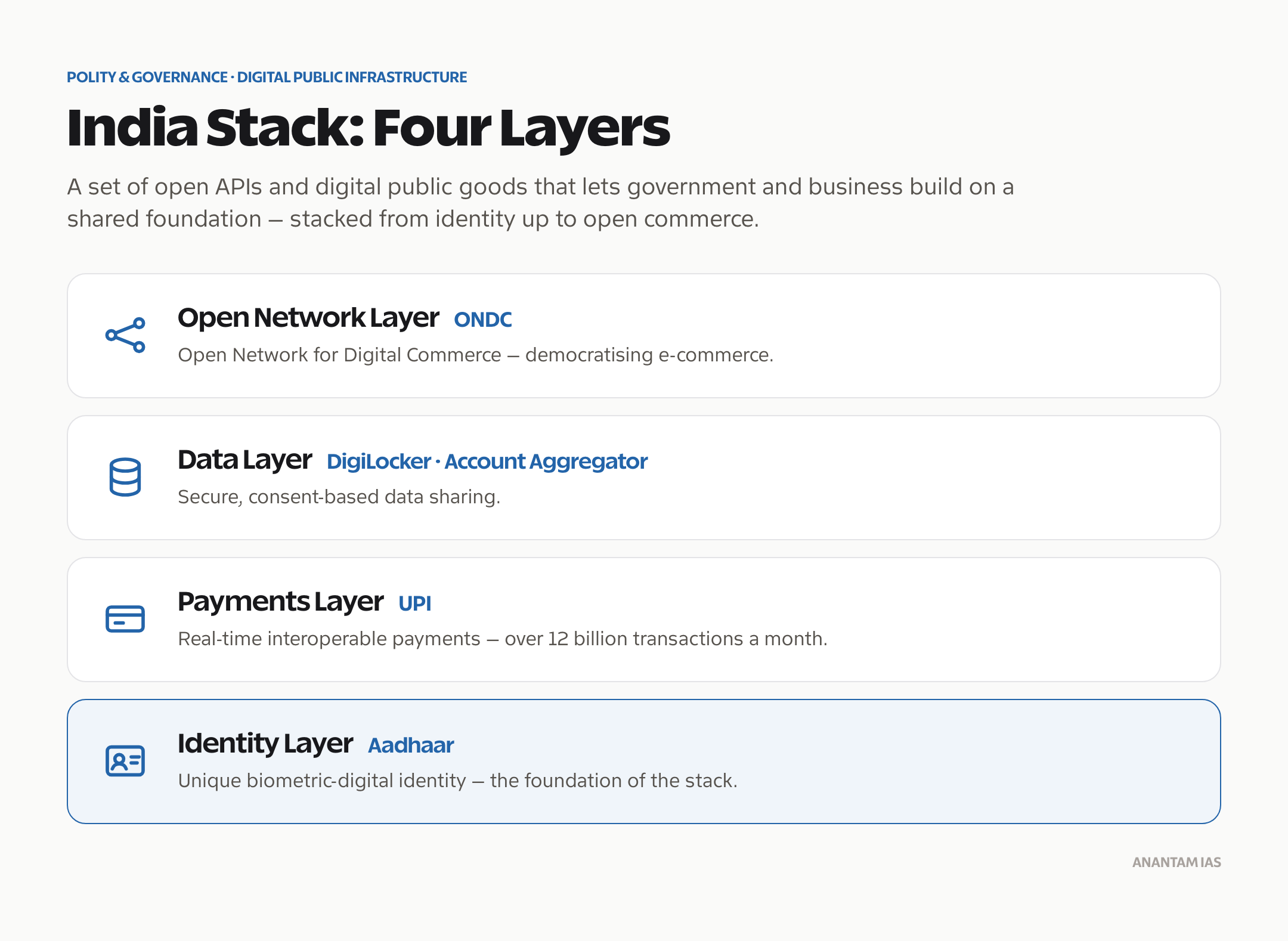
India Stack is a set of open APIs and digital public goods that allow governments and businesses to build solutions. Key layers:
Identity Layer (Aadhaar): Unique biometric-digital identity Payments Layer (UPI): Unified Payments Interface — real-time, interoperable digital payments. Over 12 billion monthly transactions. Data Layer (DigiLocker, Account Aggregator): Secure, consent-based data sharing Open Network Layer (ONDC): Open Network for Digital Commerce — democratising e-commerce
India Stack has been recognised globally and is being adopted by other countries. It represents India’s contribution to digital public infrastructure.
Challenges in E-Governance
Digital Divide
Despite rapid digital growth, significant gaps remain:
- Rural internet penetration lags urban areas
- Gender digital divide — fewer women have smartphones or digital literacy
- Regional disparities — northeast and tribal areas have lower connectivity
- Economic divide — smartphones and data costs remain barriers for the poorest
Data Privacy and Security
The Digital Personal Data Protection Act, 2023 provides the framework for data protection. However, concerns remain about:
- Mass surveillance through Aadhaar and digital transactions
- Data breaches in government portals
- Consent-based data sharing still evolving
- Cross-border data flows and storage
Infrastructure Gaps
- Last-mile connectivity remains incomplete in remote areas
- Frequent power outages affect digital service access in rural India
- Government portals often face downtime and usability issues
- Interoperability between different government systems remains imperfect
Capacity and Adoption
- Low digital literacy among older populations and rural communities
- Resistance to change within government bureaucracy
- Training gaps for government employees managing digital systems
- Language barriers — many platforms primarily operate in English and Hindi
Comparison: India’s Digital Governance vs Global Models
| Feature | India | Estonia | Singapore | UK |
|---|---|---|---|---|
| Digital Identity | Aadhaar (biometric) | e-Residency (digital ID card) | SingPass | GOV.UK Verify |
| Payments | UPI | Bank link | PayNow | Faster Payments |
| e-Voting | Not implemented | Available for national elections | Not implemented | Not implemented |
| Open Data | data.gov.in | data.gov.ee | data.gov.sg | data.gov.uk |
| Scale | 1.4 billion population | 1.3 million | 5.9 million | 67 million |
| Unique Approach | Scale + mobile-first + UPI | Digital-first small nation | Smart Nation initiative | Government as a Platform |
Way Forward
The next phase of e-governance in India focuses on:
- AI-driven governance: Using artificial intelligence for predictive analytics, chatbots, and automated decision-making
- Blockchain for transparency: Land records, supply chain tracking, and tamper-proof government records
- BharatNet completion: Connecting all 6 lakh+ villages with broadband
- Digital courts and paperless governance: Expanding e-courts and e-office adoption
- Localisation: Government services in all 22 Eighth Schedule languages
Digital India RTI Act 2005 Civil Society & NGOs
Frequently Asked Questions
What is the difference between e-Governance and e-Government?
E-Government refers to the use of ICT by government agencies for internal operations and service delivery — it focuses on the government’s digital transformation. E-Governance is broader — it encompasses e-Government plus the use of ICT to transform the relationship between government, citizens, businesses, and other stakeholders. E-Governance includes citizen participation, transparency, and democratic engagement beyond service delivery.
What is India Stack and why is it important?
India Stack is a set of open, interoperable digital public infrastructure layers — Aadhaar (identity), UPI (payments), DigiLocker (data), and ONDC (commerce). It enables governments and businesses to build digital solutions at population scale. India Stack has processed billions of transactions, enabled direct benefit transfers, and is being adopted by other developing countries as a model for digital public infrastructure.
How has UPI transformed digital payments in India?
UPI (Unified Payments Interface), launched in 2016, enables instant, real-time bank-to-bank transfers through mobile phones. It has processed over 12 billion monthly transactions, becoming the world’s largest real-time payment system. UPI has democratised digital payments — small merchants, street vendors, and rural populations use it extensively. It’s now accepted in multiple countries including Singapore, UAE, and France.
What are the main challenges of e-Governance in India?
The primary challenges are the digital divide (rural-urban, gender, economic), data privacy and security concerns, inadequate digital infrastructure in remote areas, low digital literacy especially among older and rural populations, language barriers on government platforms, and bureaucratic resistance to digital transformation. The Digital Personal Data Protection Act, 2023 and BharatNet project aim to address some of these challenges.
Tell Google you want more of this.
Add Anantam IAS as a preferred sourceOne tap, and this site shows up more often in your own Top Stories, AI Overviews and AI Mode. Remove it any time.